Voltage Stabilizer Selection: A Complete Guide for Industrial Applications
A voltage fluctuation of just 10% can reduce equipment lifespan by 50% and increase energy consumption by 15%. In industrial environments where voltage sags and surges occur daily, the cost of unprotected equipment runs into thousands of dollars per hour of downtime. This guide provides a data-driven framework for selecting voltage stabilizers that protect critical industrial assets.
Understanding Industrial Voltage Challenges
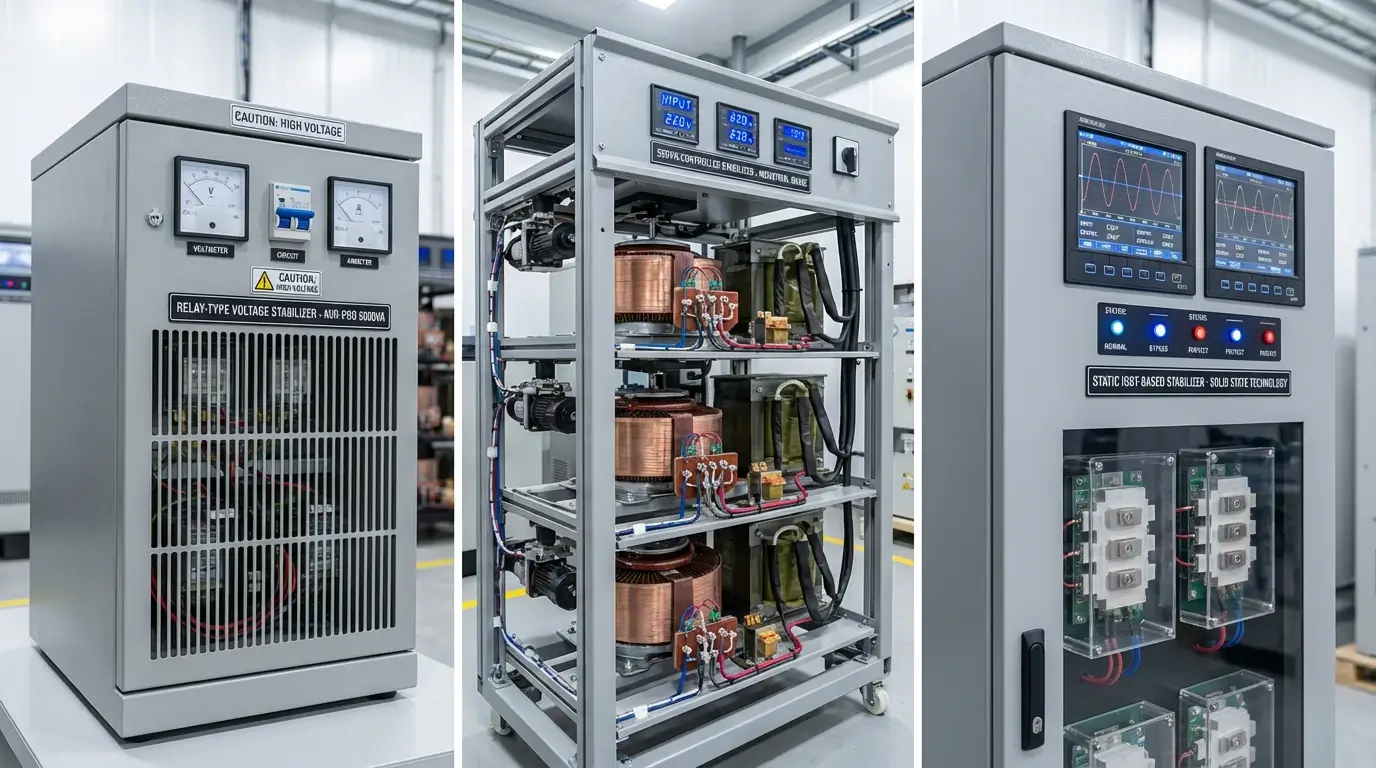
Industrial servo voltage stabilizer equipment
Industrial facilities face voltage instability from multiple sources. Grid load variations from nearby heavy industry, frequent starting of large motors and compressors, voltage drop across long transmission lines, and grid faults all contribute to voltage fluctuations. These disturbances fall into two categories: fast transients (millisecond-level events like lightning strikes) and slow variations (second-to-hour-level changes from load shifts).
The impact is measurable. Equipment failure rates increase by 30% in facilities with unregulated power. Production efficiency drops 10-15% due to reduced motor performance. Energy waste climbs 12-20% as equipment operates outside optimal voltage ranges. A voltage stabilizer with ±0.5% output precision eliminates these losses, paying for itself within 12-24 months in most applications.
Technology Types: Matching Performance to Application
Three primary technologies dominate the industrial voltage stabilizer market. Selecting the correct type requires understanding your load characteristics, voltage fluctuation speed, and precision requirements.
Relay-Type Stabilizers
Relay-type stabilizers use electromagnetic relays to tap different windings on an autotransformer. They offer the lowest initial cost and simple construction. Response time ranges from 30-100 milliseconds. Voltage regulation accuracy typically reaches ±5-8%.
Best applications: Light industrial loads with minimal voltage fluctuations, cost-sensitive projects where ±5% regulation is acceptable, facilities with stable grid supply.
Limitations: Slow response cannot correct fast transients. Mechanical relay wear requires replacement every 2-3 years in continuous operation. Limited voltage correction range (typically ±15%). Not suitable for motor loads or sensitive electronics.
Servo-Controlled Stabilizers
Servo-controlled stabilizers use a brushless motor to drive a variable autotransformer. The motor continuously adjusts to maintain output voltage. This technology provides the best balance of performance and cost for general industrial applications.
Key specifications:
- Response speed: 10-50 milliseconds per volt correction
- Output accuracy: ±1-2%
- Input voltage range: Up to ±30% correction capability
- Efficiency: Up to 98%
- Overload capacity: 200% for 1-2 minutes
Best applications: Most industrial equipment, motor-driven machinery, CNC machines, printing presses, packaging lines, HVAC systems, and general manufacturing equipment.
Maintenance considerations: Carbon brushes in traditional servo designs require inspection every 6-12 months and replacement every 2-3 years depending on usage. Brushless servo designs eliminate this maintenance requirement at slightly higher initial cost.
Static Stabilizers
Static stabilizers use IGBT (Insulated Gate Bipolar Transistor) power electronics to correct voltage without any moving parts. This technology represents the highest performance option for critical applications.
Key specifications:
- Response speed: 3 milliseconds or faster (some models <1ms)
- Output accuracy: ±0.5%
- Input voltage range: Up to ±35% correction capability
- Efficiency: 96-98%
- Overload capacity: 150% for short durations
Best applications: Medical imaging equipment (MRI, CT scanners), semiconductor manufacturing, precision measurement instruments, data centers, telecommunications infrastructure, and any application requiring zero-voltage-disturbance transfer.
Advantages: Zero maintenance with no moving parts. No acoustic noise during operation. Suitable for indoor installations where noise is a concern. EMI (electromagnetic interference) shielding available for sensitive electronics.
Technology Comparison Table
Specification | Relay-Type | Servo-Controlled | Static (IGBT) |
Response Time | 30-100ms | 10-50ms/V | <3ms |
Output Accuracy | ±5-8% | ±1-2% | ±0.5% |
Input Range | ±15% | ±30% | ±35% |
Efficiency | 92-95% | 96-98% | 96-98% |
Moving Parts | Yes (relays) | Yes (motor) | None |
Maintenance Interval | 2-3 years | 1-3 years | 5+ years |
Noise Level | Medium | Medium | Low |
Typical Lifespan | 5-8 years | 8-12 years | 15+ years |
Relative Cost | Low | Medium | High |
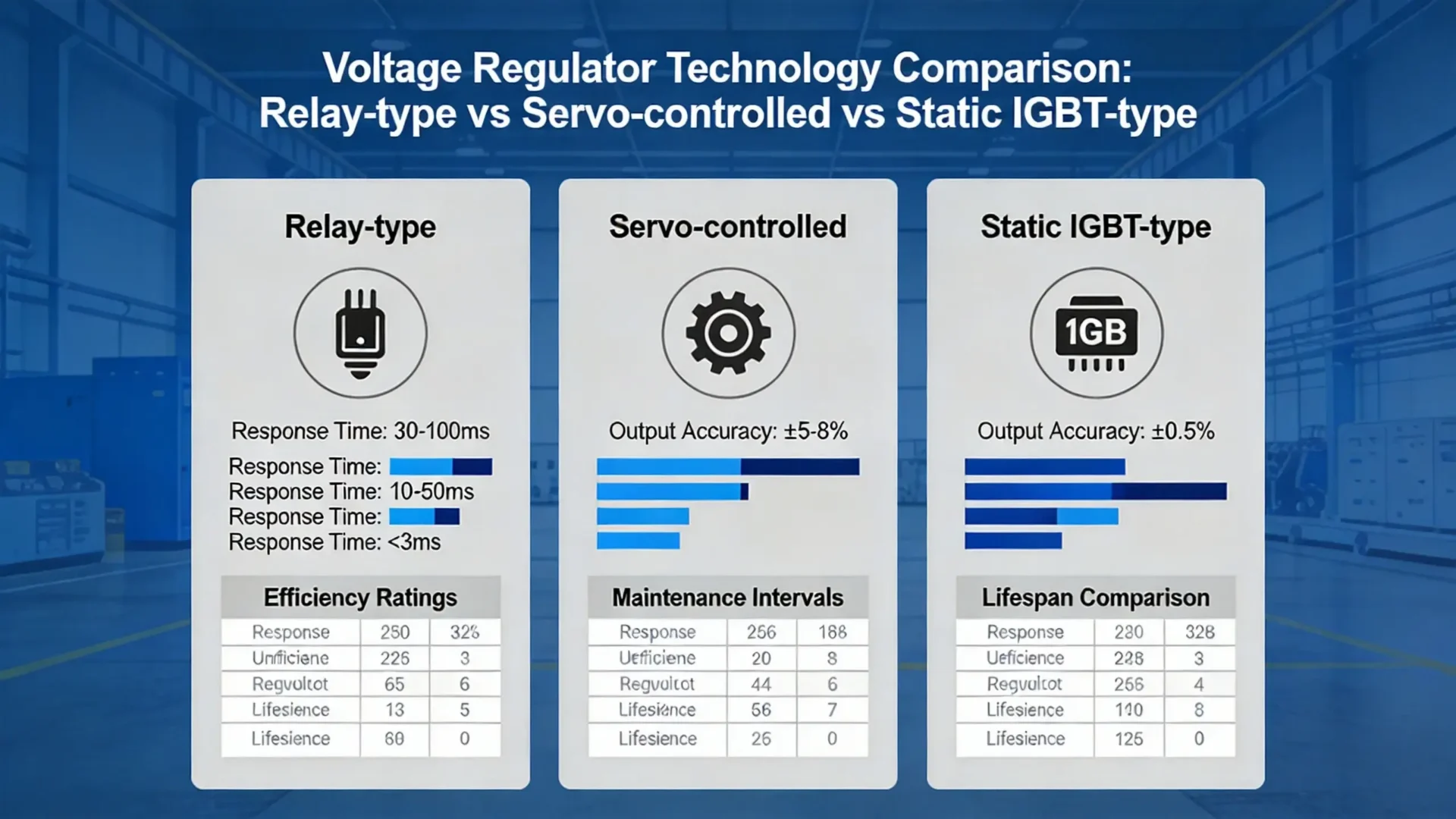
Comparison Infographic of Voltage Stabilizer Technical Parameters
Power Calculation: The Foundation of Proper Sizing
Undersized voltage stabilizers fail prematurely. Oversized units waste capital and operate inefficiently. Accurate power calculation requires following a systematic approach.
Step 1: Calculate Load Power
For single-phase systems:
kVA = V × A / 1000
For three-phase systems:
kVA = √3 × V × A / 1000
When power is specified in kW rather than kVA, account for power factor (cosφ):
kVA = kW / cosφ
Typical power factors for common equipment:
- Electric motors: 0.75-0.85
- Transformers: 0.80-0.90
- Lighting systems: 0.90-0.95
- Electronics with PFC: 0.95-0.98
Step 2: Account for Motor Starting Currents
Motor inrush current creates the most common sizing error. Induction motors draw 5-7 times rated current during startup. DC motors can draw 10-20 times rated current. This startup surge lasts 3-10 seconds but must be accommodated.
Calculation method:
- Identify all motors in the system
- Calculate the largest motor starting current (rated amps × 6)
- Add the running current of all other equipment
- If multiple motors start simultaneously, sum their starting currents
Step 3: Add Safety Margin
Industry practice recommends 20-25% safety margin above calculated load. This allowance accounts for:
- Future equipment additions
- Temporary overload conditions
- Degradation over time
- Measurement inaccuracies
Step 4: Select Standard Rating
Voltage stabilizers come in standard kVA ratings. Always round up to the next standard size. Common ratings: 3, 6, 9, 15, 20, 30, 45, 60, 75, 100, 125, 150, 200, 250, 300, 400, 500 kVA and larger for industrial applications.
Power Calculation Example
A manufacturing facility has:
- Three 10 kW motors (power factor 0.82)
- One 15 kW motor (power factor 0.82)
- Lighting and controls: 5 kW (power factor 0.95)
Step 1: Convert to kVA
- Small motors: 10 kW / 0.82 = 12.2 kVA each
- Large motor: 15 kW / 0.82 = 18.3 kVA
- Lighting: 5 kW / 0.95 = 5.3 kVA
- Running total: (3 × 12.2) + 18.3 + 5.3 = 60.2 kVA
Step 2: Account for motor starting
The 15 kW motor has the highest starting current.
Running current of other equipment: 60.2 – 18.3 = 41.9 kVA
Starting current equivalent: 18.3 × 6 = 109.8 kVA
Startup scenario total: 41.9 + 109.8 = 151.7 kVA
Step 3: Add safety margin
151.7 × 1.20 = 182 kVA
Step 4: Select standard rating
Next standard size above 182 kVA is 200 kVA
Selected: 200 kVA servo-controlled stabilizer
Input Voltage Range: Measuring Before Selecting
Selecting a stabilizer without measuring actual voltage fluctuations leads to inadequate protection. The input voltage range must exceed your measured fluctuations by a comfortable margin.
Measurement Protocol
Deploy a voltage data logger for minimum 7-14 days at the installation point. Record:
- Minimum voltage experienced
- Maximum voltage experienced
- Frequency and duration of sags
- Frequency and duration of surges
- Time of day patterns (correlate with production schedules)
Range Selection Rule
If measurements show ±16% fluctuation, select a stabilizer with ±20% capability. If input voltage exceeds the stabilizer’s correction range, the excess transfers directly to the output.
Example: Measured voltage varies from 185V to 245V on a 230V nominal system.
- Low side: (230-185)/230 = -19.6%
- High side: (245-230)/230 = +6.5%
- Required stabilizer range: At least ±25% on low side, ±15% on high side
Environmental Considerations for Industrial Installations
Industrial environments present challenges beyond electrical specifications. Proper environmental protection ensures reliable operation and full rated lifespan.
IP Rating Selection
IP (Ingress Protection) ratings indicate dust and water resistance:
IP Rating | Protection | Typical Application |
IP20 | Indoor, dry | Clean factory floors, control rooms |
IP31 | Indoor, some dripping | General industrial areas |
IP54 | Dust-protected, water spray | Factory floors with washdown |
IP65 | Dust-tight, water jets | Outdoor installations, food processing |
Temperature Considerations
Standard industrial stabilizers are rated for -10°C to +45°C ambient temperature. For operation above 40°C, derate capacity by 2-3% per degree Celsius. In high-temperature environments (foundries, metal processing, boiler rooms), specify high-temperature models rated to +60°C or higher.
Altitude above 1000 meters requires derating due to reduced air cooling. Standard derating is 1% per 100 meters above 1000m. For installations at 3000m, derate by 20%.
Corrosive Atmospheres
Coastal areas (salt air), chemical plants, and wastewater facilities require specialized protection:
- Conformal coating on PCBs
- Stainless steel or corrosion-resistant enclosures
- Sealed terminal blocks
- Enhanced ventilation with filtered intake
Installation Clearances
Maintain minimum clearances for cooling air flow:
- 200mm clearance on all sides for units up to 100 kVA
- 500mm clearance for units 100-500 kVA
- 1000mm clearance for units above 500 kVA
Vertical mounting is standard. Horizontal mounting requires derating of 10-15% due to reduced convection cooling.
Application-Specific Selection Guidelines
Healthcare and Medical Facilities
Medical equipment demands the highest voltage stability. MRI machines, CT scanners, and X-ray equipment are voltage-sensitive and patient-critical.
Recommended: Static (IGBT) stabilizers with ±0.5% accuracy
Additional requirements:
- Medical-grade isolation transformers
- EMI/RFI filtering
- Zero-crossing switching for reduced harmonic distortion
- Redundant units with automatic bypass for critical systems
- Compliance with IEC 60601-1-2 medical EMC standards
Manufacturing and Production Lines
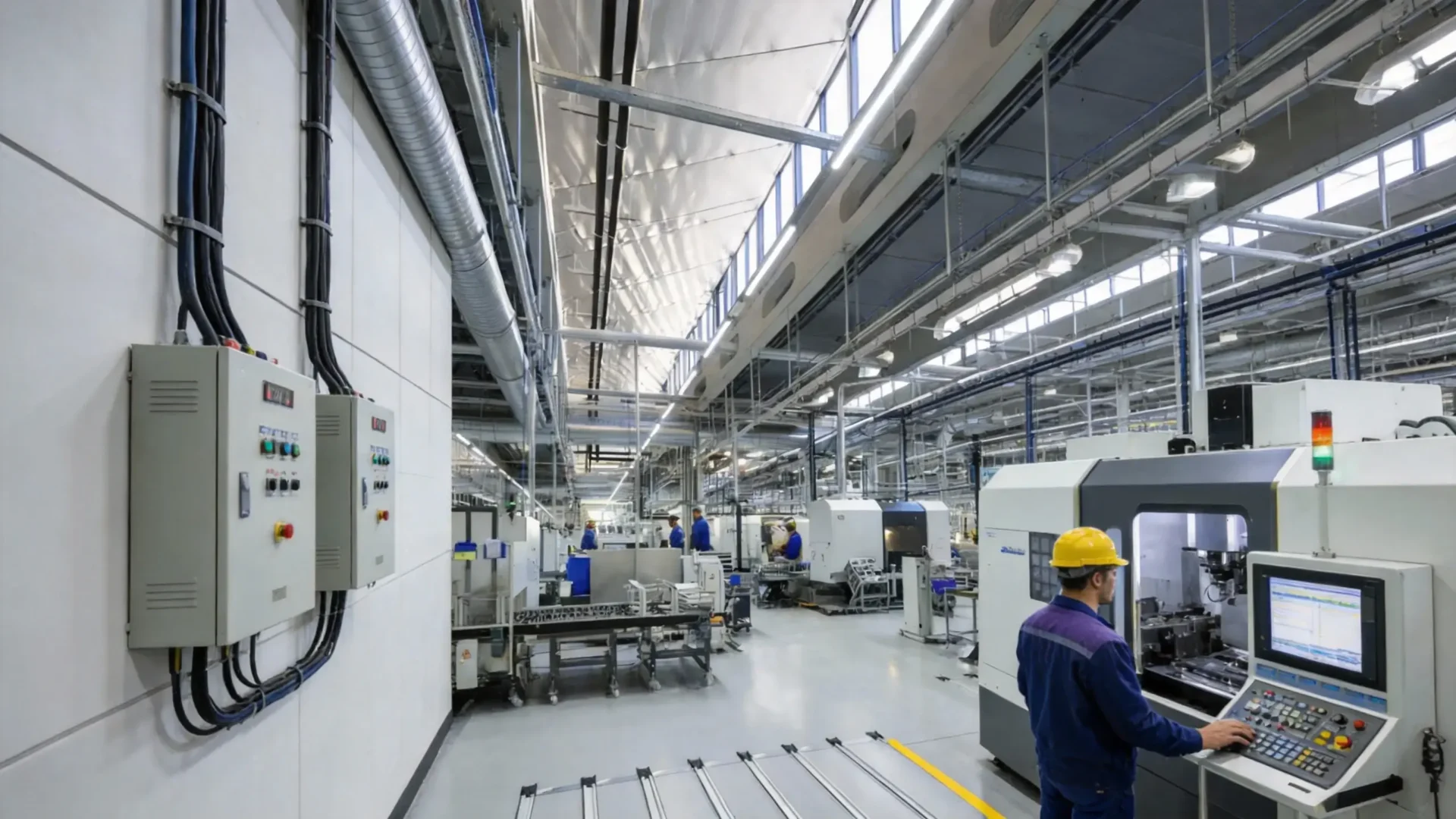
Voltage stabilizers are used in CNC applications in manufacturing plants
CNC machines, injection molding equipment, and automated assembly lines require consistent voltage for precision operation.
Recommended: Servo-controlled stabilizers for general manufacturing
Additional requirements:
- ±30% input range for grids with frequent fluctuations
- Fast response (<50ms) for motors with frequent starts
- Communication interface for monitoring voltage, current, and status
- Automatic bypass switch for maintenance without shutdown
Case example: A textile manufacturer installed 200 kVA servo stabilizers on spinning frames. Voltage sag-related stoppages decreased from 12 per shift to zero. Thread breakage rates dropped 18%. Energy consumption decreased 8% due to improved motor efficiency.
Data Centers and Telecommunications

Voltage stabilizers in data center server rooms
Server equipment, network switches, and telecommunications infrastructure require clean, stable power with zero downtime tolerance.
Recommended: Static stabilizers with automatic transfer switches
Additional requirements:
- Hot-swappable power modules for N+1 redundancy
- Bypass isolation for maintenance without load interruption
- SNMP monitoring for remote management
- Harmonic filtering (<5% THD)
- Operating efficiency >98% to reduce PUE (Power Usage Effectiveness)
Case example: An African central bank deployed Ortea Sirius Advance voltage stabilization for their data center. The system maintained ±0.5% voltage stability despite ±18% grid fluctuations. Critical financial systems achieved 99.99% uptime. ROI achieved in 16 months through avoided downtime costs.
Heavy Industry and Mining
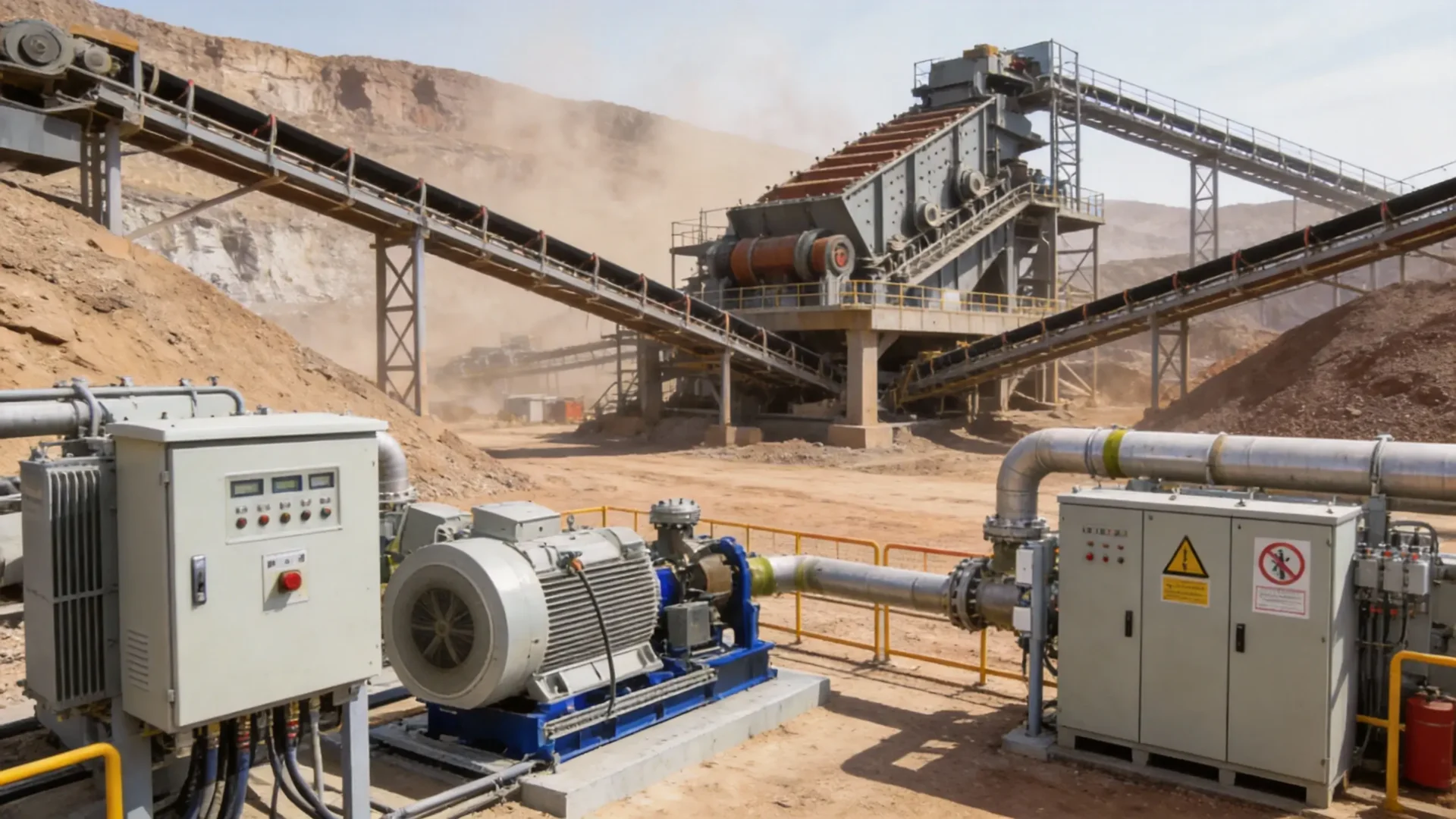
Voltage stabilizers are used in heavy industry and mining applications
Cranes, excavators, crushers, and heavy motor drives operate in harsh environments with extreme voltage fluctuations.
Recommended: Heavy-duty servo stabilizers with reinforced construction
Additional requirements:
- IP54 or higher enclosure rating
- Vibration-resistant mounting
- Sealed terminal compartments
- Oversized components for 150% intermittent loading
- Corrosion protection for outdoor and mining applications
Case example: A mining operation installed 500 kVA outdoor servo stabilizers with IP65 enclosures. Despite ±25% grid voltage fluctuations from nearby mining equipment, the crushers maintained consistent output. Equipment failure rate decreased 40% in the first year.
Decision Framework: A Step-by-Step Selection Process
Use this systematic approach to select the correct voltage stabilizer for any industrial application.
Step 1: Characterize Your Load
- Document all connected equipment with nameplate ratings
- Identify motor types and starting methods
- Note any sensitive electronics requiring ±1% or better regulation
- Determine if loads are single-phase or three-phase
Step 2: Measure Voltage Conditions
- Deploy voltage logger for minimum 7 days (14 days preferred)
- Record minimum and maximum voltages
- Document fluctuation frequency and speed of changes
- Identify time-of-day patterns
Step 3: Calculate Power Requirements
- Convert all loads to kVA
- Account for motor starting currents
- Add 20-25% safety margin
- Round up to next standard kVA rating
Step 4: Select Technology Type
Use this decision tree:
Is equipment voltage-critical (medical, semiconductor, precision)?
├─ Yes → Static (IGBT) stabilizer
└─ No
├─ Is cost the primary concern and voltage stable?
│ ├─ Yes → Relay-type (limited industrial use)
│ └─ No → Servo-controlled stabilizer (80% of industrial applications)
Step 5: Specify Environmental Requirements
- Determine IP rating for installation location
- Check ambient temperature against standard rating
- Note altitude above 1000m
- Identify corrosive atmosphere presence
- Plan maintenance access clearances
Step 6: Select Additional Features
- Digital display and metering (voltage, current, frequency, power)
- Alarm contacts for low/high voltage, overload, bypass
- Communication interface (Modbus, SNMP, Ethernet)
- Manual bypass for maintenance
- Surge protection devices (SPD) on input and output
Step 7: Verify Compliance and Standards
- CE marking for European markets
- UL/CSA certification for North America
- IEC 60076 series for power transformers
- IEC 61558 for safety isolating transformers
- Local utility company requirements
Common Mistakes to Avoid
Mistake 1: Ignoring Motor Starting Currents
Error: Sizing based on running current only
Consequence: Stabilizer trips on motor start or fails prematurely
Solution: Calculate worst-case starting scenario with all motors that start simultaneously
Mistake 2: Insufficient Input Voltage Range
Error: Selecting range based on nominal rather than measured voltage
Consequence: Stabilizer cannot correct extreme sags or surges
Solution: Measure actual voltage for minimum 7-14 days before selection
Mistake 3: Neglecting Environmental Factors
Error: Installing standard IP20 unit in washdown or outdoor area
Consequence: Premature failure from moisture or dust ingress
Solution: Match IP rating to installation environment
Mistake 4: Inadequate Safety Margin
Error: Sizing at exactly calculated load with no margin
Consequence: No capacity for expansion or temporary overloads
Solution: Always include 20-25% margin above calculated requirement
Mistake 5: Selecting Wrong Technology
Error: Choosing relay-type for fast-response applications
Consequence: Equipment damage from slow correction
Solution: Match technology to load sensitivity and fluctuation speed
Summary and Action Checklist
Selecting the right voltage stabilizer prevents equipment damage, reduces energy waste, and eliminates production interruptions from voltage fluctuations.
Immediate actions:
- Install voltage logger at installation point for 14-day monitoring period
- Document all connected equipment with nameplate ratings
- Identify motor types and starting characteristics
- Determine load sensitivity and required voltage accuracy
Selection checklist:
- Voltage measurement data (min/max, fluctuation speed)
- Complete load inventory in kW or kVA
- Motor starting current calculations
- Technology type selected (relay/servo/static)
- Power rating calculated with 20-25% margin
- Input voltage range exceeds measured fluctuations
- IP rating matches installation environment
- Temperature and altitude derating applied if needed
- Compliance certifications verified for target market
- Maintenance access and clearances planned
Expected outcomes:
- Output voltage stability: ±0.5% to ±2% depending on technology
- Equipment protection from voltage sags, surges, and transients
- 8-15% energy savings from optimized equipment operation
- 50% reduction in voltage-related equipment failures
- ROI within 12-24 months for most industrial applications
When specifications are unclear or application is critical, consult with voltage stabilizer manufacturers providing technical support. Many offer site surveys, load analysis, and custom solutions for complex industrial environments. The cost of professional consultation is minimal compared to the expense of equipment damage and unplanned downtime.
Invest in voltage stabilization today—it‘s not an expense, it’s insurance for your production continuity.