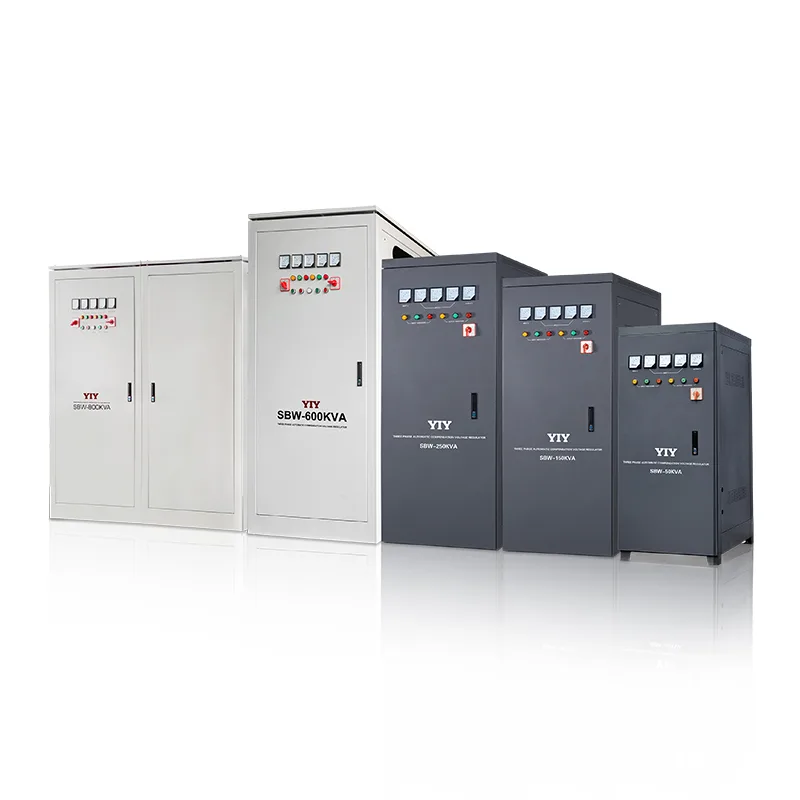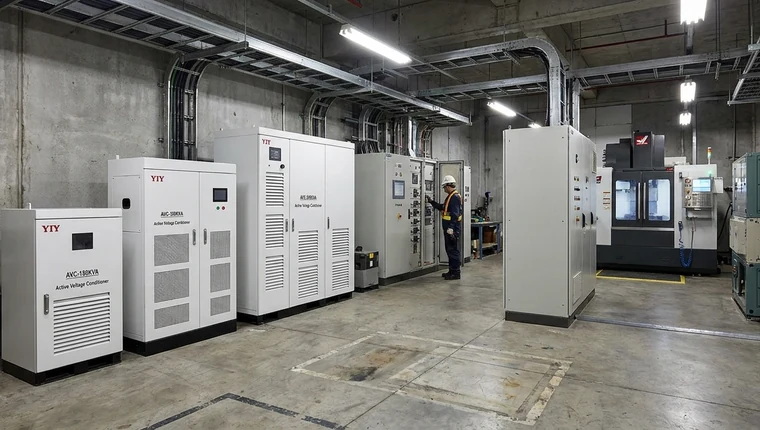
Choose a 3 phase voltage conditioner when measured site voltage, load sensitivity, startup current, or phase imbalance creates risk that nominal equipment ratings cannot manage. IEC 60038 uses standard voltage tolerances around ±10%, while practical sizing often adds a 20–30% margin for inrush and expansion.
If your CNC lines, pumps, HVAC systems, 240V machinery, or OEM panels already show nuisance trips, overheating, or unexplained downtime, a voltage stabilizer or automatic voltage regulator should be evaluated from site data first. Next, we’ll compare the real pain points, IGBT/servo/relay topology choices, sizing logic, deployment fit, and the FAQ checks that help you specify the right line voltage conditioner without overbuying.
Why do 3-phase and 240V sites need voltage conditioning before failures appear?
You need voltage conditioning before failures appear because sags, swells, transients, phase imbalance, high-inrush starts, and unstable generator or grid supply can damage equipment long before a complete outage occurs. A nameplate marked 240V or 3-phase only tells you the intended supply class; it does not prove your real input voltage, phase balance, startup current, or disturbance profile is safe for production.
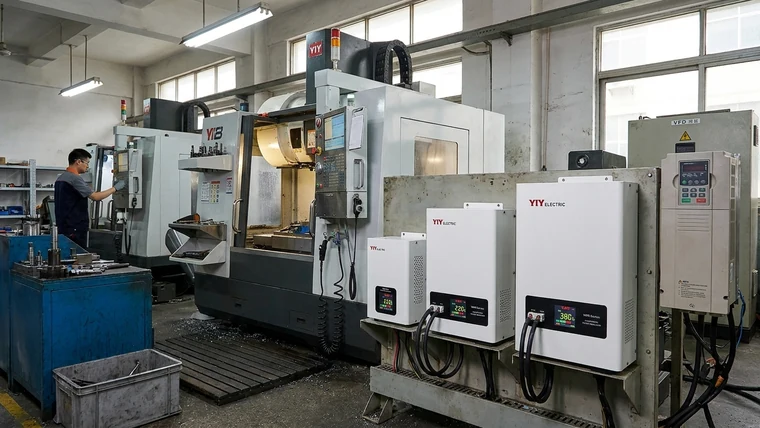
According to IEC 60038 standard voltages, standard low-voltage systems are commonly evaluated around a +/-10% voltage tolerance band.
In practice, that means a nominal 240V supply can still expose your drives, PLCs, compressors, CNC controls, and OEM panels to operating conditions that trigger faults or shorten component life if the load is sensitive.
| Symptom you see | Likely electrical cause | Buyer risk |
|---|---|---|
| Random VFD or PLC trips | Voltage sag or transient disturbance | Unplanned downtime and difficult fault diagnosis |
| Motors run hot or noisy | Phase imbalance or low voltage | Damaged windings, bearing stress, warranty disputes |
| Breakers trip during startup | High inrush current | Oversized procurement or repeated commissioning delays |
| Output varies on generator supply | Frequency/voltage fluctuation | Rejected batches and unstable process control |
| Electronics fail after storms or switching | Transient surge | Board replacement, service calls, lost production windows |
Selection should start with measured site conditions: actual input range, phase-to-phase readings, load current, power factor, startup behavior, ambient temperature, and enclosure location. For you, this avoids buying a generic line voltage conditioner that looks correct on paper but fails under the real load profile.
The cost case is usually straightforward: one nuisance trip on a packaging line, chiller, lift system, or CNC cell can cost more than the price difference between a minimal regulator and a properly specified automatic voltage regulator. The ROI is not a promised savings percentage; it is the avoided risk of downtime, rejected output, damaged drives, and unresolved responsibility between the electrical contractor, OEM, and site owner.
Environment matters as much as kVA. In dusty, humid, hot, or weak-grid locations, specify ventilation clearance, corrosion protection, appropriate enclosure/IP rating, thermal margin, bypass/protection options, and alarm visibility. Modern Three-Phase Voltage Stabilizers should also support practical maintenance workflows through voltage display, fault alarms, event logging, or integration points for plant control and maintenance review.
YIY deployment data shows voltage stabilization projects across 130+ countries and a product range from 0.5kVA to 3000kVA, supporting industrial, commercial, and OEM applications.
Which topology fits your load: IGBT, servo, or relay conditioning?
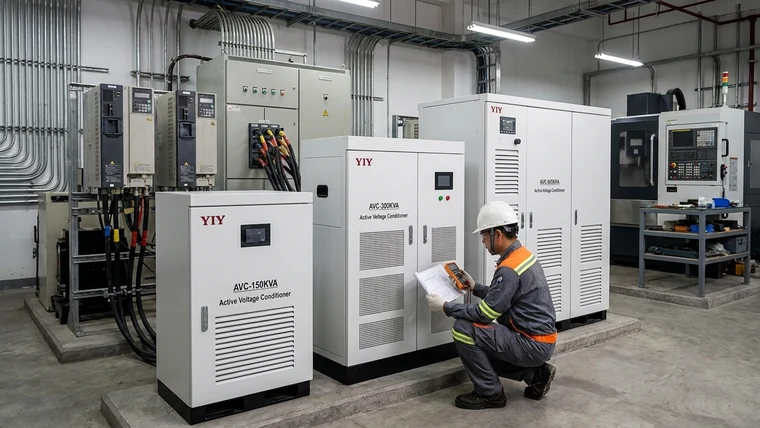
Match the topology to your load sensitivity, correction speed, precision requirement, and budget: choose IGBT double-conversion for critical electronics, servo conditioning for CNC and motor-heavy industrial loads, and relay tap-switching for non-critical, cost-controlled circuits. This prevents two expensive mistakes: underprotection that causes downtime, and overengineering that makes your RFQ harder to approve.
| Topology | Best fit | Key performance figure | What it means for you |
|---|---|---|---|
| IGBT double-conversion | Highly sensitive electronics, critical process control, medical/OEM panels, unstable grids | +/-0.5% output precision with AC-DC-AC isolation | The load receives a tightly controlled output separated from incoming grid disturbance, useful when one trip can stop production or corrupt process data. |
| Servo motor-driven autotransformer | CNC machinery, motors, compressors, production equipment, mid-to-high precision industrial loads | +/-0.5% to +/-3% precision with <=1-2 second continuous adjustment | The correction is smooth rather than stepped, so it fits loads that tolerate short voltage movement but need stable long-run operation. |
| Relay tap-switching | Lighting, HVAC, pumps, general utility loads, budget-sensitive projects | +/-5% to +/-8% regulation in discrete steps | The output is corrected in stages, which is usually acceptable when the load is not precision-sensitive and capital cost is the main constraint. |
For an IGBT voltage stabilizer, the commercial logic is risk reduction. If your equipment includes PLCs, sensors, inspection systems, drives with tight DC bus limits, or critical 240V control circuits, +/-0.5% precision is not a luxury spec; it is a way to reduce nuisance trips and unclear warranty disputes.
Servo conditioning is often the practical middle path for three-phase stabilizers. With <=1-2 second continuous correction, your RFQ can balance performance and cost for CNC cells, motors, and mixed industrial loads without specifying a static conditioner where the process does not require it.
Relay units belong in the conversation when your load is forgiving. For HVAC, lighting, and utility distribution, +/-5% to +/-8% regulation can be commercially sensible because the avoided overengineering may matter more than ultra-fast correction.
Many active conditioner suppliers emphasize one topology for three-phase sag correction. YIY’s advantage is a multi-technology portfolio across IGBT, servo, and relay designs, so your specification can follow site risk instead of a single-product sales path. In dusty, humid, hot, or weak-grid locations, also specify enclosure/IP needs, ventilation clearance, thermal margin, bypass protection, alarms, and event visibility for maintenance workflows.
How should you specify and size this power class for mixed industrial loads?
Specify this power class from measured site data, not nameplate voltage alone: total load, power factor, startup current, input voltage range, phase configuration, environment, and a 20-30% sizing margin should all be in your RFQ. That gives your supplier enough information to recommend the right voltage stabilizer or automatic voltage regulator without oversizing by guesswork.
Start with the load calculation
Use this working formula after you convert connected loads into the same unit:
Required capacity = total calculated load x 1.2 to 1.3
For example, if your calculated load is 20 kW and power factor has already been accounted for, 20 kW x 1.25 = 25 kVA, then rounding to a 30 kVA unit is often practical. In plain terms, that reserve helps absorb startup current, load variation, and near-term expansion instead of forcing the conditioner to run at its limit.
Before you ask for a quotation, prepare these inputs:
| Check | What to provide | Why it matters |
|---|---|---|
| Connected load list | W, VA, kW, or kVA for each machine | Prevents sizing from one large load only |
| Power factor | Motor/VFD/OEM panel PF values | Converts real power into apparent power correctly |
| Startup profile | Inrush current, sequence, simultaneous starts | Avoids nuisance trips during motor startup |
| Voltage data | Minimum/maximum measured input range | Confirms correction range, not just nominal voltage |
| Phase data | Phase balance, neutral, Delta or Wye | Avoids wiring mismatch and uneven loading |
| Duty cycle | Continuous, intermittent, peak periods | Supports thermal and capacity selection |
| Bypass need | Manual/automatic bypass preference | Keeps maintenance from stopping production |
Delta vs. Wye is a site-specific wiring question, especially on 240V 3-phase systems. Ask engineering to validate the conditioner connection, grounding, neutral requirement, and phase balance rather than applying a universal rule.
Environment should be part of the specification, not an afterthought. If your installation has dust, humidity, high ambient temperature, weak grid supply, limited airflow, or outdoor exposure, define enclosure/IP needs, ventilation clearance, corrosion protection, thermal margin, and maintenance access.
For higher-value deployments, add observability requirements: alarm output, event logs, remote monitoring, PLC/BMS/SCADA coordination, and a bypass switch. The cost of skipping these details is not just a wrong kVA rating; it can become avoidable downtime, unclear fault diagnosis, and delayed ROI after installation.
What would a site-first selection case look like for YIY engineering support?
A realistic YIY selection case would start with your measured site risk, then match topology and capacity to the load profile instead of forcing your project into a generic product tier. For example, consider a composite OEM retrofit: mixed CNC machines, VFD-driven motors, PLC controls, and unstable 240V / 3-phase input with dust, heat, and intermittent voltage dips.
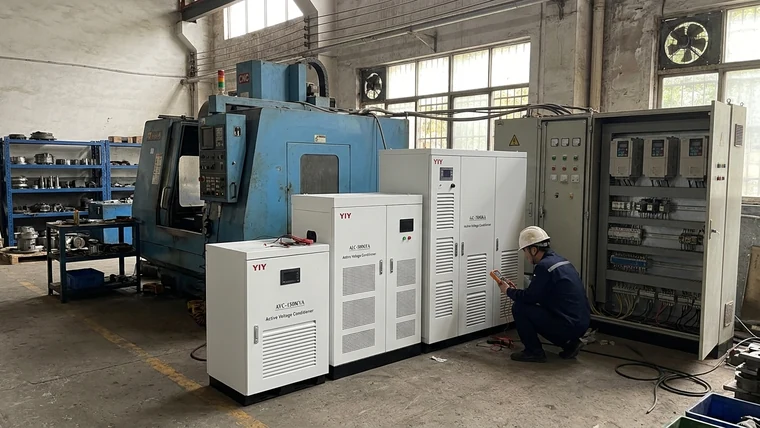
YIY’s portfolio covers 0.5 kVA to 3000 kVA for industrial, commercial, and OEM applications, so the review can stay topology-neutral at the start. Last verified: 2026-05-13.
YIY also brings 15+ years in voltage stabilization and deployments across 130+ countries, which matters when your site conditions include weak grids, generator supply, or non-standard retrofit constraints. Last verified: 2026-05-13.
| Submitted data | Engineering interpretation | Recommended direction | Procurement outcome |
|---|---|---|---|
| Load list: CNC spindles, coolant pumps, PLC cabinet, VFD motors | Mixed sensitivity; controls are more vulnerable than motors | Separate critical controls or choose tighter regulation | Avoids paying for ultra-precision where it is not needed |
| Voltage logs: dips below normal during startup | Grid sag plus inrush risk | Servo or IGBT depending on dip depth and control sensitivity | Reduces nuisance trips and commissioning disputes |
| Startup current profiles | Simultaneous starts may overload a marginal unit | Add 20-30% capacity margin and sequence starts if possible | Gives you reserve for startup and future expansion |
| Environment: dust, humidity, high ambient heat | Enclosure and cooling affect reliability | Specify ventilation, IP/enclosure needs, corrosion protection, alarms | Prevents early failure from installation conditions, not product rating |
| Budget and uptime priority | Some loads justify precision; others justify simplicity | IGBT for critical electronics, servo for CNC/motors, relay for forgiving loads | Aligns spend with downtime risk |
The cost-of-inaction frame is simple: if one avoidable trip stops a CNC cell, packaging line, or OEM test bench, the lost production window can outweigh the price difference between a minimal regulator and a correctly specified system. In practice, your ROI comes from fewer interruptions, clearer fault diagnosis, and less rework after installation.
For modern industrial maintenance, ask for alarm visibility, event logging, voltage display, and integration points with PLC, BMS, SCADA, or maintenance workflows where relevant. Your next low-friction step is to submit the load list, startup current profiles, and site voltage logs for a complimentary sizing review and topology recommendation from YIY’s engineering team.
Frequently Asked Questions
How should a 3 phase voltage conditioner be sized or specified for mixed loads?
A 3 phase voltage conditioner should be sized from calculated kVA, power factor, startup current, and measured voltage range. Build a load list with each machine’s kW, VA, or amperage, then add a 20–30% margin for inrush and expansion. If your load includes CNC, VFDs, pumps, and PLC cabinets, also note which loads start together and which controls need tighter regulation.
How does IEC 60038 compliance impact 240V 3-phase conditioner selection?
IEC 60038 compliance helps confirm that the conditioner is designed around recognized standard voltage systems and tolerance expectations. For a 240V 3-phase site, verify the supplier’s datasheet against IEC 60038 standard voltages, check input/output voltage ranges, and ask for alarm or protection behavior when voltage moves outside the safe correction window.
How does a voltage conditioner work?
A voltage conditioner works by detecting incoming voltage problems and correcting the output before power reaches your equipment. Depending on topology, it may use IGBT double conversion, servo-controlled adjustment, or relay tap switching. For your RFQ, match the method to the risk: IGBT for sensitive electronics, servo for industrial mixed loads, and relay for less critical circuits.
What does a voltage conditioner do?
A voltage conditioner stabilizes voltage and helps protect connected equipment from sags, swells, transients, phase imbalance, and unstable supply. In industrial use, its practical job is reducing nuisance trips, overheating, control faults, and unclear warranty disputes. Before buying, compare your site voltage logs with the conditioner’s correction range, response time, bypass option, enclosure rating, and alarm visibility.
Final Thoughts
A 3-phase voltage conditioner is the right choice when measured voltage instability, sensitive equipment, high startup current, or compliance-driven tolerance requirements create operational risk beyond normal equipment ratings. Your decision should move in a clear sequence: confirm the site problem, choose the topology, add realistic sizing margin, then validate the specification with engineering review.
For procurement, this matters because undersizing can lead to nuisance trips, overheated motors, failed controls, and delayed commissioning. Overspecifying can lock capital into protection your load does not need. The practical path is not to buy by voltage class alone, but to match the conditioner to real site behavior.
Start with a quick-fit checklist or first-pass review. Then submit your load list, startup current profiles, and site voltage logs for a complimentary sizing review and topology recommendation from YIY’s engineering team.
About YIY
Zhejiang Yiyen Holding Group Co., Ltd. (YIY) is a professional voltage stabilizer manufacturer with 16+ years of experience. With a 30,000sqm modern facility and an annual production capacity of 1,000,000+ units, our products are exported to 130+ countries. We provide OEM/ODM customization services and are ISO 9001:2015 certified, committed to delivering stable and reliable voltage protection solutions to global customers.
Contact Us
Email: yiyen@yiyen.com
Phone/WhatsApp: +86 13587452904
Website: https://www.yiyavr.com/
If you found this article helpful, contact us for a sizing review or customized solution.