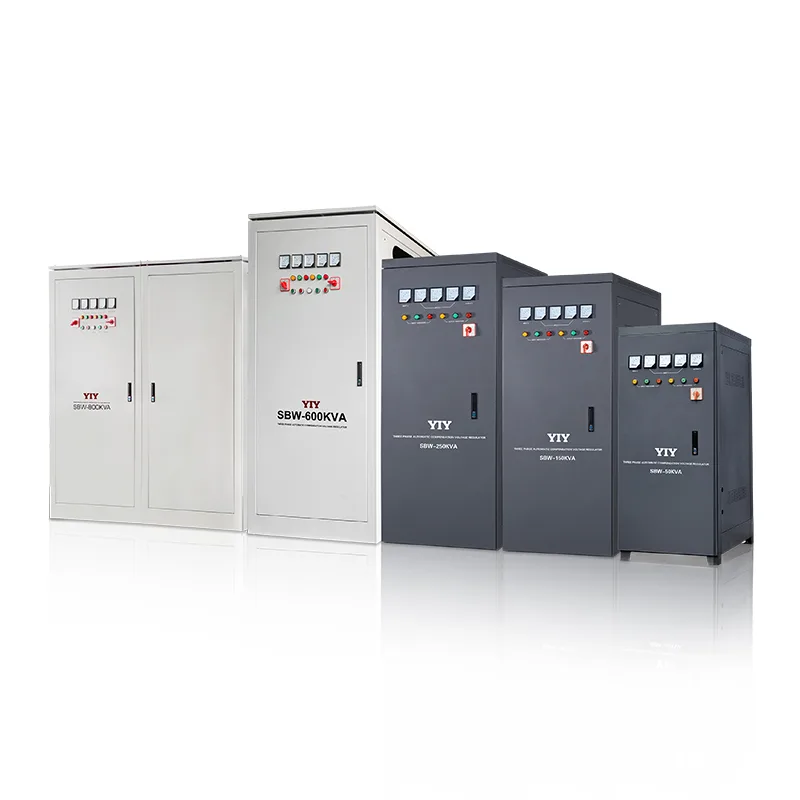
Choose an active voltage conditioner when fast voltage sags, swells, unstable mains, or phase-related disturbances are already tripping sensitive industrial or commercial loads and a conventional AVR may not respond quickly enough.
This guide will help you decide when active conditioning is justified, how it compares with AVR, servo stabilizer, static/IGBT stabilizer, UPS, and surge protection options, which standards and proof points matter, and what site data you should collect before sizing or requesting a recommendation.
When Do Voltage Problems Justify More Than A Standard Stabilizer?
You should consider this category when your measured voltage events are fast enough, deep enough, or disruptive enough to stop production or reset controls. If your problem is slow voltage drift, a conventional stabilizer may still fit; if your problem is a brief dip that shuts down automation, you should evaluate faster correction.
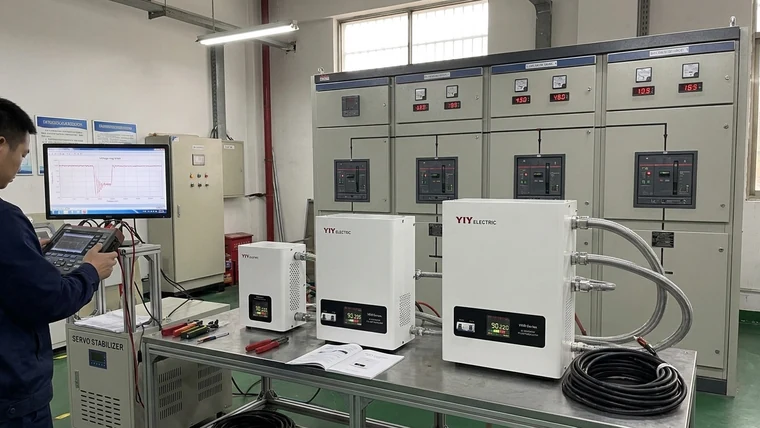
Start with site measurements instead of nominal voltage alone. A facility may be designed around 380 V, 400 V, 415 V, or 230 V supply values, but your equipment experiences the real waveform during motor starts, generator transfers, grid faults, weak-line periods, and heavy load changes. IEC 60038 nominal voltage systems gives the standards context for nominal supply-voltage values, but it does not prove your local mains remains inside a safe operating window.
For three-phase industrial load protection, compare active correction with YIY three-phase stabilizers early in your evaluation. That helps you decide whether your site mainly needs robust three-phase voltage stabilization or a faster power-conditioning topology for short disruptive events.
Symptom you see Likely electrical cause What it means for your decision PLC resets, HMI blackouts, drive faults Short voltage sag or undervoltage event Active correction may be needed if the event is brief but disruptive Compressor, chiller, or pump trips Undervoltage, overvoltage, or phase imbalance Check three-phase correction range, overload behavior, and bypass logic Flicker or unstable machine output Input fluctuation, weak mains, or load interaction Confirm response speed and whether basic AVR regulation is enough Rejected batches or interrupted process cycles Voltage event reaching sensitive controls Compare failure cost against the higher cost of active correction Repeated service calls without mechanical cause Hidden power-quality disturbance Require voltage logs, alarms, and event records before specifying
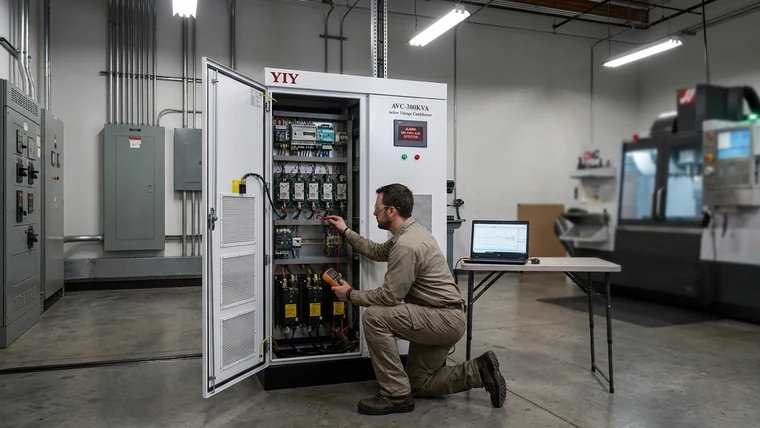
The practical takeaway is simple: if your equipment can ride through the disturbance, you may not need active conditioning. If one short event creates scrap, downtime, emergency maintenance, or customer delivery risk, the extra specification work is usually justified.
What Does An Active Voltage Conditioner Solve For You?
An active voltage conditioner corrects abnormal supply voltage before your protected load sees a process-disruptive event. In buyer terms, it is a line voltage conditioner or mains voltage conditioner used when voltage sags, swells, unstable input, or fast disturbances create downtime risk rather than only a cosmetic voltage variation.
The distinction matters because many devices protect “voltage,” but not all of them solve the same failure mode. An AVR mainly regulates high and low voltage. A servo stabilizer can provide accurate electromechanical correction for many industrial loads. A static or IGBT design can respond faster when electronic correction is required. A UPS adds stored energy for outages, while surge protection diverts transient spikes. Your job is to match the device to the event, not just to the kVA rating.
Option What it mainly solves Where it fits best Practical limit Active voltage conditioner Fast sag correction, swell correction, regulated output Sensitive industrial or commercial loads with nuisance trips Not a battery backup for long outages AVR / automatic voltage regulator General overvoltage and undervoltage regulation Loads affected by slower voltage variation May not correct short, deep sags fast enough Servo stabilizer Accurate electromechanical voltage stabilization Larger industrial loads where speed is not the main risk Moving parts and slower correction than static designs Static / IGBT stabilizer Fast electronic voltage regulation Precision loads needing rapid correction Performance depends on topology, control design, and sizing UPS Backup energy during outages IT, controls, shutdown protection, short runtime continuity Battery maintenance and runtime sizing add cost and complexity Surge protection Transient spike diversion Lightning, switching surge, panel-level protection Does not regulate sustained low or high voltage
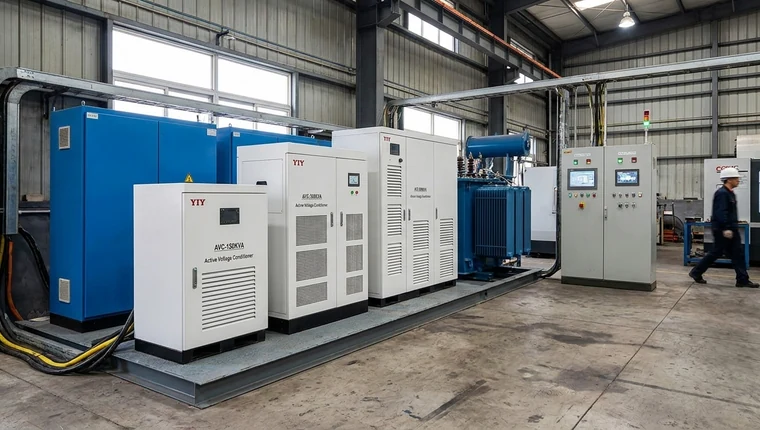
The category sits at the heavier end of power-quality equipment. YIY’s AVC active voltage conditioner covers single-phase 15–50 kVA and three-phase 30–3600 kVA, with no battery in the correction path.
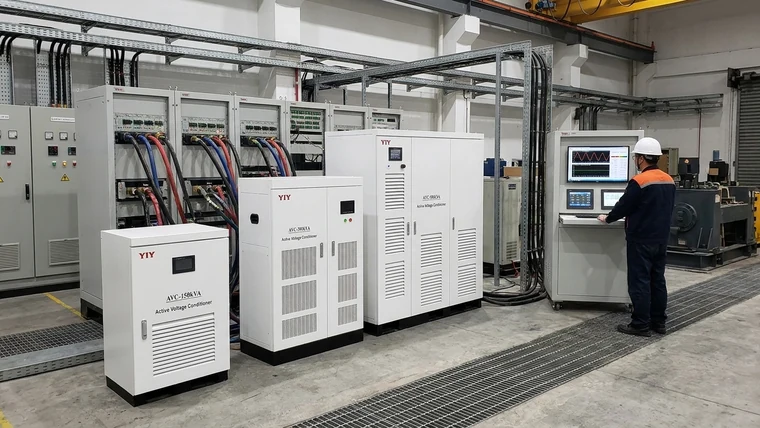
A wide capacity span doesn’t mean your site belongs at the top of it. For your RFQ, the more useful data is load kVA, inrush current, voltage event depth, event duration, phase system, bypass requirement, and monitoring needs.
How Does Active Voltage Conditioning Work?
You get protection because the system senses incoming voltage in real time, calculates the required correction, and regulates or injects corrective voltage before the disturbance reaches your load. For your equipment, the result is a more controlled supply during disturbances that would otherwise trip controls or drives.
At the technical level, sensors monitor input voltage, output voltage, current, phase status, and fault conditions. A DSP, or digital signal processor, compares those readings with the programmed output target. IGBT power devices then switch through PWM, or pulse-width modulation, to produce the corrective waveform. If you want to explore the electronic topology behind this type of fast regulation, YIY’s IGBT voltage stabilizer overview is the deeper technology path.
A typical correction sequence looks like this:
- Sense input voltage, phase balance, frequency, current, and load behavior.
- Compare readings against the programmed output window, such as 380 V, 400 V, or 415 V three-phase targets.
- Calculate the required boost, buck, or injection value through DSP logic.
- Switch IGBT modules using PWM to generate the corrective waveform.
- Regulate output voltage so your protected equipment sees a controlled supply.
- Protect or bypass the load if overload, overtemperature, short circuit, internal fault, or extreme input conditions exceed safe limits.
The correction usually reaches the load through a series injection transformer: the unit adds the missing part of the voltage during a sag and opposes the excess during a swell, while the load stays on the supply. On YIY’s AVC, sag correction completes within half a cycle, so a short dip is handled before most control power supplies drop out.
Those voltage targets, such as 380 V, 400 V, and 415 V, are not just numbers on a datasheet. They tell you what output your machinery expects, so your conditioner or stabilizer must be configured around the actual supply standard and equipment tolerance at your site.
For voltage dip and interruption language, IEC 61000-4-11 voltage dip and interruption testing defines test methods for voltage dips, short interruptions, and voltage variations. This does not automatically certify every device you compare, but it gives you a common technical vocabulary for discussing dip depth, duration, and equipment immunity.
Which Selection Criteria Should You Verify Before Specifying One?
You should specify the unit from measured voltage behavior, load profile, phase system, correction target, environment, and service model, not from kVA alone. If your inquiry only says “100 kVA three phase,” your supplier cannot reliably judge inrush, bypass behavior, thermal design, monitoring needs, or whether active conditioning is the correct topology.
Use the table below as a procurement screen before you request a quote.
Check Why it matters If you skip it Load kVA/kW and power factor kVA shows apparent load, kW shows real working power, and power factor affects current You may buy a unit that looks large enough but overheats or trips under real load Load type and inrush current Motors, compressors, pumps, transformers, CNC, PLC, and medical loads behave differently Starting events may trigger overload alarms, bypass transfer, or nuisance shutdowns Input voltage range and event data Logged sag, swell, imbalance, and generator-transfer records show what must be corrected You may specify a normal AVR for a fast disturbance problem Output tolerance and response target Tight regulation and fast response help sensitive controls ride through disturbances The unit may regulate too slowly for your actual failure mode Phase/wire system and frequency Confirm 1-phase or 3-phase, 3-wire or 4-wire, neutral condition, and 50/60 Hz Wrong configuration can delay installation or require redesign Overload capacity and bypass mode Bypass supports service continuity or controlled transfer during faults One internal fault can become a full production stop Cooling, enclosure, and footprint Dust, humidity, heat, poor ventilation, and cabinet crowding affect service life Contamination and heat buildup can shorten equipment life Monitoring and service access Alarms, event logs, dry contacts, RS485/Modbus, PLC/BMS/SCADA links, and spare parts support maintenance You lose the evidence needed to diagnose repeat power events
For capacity, list every protected load, total watts or VA, power factor, starting current, duty cycle, and expected expansion. Leave a sizing margin above the calculated load; it keeps the unit off its limit during startup peaks and future additions, and the right size depends on your inrush and expansion plan.
Apparent power is the starting number: kVA = √3 × V × A ÷ 1000 for three-phase loads and kVA = V × A ÷ 1000 for single-phase. A 400 V three-phase load drawing 100 A works out to about 69.3 kVA before margin. Treat it as a baseline; inrush, nonlinear loads, and ambient heat still move the final rating.
If your project is closer to a whole three-phase main-line protection problem than a dedicated sensitive-load conditioner, compare your numbers with 3 phase main line stabilizer sizing. For a broader selection workflow, use YIY’s industrial voltage stabilizer selection guide to organize load profile, voltage range, site conditions, and application priority before finalizing the RFQ.
What Standards, Compliance, And Proof Points Should You Ask For?
You should separate required compliance from useful engineering evidence before you approve a supplier. Standards references help you speak precisely, but your final confidence should come from a complete specification, test documentation, manufacturing controls, and a serviceable design.
Ask your supplier for the documents that match your market and application. For a typical industrial inquiry, that may include electrical drawings, rated input/output range, overload data, protection functions, cooling design, bypass mode, alarm list, test report, installation manual, and maintenance instructions. If you work in a regulated environment, you may also need project-specific compliance documentation before installation.
YIY is ISO 9001:2015 certified, and the official ISO 9001:2015 page defines the quality management system standard behind that certification. For you, this does not replace technical verification of a specific model, but it does support supplier evaluation because consistent design, production, inspection, and service processes matter when you are buying voltage-protection equipment for critical loads.
Also check practical service evidence. A well-specified conditioner should not become a black box after commissioning. Your maintenance team should be able to see alarms, understand bypass status, review event history, and access service support without turning every voltage complaint into guesswork.
How Should You Collect Data Before Requesting A Recommendation?
You should collect enough site data to let the recommendation follow your actual failure mode. The goal is a first-pass fit review, not a paperwork burden, so start with the measurements and operating details that most directly affect sizing and topology.
A useful data pack includes:
- Voltage records: normal input range, worst-case sag/swell, phase imbalance, generator-transfer events, and trip timestamps.
- Load profile: equipment list, kVA/kW, power factor, duty cycle, starting current, and whether loads start together.
- System configuration: single-phase or three-phase, 3-wire or 4-wire, neutral condition, grounding system, and 50/60 Hz frequency.
- Application priority: which loads are critical, what happens during a trip, and whether a short stop is acceptable.
- Environment: ambient temperature, dust, humidity, ventilation space, cabinet location, altitude if relevant, and service access.
- Output target: required voltage, tolerance, response expectation, bypass preference, alarm interface, and monitoring protocol.
Log long enough to catch several real events. If your events are seasonal, generator-related, or tied to specific production cycles, you may need a longer or more targeted measurement period. In practical terms, the data should include the moment your equipment fails, not only a quiet week when the mains looked stable.
What Final Checks Should You Complete Before You Decide?
You should verify the failure mode, compare alternatives, and confirm service expectations before you lock the specification. This final review keeps procurement focused on uptime and technical fit instead of choosing the most expensive or cheapest device by default.
Decision check What to confirm Better next action Is the problem slow drift or fast disturbance? Compare voltage logs with trip timestamps Use AVR/servo for slow variation; evaluate active correction for fast sags Is backup power required? Confirm whether the load must continue during outages Add UPS if runtime is required; do not expect a conditioner to act as a battery Is the protected load critical? Estimate downtime, scrap, restart time, and safety impact Prioritize faster correction and better monitoring for critical loads Is the unit serviceable on site? Check bypass, alarms, spare parts, filters, and access clearance Specify maintenance-friendly design before purchase Is the RFQ complete? Include load data, voltage records, environment, output target, and monitoring needs Request a first-pass fit review before final price comparison
If you are comparing supplier proposals or trying to justify a capacity tier internally, the guide to compare before buying a voltage stabilizer can help you structure the decision around downtime risk, specification quality, and total fit rather than price alone.
Frequently Asked Questions
What Field Evidence Should Buyers Collect First?
Start with recorder screenshots, alarm timestamps, affected equipment names, phase system, and the operating condition when each trip happened. This evidence lets engineering separate grid events from mechanical faults or control-software issues.
For supplier review, attach the lowest and highest measured input values, event duration if available, load kVA/kW, and the production impact of each stop. That creates a more useful first-pass recommendation than a generic request for a device name.
Which Loads Deserve Priority In The First Specification?
Prioritize loads where one interruption creates scrap, safety risk, restart labor, or missed delivery commitments. Typical examples include CNC lines, PLC-controlled machinery, medical or laboratory systems, packaging equipment, and process controls.
The RFQ does not need to cover the whole facility at once. A dedicated protection scope for the highest-cost failure point can be easier to size, justify, install, and verify before expanding protection across other panels.
How Should Maintenance Teams Operate The Unit After Installation?
Keep the protected circuit energized according to the manufacturer manual and your site isolation procedure. Maintenance teams should know bypass position, alarm meanings, ventilation requirements, filter checks, and lockout steps before the first production shift.
Ask the supplier for a commissioning checklist and a simple alarm-response table. Those two documents reduce confusion when operators see a fault code or when service staff need to isolate the cabinet safely.
When Should A UPS Be Included In The Same Project?
Include UPS support when the load must continue during an outage or when controls need time for orderly shutdown. Voltage conditioning can improve supply quality, but it does not replace stored energy for sustained power loss.
For mixed projects, define which loads need ride-through time and which only need regulated input. That split helps avoid overspending on batteries for equipment that only needs voltage correction.
What Makes A Supplier Recommendation Trustworthy?
A useful recommendation explains the assumed load, input window, output target, overload margin, protection logic, bypass design, and monitoring interface. It should also state what information is still missing.
Before approving the quote, ask the supplier to map each recommended parameter back to your measured data. This keeps the decision tied to site risk instead of sales language.
Final Thoughts
Choose an active voltage conditioner when logged sags or swells are already tripping sensitive loads faster than an AVR or servo unit can react. If the problem is slow drift, a conventional stabilizer is usually the cheaper fit. Compare the options across YIY’s voltage stabilizer range.