When comparing V Guard vs Everest stabilizer for industrial OEM applications, buyers should evaluate technical specifications, compliance certifications, and supplier capability rather than brand recognition alone. Both are established Indian-market brands, but OEM distributors sourcing at scale often find that dedicated voltage stabilizer manufacturers deliver deeper OEM/ODM customization, certified quality control, and direct factory engineering support. The short answer: V-Guard suits residential and light-commercial loads, Everest fits mid-range industrial use, and neither is purpose-built for OEM/ODM distribution.
V Guard vs Everest: Side-by-Side Comparison
| Criteria | V-Guard | Everest | Dedicated OEM Manufacturer |
|---|---|---|---|
| Primary segment | Residential / light commercial | Mid-range industrial | Industrial + OEM/ODM |
| Typical capacity range | 0.5–10 kVA | 1–50 kVA | 0.5–3000 kVA |
| Core technology | Relay / servo | Servo | Relay, servo & IGBT |
| Custom labeling (white-label) | No | Limited | Yes |
| MOQ flexibility for distributors | Low | Medium | High (low MOQ) |
| Export / IEC documentation | India-focused | Regional | 130+ countries, IEC 60038 |
Key Comparison Criteria for Industrial & OEM Buyers
For industrial and OEM buyers, the comparison should focus on input voltage correction range, correction speed (servo systems typically respond in 1–2 seconds; IGBT in milliseconds), protection features (over/under-voltage, overload, short-circuit), IEC compliance, and after-sales support. V-Guard is primarily a consumer-grade brand optimized for single appliances and homes. Everest targets mid-range industrial applications. Neither offers the OEM customization depth — custom firmware, branded enclosures, and repeatable volume production — that dedicated manufacturers provide.
What OEM Distributors Should Compare Instead
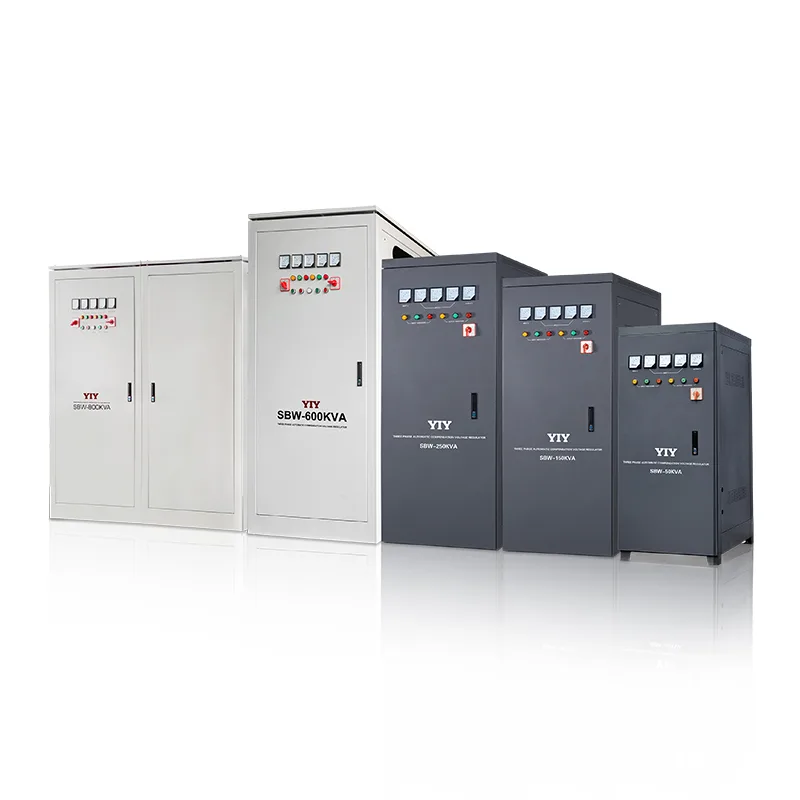
Rather than choosing between two retail brands, OEM distributors sourcing voltage stabilizers for resale should compare factory audit capability, custom labeling options, IEC 60038 compliance documentation, and minimum order quantities. Manufacturers like YIY (Zhejiang Yiyen Holding Group) have specialized in OEM/ODM voltage stabilizers from 0.5 kVA to 3000 kVA since 2008, with a 30,000 m² facility, 300+ staff, 1,000,000+ units/year of capacity, certified quality control, and export experience in 130+ countries. To compare dedicated voltage stabilizer manufacturers on capacity, customization, and certification, see our OEM shortlist guide.
Selection Checklist for Industrial Buyers
- Verify the input voltage correction range matches your grid conditions
- Confirm IEC 60038 (or equivalent) compliance documentation
- Request a factory audit report or ISO 9001 certification
- Compare servo vs relay vs IGBT technology for your specific load type
- Evaluate MOQ, lead time, and white-label options for your distribution volume
- Check correction speed and accuracy (±1% to ±3%) against equipment sensitivity
Frequently Asked Questions
Which is better, V-Guard or Everest?
For home and light-commercial use, V-Guard is the stronger consumer brand with wide service coverage. For mid-range industrial loads, Everest’s servo range is the better fit. For OEM distribution or heavy industrial capacity above 50 kVA, neither is ideal — a dedicated voltage stabilizer manufacturer offering custom specifications, OEM/ODM branding, and documented quality control is the better procurement choice.
Is V-Guard stabilizer good for industrial use?
V-Guard stabilizers are engineered mainly for residential and light-commercial equipment such as ACs, refrigerators, and TVs. For continuous industrial loads, three-phase systems, or capacities above 10 kVA, an industrial-grade servo or IGBT stabilizer from a dedicated manufacturer is more appropriate.
What should OEM buyers prioritize over brand name?
OEM buyers should prioritize technology fit (relay/servo/IGBT), capacity range, IEC compliance documentation, customization and white-label capability, MOQ flexibility, production capacity, and export experience — factors that determine delivery reliability and end-customer satisfaction far more than retail brand recognition.