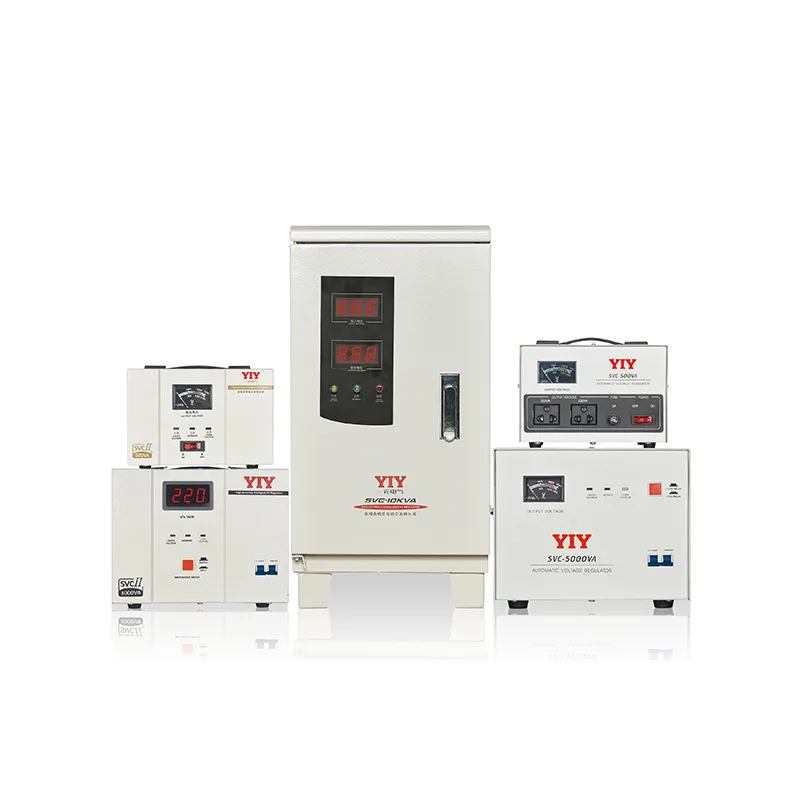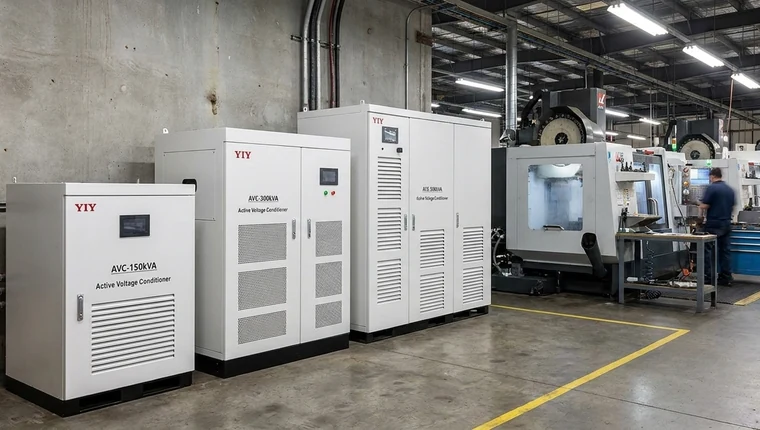
Before buying servo stabilizer india, compare supplier capability, voltage correction range, load fit, testing proof, standards evidence, lifecycle support, and quotation integrity; these checks decide whether your stabilizer protects production equipment or becomes a procurement risk.
This guide walks you through the key decisions behind your RFQ: what problem you are solving, how to qualify a manufacturer, how servo technology affects sizing, how to compare quotations, what documents to request, and when YIY can help with a first-pass fit review.
If your buying process is still based mainly on price or catalog kVA, start with the technical basics of a servo voltage stabilizer and then use the checklist below to turn your inquiry into a more reliable procurement decision.
What Sourcing Problem Are You Really Solving?
You are not only buying voltage correction; you are reducing the risk that unstable power, poor sizing, or weak supplier support will disrupt your equipment. For Indian industrial sourcing, the practical question is whether the stabilizer is matched to your real site conditions and backed by a supplier who can prove what they quote.
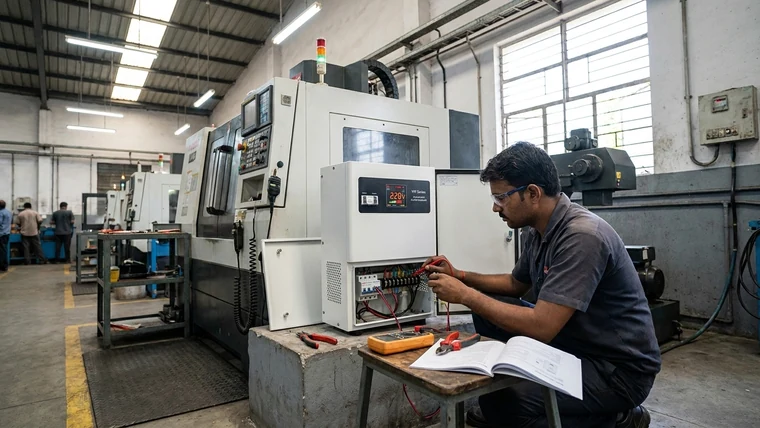
If your plant sees voltage fluctuation, phase imbalance, nuisance trips, motor heating, CNC sensitivity, compressor faults, or line stoppages, a servo AVR may be part of the answer. But the stabilizer only works as intended when the input range, load behavior, protection package, installation environment, and service model are all considered together.
For procurement, this means you should not shortlist suppliers only by searching for a servo voltage stabilizer manufacturer in India, a supplier in Delhi, or a servo stabilizer manufacturer in Chennai. Location can matter for service, but your bigger risk is whether the quoted unit matches your voltage profile, duty cycle, ambient conditions, and documentation requirements. To decide which voltage stabilizer manufacturers to shortlist on capability rather than location, use our manufacturer selection guide.
Local presence is not proof of engineering capability. In cities such as Mumbai, many offers share the same sales language; ask early whether the seller is a trader, an assembler, a distributor, or the factory itself, and who controls model design, testing, spares, and custom input windows.
Use nominal voltage references carefully. IEC 60038 standard voltages define internationally recognized voltage references, which helps you use a common language in your RFQ. In practical terms, this gives your supplier a baseline for nominal voltage, but it does not replace measured site data from your own feeder.
Your first screen should answer five questions:
- Is the incoming voltage range measured under actual production conditions?
- Is the load profile based on connected kVA, starting current, duty cycle, and future expansion?
- Is the supplier quoting the same phase configuration, frequency, output tolerance, and protection package you requested?
- Is there proof of factory testing, documentation control, and warranty responsibility?
- Is the cabinet suitable for dust, humidity, heat, ventilation limits, and site maintenance access?
When you answer these before comparing prices, your RFQ becomes a technical qualification tool instead of a race to the lowest line item.
Which Indian Industrial Belts Need Servo Stabilization Most?
Location doesn’t decide the need; your voltage log does. But buyers in the main belts tend to protect different loads:
- Coimbatore: textile machinery, CNC shops, pumps, compressors, and fabrication loads.
- Chennai and Noida: plants in industrial estates with mixed feeder conditions.
- Delhi area: heat, dense networks, and switching disturbances.
Even where supply is generally good, feeder-level drops, phase imbalance, or peak-hour trips can still hit a plant. Choose servo correction when logs show fluctuation during shifts, drives or PLCs trip on dips, or long-duty motors and textile lines run on the same feeder.
Which Seven Sourcing Checks Should You Complete Before RFQ?
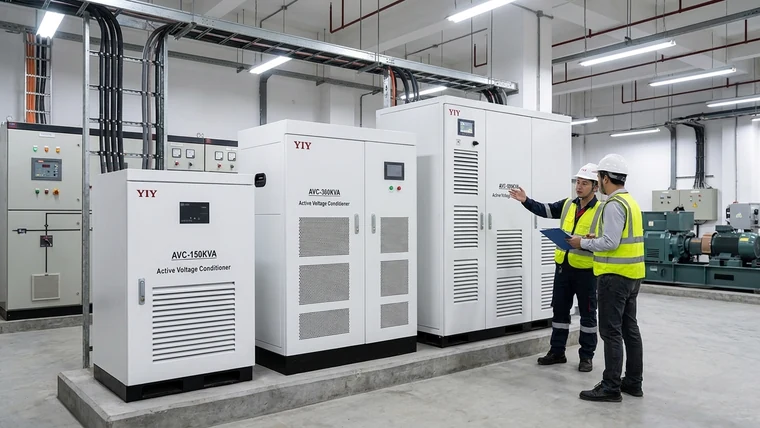
You should complete these seven checks before RFQ so each supplier quotes the same duty, evidence level, and service expectation. Without them, your quotation comparison can look competitive while hiding major differences in voltage range, build quality, protection design, and support.
| Check | Why it matters | If you skip it |
|---|---|---|
| Load profile review | Your supplier needs connected kVA, running load, starting current, duty cycle, and expansion margin | You may buy a unit that trips, overheats, or under-corrects when motors start |
| Measured voltage range | Real lowest and highest input voltage define correction range and design margin | A cheaper quote may cover a narrower fluctuation band than your site needs |
| Phase and imbalance review | Three-phase loads may require phase loss, phase sequence, and imbalance protection | Sensitive equipment can still fault even when average voltage looks acceptable |
| Factory test evidence | No-load, load, output accuracy, protection, and wiring checks reduce commissioning risk | You accept hidden defects that may only appear after installation |
| Documentation package | Wiring diagram, data plate, manual, test report, and warranty terms help your maintenance team | Troubleshooting and warranty claims become slower and harder to prove |
| Quality-system review | ISO 9001:2015 quality management systems give a recognized process-control framework | A certificate alone is not enough, but no process evidence makes repeatability harder to judge |
| Service and spares plan | Spare parts, response responsibility, and warranty scope affect lifecycle risk | A low upfront price can become expensive when downtime ownership is unclear |
In practical terms, ISO 9001:2015 does not prove that a specific stabilizer is right for your plant. It helps you ask whether the supplier controls design review, purchasing, production inspection, test records, and corrective actions.
For your RFQ, ask the supplier to connect each technical promise to a document. If the quote says overload protection, request the protection rating or function description. If it says wide input range, request the actual range and output tolerance. If it says factory tested, request the test format or sample report.
How Do Servo AVR Principles Affect Your Sizing Decision?
Servo AVR principles affect your sizing decision because a motor-driven correction system must match your voltage fluctuation speed, load kVA, phase configuration, duty cycle, and site environment. A servo stabilizer can be a strong industrial choice, but only when its correction range and mechanical design fit the way your load behaves.
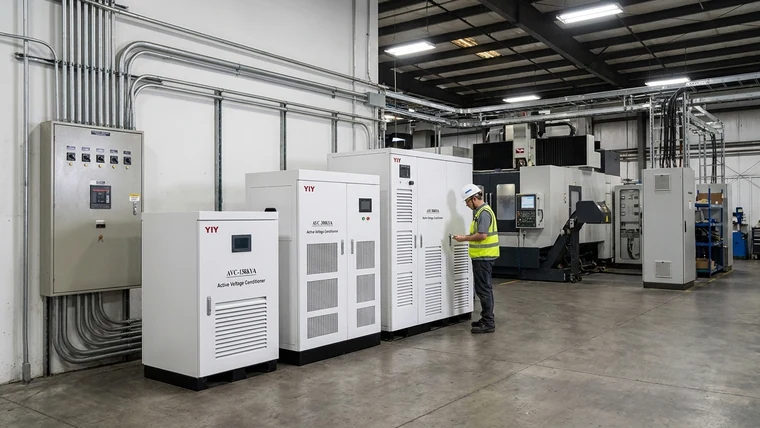
A typical servo voltage stabilizer uses a control board to monitor input or output voltage, then commands a servo motor to adjust a carbon brush across an autotransformer or variac. This creates smooth voltage correction rather than stepped relay switching. For you, the benefit is steadier output for loads such as CNC machines, motors, pumps, compressors, packaging lines, and main distribution panels.
The tradeoff is response speed. A servo system is not instant because the correction mechanism moves physically. That is acceptable for many industrial voltage fluctuation patterns, but you should confirm correction speed if your site experiences rapid dips, frequent surges, or sensitive electronic loads.
| Sizing factor | What to check | What it means for you |
|---|---|---|
| Input range | Lowest and highest incoming voltage during real operation | A narrow-range quote may fail if your feeder drops below the assumed range |
| Output tolerance | Required output band for the protected load | Tighter tolerance helps CNC, control systems, lab equipment, and drives stay stable |
| kVA and overload margin | Running load, inrush current, duty cycle, and future capacity | Proper margin reduces heating, nuisance trips, and premature wear |
| Phase configuration | Single-phase, three-phase common correction, or three-phase independent correction | The correction method affects performance when phases are uneven |
| Correction speed | How quickly output returns to the acceptable band | Faster correction matters when voltage swings are frequent or abrupt |
| Cooling and enclosure | Air cooling, oil cooling, ventilation, IP needs, dust, humidity, ambient heat | A correct electrical size can still fail if the cabinet cannot handle the environment |
For a main three-phase production line, do not accept a simplified recommendation until you have checked phase imbalance, phase sequence, phase loss, neutral condition, bypass arrangement, and upstream protection. If your unit protects main distribution rather than a single machine, review 3 phase main line stabilizer sizing before you finalize your requirement.
Environment should also shape your specification. Dust can block ventilation and contaminate moving parts. Humidity can stress insulation and terminals. High ambient heat can reduce thermal margin. Poor ventilation can make an otherwise suitable unit run hotter than expected. For your site, ask about cabinet airflow, fan access, derating, surge protection, bypass, and service clearance.
Which Technology Fits Your Precision and Budget Requirements?
For many factory loads, servo technology is the practical middle option between low-cost relay stabilizers and higher-speed static or IGBT systems. Your best choice depends on load sensitivity, fluctuation speed, budget, maintenance access, and acceptable downtime risk.
| Technology | Best fit | Main limitation | What it means for you |
|---|---|---|---|
| Relay stabilizer | General low-cost loads with less demanding precision | Stepped correction and limited suitability for sensitive industrial loads | You may save upfront cost, but output correction is less smooth |
| Servo stabilizer | General industrial loads needing smoother correction and practical capacity | Mechanical movement means response is not instant and parts need maintenance | You get a balanced option for many plants when sizing and maintenance are clear |
| Static or IGBT stabilizer | Sensitive loads needing faster correction or higher precision | Often higher cost and more specialized design requirements | You may justify the upgrade for critical electronics, medical, lab, or high-speed processes |
If your load is highly sensitive or your voltage disturbance is fast, compare the servo option with an IGBT voltage stabilizer instead of assuming one topology fits every case. For your buying decision, the important point is not which technology sounds more advanced; it is which design keeps your equipment inside its safe operating band.
A servo stabilizer is often suitable for production machinery, CNC groups, pumps, compressors, lifts, textile machines, packaging lines, and industrial panels where voltage fluctuation is frequent but not so abrupt that static correction is required. For loads with very tight tolerance requirements, ask for output accuracy, response data, bypass behavior, protection logic, and maintenance expectations before approving the topology.
How Should You Compare Quotations Without Being Misled by Price?
You should compare quotations only after you normalize electrical duty, protection scope, testing evidence, documentation, and service responsibility. If one supplier quotes a wider input range, stronger protection, better enclosure, and full test documentation while another quotes only a kVA label, the lower price is not a true like-for-like saving.
| Quotation item | What to normalize | Why it matters to you |
|---|---|---|
| Electrical rating | kVA, phase, frequency, input range, output tolerance, correction speed | A low quote may simply cover a lighter or narrower duty |
| Load assumptions | Motors, CNC, compressors, lifts, mixed loads, inrush, duty cycle | Starting current can require extra margin beyond running kVA |
| Protection package | Overload, short circuit, surge, phase loss, phase sequence, bypass, alarms | Protection gaps create risk during abnormal supply or load events |
| Mechanical build | Enclosure, cooling method, IP needs, cable entry, ventilation, service access | Dust, humidity, and heat can turn a correct model into a site problem |
| Testing proof | Routine test report, output accuracy check, protection test, serial number | Your maintenance team needs traceable evidence if problems occur |
| Commercial terms | Lead time, warranty scope, spare parts, export packing, after-sales owner | Slow support can erase the benefit of a lower purchase price |
Searches such as 10 kVA servo stabilizer price in India or 15 kVA servo stabilizer price in India can help you understand the market conversation, but they should not set your final benchmark. Price only becomes meaningful after your supplier confirms voltage range, build material, enclosure, protection package, testing, warranty, and installation assumptions.
If you are comparing a capacity-specific offer, use a structured approach like compare before buying a voltage stabilizer so your commercial review does not drift away from technical fit. Your goal is to compare the total delivered risk, not only the first invoice.
Red flags include vague input voltage range, no derating note, missing load assumptions, no test report, unclear warranty owner, generic “as per standard” language, and a supplier who cannot explain how the unit will behave during phase loss, overload, or bypass operation.
What Should Your RFQ Include for a Reliable Technical Review?
Your RFQ should include measured voltage, load profile, installation environment, target market, documentation needs, and compliance expectations before you ask for the final commercial offer. This gives the supplier enough information to confirm fit instead of guessing from a kVA number.
Use this structure before you send your inquiry:
| RFQ item | What to send | Why it matters |
|---|---|---|
| Load data | Connected kW/kVA, running current, motor sizes, starting method, inrush, duty cycle | Helps the supplier size margin and avoid nuisance tripping |
| Voltage data | Lowest/highest input voltage, phase imbalance, fluctuation frequency, nominal voltage | Defines correction range and output stability requirements |
| Application | CNC, compressor, lift, pump, production line, distribution panel, mixed load | Different loads create different starting and protection risks |
| Site environment | Dust, humidity, heat, indoor/outdoor use, ventilation, cabinet space, IP preference | Prevents cabinet and cooling problems after delivery |
| Protection needs | Bypass, overload, short circuit, surge, phase loss, phase sequence, alarms, meters | Clarifies what must be included instead of assumed |
| Documents | Wiring diagram, test report, data plate, manual, warranty, certificate copies | Gives your maintenance and procurement teams traceable records |
For a broader selection workflow, you can use industrial voltage stabilizer selection to organize measured voltage, load behavior, duty cycle, topology choice, and protection review before final quote comparison.
For procurement and compliance FAQs, include a concrete verification step. If a supplier claims ISO certification, verify the certificate scope, issuer, validity period, and whether the scope covers manufacturing or only trading. If a supplier claims factory testing, request a sample routine test report and check whether the model, kVA, input range, output tolerance, serial number, and date format match the quotation.
Your RFQ does not need to be perfect on the first pass. A good supplier should be able to review the available information, identify missing data, and tell you what must be confirmed before production.
When Does YIY Fit Your Sourcing Shortlist?
You should consider YIY when your project needs more than a local catalog quote: technical review, OEM/ODM support, custom voltage range, export documentation, cabinet adaptation, or comparison across servo and other voltage-stabilization technologies. This is especially useful when your buyer, contractor, or end customer needs documented proof before approval.
Some India-focused suppliers emphasize local service, government projects, railway experience, or isolation transformer combinations. Those strengths can matter for certain domestic projects. Your evaluation should also check whether the supplier can support global documentation, OEM labeling, target-market compliance needs, custom enclosure requirements, and broader topology choices when your project scope extends beyond a standard domestic installation.
YIY’s role is to help you turn your voltage and load information into a technically reviewable requirement. That may include confirming whether a servo unit is suitable, whether a different topology should be considered, what protection package is appropriate, and what documentation should be prepared for your RFQ or customer approval file.
Start with a low-friction review: send your load type, measured voltage range, phase, frequency, target market, and any compliance requirements. YIY can provide a first-pass fit conversation or short checklist before you prepare detailed logs, drawings, or internal approval documents.
Frequently Asked Questions
How Do I Size a Servo Stabilizer When the Load Includes Motors or CNC Machines?
Size your stabilizer from measured site voltage, total running kVA, starting current, duty cycle, phase imbalance, overload margin, correction range, and future load margin. For motors, compressors, lifts, and CNC machines, do not rely only on nameplate kW. Ask your supplier to review inrush current, output tolerance, response speed, bypass design, and protection settings before approving the quote.
Is a Servo Voltage Stabilizer Better Than a Relay or Static Stabilizer for Factory Loads?
A servo voltage stabilizer is often a practical middle option for factory loads because it offers smoother correction than relay designs and lower cost than many static or IGBT systems. Relay designs suit simpler low-cost loads, while static or IGBT units may fit faster or more sensitive applications. Verify your fluctuation speed, load sensitivity, maintenance access, and downtime tolerance before choosing.
Should I Shortlist a Local Indian Supplier or an OEM/ODM Manufacturer for Export Projects?
Choose based on project scope, documentation needs, customization depth, target-market compliance, after-sales responsibility, and verified production capability rather than location alone. A local supplier may help with site service inside India, while an OEM/ODM manufacturer may better support export packaging, private labeling, custom voltage ranges, and multi-market approval files.
What Documents Should I Request from a Servo Voltage Stabilizer Manufacturer in India?
Request a technical quotation, wiring diagram, test report, data plate draft, user manual, warranty terms, and applicable quality or compliance certificates. Cross-check the model number, kVA rating, input range, output tolerance, phase, frequency, protection functions, and serial-number format across all documents. If a certificate is cited, verify the scope and issuer instead of accepting the logo alone.
What Is the Most Common Procurement Mistake?
The most common mistake is comparing kVA and price before confirming measured voltage range, load behavior, protection package, and test evidence. To avoid this, ask each supplier to quote against the same input range, output tolerance, load assumptions, cabinet requirements, and document list. If the quotation cannot show these details, your comparison is not yet RFQ-ready.
Final Thoughts
You make a better servo stabilizer decision when you treat the purchase as a sourcing qualification process, not a catalog match. Define the site risk first, qualify the manufacturer, verify the technology fit, normalize quotations, and then send a complete RFQ.
That sequence protects your project from the most common hidden risks: undersized kVA, narrow voltage range, weak protection, poor environmental adaptation, missing test proof, and unclear service responsibility. It also helps you compare suppliers fairly, whether you are reviewing a local Indian vendor, a city-specific manufacturer, or an OEM/ODM partner for export work.
If you want a practical next step, ask YIY for a quick review or short RFQ checklist first. After that first pass, send your load profile, voltage range, target market, and compliance needs so YIY can confirm whether this capacity tier and configuration fit your sourcing plan.