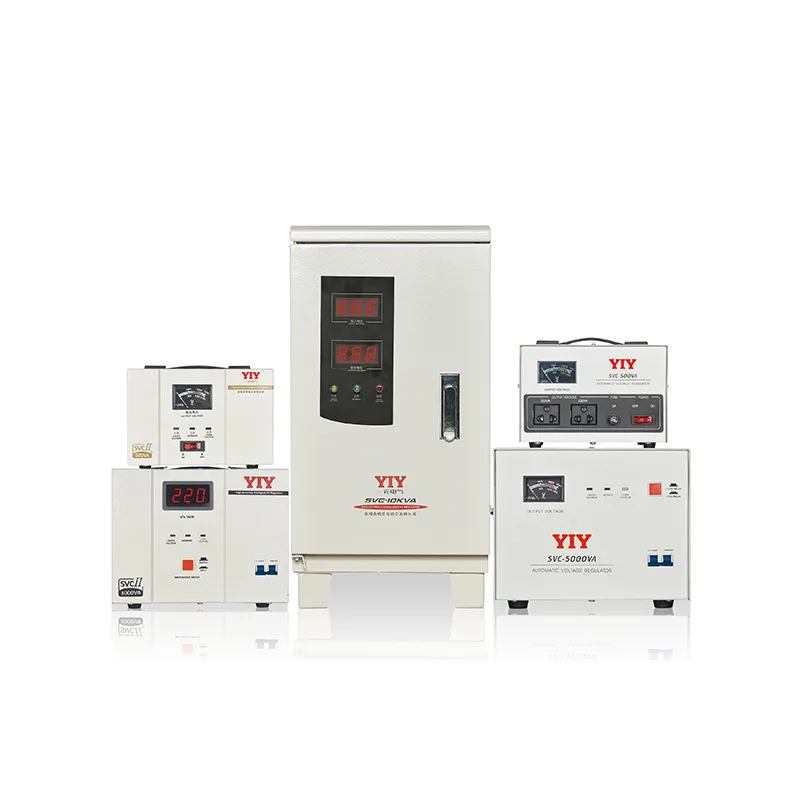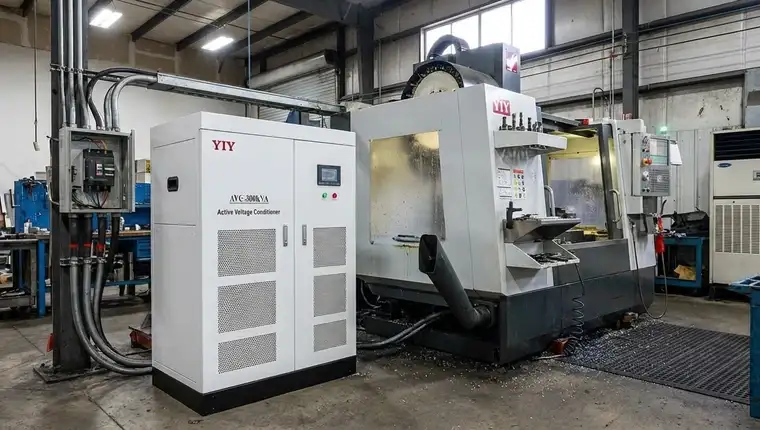
The HSN code for servo voltage stabilizer imports is 8504 — the classification covering transformers, static converters, and inductors under the Harmonized System nomenclature maintained by the World Customs Organization. Below: when servo beats relay or IGBT, and what to verify before you order.
What the HSN Code for Servo Voltage Stabilizer Covers and Why It Matters
HSN code 8504 covers electrical transformers, static converters, and inductors — and servo voltage stabilizers fall squarely within this heading. The classification is not arbitrary: a servo stabilizer combines an autotransformer with a servo motor drive and MCU control circuit, making it a regulated power conversion device by function and construction.
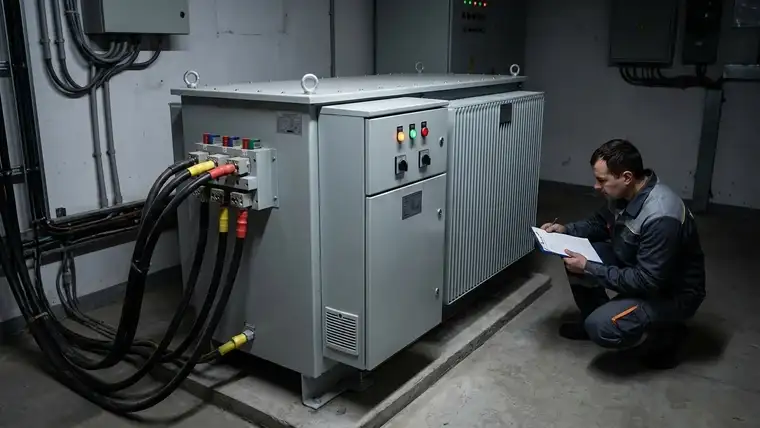
Why the Classification Has Direct Cost Consequences
Getting the HSN code right affects three things procurement teams care about immediately:
- Import duty rates — misclassification can trigger the wrong duty bracket, inflating landed cost or creating compliance exposure during customs audit
- GST input credit — in markets like India, the correct HSN code on invoices is required to claim input tax credit under GST HSN code requirements; a wrong code blocks the credit chain
- Customs clearance speed — accurate classification reduces the probability of holds, re-inspection, or documentation requests at the port of entry
For a 45KVA–150KVA three-phase unit like the PWR-3 series, the difference in landed cost between a correctly and incorrectly classified shipment can be significant enough to affect project budgets.
Who Needs to Get This Right
Industrial buyers and procurement managers sourcing servo stabilizers for manufacturing lines, telecom infrastructure, or medical facilities are the primary audience for this decision. These environments share a common profile: unstable grid input, sensitive downstream loads, and zero tolerance for unplanned downtime.
In these sectors, the stabilizer is not a commodity purchase — it’s a compliance and operational risk decision. The HSN code determines how the unit is documented across the supply chain, from supplier invoice to customs declaration to asset register.
The Practical Implication
Verify the HSN code with your supplier before issuing a purchase order. For servo voltage stabilizers, 8504 is the correct heading. Confirm the sub-heading with your customs broker based on the specific unit capacity and configuration, as sub-classifications under 8504 vary by jurisdiction and product spec.
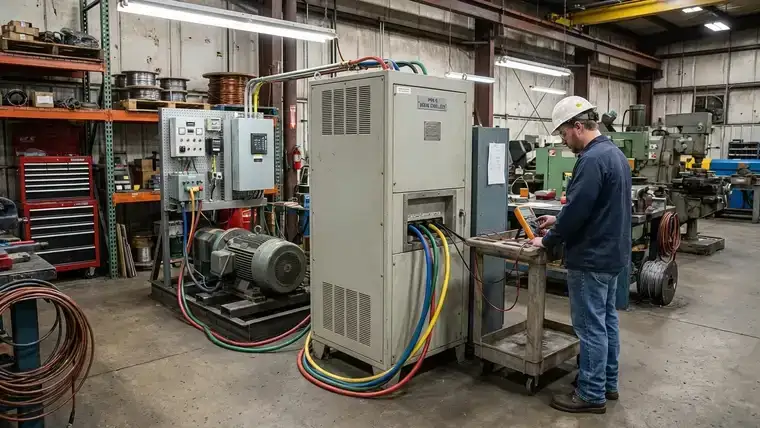
Who Is Searching for This and What Decision They Face
The buyers searching for the HSN code for servo voltage stabilizer sourcing are not browsing — they are mid-procurement. Procurement managers, electrical engineers, and technical buyers at manufacturing plants, telecom facilities, and medical installations reach this query when they are preparing import documentation, validating supplier invoices, or confirming GST compliance before issuing a purchase order.
The Compliance Half of the Decision
Industrial buyers need the correct HSN code for two immediate reasons: customs clearance and GST input credit. In markets like India, the HSN code must appear on supplier invoices for the credit chain to hold. A misclassified unit — even one that performs correctly — creates downstream paperwork problems that delay installation and inflate landed cost. For high-capacity three-phase units in the 45KVA–150KVA range, that exposure is not trivial.
The Technology Half of the Decision
The HSN code question rarely arrives alone. Behind it is a parallel decision: is servo the right topology for this application, or would relay-based or IGBT-based stabilization be a better fit? These are not interchangeable. Servo designs deliver continuous, stepless correction with tight output precision and correction measured in seconds, well-suited for manufacturing lines, CNC equipment, and telecom infrastructure where load profiles are heavy and grid instability is chronic.
Relay-type stabilizers are lower cost but step-correct in discrete increments, making them unsuitable for precision loads. IGBT designs offer faster response but carry higher unit cost and complexity, typically reserved for mission-critical or medical-grade environments.
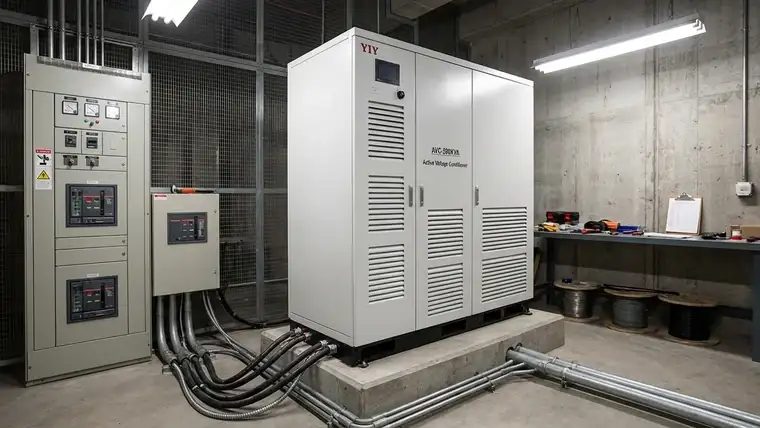
Where YIY Fits This Segment
For three-phase industrial loads, YIY’s PRO-3 series (1.5–100KVA) and PWR-3 series (45–150KVA) address this buyer segment directly. Both lines feature MCU control (output precision: PRO-3 ≤2%, PWR-3 ±3%), and industrial-grade component selection — covering the range from mid-scale manufacturing to high-demand process environments with unbalanced loading requirements.
How Servo Voltage Stabilizers Work — The Control Mechanism
A servo voltage stabilizer corrects output voltage through a closed-loop electromechanical system — not discrete switching steps. The core components are an autotransformer, a carbon brush assembly, a servo motor, and an MCU monitoring circuit. These four elements work together in a continuous feedback loop that keeps output voltage within tight tolerances regardless of grid fluctuation.
The Correction Loop
The MCU samples output voltage continuously. When it detects a deviation from the setpoint, it sends a directional signal to the servo motor. The motor rotates the carbon brush along the winding of the autotransformer — advancing or reversing position to raise or lower the output voltage. Because the brush moves continuously rather than jumping between fixed taps, correction is stepless and proportional to the deviation magnitude.
This is the fundamental difference from relay-type stabilizers, which switch between discrete transformer taps. Relay designs correct in fixed voltage steps, which is acceptable for resistive loads but introduces micro-transients that degrade sensitive electronics over time.
Precision and Response Specifications
YIY publishes ±3% output for SVC-3 and ≤2% for PRO-3, and correction takes seconds rather than milliseconds. That is fast enough for CNC spindle drives, precision machining centers, and industrial PLCs, where sustained voltage excursions can trigger faults or damage servo amplifiers. Output voltage tolerances align with IEC 60038 standard voltage levels for industrial equipment.
For three-phase industrial loads, the MCU monitors each phase independently. This matters for unbalanced loading scenarios common in manufacturing environments where phase loads differ significantly across production equipment.
Why This Design Suits Industrial Loads
The stepless correction profile eliminates the voltage notching that relay designs introduce. For CNC machines, injection molding equipment, and automated assembly lines, this translates directly to fewer nuisance trips, more consistent cycle times, and longer drive component life. The servo motor itself is a standard AC induction type — field-serviceable, with carbon brush replacement as the primary scheduled maintenance item.
For a deeper look at how each stabilizer topology handles voltage correction differently, see how voltage stabilizer works.
When to Choose Servo Over Relay or IGBT Designs
Servo is the right topology for most industrial three-phase applications — it corrects more tightly than relay and costs less than IGBT. The decision comes down to load sensitivity, budget, and response time requirements.
Topology Comparison: Servo vs. Relay vs. IGBT
| Criterion | Servo | Relay | IGBT |
|---|---|---|---|
| Correction method | Stepless (continuous) | Stepped (discrete taps) | Electronic switching |
| Output precision | Tight, stepless | Wider, stepped band | Tightest |
| Response time | Seconds | Fast steps | Milliseconds |
| Best load type | Industrial three-phase | Residential / light commercial | Mission-critical |
| Maintenance | Carbon brush replacement | Relay contact wear | Minimal mechanical |
| Capital cost | Medium | Low | High |
| Lifecycle cost | Low–medium | Low | High |
| Unbalanced load support | Yes (rated models) | Limited | Yes |
Where Servo Wins
Industrial precision loads are servo’s home ground. servo stabilizer for CNC machines, injection molding equipment, automated assembly lines, and telecom infrastructure all share the same profile: heavy continuous loads, chronic grid instability, and zero tolerance for voltage notching. Servo’s stepless correction eliminates the micro-transients that relay designs introduce with every tap switch — transients that degrade drive components and trigger nuisance faults over time.
Cost-sensitive three-phase applications are where servo’s value proposition is clearest. IGBT stabilizers offer faster electronic switching (milliseconds versus seconds), but that speed premium comes at significantly higher unit cost and more complex maintenance. For the vast majority of industrial loads — where correction in seconds is within tolerance — servo delivers equivalent protection at lower capital and lifecycle cost.
YIY’s PRO-3 series (1.5–100KVA, ≤2% output precision, MCU control) suits mid-scale manufacturing; the three-phase stabilizer type selection guide walks through sizing. The PWR-3 series (45–150KVA) covers high-demand sites with unbalanced phase loads. Both are compared in the product section below.
Where Relay or IGBT May Fit Better
Relay stabilizers are appropriate for residential and light commercial loads — single-phase applications, HVAC, lighting, and general office equipment where a wider, stepped tolerance band is acceptable and budget is the primary constraint. They are not suitable for precision industrial loads.
IGBT stabilizers make sense for mission-critical environments where millisecond response is non-negotiable: medical imaging equipment, semiconductor fabrication, or data center UPS bypass scenarios. The higher cost is justified when load sensitivity genuinely requires electronic-speed correction. For most manufacturing and telecom applications, it is not.
The practical rule: if your load is industrial and three-phase, servo is the default choice. Move to IGBT only when the load specification explicitly requires millisecond-level response.
Specification and Maintenance Checkpoints Before You Buy
Headline kVA and output voltage specs tell you what a servo stabilizer can do under ideal conditions. They don’t tell you whether it will perform reliably at your site, with your load profile, over a five-year service horizon. These are the checkpoints that matter before you finalize a model and issue a purchase order.
Pre-Purchase Specification Checklist
| Checkpoint | What to Verify | Why It Matters |
|---|---|---|
| Input voltage range | Actual low-end floor during peak demand | Prevents protection shutdown on chronic undervoltage sites |
| Phase balance | Whether load is balanced or unbalanced across phases | Unbalanced loads require explicit 100% unbalanced rating |
| Bypass requirement | Manual or automatic bypass needed | Continuous-process sites need clean grid path during maintenance |
| Carbon brush interval | Inspection cycle for your duty profile | Factors into total cost of ownership vs. static designs |
| kVA sizing | Total connected load plus a margin for motor starts | Prevents overload trips during startup surges |
For a worked sizing example, see the 20kva voltage stabilizer guide before scaling up or down.
Confirm Input Voltage Range Against Site Conditions
The first number to verify is the actual low-end input voltage your grid delivers during peak demand or seasonal dips. Each servo model publishes a minimum input voltage. If your site regularly drops below that threshold, you need a unit rated for ultra-low input operation.
If your facility sees chronic undervoltage, confirm the unit’s minimum input spec against your worst-case site measurement rather than the utility’s nominal rating. The PWR-3 series is built for this case.
Unbalanced Three-Phase Loads Require Explicit Rating
Most servo stabilizers are rated for balanced three-phase loads. Manufacturing environments rarely deliver that. When phase loads differ significantly — as they do on production lines where equipment is distributed unevenly across phases — you need a unit explicitly rated for 100% unbalanced loading.
The PWR-3 series carries this rating. A standard three-phase unit without it will struggle to maintain output precision under unbalanced conditions, and in some cases will trigger protection faults during normal operation. Verify this spec directly with your supplier before ordering.
Bypass Requirements and Site Continuity
Confirm whether your application requires a manual or automatic bypass. Servo stabilizers need periodic maintenance — and during that window, your load needs a clean path to the grid. For continuous-process environments, a built-in bypass is not optional. Specify it at the quotation stage, not after installation.
Carbon Brush Maintenance: Factor It Into Total Cost of Ownership
Servo stabilizers have one scheduled maintenance item that static designs do not: carbon brush inspection and replacement. The brush assembly is the contact point between the servo motor and the autotransformer winding. Brushes wear gradually and need periodic inspection; the interval depends on duty cycle and load profile.
The task is simple but recurring. Put brush intervals and local service availability into any total cost of ownership comparison against a static IGBT design, which has no scheduled mechanical maintenance.
YIY Product Fit and How to Get a Technical Review
Most three-phase industrial applications fall into one of two profiles: standard precision loads running on a reasonably stable grid, or high-demand environments where grid quality is poor and load balance is unpredictable. YIY’s PRO-3 and PWR-3 series are built around these two profiles specifically.
PRO-3: Standard Three-Phase Industrial Applications
The PRO-3 series (1.5–100KVA) covers the majority of industrial servo stabilizer requirements. It delivers ≤2% output precision under MCU control, with built-in motor protection. This makes it a practical fit for manufacturing lines, CNC equipment clusters, and telecom infrastructure where load profiles are heavy but grid conditions are within normal operating range. The MCU monitors each phase independently, which matters for production environments where phase loads shift across shifts or equipment cycles.
PWR-3: High-Demand and Unstable-Grid Sites
The PWR-3 series (45–150KVA) is designed for sites where standard servo units hit their limits. It handles ultra-low input voltages that would push a standard unit into protection shutdown, supports 100% unbalanced loading across phases, and includes surge protection for environments with chronic grid instability.
If your facility is in an industrial zone with heavy concurrent load, or if your production equipment is distributed unevenly across phases, evaluate the PWR-3 first as the baseline specification.
Getting a Technical Review Before You Commit
Headline specs don’t confirm topology fit. The right question isn’t just “which kVA rating” — it’s whether servo is the correct topology for your load sensitivity, grid conditions, and maintenance context, or whether relay or IGBT would serve better.
Before engaging a supplier, reviewing how industrial voltage stabilizer manufacturers approach application validation will help you ask the right questions during the quotation process.
YIY offers a technical review to work through exactly this: input voltage range at your site, load type and phase balance, bypass requirements, and whether servo, relay, or IGBT is the right fit. The company is ISO 9001:2015 certified and exports to 130+ countries — the review process is built around application inputs, not generic lead capture.
To request a technical review, contact the engineering team directly with your site load profile and grid conditions.
Frequently Asked Questions
What Is the HSN Code for Servo Voltage Stabilizer Imports?
Use HSN code 8504, the heading for transformers and static converters. Ask your customs broker to confirm the sub-heading for your unit and destination market, and check that the supplier invoice carries the same code.
When Is a Servo Voltage Stabilizer Necessary Versus a Relay or IGBT Type?
Pick servo for three-phase production loads such as CNC centers, molding machines, and assembly lines that need stepless correction at moderate cost. Pick relay for light residential or office loads that accept a wider, stepped band. Pick IGBT only when the load specification demands millisecond correction, as in medical imaging or semiconductor tools.
What Should Buyers Evaluate Before Choosing a Servo Voltage Stabilizer?
Check four things: the lowest input voltage your site actually sees at peak demand, whether the unit is rated for unbalanced phase loads, whether a manual or automatic bypass is needed, and how often the carbon brushes need inspection under your duty cycle. Ask the supplier to confirm each item in writing with the quotation.
Final Thoughts
Two decisions drive this purchase: getting the HSN classification right, and confirming servo is the correct topology for your load.
The HSN code for servo voltage stabilizer imports is 8504. Verify the sub-heading with your customs broker before issuing a purchase order — misclassification affects duty rates, GST input credit, and clearance speed.
On the technology side, servo is the default choice for most industrial three-phase applications. It delivers stepless correction and tight output precision at a lower cost than IGBT, without the voltage notching of relay designs. The exceptions are narrow: relay for light residential loads, IGBT only when millisecond response is a hard requirement.
If you’re unsure whether servo, relay, or IGBT fits your specific load profile and grid conditions, YIY’s engineering team offers a technical review based on your actual site inputs. Contact them directly to request one.
Trade Notes: HSN Classification Does Not Replace Product Qualification
Buyers who search HSN codes are usually not at the same stage as buyers comparing topology, capacity, or application fit. They are trying to align customs, tax, invoicing, and procurement documentation. That makes this page valuable as a trade-compliance checkpoint — but only if it clearly separates tariff logic from engineering selection logic.
- Use this page for invoice and customs coordination: procurement, import-export, and tax handling teams who need classification consistency before issuing POs.
- Do not stop at the HSN code: classification tells the buyer how the item is declared, not whether the selected servo stabilizer is actually right for the load.
- Escalate to engineering review: once the classification question is settled, move the buyer into the industrial selection guide or the servo / relay / IGBT comparison.
- Commercial checkpoint: keep the HSN record, the quoted topology, and the model family aligned. Mismatch between customs language and technical quotation creates downstream commercial friction.
Treat HSN code lookup as one procurement step in the workflow, not the engineering decision itself.