Servo Stabilizer for CNC Machines: Complete Protection & Selection Guide
TL;DR: Voltage fluctuations cause CNC machines to lose precision, trigger alarms, and suffer premature component failure. A servo stabilizer corrects incoming voltage in real time, maintaining output accuracy within ±0.5–1%. Size your stabilizer at 1.5–2× your CNC machine’s rated kVA to handle startup inrush current. For most CNC applications, servo-controlled stabilizers offer the best balance of accuracy, load handling, and cost compared to static or relay alternatives.
When a shop moves from protecting CNC machines to planning the next voltage-protection step, use this voltage stabilizer selection guide to compare capacity, phase, and site conditions before choosing the next stabilizer.
Why CNC Machines Need Voltage Protection
CNC machines are among the most voltage-sensitive equipment in any manufacturing facility. Their operation depends on precise coordination between spindle motors, servo drives, control boards, and sensors — all of which require consistent, clean power to function correctly.
Yet in real-world industrial environments, the power supply is rarely ideal. Grid instability, nearby heavy equipment starting up, transmission line losses, and seasonal load variations create voltage fluctuations that directly threaten CNC performance and longevity.
How Voltage Fluctuations Damage CNC Equipment
Even a voltage deviation of ±10% from the nominal rating can trigger a cascade of problems in CNC operations:
- Precision loss in machining — Spindle motors and servo drives require constant voltage to maintain micro-level accuracy. A sudden voltage dip can cause a spindle to slow momentarily, producing inaccurate cuts and dimensional errors. Over time, this leads to increased scrap rates and rejected parts.
- Controller malfunctions and emergency shutdowns — CNC controllers are essentially specialized computers. Voltage fluctuations beyond ±10% of the rated input can disable drive systems, corrupt G-code execution mid-process, or trigger emergency shutdown protocols. Each unplanned stop means lost production time and potential damage to workpieces.
- Servo drive and VFD failures — Variable frequency drives (VFDs) and servo drives contain sensitive power electronics. Repeated voltage spikes cause overheating, capacitor degradation, and insulation breakdown. These components are among the most expensive to replace in a CNC machine.
- Premature component wear — Continuous exposure to unstable voltage stresses motors, transformers, and electronic circuits. This accelerated aging reduces equipment lifespan by up to 50%, according to industrial power quality studies.
The Real Cost of Unprotected CNC Operations
The financial impact extends beyond repair bills. Consider these cumulative costs:
- Unplanned downtime — A single CNC machine stoppage can cost $200–$500+ per hour in lost production, depending on the operation
- Scrap and rework — Voltage-induced dimensional errors create defective parts that must be scrapped or reworked
- Maintenance escalation — Reactive repairs cost 3–5× more than preventive protection
- Shortened equipment lifespan — A CNC machine designed to last 15–20 years may need major overhauls or replacement within 8–10 years without voltage protection
Real-world results speak clearly. An automotive parts manufacturer deployed a YIY PRO-3 Series 100 kVA servo stabilizer to protect their CNC machining center. The results within the first year: 87% reduction in unplanned downtime, 32% improvement in part quality, and 15% energy savings — achieving full ROI in just 8 months.
In another documented case, a properly specified servo stabilizer solved chronic power issues in manufacturing facilities, eliminating unplanned downtime and reducing annual maintenance costs by over 40%.
A well-sized voltage stabilizer typically pays for itself within 12–24 months through reduced downtime and maintenance costs alone.
What Is a Servo Voltage Stabilizer?
A servo voltage stabilizer is an electromechanical device that automatically corrects voltage fluctuations to deliver a stable output to connected equipment. It is the most widely used stabilizer type for industrial CNC applications, accounting for roughly 80% of installations worldwide.
How Servo Stabilizers Work
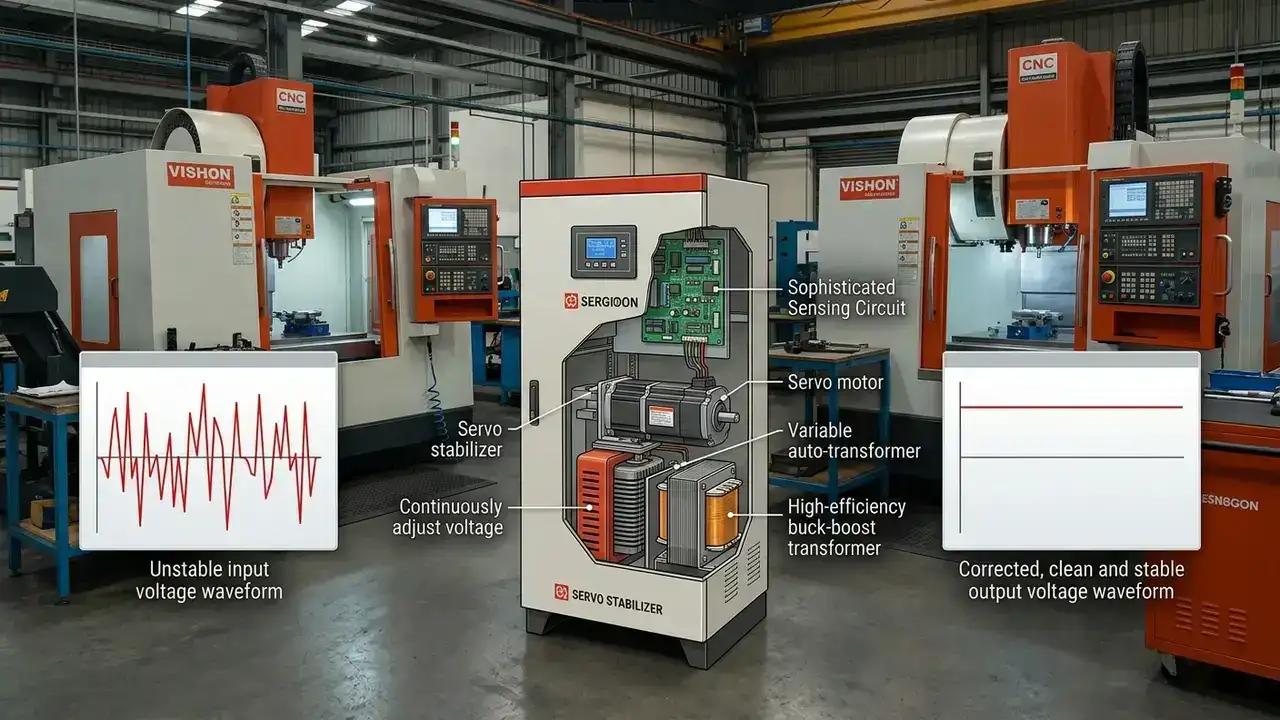
The operating principle involves four main components working together:
- Sensing circuit — Continuously monitors the incoming (input) voltage
- Control circuit — Compares the input against the desired output setpoint and calculates the required correction
- Servo motor — Drives a movable contact (carbon brush) along the windings of a variable autotransformer (variac)
- Buck-boost transformer — Adds or subtracts voltage to correct the output to the target level
When the input voltage fluctuates, the control circuit signals the servo motor to adjust its position. This changes the transformer winding ratio, which either boosts (increases) or bucks (decreases) the voltage to maintain a stable output — typically 380V, 400V, or 415V for three-phase CNC applications.
This entire correction happens automatically and continuously, without any operator intervention.
Key Technical Specifications
When evaluating a servo stabilizer for CNC use, these specifications matter most:
- Output accuracy — ±1–3% is standard; high-precision models achieve ±0.5%. YIY’s servo voltage stabilizers deliver ±0.5% output precision across their product range — among the tightest tolerances available from any manufacturer
- Input voltage range — Three-phase models typically cover 304V–456V (±20%). For severely unstable grids, YIY’s PWR-3 Series extends to 266V–494V (±30%), ensuring correction even under extreme voltage sag
- Correction speed — Response within 1–2 seconds for full correction. MCU-controlled models provide faster, more precise adjustments than basic analog controls
- Efficiency — 95–98% across the range (YIY PRO-3 and PWR-3 Series achieve 98%), meaning minimal energy waste
- Capacity range — From 1.5 kVA for a single small CNC router up to 3,000 kVA for entire factory floors — matching any CNC installation scale
- Overload capacity — 120%+ with MCU-controlled auto-cutoff (3-second response at 120% overload), critical for handling CNC startup surges
- Waveform distortion — Zero additional distortion to the output waveform
- Protection features — Over/under voltage trip, overload protection (MCB/MCCB/MCU), short circuit protection, phase reversal, phase loss prevention, surge protection, over-temperature protection, and fan failure auto-cutoff
Servo vs Static Stabilizers: Which Is Better for CNC?
This is one of the most common questions CNC operators ask. Both technologies have legitimate applications, but for most CNC environments, servo stabilizers hold a clear advantage. Here is how they compare:
Correction speed
- Servo: 10–50ms per volt correction (adequate for CNC load characteristics)
- Static: Under 3ms (faster, but the extra speed is rarely necessary for CNC motor loads)
Output accuracy
- Servo: ±0.5% to ±1%
- Static: ±0.5% to ±1% (similar precision levels)
Inrush current handling
- Servo: Excellent — handles 200% overload for 1–2 minutes, ideal for CNC motor startups
- Static: Limited — typically 150% for short durations, may struggle with heavy inrush loads
Maintenance
- Servo: Periodic brush inspection (every 6–12 months), brush replacement every 2–3 years. Brushless servo designs eliminate this requirement
- Static: Virtually maintenance-free (no moving parts)
Durability in industrial environments
- Servo: Proven ruggedness in dusty, hot, humid factory conditions
- Static: Sensitive power electronics may be less resilient in harsh industrial environments
Cost
- Servo: More cost-effective for equivalent capacity
- Static: Higher upfront cost, especially at larger capacities
Best for CNC? Servo stabilizers are the preferred choice for CNC applications because:
- CNC machines generate significant inrush current during startup (4–8× rated current), which servo stabilizers handle better
- CNC environments are inherently industrial — dust, heat, and vibration favor the ruggedized construction of servo units
- The correction speed of servo stabilizers (under 50ms) is more than sufficient for the load characteristics of CNC motors and drives
- Better cost-to-performance ratio at the 20–200+ kVA capacities typical for CNC installations
For a deeper dive into the underlying regulation technologies, see our detailed comparison of servo vs IGBT technology in voltage stabilizers.
Static stabilizers are a better choice when speed and silent operation are the primary requirements — for example, in medical imaging, data centers, or laboratory settings where CNC machines are not present.
For a broader overview of voltage stabilizer solutions for industrial equipment, including CNC, injection molding, and other heavy-duty applications, explore our dedicated solutions page.
How to Size a Servo Stabilizer for Your CNC Machine
Undersizing is the most common and costly mistake. A stabilizer rated too close to the CNC machine’s running load will trip on startup or fail prematurely under stress.
Step-by-Step Sizing Guide
Step 1: Determine your CNC machine’s power rating
Check the machine’s nameplate or technical documentation for its kVA rating. Common examples:
- Small CNC router: 5–10 kVA
- CNC lathe (e.g., Haas ST-20): 14–28 kVA (continuous to peak)
- CNC milling center (e.g., Haas VF-3): 14–20 kVA
- Large VMC / 5-axis CNC: 30–50 kVA
- CNC with hydraulic systems: 40–80 kVA
Step 2: Apply the inrush current multiplier
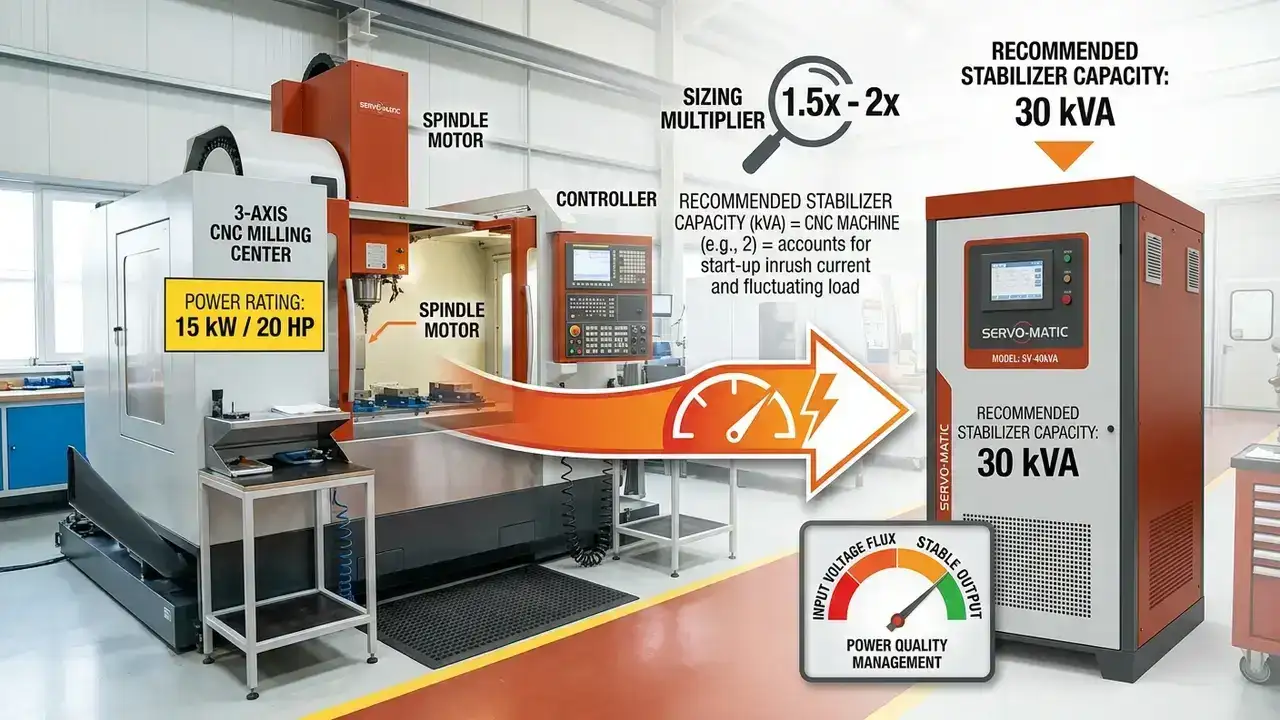
CNC machines draw 4–8× their rated current during startup. The standard sizing rule is:
> Stabilizer capacity = CNC rated power (kVA) × 1.5 to 2.0
For machines with particularly heavy startup loads (large spindle motors, hydraulic power packs), use the 2.0× multiplier.
Step 3: Account for multiple machines
If one stabilizer serves multiple CNC machines, calculate the total connected load and consider whether machines start simultaneously.
Step 4: Add safety margin and select standard size
Round up to the next standard kVA rating. YIY offers standard sizes across three servo product lines optimized for different CNC scenarios:
- PRO-3 Series (1.5–100 kVA) — MCU-controlled, ±2% precision, motor protection, colorful LED display. Ideal for individual CNC machines or small workshops
- PWR-3 Series (45–150 kVA) — Ultra-wide input range (±25% to ±30%), surge protection, 100% unbalanced loading capability. Best for CNC facilities with severe voltage fluctuations
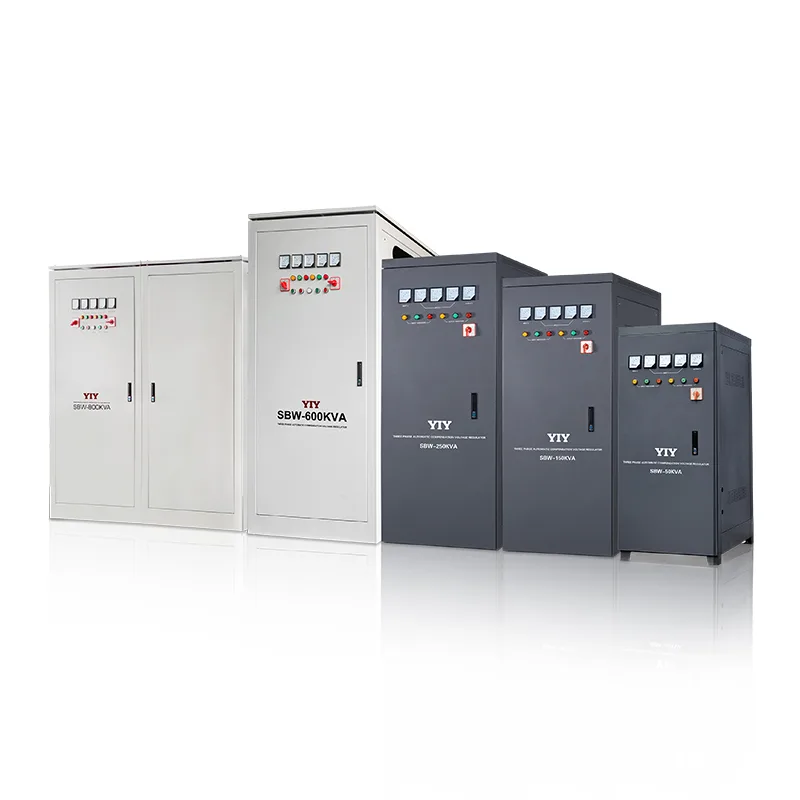
- SBW Series (30–3,000 kVA) — Industrial heavy-duty, available in air-cooled and oil-cooled configurations. Designed for large CNC production lines and multi-machine installations
Sizing Example
A workshop has a Haas VF-3 milling center (20 kVA peak) and a Haas ST-20 lathe (40 kVA peak):
- Total connected load: 20 + 40 = 60 kVA
- Apply 1.5× multiplier: 60 × 1.5 = 90 kVA
- Recommended: YIY SBW-100K (100 kVA, three-phase, ±2–3% precision, ≥96% efficiency, 304V–456V input range) — or YIY PWR-3-100K if the facility experiences severe voltage fluctuations requiring ±30% input coverage
For facilities with multiple CNC machines, consider a comprehensive selection approach that accounts for demand diversity and future expansion.
Key Features to Look For
Not all servo stabilizers are equal. When selecting one for CNC protection, prioritize these features:
Wide input voltage range — A range of at least ±25% (e.g., 280V–480V for 380V output) covers most industrial voltage fluctuation scenarios. Facilities in areas with severe grid instability should look for ±30% or wider.
High output accuracy — ±1% is the minimum for CNC applications. Premium models offering ±0.5% accuracy provide an extra margin of protection for high-precision machining operations.
Fast correction speed — Look for correction rates of 20–90V per second (equivalent to 10–50ms response time). This ensures voltage corrections keep pace with the fluctuation speed in industrial environments.
Comprehensive protection suite — Essential protections include:
- Over and under voltage trip
- Overload protection
- Short circuit protection (MCB/MCCB)
- Phase reversal protection
- Single-phase prevention
- Neutral failure protection
Digital monitoring — A digital display showing input voltage, output voltage, load percentage, and fault indicators enables real-time monitoring. Some advanced models include communication interfaces for integration with factory monitoring systems.
Bypass switch — A manual bypass allows the CNC machine to run directly from the mains during stabilizer maintenance, avoiding production shutdowns.
Cooling system — Air-cooled models suit most workshops. YIY’s PRO-3 Series covers 1.5–100 kVA air-cooled, while the SBW Series offers both air-cooled and oil-cooled configurations for capacities from 30 kVA up to 3,000 kVA. Oil-cooled models are preferred for capacities above 500 kVA or environments with ambient temperatures above 40°C.
Build quality and certification — Look for ISO 9001 certified manufacturing, CE marking, and compliance with IEC standards. Verify the manufacturer’s certifications and compliance standards against your industry requirements. YIY’s quality control process includes servo motor performance testing, carbon brush wear analysis, mechanical endurance cycling, and noise level measurement — ensuring every unit meets industrial reliability standards.
Installation Best Practices
Proper installation maximizes the effectiveness and lifespan of your servo stabilizer:
- Place the stabilizer between the main power supply and the CNC machine — It should be the first device the incoming power passes through before reaching the CNC
- Ensure adequate ventilation — Air-cooled models need clear space around all ventilation openings. Avoid enclosed cabinets without forced airflow
- Use appropriately sized cables — Undersized cables cause voltage drop and heat buildup. Size cables based on the stabilizer’s full rated current, not just the typical load
- Provide proper grounding — Connect the stabilizer’s ground terminal to the facility’s main grounding electrode system. Poor grounding increases sensitivity to electrical noise
- Install on a stable, level surface — Servo stabilizers contain precision mechanical components that perform best when properly leveled
- Maintain clearance for maintenance — Allow at least 0.5m clearance on all sides for inspection and servicing access
- Consider environmental conditions — For dusty workshops, opt for models with higher IP ratings (IP54 or above). For high-temperature environments, consider oil-cooled models
Frequently Asked Questions
What size servo stabilizer do I need for my CNC machine?
Multiply your CNC machine’s rated power (kVA) by 1.5 to 2.0 to determine the minimum stabilizer capacity. This accounts for the high inrush current during CNC startup, which can be 4–8× the normal running current. For example, a CNC machine rated at 20 kVA needs a 30–45 kVA servo stabilizer — such as the YIY PRO-3-45K (45 kVA, MCU-controlled, ±2% precision). When protecting multiple machines with a single stabilizer, add the individual kVA ratings together before applying the multiplier, then select from the SBW Series (30–3,000 kVA) for larger combined loads.
Can voltage fluctuations really damage my CNC machine?
Yes. Voltage fluctuations cause both immediate and cumulative damage. Immediate effects include controller malfunctions, emergency shutdowns, and corrupted machining operations. Long-term effects include premature wear on servo drives, VFDs, capacitors, and motor insulation. Studies indicate that equipment operating with voltage fluctuations exceeding ±10% experiences up to 50% reduction in operational lifespan. A servo stabilizer eliminates these risks by maintaining output voltage within ±0.5–1% of the target.
How often does a servo stabilizer need maintenance?
For traditional servo stabilizers with carbon brushes, inspect brushes every 6–12 months and plan for replacement every 2–3 years depending on operating hours and voltage fluctuation severity. General maintenance includes cleaning ventilation paths, checking terminal connections, and verifying output accuracy. Brushless servo designs and modern industrial stabilizers reduce maintenance requirements significantly. Oil-cooled models additionally require periodic oil level checks and oil replacement every 3–5 years.
Is a servo stabilizer better than a UPS for CNC machines?
They serve different purposes and are often used together. A servo stabilizer corrects ongoing voltage fluctuations (too high or too low voltage) to maintain consistent power quality. A UPS (Uninterruptible Power Supply) provides backup power during complete power outages. For CNC machines, a servo stabilizer is the primary protection against the most common and damaging power issue — voltage instability. A UPS adds protection against complete power loss but does not regulate voltage quality during normal operation.
What is the difference between air-cooled and oil-cooled servo stabilizers for CNC?
Air-cooled servo stabilizers use fans to dissipate heat and are suitable for most workshop environments up to about 100 kVA capacity. They are more compact and easier to maintain. Oil-cooled servo stabilizers use transformer oil for heat dissipation and are preferred for higher capacities (100 kVA and above), continuous heavy-duty operation, or environments with ambient temperatures exceeding 40°C. Oil-cooled units are quieter and more durable in demanding conditions but require periodic oil maintenance.
Protecting your CNC machines from voltage fluctuations is not an optional expense — it is an investment in precision, productivity, and equipment longevity. A properly sized servo stabilizer ensures your CNC machines deliver consistent, high-quality output regardless of power grid conditions.
Need help with general capacity sizing? For CNC machines under 25 KVA, see the Three-Phase Guide (10–25 KVA). For larger CNC production lines over 200 KVA, see the Industrial Guide (200–500 KVA).
Machine-Cell Notes: What CNC Buyers Should Freeze Before Quoting
CNC buyers often focus on spindle power and ignore the rest of the electrical brief. In practice, the stabilizer choice depends just as much on servo-drive sensitivity, the machine control brand, startup behavior, and whether the project protects one machine, one workshop panel, or an entire machining department.
- Single-machine or compact workshop projects: stay with this CNC guide and lock the machine-level protection logic first.
- Shared workshop panels: if multiple CNC machines and auxiliaries are being grouped together, compare against the 10-25 KVA guide before freezing the final rating.
- Department or plant-scale machining halls: if the stabilizer is effectively protecting a feeder rather than a machine, escalate to the 200-500 KVA industrial guide.
- Application-page checkpoint: buyers who need a faster commercial summary before the full article can cross-check the CNC solution page and then return here for machine-level sizing.
The most useful CNC quote is the one that distinguishes machine protection from feeder protection. When those two are mixed together, the shortlist usually drifts toward the wrong model family.