Sustained undervoltage makes motors run hotter and less efficiently and shortens equipment life. For industrial facilities operating heavy machinery, production lines, or critical infrastructure at the 500 kVA capacity level, selecting the right voltage stabilizer technology—servo, relay, or IGBT—directly impacts operational reliability and total cost of ownership.
This guide walks plant engineers and procurement teams through the technical decision framework for specifying a 500 kVA three-phase automatic voltage regulator (AVR).
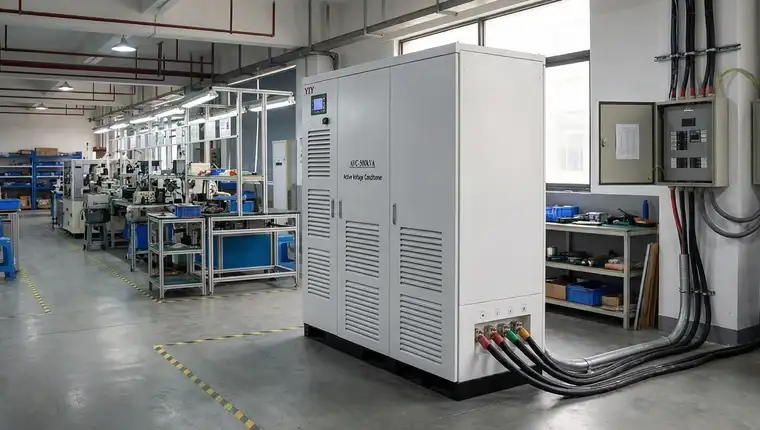
For teams comparing 500 kVA sizing where millisecond voltage correction matters across heavy machinery, production lines, and critical infrastructure, review this active voltage conditioner for fast three-phase voltage compensation without moving correction parts in the main power path.
Facilities comparing 500 kVA sizing for heavy machinery, production lines, and critical infrastructure can review this three-phase servo voltage stabilizer for MCU-controlled regulation and <=2% output precision.
Understanding 500 kVA Voltage Stabilizer Requirements
A 500 kVA voltage stabilizer is an industrial-grade automatic voltage regulator designed for three-phase power systems, typically operating at 380-400V. These units maintain constant output voltage despite input fluctuations ranging from ±20% to ±30%, protecting sensitive equipment from voltage sags, surges, and phase imbalances common in utility grids.
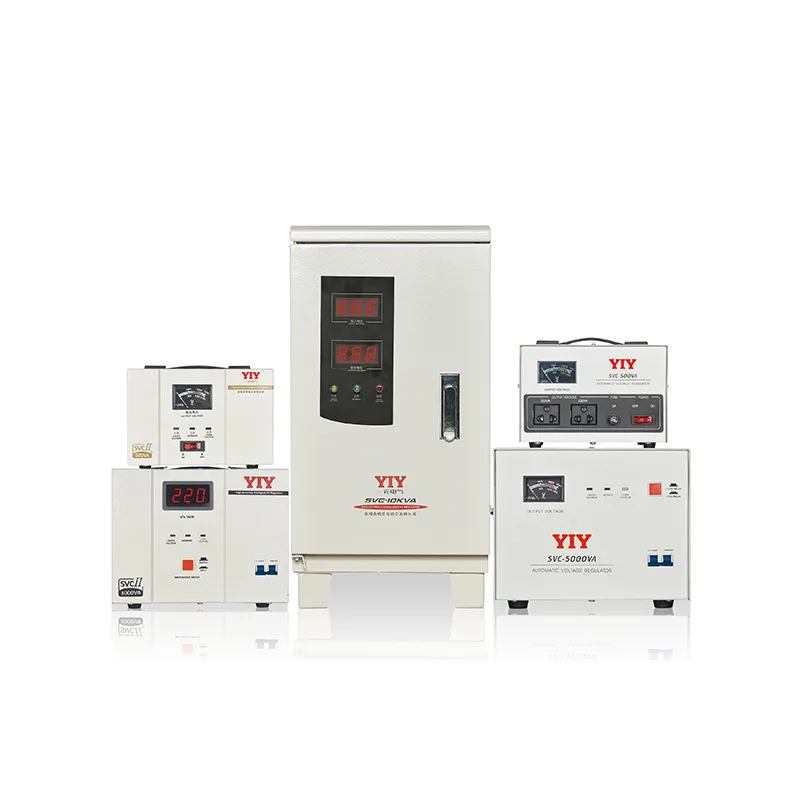
The large-capacity voltage stabilizer range covers SBW and SBW-F IP54 servo cabinets and AVC conditioners, with input window and bypass ratings per model.
The 500 kVA capacity threshold represents a critical decision point. Facilities at this scale—manufacturing plants, data centers, hospital complexes, or large commercial buildings—face distinct challenges. Input voltage instability can trigger production downtime, damage precision machinery, or compromise critical loads. A properly sized stabilizer acts as the first line of defense, but the technology choice (servo, relay, or IGBT) determines precision, response time, and long-term reliability.
Three-phase systems at 500 kVA typically serve mixed loads: inductive motors with high starting currents, resistive heating elements, and capacitive power supplies. Each load type responds differently to voltage variations. Motors lose torque and overheat under low voltage. Electronic equipment malfunctions or fails when voltage exceeds tolerance. The stabilizer must handle both steady-state regulation and transient response during load switching.
Who Needs This and What They Need to Decide
Industrial engineers face a three-part decision: technology type, sizing margin, and compliance requirements. Facility managers prioritize uptime and maintenance costs. Procurement teams balance initial investment against total cost of ownership. All three stakeholders need a common framework to evaluate 500 kVA voltage stabilizer options.
The core decision revolves around precision versus cost. Servo stabilizers offer ±0.5-3% output accuracy with 1-2 second response times, making them the industrial standard for general manufacturing. Relay stabilizers provide ±5-8% accuracy with 20-40ms response but at lower cost, suitable for less sensitive loads. IGBT stabilizers deliver ±0.5% precision with sub-20ms response, essential for medical equipment, semiconductor fabrication, or precision instrumentation.
Application context determines technology fit. A textile mill with motor-driven looms tolerates ±5% voltage variation, making relay technology cost-effective. A pharmaceutical facility with automated filling lines requires ±2% precision to maintain process control, pointing toward servo technology. A hospital operating room with life-support systems demands ±0.5% regulation and galvanic isolation, necessitating IGBT technology despite higher cost.
Competitor analysis reveals market positioning. Regional suppliers like Servomax focus on India-specific voltage ranges (160-270V single-phase) without IGBT options or global certification. TSI Power emphasizes outdoor telecom applications with IP54 enclosures. Generic Alibaba vendors offer low-cost relay units but lack ISO 9001 quality systems or IEC compliance documentation. YIY differentiates through full technology range (servo, relay, IGBT), 0.5-3000 kVA capacity spectrum, and deployment across 130+ countries with CE, ISO 9001:2015, and ISO 14001 certifications.
In procurement terms, that means Servomax remains India-focused, TSI Power is strongest in outdoor telecom environments, and many Alibaba-style vendors still lack the certification depth, engineering support, and OEM delivery discipline that industrial buyers expect. YIY’s advantage is broader industrial fit, IGBT precision options, a documented engineering team, OEM support, and real project coverage across 130+ countries.
Standards, Compliance, and Proof Points
IEC 60038 defines standard voltage levels and tolerance limits for three-phase systems. For 400V nominal voltage, the standard specifies ±10% input tolerance (360-440V) as the normal operating range. Voltage stabilizers must maintain output within ±2% (392-408V) under this input variation. Beyond ±10% input, the stabilizer should trigger alarms and, if equipped, bypass mode to prevent damage.
IEC 61000-4-30 establishes power quality measurement methods. Class A instruments measure voltage with 0.1% accuracy over 10-minute intervals. This standard matters when verifying stabilizer performance claims. A manufacturer stating “±1% output accuracy” must demonstrate compliance through Class A measurement under defined load and input conditions.
Sizing methodology follows a conservative approach. Calculate total connected load in kW, convert to kVA using power factor (typically 0.8 for industrial loads), then add 20-30% safety margin. For example, a 400 kW load at 0.8 power factor equals 500 kVA. Adding 25% margin yields 625 kVA recommended capacity. This margin accounts for motor starting currents (5-7× rated current), future expansion, and derating at elevated ambient temperatures.
Load calculation requires detailed equipment inventory. List each motor, transformer, and power supply with rated power and starting current. Sum the continuous loads and the largest motor starting current. If total exceeds stabilizer capacity, either upsize the unit or implement soft-start controls on large motors. Undersizing leads to voltage droop during startup, defeating the stabilizer’s purpose.
Testing and verification protocols matter for procurement. Request factory acceptance test (FAT) reports showing input voltage sweep from -20% to +20% with output voltage recorded at 10% intervals. Load test at 100%, 75%, 50%, and 25% capacity. Measure response time by applying a 10% input step change and recording time to reach ±1% of final output. These tests validate manufacturer claims before shipment.
YIY Capabilities, Product Fit, and Implementation Guidance
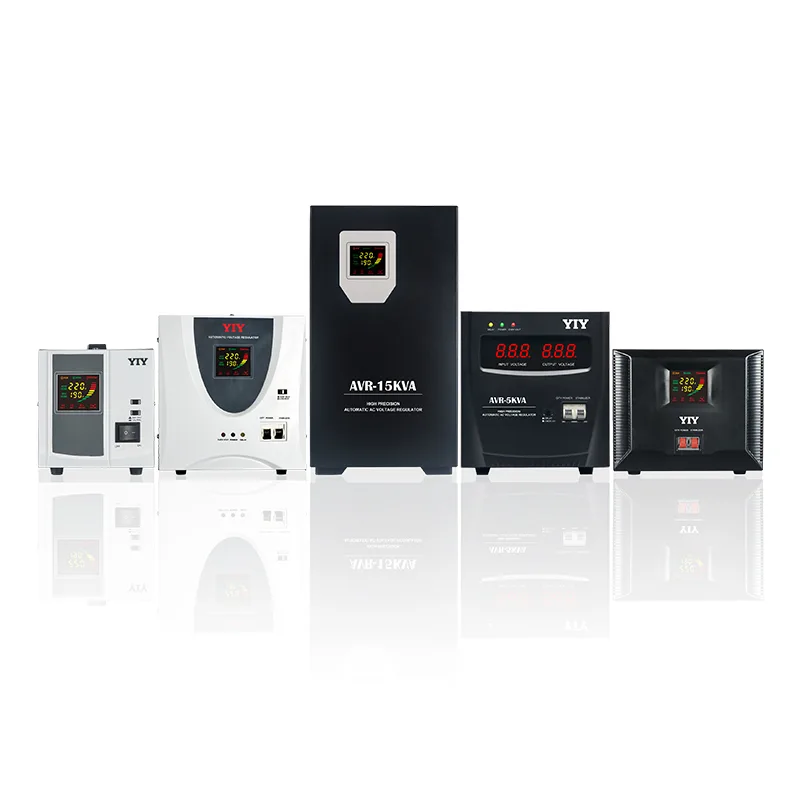
YIY manufactures voltage stabilizers from 0.5 kVA to 3000 kVA across three technology platforms. Servo stabilizers use motor-driven autotransformers with microcontroller-based control, achieving ±0.5-3% output accuracy and 1-2 second response. Relay stabilizers employ electromagnetic contactors switching transformer taps, delivering ±5-8% accuracy with 20-40ms response. IGBT stabilizers utilize pulse-width modulation (PWM) with galvanic isolation, providing ±0.5% accuracy and sub-20ms response.
For 500 kVA applications, YIY’s servo stabilizer line offers the optimal balance of precision, reliability, and cost. The SBW-500 model handles 380V ±20% input (304-456V) and maintains 380V ±2% output (372-388V) under full load. Three-phase independent regulation compensates for phase imbalance up to 10%. Overload capacity reaches 150% for 60 seconds, accommodating motor starting transients. Efficiency exceeds 98% at rated load, minimizing heat generation and energy waste.
Installation guidance addresses common deployment scenarios. Wall-mounted units suit indoor electrical rooms with controlled ambient temperature (0-40°C). Floor-standing cabinets with IP21 or IP23 enclosures work for semi-outdoor locations. Oil-cooled models extend operation to 50°C ambient for tropical climates or poorly ventilated spaces. Bypass switches enable maintenance without system shutdown, critical for 24/7 operations.
Integration with existing infrastructure requires attention to upstream and downstream protection. Install a circuit breaker rated 1.25× stabilizer input current upstream. Add surge protection devices (SPD) if lightning exposure exists. Downstream, coordinate motor starter overload settings with stabilizer output characteristics. Verify that existing cables handle stabilizer output current without voltage drop exceeding 2%.
YIY’s engineering team provides load analysis and sizing verification. Submit equipment list with rated power, starting current, and duty cycle. Engineers calculate total demand, recommend stabilizer capacity, and specify configuration (wall-mount, floor-standing, oil-cooled). This service eliminates guesswork and ensures first-time-right specification.
Selection Criteria and Sizing Considerations
Technology selection follows a decision tree. Start with precision requirements. If equipment tolerates ±5% voltage variation, relay technology suffices. If ±2-3% precision is needed, servo technology applies. If ±0.5% regulation or galvanic isolation is mandatory, IGBT technology is required.
Response time matters for dynamic loads. Relay stabilizers react in 20-40ms, fast enough for most industrial motors. Servo stabilizers take 1-2 seconds, acceptable for steady-state loads but inadequate for rapid load changes. IGBT stabilizers respond in under 20ms, essential for power supplies with active power factor correction or variable frequency drives (VFDs) that react to voltage transients.
Environmental factors influence technology choice. Servo stabilizers with motor-driven mechanisms require clean, dry environments. Dust, humidity, or corrosive atmospheres degrade carbon brushes and slip rings. Relay stabilizers tolerate harsher conditions but generate electromagnetic interference (EMI) during switching. IGBT stabilizers operate in extreme environments but require forced cooling and EMI filtering.
Total cost of ownership (TCO) extends beyond purchase price. Servo stabilizers cost 1.5-2× relay units but offer 10-15 year lifespan with annual brush replacement. Relay stabilizers cost less initially but require contactor replacement every 3-5 years. IGBT stabilizers cost 2-3× servo units but eliminate mechanical wear, reducing maintenance to fan and capacitor replacement every 5-7 years.
Capacity sizing revisited: the 20-30% margin rule applies to continuous loads. For intermittent high-power loads (welders, X-ray machines, motor starts), calculate duty cycle. A 100 kW welder operating 30% duty cycle contributes 30 kW to continuous load but requires 100 kW instantaneous capacity. Size the stabilizer for peak demand, not average demand, to prevent voltage droop during high-power events.
Phase balance considerations matter for three-phase systems. If single-phase loads create imbalance exceeding 10%, specify independent phase regulation. YIY’s servo and IGBT stabilizers regulate each phase separately, compensating for unequal loading. Relay stabilizers typically regulate all phases together, limiting effectiveness under imbalanced conditions.
Input voltage range determines stabilizer capability. Standard models handle ±20% input variation (320-480V for 400V nominal). Wide-range models extend to ±30% (280-520V) for grids with severe instability. Ultra-wide-range models reach ±40% (240-560V) for remote locations or generator-fed systems. Wider range increases cost and size; specify based on actual grid conditions, not worst-case scenarios.
Sizing and Technology Comparison at 500 kVA
How should a 500 kVA voltage stabilizer be sized or specified?
Size by calculating total load in kW, dividing by power factor (0.8 typical), and adding 25% margin. For 400 kW load: 400 ÷ 0.8 = 500 kVA, plus 25% = 625 kVA recommended. Specify technology (servo for ±2% precision, relay for ±5%, IGBT for ±0.5%), input voltage range (measure actual grid), and enclosure (IP21 indoor, IP23 semi-outdoor, oil-cooled for high ambient). Request FAT reports and compliance certificates.
What are the key differences between servo, relay, and IGBT stabilizers at 500 kVA?
| Feature | Servo | Relay | IGBT |
|---|---|---|---|
| Output Accuracy | ±0.5-3% | ±5-8% | ±0.5% |
| Response Time | 1-2 seconds | 20-40ms | <20ms |
| Efficiency | 97-98% | 98-99% | 96-97% |
| Lifespan | 10-15 years | 8-12 years | 15-20 years |
| Maintenance | Annual brush replacement | Contactor replacement 3-5 years | Fan/capacitor 5-7 years |
| Relative Cost | 1.5-2× relay | Baseline | 2-3× servo |
| Best Application | General industrial | Cost-sensitive, less critical | Precision, medical, critical |
Frequently Asked Questions
What Should Buyers Evaluate Before Choosing a 500 kVA Voltage Stabilizer?
Evaluate four factors: load characteristics (motor-heavy, electronic, mixed), input voltage range (measure actual grid variation over 7 days), precision requirements (equipment voltage tolerance), and environmental conditions (temperature, humidity, dust). Request manufacturer data sheets showing input/output curves, efficiency at partial load, and overload capacity. Verify compliance with IEC 60038 and local electrical codes.
When Is a 500 kVA Voltage Stabilizer Necessary?
A 500 kVA stabilizer becomes necessary when total connected load exceeds 400 kW (at 0.8 power factor) and input voltage varies beyond equipment tolerance. Symptoms include motor overheating, frequent equipment trips, flickering lights, or premature component failure. Log input voltage over a full production cycle; if the swing regularly falls outside what the equipment tolerates and it has no built-in regulation, a stabilizer is justified.
What Is the Voltage of 500 kVA?
500 kVA refers to capacity (apparent power), not voltage. A 500 kVA stabilizer typically operates at standard three-phase voltages: 380V, 400V, or 415V depending on regional grid standards. The kVA rating indicates the maximum load the stabilizer can handle. For example, a 500 kVA unit at 400V three-phase can supply approximately 722A (500,000 VA ÷ (400V × √3)). Voltage and capacity are independent specifications—always verify both when sizing equipment.
What Documentation Should Accompany a 500 kVA Stabilizer Purchase?
Request factory acceptance test (FAT) reports, IEC 60038 compliance certificate, ISO 9001 quality system certificate, CE marking (for EU export), electrical schematic, installation manual, and maintenance schedule. For critical applications, request third-party test reports from accredited labs. Confirm the warranty period in writing and check spare parts availability.
How Does YIY Support 500 kVA Stabilizer Deployment?
YIY provides pre-sales load analysis, sizing verification, and technology recommendation based on submitted equipment lists. Post-sales support includes installation supervision, commissioning assistance, and operator training. Technical questions can go to the engineering team by email (yiyen at yiyen.com) or WhatsApp (+86 13587452904), and spare parts lead times are confirmed in the quotation.
Next Steps
Offer a sizing review with YIY based on load list, starting current, input-voltage window, and installation conditions. Our engineering team will recommend stabilizer capacity, technology type, and configuration within 24 hours.
Contact YIY to discuss your specific application. Whether you need servo precision for manufacturing, relay economy for commercial buildings, or IGBT performance for critical infrastructure, our 16+ years of experience across 130+ countries ensures a solution that fits your load, budget, and timeline.
—
About YIY
Zhejiang Yiyen Holding Group Co., Ltd. (YIY) is a professional voltage stabilizer manufacturer with 16+ years of experience in power quality solutions. With a 30,000㎡ modern manufacturing facility and an annual production capacity of 1,000,000+ units, our products are exported to 130+ countries worldwide.
Our product range spans 0.5 kVA to 3000 kVA across servo, relay, and IGBT technologies. We hold ISO 9001:2015 quality management certification, ISO 14001 environmental management certification, and CE marking for European markets. Our engineering team provides technical support from initial sizing through commissioning and ongoing maintenance.
YIY serves diverse industries: manufacturing, healthcare, telecommunications, data centers, commercial buildings, and infrastructure projects. Our commitment to precision engineering and reliable voltage protection has made us a trusted partner for plant engineers, facility managers, and procurement teams globally.
Contact Us
📧 Email: yiyen at yiyen.com
📞 Phone/WhatsApp: +86 13587452904
🌐 Website: https://www.yiyavr.com/