Picking a 300 kVA stabilizer for an industrial facility is not a catalog decision. The wrong capacity margin leaves CNC machines and production lines exposed to voltage sags and brownouts. The wrong technology — Servo, Relay, or IGBT — can mean premature failure or unnecessary cost. And an input range that doesn’t match your utility’s actual behavior will stress the unit from day one.
This guide covers the comparisons that matter before you commit to a specification: how load profile and starting current affect sizing, which technology type fits standard industrial versus mission-critical environments, what compliance certifications to verify, and how to evaluate a manufacturer’s real capabilities against your project conditions. By the end, you’ll have a structured framework to convert site data into a defensible purchase decision.
What 300 kVA Stabilizer Means and When It Matters
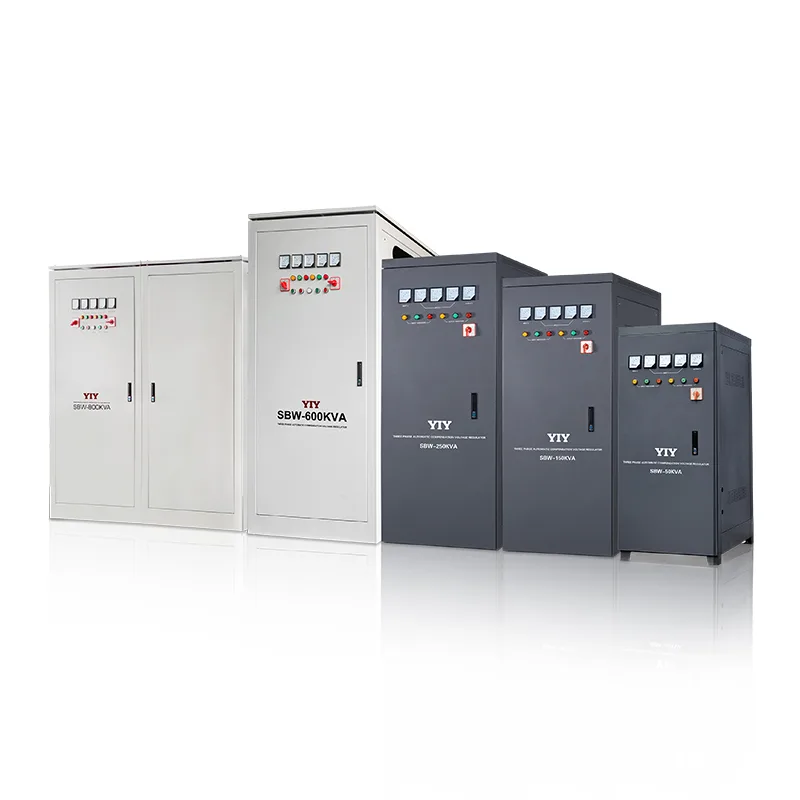
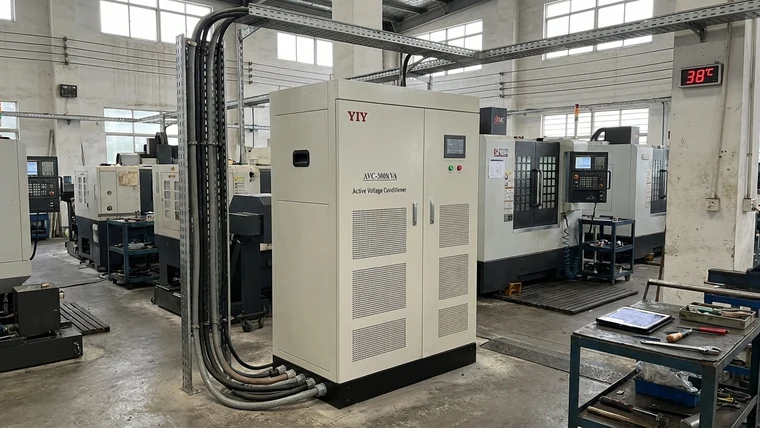
A 300 kVA stabilizer is a high-capacity three-phase automatic voltage regulator (AVR) built for industrial-grade applications. Its core function: maintain stable output voltage regardless of what the utility grid delivers — whether that’s sags, surges, spikes, or sustained brownouts.
For 300kVA projects, the large-capacity three-phase stabilizers page lists SBW and SBW-F ratings, input windows and shipping dimensions.
The capacity in practical terms
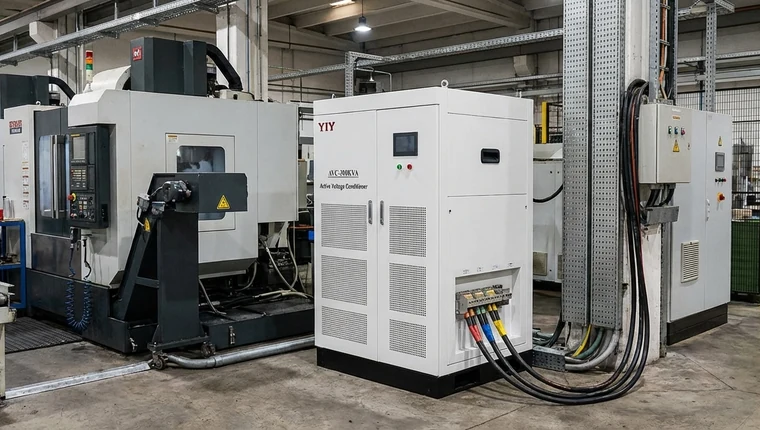
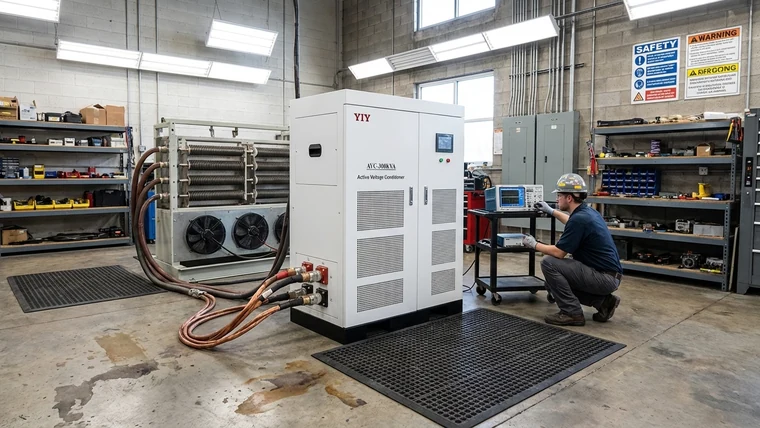
300 kVA translates to roughly 240–300 kW of usable load capacity at a typical 0.8 power factor. That positions it squarely in the medium-to-large industrial bracket — large enough to protect a full CNC machining line, a multi-elevator building system, or a production floor running several high-inertia motors simultaneously. At this scale, voltage instability isn’t a nuisance; it causes tool offsets, PLC faults, motor winding damage, and unplanned downtime.
When this capacity is the right specification
300 kVA becomes the right specification when your total connected load — after applying a 20–30% safety margin — lands in the 230–270 kW range. A typical calculation: sum all equipment nameplate loads, multiply by 1.25, and select the next standard capacity tier above the result. Facilities running CNC machining centers, injection molding machines, heavy presses, or large HVAC compressors often arrive at this tier.
What separates serious suppliers at this scale
Not all manufacturers offer meaningful choice at 300 kVA. Most regional suppliers stock servo-only or relay-only units, limiting how well the technology matches the application. YIY’s product range spans 0.5 kVA to 3,000 kVA and includes Servo, Relay, and IGBT technologies across that entire range — giving buyers the option to match precision class and correction speed to actual site conditions. If your load margin pushes capacity requirements higher, the same technology decision applies at adjacent tiers such as the 500 Kva Voltage Stabilizer Guide500 kVA voltage stabilizer. That breadth, combined with ISO 9001:2015 certification and supply reach into 130+ countries, makes YIY a practical option for both direct procurement and OEM/ODM project needs.
Who Needs This and What They Need to Decide
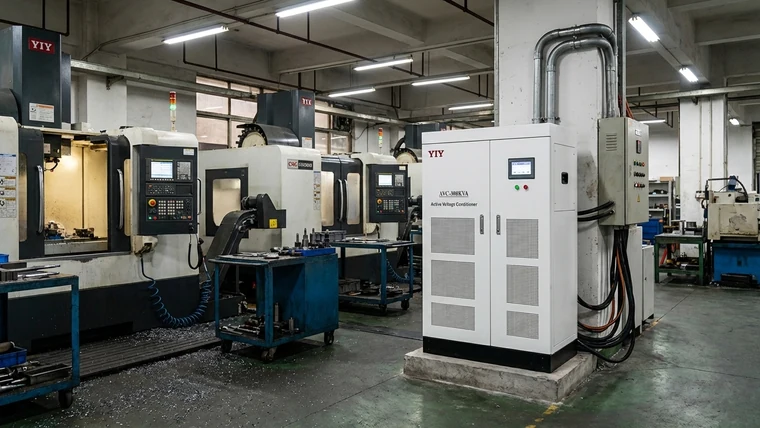
The buyers evaluating a 300 kVA stabilizer are not browsing a product catalog — they’re solving a real engineering problem under procurement pressure. The core audience: industrial engineers, procurement managers, and facility operators in manufacturing, mining, and heavy infrastructure who need to protect CNC machines, production lines, elevators, and high-inertia motors from voltage instability. For a broader orientation on how industrial selection criteria are structured across capacity tiers, the Voltage Stabilizer Industrial Technical Guideindustrial voltage stabilizer technical guide covers the full framework.
The buying job
The decision isn’t simply “which stabilizer.” It’s a compound specification exercise: confirm the load profile, verify the input-voltage window matches your utility’s actual behavior, choose the right correction technology, and then validate the supplier can deliver, certify, and support at this scale. Each of these is a distinct choice that can cascade into a bad outcome if rushed.
Where supplier choice actually diverges
Most regional suppliers offer servo-only or AVR-only units and ship to domestic markets. Servomax, for instance, focuses on India and does not offer IGBT technology or OEM/ODM services — which limits flexibility for international projects or panel builders who need branded product integration.
YIY covers a different scope. The full range runs 500 VA to 3,000 kVA across Servo, Relay, and IGBT technologies, exported to 130+ countries. That technology breadth matters: Servo suits standard industrial loads, while IGBT is the right call for mission-critical applications requiring ±0.5% output precision and 10 ms correction speed. For EPC teams and panel builders sourcing at volume, YIY’s OEM/ODM capability — absent in most competitors — means specifications can be customized before manufacturing rather than patched after delivery.
Standards, Compliance, and Proof Points
Buying a 300 kVA voltage stabilizer without checking compliance creates downstream risk — equipment warranties can be voided, customs clearance can fail, and insurance claims can be denied when the unit doesn’t meet the electrical standards of the installation country.
Mandatory requirements
| Standard | Requirement | Applicability | How to Verify |
|---|---|---|---|
| CE Marking | EMC + Low Voltage Directive | EU and EU-aligned markets | Supplier CE declaration of conformity |
| HomepageIEC 60038 | Nominal voltages, ±10% input tolerance | All international installations | Check unit input range spec against IEC 60038 table |
| HomepageIEC 61000 | Electromagnetic compatibility (EMC) | Facilities with CNC, PLC, or shared grid | Request EMC test report from supplier |
| ISO 9001:2015 | Quality management for manufacturing | All procurement | Request scoped certificate (stabilizer design + production) |
| ISO 14001 | Environmental management | ESG-sensitive procurement | Request certificate |
CE marking is required for any unit destined for the European Union or markets that follow EU directives. It confirms electromagnetic compatibility and low-voltage directive compliance — two criteria that industrial buyers in regulated markets cannot waive.
IEC 60038 sets the reference for nominal voltages with ±10% input variation as the standard operating envelope for industrial supply. Units that advertise a wider input window (±20% or custom) cost more but eliminate the risk of the stabilizer dropping out during sustained brownouts.
IEC 61000 governs electromagnetic compatibility. A 300 kVA stabilizer without EMC compliance can introduce harmonic disturbances into shared grid infrastructure — a real concern in facilities running sensitive CNC or PLC-controlled equipment alongside the stabilizer.
Quality system certification
ISO 9001:2015 is the baseline quality management standard for manufacturing. When a supplier holds this certification for stabilizer design, production, and service — not just general operations — it means the production process is auditable and consistent. YIY’s ISO 9001:2015 certification covers stabilizer design and manufacturing specifically, not as a blanket corporate credential. ISO 14001 environmental certification rounds out the compliance picture for buyers in ESG-sensitive procurement environments.
YIY Capabilities, Product Fit, and Implementation Guidance
YIY’s manufacturing footprint is built for projects at this scale. With a 30,000 m² production facility and annual output exceeding 1,000,000 units, the capacity to fulfill large industrial orders — including those requiring simultaneous delivery of multiple 300 kVA units — is not a constraint. The 16+ years of stabilizer-specific manufacturing experience translates directly to consistent quality at this power class, backed by ISO 9001:2015 certification scoped to stabilizer design, production, and service.
Technology match by application type
Where most regional competitors stock servo-only lines, YIY’s product range spans Servo, Relay, and IGBT technologies from 500 VA to 3,000 kVA — all accessible at the 300 kVA tier. A standard industrial environment running CNC machines, injection molding equipment, or HVAC compressors can be matched to a 200 Kva Servo Stabilizer Price Guide300 KVA servo stabilizer for the best cost-precision balance. Facilities with tighter tolerances — medical equipment rooms, precision lab environments, or data-adjacent infrastructure — can specify an IGBT unit delivering ±0.5% output accuracy and 10 ms correction response without switching suppliers.
OEM/ODM for panel builders and EPC teams
For panel builders integrating stabilizers into switchgear assemblies, or EPC teams sourcing under a branded project specification, YIY supports full OEM/ODM customization before manufacturing — not as a retrofit. This eliminates the post-delivery engineering work that generic catalog suppliers require. Combined with export reach into 130+ countries, this makes YIY a viable single-source option for projects spanning multiple geographies or requiring consistent branded product across installations.
What to send for a sizing review
To get an accurate product recommendation, prepare your load list with starting current data, the utility’s measured input-voltage range (not nominal), and installation environment details (indoor/outdoor, ambient temperature, altitude). These four inputs determine whether a Servo or IGBT unit is appropriate and whether any derating applies to your 300 kVA specification.
Selection Criteria and Sizing Considerations
Use these four checkpoints to convert site data into a defensible specification for any 3 phase 300 kVA AVR purchase.
Checkpoint 1: Load calculation and capacity margin
Start with your actual connected load, not the nameplate rating of the stabilizer. Sum all equipment loads, multiply by 1.25–1.3, then select the next standard capacity tier.
| Equipment | Rated Load (kW) | Starting Current Multiplier | Adjusted Load (kW) |
|---|---|---|---|
| CNC machining center (×3) | 45 | 4–6× at startup | 56 peak |
| Injection molding machine | 55 | 3–4× at startup | 68 peak |
| HVAC compressor | 40 | 3× at startup | 48 peak |
| Auxiliary (lighting, controls) | 20 | 1× | 20 |
| Subtotal | 160 | — | — |
| +25% margin | 200 kW | — | — |
| Selected tier | 300 kVA | — | ~240 kW at 0.8 PF |
For facilities running Servo Stabilizer For Cnc Machinesservo stabilizer for CNC machines, high-inertia motor starting current peaks — typically 3–6× nameplate — are the primary sizing driver. Confirm that transient peaks don’t exceed the unit’s rated short-term overload capacity before locking your specification.
Checkpoint 2: Input voltage window
Measure your utility’s actual input range over a full week — not just the nominal value. A 3 phase 300 kVA AVR must handle your real voltage floor and ceiling, not an assumed ±10% band. Units with a wider input window (±20% or custom) cost more but eliminate the risk of the stabilizer dropping out during sustained brownouts. If your utility data shows input variation beyond ±15%, flag this explicitly in your RFQ.
Checkpoint 3: Technology match to load sensitivity
The right technology depends on load sensitivity, not cost alone. For a complete Stabilizer Voltage Regulator ComparisonRelay vs Servo vs IGBT comparison across all three technology types, the full guide covers decision logic by application. For the 300 kVA tier, the core trade-off is Servo versus IGBT:
| Criterion | Servo Stabilizer | IGBT Stabilizer |
|---|---|---|
| Output voltage precision | ±1–2% | ±0.5% |
| Correction speed | 10–50 ms (motor speed-dependent) | 10 ms or faster |
| Best application | CNC, injection molding, HVAC, general industrial | Medical equipment, precision instruments, data-adjacent |
| Harmonic distortion | Low (motor-driven correction) | Very low (PWM/DSP topology) |
| Cost tier | Moderate | Higher |
| Maintenance | Motor brushes require periodic service | Solid-state, lower mechanical maintenance |
| Suitability for 300 kVA | ✓ Standard choice | ✓ Mission-critical loads only |
Servo suits most standard industrial 300 kVA voltage regulator applications where ±1–2% output precision is acceptable. For applications protecting medical equipment, precision instrumentation, or data-adjacent infrastructure, IGBT is the correct specification: ±0.5% output accuracy and 10 ms correction response are not marketing figures — they are the actual threshold between adequate and inadequate protection at this scale.
Checkpoint 4: Environment and installation constraints
Ambient temperature above 40°C or installation altitude above 1,000 m both require derating — check the manufacturer’s derating curve before finalizing capacity. Indoor versus outdoor installation determines enclosure rating (IP class). Air-cooled units are standard for most factory floors; forced-air or oil-cooled configurations apply to higher ambient or enclosed panel environments.
Common Questions, Next Steps, and CTA
What’s still missing from the evidence
No direct YIY 300 kVA product spec sheet was available during research — which means exact input voltage range, cooling configuration (air-cooled vs. forced-air), and efficiency curve data should be confirmed directly with the engineering team before finalizing your specification. The framework and technology-match logic in this article reflects confirmed general specifications; unit-level data requires a quote request.
Specific 300 kVA deployment case studies are also absent from the public record. If your project requires application references — e.g., a CNC machining facility running 12 axes simultaneously, or a multi-building HVAC plant at altitude — ask YIY’s team directly. Case data at this capacity tier tends to live in pre-sales documentation, not product pages.
What to do next
If you’ve worked through the sizing checkpoints in this guide and your load calculation confirms a 300 kVA tier, the right next step is a sizing review — not a catalog lookup. Share your load list with starting current data, your utility’s measured input-voltage range, and installation environment details (ambient temperature, altitude, enclosure type).
YIY’s engineering team can confirm whether a Servo or IGBT unit fits your site, whether any derating applies, and whether OEM/ODM customization is relevant to your project scope. Contact them directly at yiyen at yiyen.com or via yiyavr.com to request a sizing review.
Frequently Asked Questions
What should buyers evaluate before choosing a 300 kVA stabilizer?
Four criteria matter most: load profile (sum all nameplate loads and account for motor starting current peaks), input voltage window (measure actual utility behavior over at least one week — not just the nominal value), technology fit (Servo for standard industrial loads, IGBT for mission-critical precision), and site conditions (ambient temperature above 40°C or altitude above 1,000 m both require derating). Compliance certifications — CE marking, IEC 61000 EMC, and ISO 9001:2015 scoped to stabilizer manufacturing — should be verified before shortlisting any supplier.
When is a 300 kVA stabilizer necessary?
A 300 kVA unit is the right specification when your total active load — after applying a 20–30% safety margin — lands in the 230–270 kW range. Facilities running CNC machining centers, injection molding machines, heavy presses, or large HVAC compressors typically arrive at this tier. At this scale, voltage instability doesn’t just cause nuisance trips; it produces tool offsets, PLC faults, and motor winding damage that translate directly into unplanned downtime.
How should a 300 kVA stabilizer be sized or specified?
Sum all equipment nameplate loads, multiply by 1.25 to 1.3, then select the next standard capacity tier above the result. Confirm that high-inertia motor starting peaks don’t exceed the unit’s transient rating. Lock down the input voltage range from measured site data, choose Servo or IGBT based on load sensitivity, and verify derating requirements for your installation environment before submitting an RFQ.
Servo or IGBT — which is right for a 300 kVA application?
Servo is the standard choice for most industrial environments: CNC machines, injection molding, HVAC compressors, and general production equipment where ±1–2% output precision is sufficient. IGBT is warranted when load sensitivity demands ±0.5% output accuracy and sub-10 ms correction — typically medical, laboratory, or data-adjacent environments. The cost delta is real; don’t over-specify unless the application genuinely requires it.
Final Thoughts
Buying a 300 kVA stabilizer is a specification exercise, not a product search. The decision comes down to four variables: confirmed load with starting current peaks, measured input voltage range from your actual utility, the right technology match (Servo for standard industrial, IGBT for mission-critical precision), and site conditions that may require derating. Get these four inputs right, and the unit selection becomes straightforward. Skip any of them, and you’re guessing at a scale where mistakes are expensive.
Compliance — CE marking, IEC 61000 EMC, ISO 9001:2015 scoped to stabilizer manufacturing — is not optional for cross-border procurement. Verify it before shortlisting.
If your load calculation lands in the 230–270 kW range, submit a sizing review request to YIY’s engineering team with your load list, starting current data, input-voltage window, and installation conditions.
About YIY
Zhejiang Yiyen Holding Group Co., Ltd. (YIY) is a professional voltage stabilizer manufacturer with 16+ years of experience. With a 30,000 m² modern facility and annual production capacity of 1,000,000+ units, YIY products are exported to 130+ countries. OEM/ODM customization services are available. ISO 9001:2015 certified, scoped to stabilizer design, manufacturing, and service.
Contact Us
Email: yiyen at yiyen.com
Phone/WhatsApp: +86 13587452904
Website: https://www.yiyavr.com/