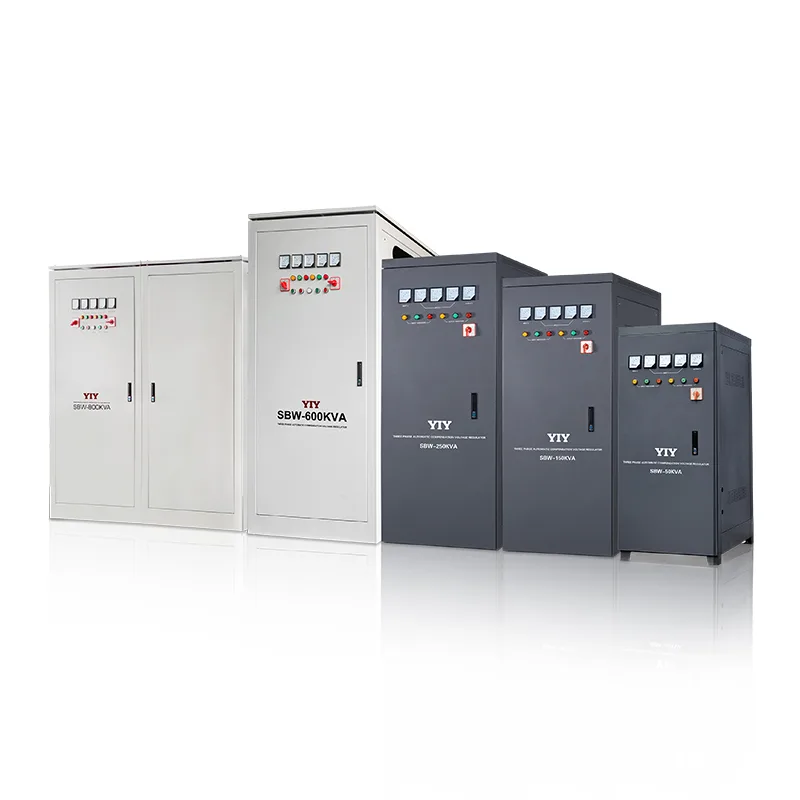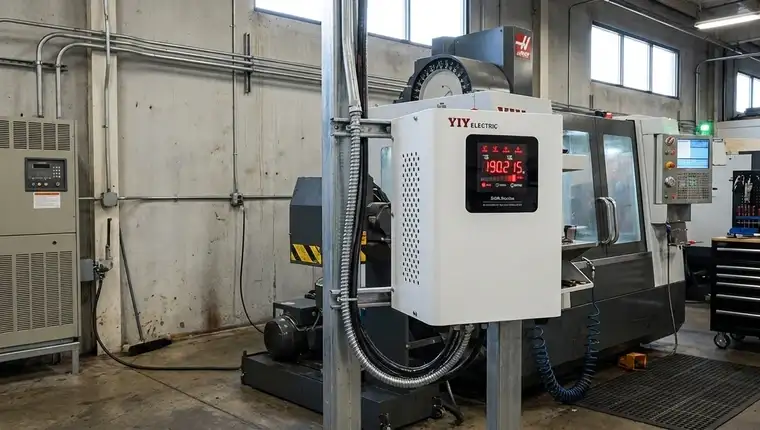
Comparing a 3 phase stabilizer 15kva means checking four things before you order: capacity margin for motor inrush, control architecture and precision, site and electrical readiness, and supplier evidence.
Most 15 kVA industrial loads point to a servo voltage stabilizer.
What a 15kVA 3-Phase Stabilizer Does & When to Specify It
Operational Role and Precision Control
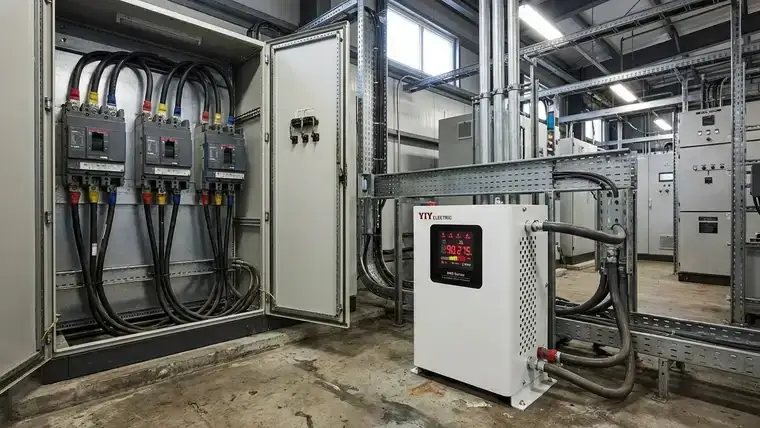
A 15kVA three-phase stabilizer is a closed-loop regulator, usually servo-driven, for 380/400/415 V networks; nominal voltages are defined in IEC 60038:2009. It monitors the supply and adjusts the transformer ratio to absorb sags, surges, and brownouts before they reach downstream controls.
Where 15 KVA Sits in the Capacity Range
At a power factor of 0.8–1.0, 15 kVA corresponds to 12–15 kW of real load (15 kVA × PF). That puts it above small single-phase relay units and below 30 kVA-plus systems used for whole-facility or heavy machine-cluster protection: it fits one mid-scale production cell, or a small building where all loads share one protection point.
Critical Load Mapping
This nominal capacity directly targets electromechanical assemblies where even minor voltage deviations trigger immediate performance degradation or hard system faults. Primary deployment zones feature high-torque CNC spindles, vertical elevator traction motors, commercial HVAC scroll compressors, and synchronized automated packaging lines. Unstable supply voltages force variable frequency drives into constant torque-limiting mode, which rapidly degrades stator insulation and shortens mechanical component lifespans.
Neutralizing Phase Imbalance and Overload
Spreading the load across three legs avoids the I²R heating and neutral shift that come with forcing high demand through one line. A properly specified three-phase stabilizer corrects each phase and spreads motor inrush, which is why continuous motor loads at this size are rarely protected single-phase.
How to Size Capacity and Account for Starting Currents
Why a Starting-Current Margin Matters
Nameplates don’t capture motor inrush. Add a margin above connected load for starting current and planned growth, agreed with the supplier from measured starts. The method mirrors the 10–25 kVA three-phase guide, with tighter thermal headroom for spindle and compressor loads.
Practical Sizing Workflow
Map every downstream asset and convert kW to kVA using measured power factor. A cell with a 15 kW CNC spindle, 3 kW of hydraulic pumps, and 2 kW of lighting and controls is 20 kW; at PF 0.8 that’s 25 kVA running demand before any starting margin, so 15 kVA is clearly too small and the next tier up is the starting point.
Adjusting for Site Realities
Wide input swings and harmonic distortion make the compensator work harder and run hotter in 24/7 duty. Sites with heavily unbalanced phases should also confirm neutral sizing so the neutral voltage doesn’t drift across asymmetric legs.
The Hidden Cost of Undersizing
Buying a unit that exactly matches a machine nameplate ignores the transient current needed to start heavy rotating loads. Induction motors draw several times rated current at start, so an undersized stabilizer overheats and trips; the same mistake applies when sizing a 3 kVA stabilizer for lab equipment.
Core Specs to Compare: Servo Technology, MCU Control, & Precision
Understanding the underlying architecture is essential when determining industrial servo stabilizer specs for an RFQ. The table below outlines how different technologies stack up for medium-to-heavy manufacturing environments:
| Architecture | Precision Range | Correction Speed | Primary Use Case | Reliability & Maintenance |
|---|---|---|---|---|
| Relay/Switcher | Widest, stepped | Fast steps | Lighting, basic HVAC, non-precision loads | High contact wear, prone to arcing |
| Servo-Motor | ±3% (SVC-3) / ≤2% (PRO-3) | Smooth, seconds | CNC, elevators, packaging, motors | High mechanical durability, low maintenance |
| IGBT/Solid-State | Tightest | Sub-cycle | Semiconductor labs, medical imaging | Highest cost, complex electronics cooling |
Architecture Selection and Industrial TCO
Procurement teams must align control architecture directly with regional grid instability and long-term operational budgets. Servo-driven systems deliver the optimal equilibrium of steady-state precision and mechanical durability, effectively bypassing the rapid contact fatigue inherent in legacy relay-switching designs. While solid-state IGBT topologies provide instantaneous transient response, their prohibitive capital expenditure restricts deployment exclusively to niche semiconductor cleanrooms. Servo-based mechanical compensation ultimately secures lower total cost of ownership by sustaining strict voltage control under continuous heavy inductive motor loads.
MCU-Controlled Regulation and Active Protection
MCU feedback is the standard for tight regulation; YIY’s PRO-3 publishes ≤2% output precision. The controller tracks phase drift, and thermistor sensing cuts out on overheating before winding insulation is damaged.
Input Voltage Windows and Maintenance Continuity
Confirm the input window against your logged minimum and maximum voltage. Specify an isolated manual bypass so engineers can take the stabilizer off the bus for service while 380 V machinery stays energized.
Global Compliance Baselines
Never finalize a purchase order until the manufacturer explicitly documents valid CertificationsISO 9001 certification requirements alongside current CE conformity marking. These internationally recognized frameworks verify rigorous component traceability, systematic environmental controls, and mandatory electrical safety protocols for heavy-duty plant environments. Verifiable compliance documentation dramatically accelerates third-party facility audits while definitively removing procurement liability from unregulated voltage hardware.
Quality Evidence and RFQ Document Checklist
Treat IEC 60038 voltage matching, EMC immunity, and CE marking for European export as entry requirements. ISO 9001:2015 shows an audited quality system; ISO 14001 matters only where your procurement policy requires environmental reporting.
Before the PO, request:
- Load test reports at rated load and at the stated overload rating
- Unbalanced-load performance data, since three-phase loads rarely balance in practice
- Confirmation of the bypass isolation switch
- CE and IEC compliance certificates from the issuing body
Installation Readiness, Site Conditions, & Protection Planning
Environmental Constraints and Cooling Trade-Offs
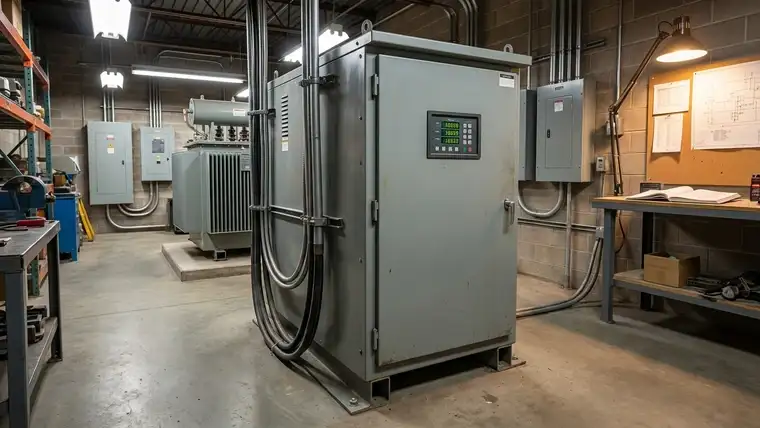
Follow the datasheet’s clearance and ambient temperature limits so heat can exhaust freely.
Air-cooled cabinets cost less and are simpler to maintain; oil-cooled designs handle heat better in continuous 24/7 duty, at the cost of extra fire-safety planning.
Electrical Routing and Maintenance Accessors
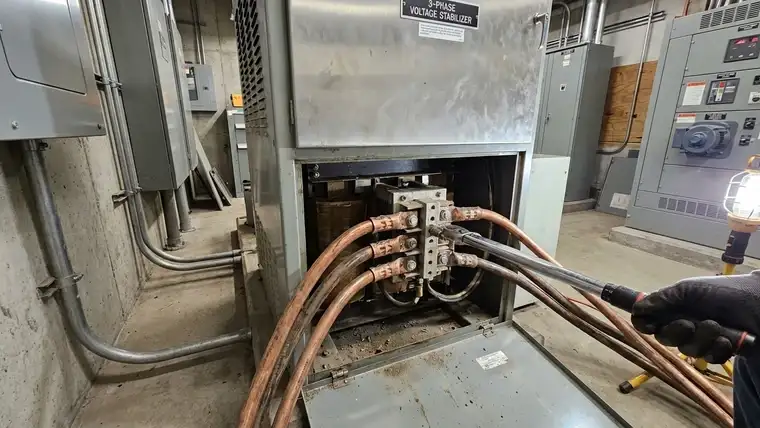
Input and output cabling must strictly align with the stabilizer’s full-load amperage to prevent localized conductor overheating, demanding copper conductors sized precisely to IEC 60364 or local electrical codes. Heavy-duty terminal lugs require calibrated crimping and verified torque application to eliminate resistance-induced contact heating under heavy motor startup currents. Crucially, facility engineers must route a fully isolated manual maintenance bypass switch directly into the main busbar, guaranteeing uninterrupted downstream equipment operation during active regulator servicing or upstream grid switching.
Mandatory Protection Interlocks
Hardware protection should act independently of control logic: overload cutoff at the rating stated on the datasheet, a fan-failure interlock, short-circuit detection, and coordinated surge protection against lightning and utility transients.
Essential Pre-Quotation Data Collection
Log grid voltage with a power quality analyzer over a representative period, including peak production. Check floor loading for the cabinet weight, and send THD readings so the manufacturer can account for VFD-heavy loads.
Vendor Evaluation & RFQ Checklist for Final Model Selection
Bridging technical analysis with final procurement requires a disciplined comparison framework that separates marketing claims from verifiable engineering data. Procurement teams must standardize vendor evaluation around three operational pillars before issuing formal bid requests.
Strategic Supplier Tiering
Supplier scope shows capability limits. Prefer manufacturers with servo, relay, and IGBT portfolios, OEM/ODM flexibility, and spare-part support in your region; YIY exports to 130+ countries.
The guide to industrial voltage stabilizer manufacturers covers commissioning support and how to verify calibration before handover.
Environmental Ruggedization & Site Constraints
Outdoor sites need weather-rated housings, conformal coating, and sealed ventilation. Indoor rooms still need thermal clearance, and hot or tropical installations need component derating agreed with the supplier.
Standardized 5-Point RFQ Checklist
Submitting a rigorously defined request for quotation forces vendors to quote actual engineering specifications rather than inflated base models. Lock your technical inquiry around these five critical operational parameters:
- Exact Load Breakdown: Catalog continuous running demand alongside cold-start inrush multipliers for all heavy inductive motors.
- Min/Max Input Voltage Window: Supply power quality logs covering peak production to accurately match the required corrective transformer bandwidth.
- Phase Balance Tolerance: State maximum expected phase-to-phase deviation to properly size the internal neutral and isolation busbars.
- Ambient Operating Conditions: Declare peak temperature, altitude, and humidity thresholds to trigger mandatory thermal derating adjustments.
- Required Protection Protocols: Define non-negotiable hardware interlocks, including Class C surge clamping, thermal cutoff thresholds, and manual maintenance bypass routing.
How YIY PRO-3 and SVC-3 Cover the 15 KVA Requirement
Both series are three-phase servo designs covering 1.5–100 kVA, and the SVC-3 spec table lists a 15 kVA model.
- PRO-3 for precision loads: MCU control with ≤2% output precision, built-in motor protection, and an LED display of input and output voltage. Fits CNC cells with servo drives and a control cabinet on one circuit.
- SVC-3 for unbalanced sites: ±3% output, 100% unbalanced load capability, and a 278–433 V input option for weak grids. Fits lines that load L1, L2, and L3 unevenly.
Not Comparable to Single-Phase Retail Units
Single-phase relay units sold through retail channels are a different category: one phase, stepped correction, light protection. A 15 kVA industrial unit adds three-phase compensation, an industrial input range, and a full protection stack, so price comparisons between the two mislead.
Buying Notes: 15 KVA Is a Workshop Decision, Not a Plant Decision
15 kVA is easy to misquote: buyers compare it against household units on one side and feeder-level plant hardware on the other. It suits one workshop panel, one process cell, or a small group of coordinated three-phase loads.
Go smaller for a single branch or appliance-style load; the 5 kVA servo guide covers that band. Before you settle on 15 kVA, freeze inrush behavior and panel growth, because startup concurrency often pushes a project into the next tier.
Frequently Asked Questions
What Should Buyers Evaluate Before Choosing a 3 Phase Stabilizer 15kva?
Prioritize control architecture, input range, and thermal clearance. Pick an MCU-driven servo unit for tight output, confirm the input window covers your logged extremes, and check for a manual bypass, overheat protection, and surge protection.
How Should a Stabilizer 15kva 3 Phase Be Sized or Specified?
Convert connected load to kVA with the measured power factor, then add a starting-current margin agreed with the supplier. A 20 kW baseline at PF 0.8 is already 25 kVA, so it needs a larger tier than 15 kVA.
What Drives 15 KVA Stabilizer Price Differences?
Correction technology, input window width, winding material, enclosure rating, cooling method, and certification scope. Ask suppliers to quote the same specification line by line, and compare the technical package before the price.
What Can a 15 kVA Stabilizer Carry Without Tripping or Overheating?
About 12 kW of continuous inductive load at PF 0.8, provided the phases are reasonably balanced to avoid neutral drift and conductor heating. CNC spindles and packaging lines run reliably as long as motor starts stay within the margin agreed for the unit.
When Is a 15 KVA Stabilizer Necessary Versus a Smaller or Larger Unit?
When the protected load converts to roughly 12–15 kVA including starting margin, and the grid regularly leaves the tolerance your equipment accepts. Below that, a smaller servo unit is enough (see the 10 kVA 3-phase specifications); above it, see the 20kVA stabilizer technical guide.
Final Thoughts
A 3 phase stabilizer 15kva is right when converted load, starting current, and site voltage all fit the tier. Shortlist from YIY’s three-phase stabilizers and send your load list for a sizing review.