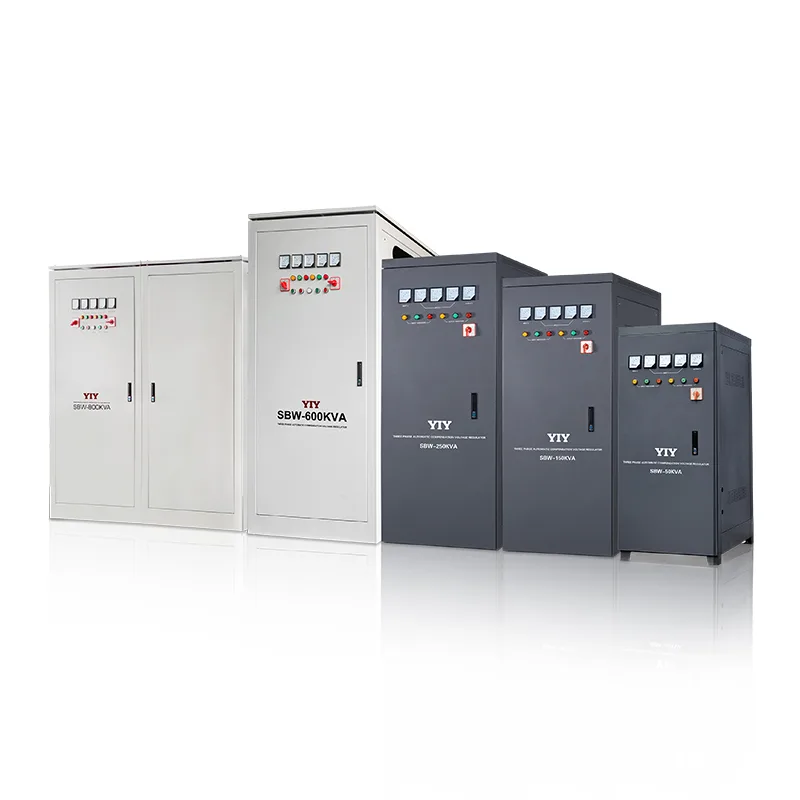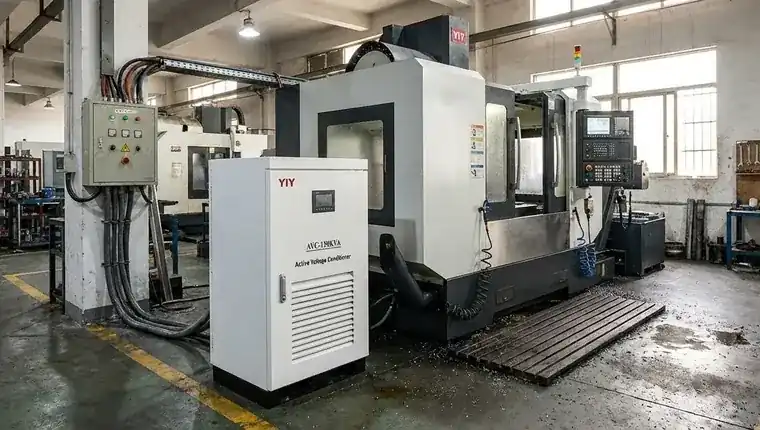
20KVA stabilizer is a high-capacity voltage regulator designed to protect industrial machinery from fluctuations and prevent production downtime. Industrial equipment failures from voltage fluctuations can halt production lines and damage sensitive machinery, making voltage protection a critical infrastructure decision.
A 20KVA stabilizer addresses this by maintaining constant output voltage for loads in the 16-20kW range—typical for CNC machines, industrial lighting systems, and auxiliary equipment in manufacturing facilities.
This guide walks through the core decisions: understanding what 20KVA capacity means for your application, comparing servo, relay, and IGBT technologies, calculating proper sizing margins, and evaluating manufacturers against compliance standards and proven capability. Whether you’re protecting a single production cell or planning facility-wide voltage management, the framework here helps you specify the right solution and avoid costly mismatches between equipment needs and stabilizer performance.
What a 20KVA Stabilizer Is and Why It Matters
A 20KVA stabilizer is a voltage regulation device with a 20 kilovolt-ampere capacity, designed to maintain constant output voltage regardless of input fluctuations. In practical terms, this capacity supports equipment loads in the 16-20kW range, making it suitable for mid-scale industrial applications where multiple machines or systems draw power simultaneously. The KVA rating accounts for both active power (kW) and reactive power, ensuring the stabilizer can handle the full electrical characteristics of connected loads.
The Power Quality Problem
Industrial facilities face three primary voltage issues that threaten equipment operation. Voltage sags—temporary drops below nominal levels—occur during heavy load switching or grid disturbances and can cause motor stalls or control system resets. Brownouts represent sustained undervoltage conditions that force equipment to draw excessive current, accelerating component wear and triggering thermal failures. Voltage surges from lightning strikes, switching transients, or utility grid events can instantly damage sensitive electronics and control circuits.
Why Voltage Stability Matters
Sensitive industrial equipment operates within narrow voltage tolerances, typically ±5-10% of nominal ratings. CNC machines rely on precise servo motor control and digital positioning systems that malfunction under voltage variation, resulting in dimensional errors or program interrupts. Industrial lighting systems experience reduced lifespan and lumen output degradation when subjected to voltage instability. Auxiliary equipment—including PLCs, variable frequency drives, and instrumentation—contains microprocessor-based controls vulnerable to voltage-induced logic errors and memory corruption.
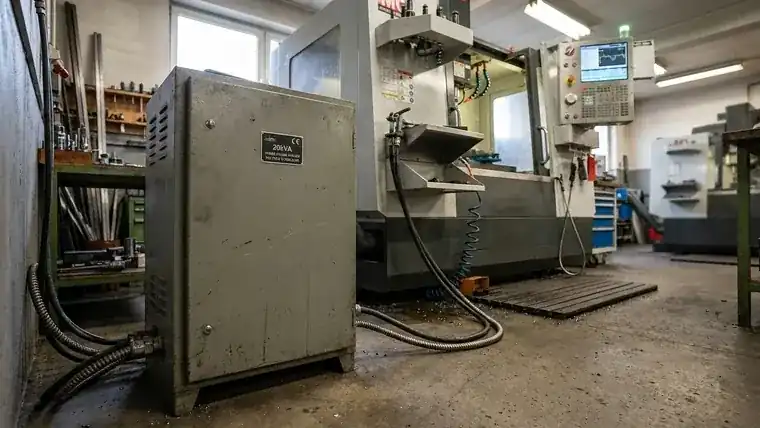
A 20KVA stabilizer addresses these risks by continuously monitoring input voltage and adjusting output through servo motor control or electronic switching, maintaining output within ±2-3% tolerance regardless of input swings between 160-260V (typical range). This protection prevents the cascading failures that occur when one piece of equipment trips offline and shifts its load to remaining circuits, creating a cycle of voltage disturbance across the facility.
Who Needs a 20KVA Stabilizer
Industrial engineers and facility managers typically evaluate 20KVA stabilizers when protecting equipment loads in the 15-25kW range. This capacity bracket covers common industrial scenarios: a CNC machining cell drawing 15kW, auxiliary HVAC systems for clean rooms, industrial lighting arrays across production floors, or packaging line control systems.
Procurement teams enter this decision when voltage instability has caused equipment trips, when expanding facilities into regions with unreliable grid supply, or when commissioning sensitive machinery that requires tighter voltage tolerance than the local utility provides.
Common Equipment Applications
CNC machines represent the most voltage-sensitive application in this capacity range—servo motors and digital controllers require stable input to maintain positional accuracy and prevent program interrupts. Industrial lighting systems, particularly high-intensity discharge or LED arrays spanning large facilities, experience accelerated degradation and color shift under voltage variation. Auxiliary equipment including programmable logic controllers (PLCs), variable frequency drives (VFDs), and process instrumentation contains microprocessor-based controls that reset or corrupt data when voltage drops below threshold, creating cascading failures across interconnected systems.
The Buying Decision
The evaluation centers on three technical decisions: capacity sizing with appropriate safety margin (typically 20-30% above connected load), technology selection between servo, relay, and IGBT architectures based on precision requirements and budget constraints, and specification verification against input voltage range, output regulation tolerance, and response time. Procurement teams must also assess manufacturer capability—production capacity for volume orders, compliance with relevant standards (IEC, CE marking), and technical support for installation and commissioning.
The decision timeline typically compresses when equipment damage has already occurred or when project commissioning deadlines approach.
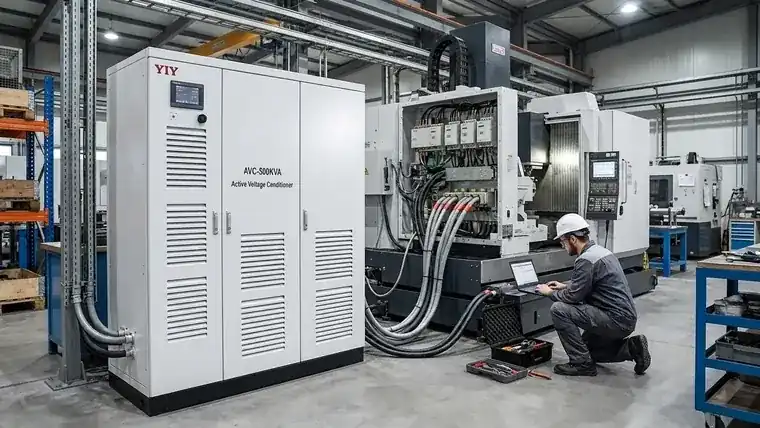
Technology Comparison: Servo vs Relay vs IGBT
Voltage stabilizers for 20KVA industrial applications use three primary control technologies: servo motor systems, relay-switched tap changers, and IGBT-based electronic switching. Each architecture makes different tradeoffs between precision, response time, cost, and maintenance requirements.
| Technology | Output Precision | Response Time | Best For | Cost |
|---|---|---|---|---|
| Servo | ±0.5–3% | 1–2 seconds | Industrial balance, CNC | Medium |
| Relay | ±5–8% | <10ms | General loads, fast switching | Low |
| IGBT | ±0.5% | <10ms | Mission-critical, isolation | High |
Understanding these differences determines whether your equipment receives adequate protection or experiences premature failure from residual voltage variation.
Servo Technology: The Industrial Standard
Servo stabilizers use a motor-driven variable transformer (variac) to continuously adjust output voltage, delivering ±2-3% regulation precision across the full input range. This mechanical approach provides reliable performance in harsh industrial environments—dust, temperature extremes, and electrical noise that would compromise purely electronic systems. The servo architecture handles 100% unbalanced loads and inrush currents without derating, critical for motor-driven equipment and three-phase applications.
Maintenance intervals extend to 12-18 months with proper installation, and component replacement costs remain moderate compared to specialized power electronics.
Relay Technology: Speed Over Precision
Relay-based stabilizers switch between transformer taps in discrete steps, typically achieving ±5-8% output regulation. Response time reaches 10-20 milliseconds—faster than servo systems—but the stepped output creates voltage jumps during transitions that sensitive equipment may register as disturbances. This technology suits residential and light commercial applications where cost minimization outweighs precision requirements, but falls short for CNC machines, medical equipment, or process control systems that demand tighter voltage windows.
IGBT Technology: Maximum Precision at Premium Cost
IGBT (Insulated Gate Bipolar Transistor) stabilizers use high-frequency electronic switching to achieve ±1% regulation with sub-millisecond response times. This performance comes at 40-60% higher capital cost and introduces harmonic distortion that requires additional filtering. Mission-critical applications—data centers, semiconductor fabrication, precision instrumentation—justify the investment, but most 20KVA industrial loads operate reliably within servo-grade tolerances.
Why Servo Wins for 20KVA Industrial Loads
For the 16-20kW equipment range typical of 20KVA applications, servo technology delivers the optimal precision/reliability/cost balance. The ±2% regulation protects sensitive controls while the robust mechanical design withstands industrial conditions that would require frequent IGBT module replacement. Relay systems cannot meet the voltage stability requirements of modern CNC machines and automated production equipment, leaving servo as the practical choice for industrial voltage protection.
How to Size and Select the Right 20KVA Stabilizer
Proper sizing starts with calculating total connected load and applying a safety margin. The standard formula multiplies your total equipment load by 1.2 to 1.3, accounting for startup inrush currents and future expansion. This margin prevents overloading and ensures the stabilizer operates within its optimal efficiency range.
Sizing Example
Consider a facility with 15kW CNC machine, 2kW industrial lighting, and 3kW auxiliary equipment—totaling 20kW. Applying the 1.25 safety factor yields 25KVA minimum capacity (20kW × 1.25). In practice, you would specify a 30KVA unit to provide additional headroom for motor starting currents and avoid operating continuously at maximum capacity, which accelerates component wear.
Selection Criteria
Input voltage range determines whether the stabilizer can handle your site’s actual grid conditions. Measure your facility’s voltage variation over several days—if you see swings between 160-260V, ensure the stabilizer’s input range covers this span with margin. Output precision matters for sensitive equipment: CNC machines and process controllers typically require ±2-3% regulation, while general industrial loads may tolerate ±5%.
Protection features separate industrial-grade units from basic models. Essential protections include overload cutoff (typically 120-150% for 10-60 seconds), thermal shutdown when internal temperature exceeds safe limits, and phase sequence/imbalance detection for three-phase systems. These prevent cascading failures when upstream faults occur.
Environmental and Load Factors
Installation environment affects performance and lifespan. Stabilizers rated for 40°C ambient temperature will derate in hotter conditions—add 10-15% capacity if installing in non-air-conditioned spaces. Humidity above 90% requires conformal coating on electronics. Allow minimum 300mm clearance on all sides for ventilation.
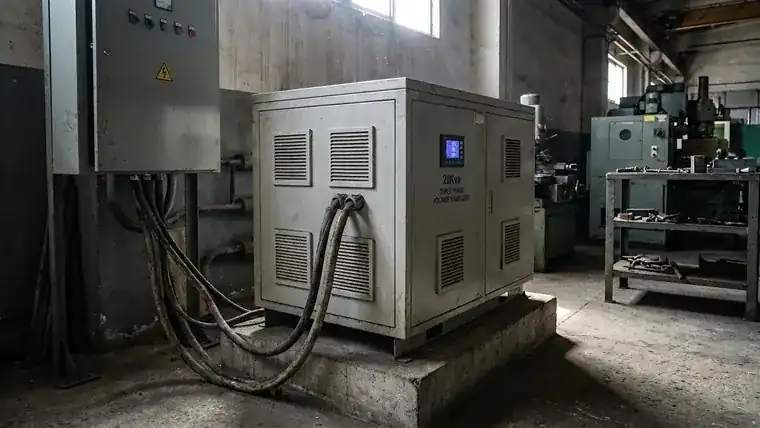
Load characteristics influence technology choice and sizing. Balanced three-phase loads allow standard sizing, but unbalanced loads (common when single-phase equipment connects to three-phase supply) require stabilizers rated for 100% phase imbalance. Inductive loads like motors and transformers have power factors of 0.6-0.8, meaning a 20kW inductive load may require 25-30KVA capacity even before applying safety margins, while resistive loads (heaters, lighting) operate near unity power factor and size more predictably.
Standards, Compliance, and Quality Assurance
Industrial voltage stabilizers operate under specific international standards that define performance requirements and safety thresholds. IEC 60038 establishes voltage level standards that stabilizers must maintain, while IEC 61000 series addresses electromagnetic compatibility (EMC)—ensuring the device neither generates excessive electrical noise nor succumbs to interference from surrounding equipment. Compliance with these standards prevents the stabilizer itself from becoming a source of power quality problems.
Quality Management and Certification
ISO 9001:2015 certification indicates systematic quality management across design, manufacturing, and service operations. This standard requires documented processes for design validation, production control, and traceability—critical when stabilizers protect equipment worth significantly more than the stabilizer itself. For facilities exporting to or operating in EU markets, CE marking demonstrates conformity with European safety, health, and environmental protection standards, removing regulatory barriers to deployment.
Protection Features as Quality Indicators
Industrial-grade 20KVA stabilizers incorporate multiple protection layers that reflect manufacturing quality and design maturity. Overload protection typically triggers at 120-150% of rated capacity, preventing transformer saturation and component damage during transient conditions. Thermal protection monitors internal temperature and initiates shutdown before insulation degradation occurs. Motor protection circuits prevent servo motor burnout during extended correction cycles, while fan failure detection ensures cooling system integrity—a frequently overlooked failure mode that leads to premature component aging.
Proven Manufacturing Capability
YIY’s deployment across 130+ countries and capacity range spanning 0.5KVA to 3000KVA demonstrates production scale and technical breadth that supports both standard and custom requirements. This range indicates manufacturing flexibility—facilities producing only narrow capacity bands typically lack the process control and component sourcing relationships needed for reliable OEM/ODM partnerships or non-standard specifications.
Frequently Asked Questions
What Should Buyers Evaluate Before Choosing a 20KVA Stabilizer?
Evaluate three critical factors: input voltage range at your site (measure actual fluctuations over several days), output regulation precision required by your equipment (CNC machines need ±2-3%, general loads tolerate ±5%), and protection features including overload cutoff, thermal shutdown, and phase imbalance detection. Also verify the manufacturer’s compliance with IEC standards, production capacity for volume orders, and technical support capability for installation and commissioning.
When Is a 20KVA Stabilizer Necessary?
When a group of machines whose combined demand sits around this rating keeps tripping, resetting or running hot because the supply drifts. Typical examples are a CNC cell, a packaging line with its controls, or clean-room auxiliaries. It also makes sense when you install sensitive machinery at a site where the utility cannot hold the tolerance the equipment maker specifies.
How Should a 20KVA Stabilizer Be Sized or Specified?
Total the loads that run together, convert kW to kVA with the power factor, and add headroom for motor starts and growth. If the result lands close to 20 kVA, step up a frame rather than run the unit at its limit. Hot rooms without air-conditioning may need derating, so ask the supplier for the derating curve.
Final Thoughts
Selecting the right 20KVA stabilizer requires balancing capacity calculations, technology tradeoffs, and compliance requirements against your specific application needs. The framework outlined here—sizing with 20-30% margins, comparing servo precision against relay speed and IGBT cost, and verifying manufacturer capability through standards compliance—provides a structured approach to evaluation. However, the optimal specification depends on variables this guide cannot address: your exact input voltage range, load characteristics (balanced vs. unbalanced, inductive vs. resistive), ambient conditions, and integration requirements.
If you’re evaluating stabilizers for a specific installation, share your load profile, site voltage measurements, and environmental conditions with qualified manufacturers. This allows engineering teams to recommend models with verified input ranges, appropriate protection features, and proper derating for your operating environment—moving from general guidance to a specification that actually protects your equipment.
About YIY
Zhejiang Yiyen Holding Group Co., Ltd. (YIY) is a professional voltage stabilizer manufacturer with 16+ years of experience. With a 30,000sqm modern facility and an annual production capacity of 1,000,000+ units, our products are exported to 130+ countries. We provide OEM/ODM customization services and are ISO 9001:2015 certified, committed to delivering stable and reliable voltage protection solutions to global customers.
Contact Us
Email: yiyen at yiyen.com
Phone/WhatsApp: +86 13587452904
Website: https://www.yiyavr.com/
If you found this article helpful, contact us for a sizing review or customized solution.