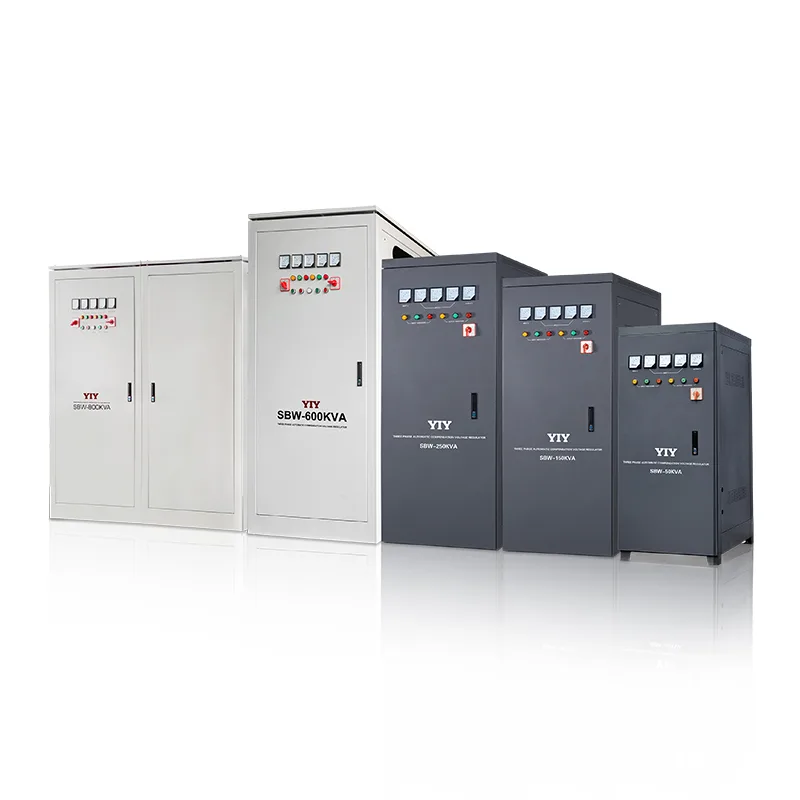
A 20 kva servo stabilizer 3 phase fits best when your real connected load stays within usable kVA after power factor, starting current, safety margin, and measured input-voltage range are checked.
The 20 kVA label is only the starting point; your load list, motor behavior, phase balance, and site voltage window decide whether this capacity tier is safe.
This guide walks you through the questions that matter before buying: what the stabilizer solves, how servo correction works, when servo is better than relay or static regulation, how to size a 20 kVA three-phase unit, what affects price, and what you should verify before final approval.
If you are still narrowing the product category, start by confirming that your application belongs in industrial three-phase stabilizers before you compare individual models or quotations.
What Problem Does a 20 kVA Three-Phase Servo Stabilizer Solve?
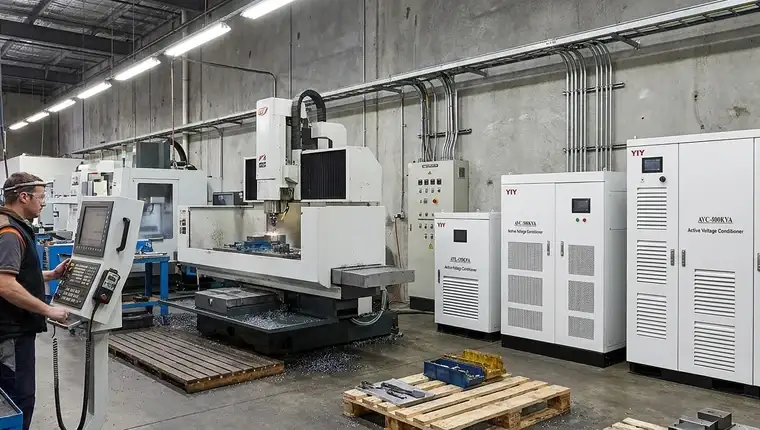
You use this stabilizer when unstable three-phase supply is already affecting equipment reliability, process consistency, or maintenance workload. A 20 kVA three-phase servo voltage stabilizer corrects voltage sags, surges, and gradual voltage variation before they reach CNC machines, lifts, compressors, pumps, HVAC motors, packaging equipment, or mixed industrial distribution panels.

A 20 kVA rating means apparent power capacity. It does not mean every 20 kW load is suitable. If your load is 16 kW at 0.8 power factor, the apparent load is already 20 kVA before margin:
kVA = kW / power factor
For you, that means a 16 kW load at 0.8 PF leaves little headroom for motor starting current, future expansion, high ambient temperature, overload events, or phase imbalance. A motor-heavy site may need oversizing, a soft starter/VFD review, or a wider capacity tier even when the nameplate total looks close to 20 kVA.
Voltage standards also matter. The official IEC 60038 standard voltages reference standard voltage systems, and YIY technical documentation commonly uses a ±10% input-tolerance context for standard voltage applications. In practical terms, you should not choose only by nominal 380V/400V/415V labels; you should match the stabilizer input range to the lowest and highest voltage your site actually records.
Common applications for this capacity include:
- CNC machines with voltage-sensitive controls and drives
- Elevators or lifts with motor loads and safety-control panels
- Pumps, compressors, and HVAC motor circuits
- Packaging lines, conveyors, and small production cells
- Mixed three-phase distribution panels in workshops or light factories
The risk of poor selection is not limited to a damaged board. If your AVR is undersized or its correction range is too narrow, you may still see nuisance trips, overheated motors, contactor stress, inconsistent machine behavior, emergency service calls, and avoidable production stops.
How Does a Servo Stabilizer Regulate Your Three-Phase Load?
You get continuous voltage correction from a servo stabilizer because it monitors incoming voltage and adjusts an autotransformer ratio through a motor-driven carbon brush. In simple terms, the controller reads the supply condition, drives the servo motor forward or reverse, moves the brush on the variac/autotransformer winding, and raises or lowers the output toward the target voltage.
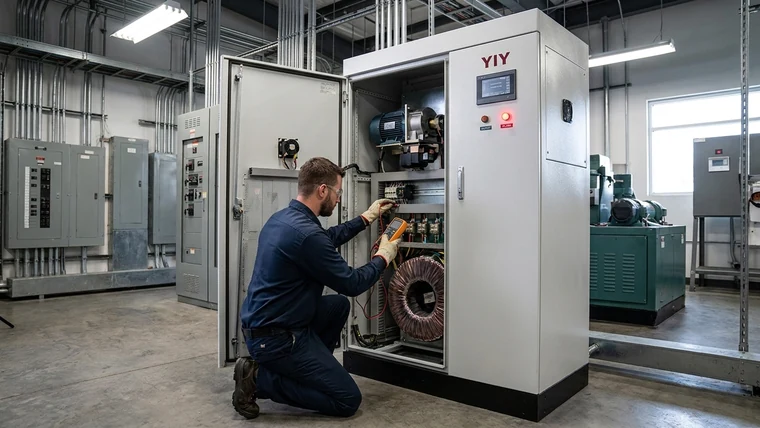
This correction loop matters because many industrial sites do not only experience instant spikes. Your supply may drift during peak demand, generator transfer, long cable runs, or utility instability. A servo AVR is well suited to these gradual fluctuations because it provides smoother correction than basic step-switching designs.
The basic operating sequence is:
- Input detection: the controller samples incoming three-phase voltage.
- Motor adjustment: the servo motor rotates based on the correction command.
- Transformer ratio change: the carbon brush moves along the autotransformer winding.
- Output stabilization: the adjusted ratio brings the output voltage closer to the set target.
YIY internal servo documentation places typical servo output precision around ±0.5% to ±3% with response time around 1 to 2 seconds, depending on model and test conditions. For you, the precision figure describes how close the output remains after correction; the response time tells you whether the unit is suitable for normal grid fluctuation or whether your process needs a faster static/IGBT design.
A servo stabilizer is not the same as a surge protector, UPS, or isolation transformer. It regulates voltage over a defined range. If your site has lightning exposure, fast transients, harmonic problems, deep interruptions, or sensitive PLC-heavy automation, you may need additional protection or a different regulator topology.
When Should You Choose Servo Instead of Relay, Static, or Non-Contact Designs?
You should choose servo when your industrial load needs stable continuous correction, practical precision, serviceable construction, and a balanced cost-to-capacity profile. Relay designs fit more forgiving loads, while static/IGBT or non-contact units fit sites where fast response, brush-free operation, or very sensitive electronics are more important than purchase cost.
| Technology type | How it corrects voltage | Typical fit for your load | Main advantage | Main caution |
|---|---|---|---|---|
| Servo | Motor-driven carbon brush adjusts autotransformer ratio | CNC, lifts, pumps, compressors, mixed industrial panels | Continuous correction and practical industrial precision | Brush/variac inspection is part of maintenance |
| Relay | Switches transformer taps in steps | Basic loads with wider voltage tolerance | Economical and simple | Output changes in steps, which may not suit control panels |
| Static/IGBT | Uses electronic high-speed correction | PLC-heavy lines, instruments, sensitive automation | Faster response and no mechanical brush movement | Higher cost and more specialized service needs |
| Non-contact | Uses electronic or brushless correction, model-dependent | Sites where brush maintenance is difficult | Lower brush-maintenance concern | Verify overload behavior, input range, and load compatibility |
For a 20 kVA three-phase AVR, topology selection should follow your site problem. If your machines trip during gradual low-voltage periods, servo is often a strong fit. If your process trips on very short dips, a static regulator may be safer. If your workshop is dusty, humid, hot, or hard to access, you should review enclosure, cooling, and maintenance access before approving any brush-based design.
Market comparisons can help, but they should not replace your measured data. Some suppliers emphasize India-focused projects, some highlight outdoor or extreme-site construction, and some catalog listings show input windows such as 295-465V or 304-456V. Those ranges are useful reference points, but your final specification should follow your actual logged voltage and equipment sensitivity.
For a broader topology and application framework, use industrial voltage stabilizer selection to compare load sensitivity, phase type, correction speed, capacity, and operating environment before you commit to a three-phase servo setup.
How Should You Size a 20 kVA Three-Phase Stabilizer Before Ordering?
You should size this capacity tier from measured load data, power factor, starting current, duty cycle, and input-voltage range instead of assuming the catalog rating is enough. A stabilizer 20 kva 3 phase may be correct for your site, but only if the usable capacity remains safe under real operating conditions.

Start with a load schedule. Include every connected machine, its kW or kVA, power factor, phase connection, starting method, and whether it runs continuously or intermittently. If your connected loads do not all run together, apply a realistic diversity factor, but do not use diversity to hide a high-starting-current motor that can trip the AVR during startup.
For capacity-specific checks, the 20kva voltage stabilizer guide can help you review usable kVA, power factor, and application fit in more detail.
| Check | Why it matters | If you skip it |
|---|---|---|
| Load list: kW, kVA, PF, phase balance | Confirms real apparent load and usable capacity | Undersizing, overheating, nuisance trips |
| Motor HP/kW and starting method | DOL starting can draw much higher momentary current | Stabilizer trips during startup |
| Duty cycle and diversity | Shows whether loads run together or intermittently | You may overspend or underprotect |
| Measured lowest/highest input voltage | Defines the required correction window | The unit may fail even at correct kVA |
| Output voltage and frequency | Confirms match to 380V/400V/415V and 50/60 Hz equipment | Wrong output can damage equipment |
| Protections and bypass | Covers overload, phase loss, short circuit, surge, and service continuity | Longer downtime during faults or maintenance |
A practical procurement screen should ask each supplier for the same minimum data:
| Check | Why it matters | If you skip it |
|---|---|---|
| Written model datasheet | Keeps quotation and technical approval aligned | You may approve a different build than quoted |
| Input range under load | Confirms correction at your real low/high voltage | The AVR may saturate outside range |
| Overload curve | Shows short-duration tolerance for starts | Motor loads may trip the stabilizer |
| Cooling method and clearance | Controls heat rise and service life | Components may run hot in panels |
| Enclosure/IP option | Matches dust, humidity, and installation location | Maintenance failures may increase |
| Manual and wiring diagram | Confirms earthing, bypass, startup, and alarms | Installation errors become more likely |
If your stabilizer will serve a main distribution line rather than one machine, use 3 phase main line stabilizer sizing to review load grouping, diversity, protection coordination, and site measurement before you approve the final capacity.
What Affects 20 kVA Servo Stabilizer 3 Phase Price?
You should compare price only after the electrical and mechanical specifications are equivalent. The 20 kva servo stabilizer 3 phase price is affected by input range, winding material, cooling design, enclosure, protection package, bypass arrangement, meters, certifications, customization, and freight basis.
A lower quote may be reasonable if your application is simple. It may also be incomplete if it excludes bypass, surge protection, phase-loss protection, export packaging, test documentation, or a wider correction range. For your procurement comparison, ask suppliers to separate the cost drivers instead of quoting only one headline number.
Key price drivers include:
- Input voltage range: wider correction windows usually require heavier design.
- Winding material: copper and aluminum builds differ in cost, heat behavior, and buyer preference.
- Cooling method: air-cooled and oil-cooled units suit different environments and maintenance practices.
- Protection scope: overload, short circuit, over/under-voltage, surge, phase loss, and phase sequence protection change value.
- Metering and alarms: digital display, fault indication, and event visibility support maintenance.
- Bypass type: manual or automatic bypass affects uptime during service or fault conditions.
- Documentation: manuals, test reports, certifications, and wiring diagrams reduce installation risk.
When a quote seems unusually low, verify whether it covers the same voltage window, same output accuracy, same enclosure, same winding material, same warranty terms, and same freight terms. If you may need a larger capacity after starting-current review, this late-stage compare before buying a voltage stabilizer resource can help you think through what changes when you move into a higher capacity tier.
What Should You Verify with the Manufacturer Before Final Approval?
You should approve the unit only after the manufacturer confirms the datasheet against your site conditions. The goal is to avoid a stabilizer that looks correct on paper but overheats, trips during motor starts, or cannot correct your real grid voltage.
Ask for written confirmation of:
- Rated capacity and overload tolerance
- Input voltage range and output voltage
- Output accuracy and response time test conditions
- Phase loss, phase sequence, over-voltage, under-voltage, overload, short-circuit, and surge protections
- Cooling method, enclosure/IP option, and installation clearance
- Manual or automatic bypass arrangement
- Display, alarm, and optional monitoring functions
- Wiring diagram, earthing requirement, and startup sequence
- Maintenance interval for brush, variac, ventilation, and fasteners
Manufacturer credibility should be verified at the document level, not only by brochure claims. If a supplier mentions ISO certification, ask for the certificate number, issuing body, scope, and validity period. You can also reference the official pages for ISO 9001:2015 quality management and ISO 14001 environmental management to confirm what those standards cover. For you, this means the certificate should apply to relevant design, manufacturing, or service processes, not just appear as a logo in marketing material.
YIY’s manufacturing context includes long-term voltage stabilization experience, global export support, servo and broader AVR technology options, and technical sizing review for industrial applications. That matters when your buyer decision depends on application fit rather than a generic catalog match.
Frequently Asked Questions
How Should You Compare Pricing for 20 kva Stabilizer 3 Phase?
Compare pricing by matching the same electrical specification first. Ask each supplier for input voltage range, output accuracy, winding material, cooling method, bypass type, protection list, enclosure rating, metering, certification documents, warranty terms, and freight basis. Then verify the model number on the quotation against the datasheet and manual before approval.
Can a 20 kVA Three-Phase Servo AVR Run Motor Loads with High Starting Current?
It can run motor loads only if the starting current stays within the stabilizer’s overload capacity. Verify motor kW or HP, power factor, starting method, peak current, and duty cycle. As a concrete action, send the motor nameplate photo and starting method—DOL, star-delta, soft starter, or VFD—to the manufacturer before you approve the stabilizer.
What Affects 20 kVA Stabilizer 3 Phase Price Most?
Price is mainly affected by input range, copper or aluminum winding, cooling design, protection package, enclosure, bypass, metering, certifications, customization, and logistics. To avoid false comparison, request a line-item quotation and confirm whether surge protection, phase-loss protection, test report, installation accessories, and export packaging are included.
Where Should You Verify the Official Manual for 20 kva Stabilizer 3 Phase?
Verify the official manual directly with the manufacturer or authorized distributor. Cross-check the manual revision, model number, wiring diagram, earthing requirement, input/output voltage range, installation clearance, startup sequence, bypass operation, alarm logic, overload behavior, and maintenance interval against the actual product nameplate before energizing the unit.
When Is This Capacity Tier Not Enough?
This capacity may not be enough when your corrected kVA is already near 20 kVA, your motors have high inrush current, your site voltage drops deeply, or your load may expand soon. In that case, ask for an application review rather than simply moving one size up, because input range, overload curve, cooling, and phase balance may be just as important as capacity.
Final Thoughts
Your best 20 kVA three-phase servo stabilizer is the unit whose usable capacity, input range, starting-current tolerance, protection package, enclosure, and maintenance plan match your real operating site. If you buy by price or headline kVA alone, you risk approving equipment that still trips under motor starts, fails outside the site voltage window, or leaves your operators without bypass and fault visibility.
A low-friction next step is to ask YIY for a first-pass sizing review. Share your load list, motor starting method, measured input-voltage window, required output voltage, ambient temperature, dust/humidity conditions, and installation space; YIY can help you confirm whether this three-phase servo setup fits or whether another capacity or topology is safer.
About YIY
Zhejiang Yiyen Holding Group Co., Ltd. (YIY) is a professional voltage stabilizer manufacturer with 16+ years of experience. With a 30,000sqm modern facility and annual production capacity of 1,000,000+ units, YIY products are exported to 130+ countries. YIY provides OEM/ODM customization services and voltage protection solutions for global industrial customers.
Contact YIY
Email: yiyen@yiyen.com
Phone/WhatsApp: +86 13587452904
Website: https://www.yiyavr.com/