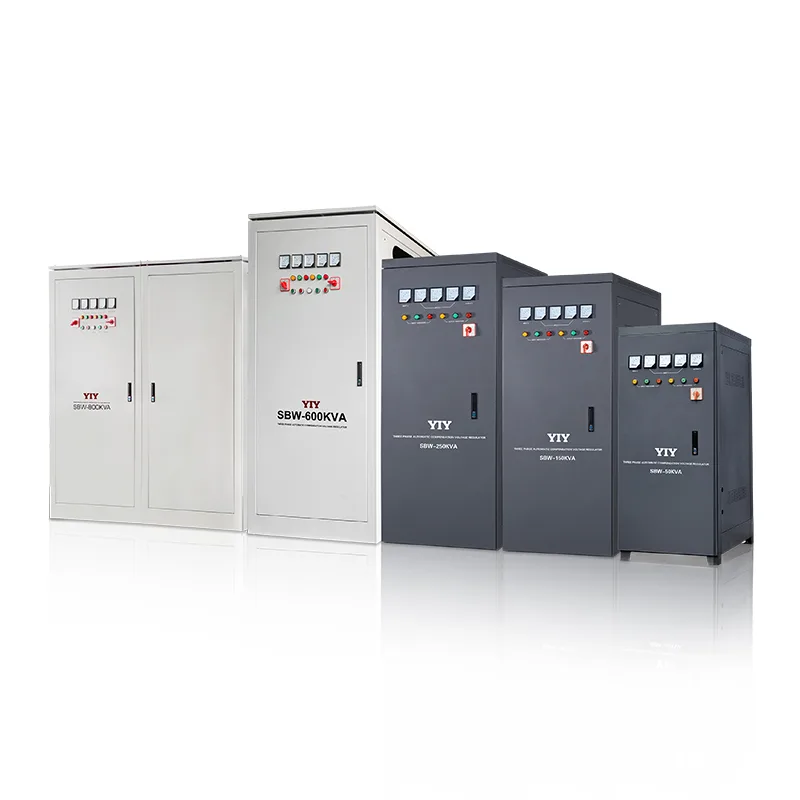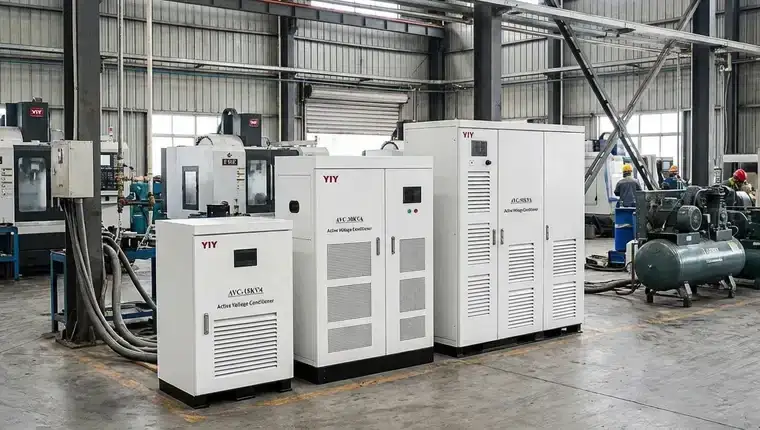
A 15KVA stabilizer price in Nigeria typically starts around ₦620,000 for entry-level servo units with 80–280V input range. That baseline reflects local brands like PRAG, Max, and Proton—adequate for basic voltage correction but without MCU precision, global certifications, or the protection depth industrial loads require. Understanding voltage stabilizer vs voltage protector differences helps clarify which protection level your application actually needs before comparing quotes.
Your real job isn’t finding the lowest price—it’s converting your load list, starting current, input-voltage window, and site conditions into a specification that won’t fail when Nigeria’s grid drops to 80V or spikes to 280V.
Who Needs a 15KVA Stabilizer and What Drives the Decision
Industrial and Commercial Buyers
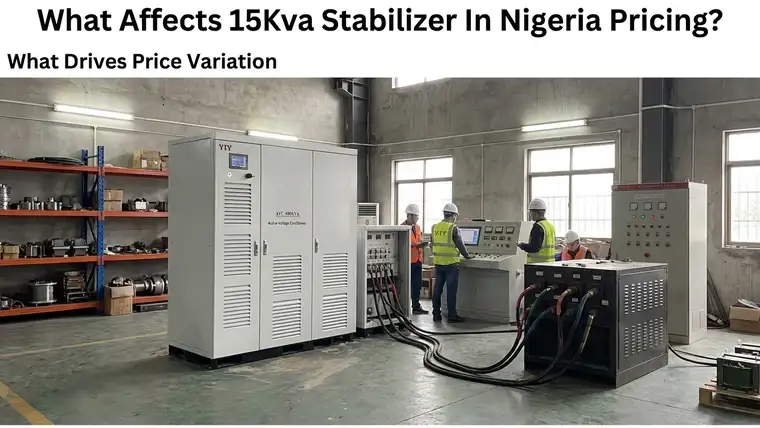
Plant engineers, facility managers, and procurement teams in Nigeria face a recurring problem: voltage sags and surges that damage critical equipment. A 15KVA stabilizer protects industrial loads like CNC machines, commercial elevators, centralized AC units, and production-line controllers that cannot tolerate voltage swings. The buying job is straightforward—find reliable 15KVA stabilizer pricing, compare single-phase versus three-phase options, and request quotes that match actual load profiles and starting currents.
Nigeria’s Grid Reality
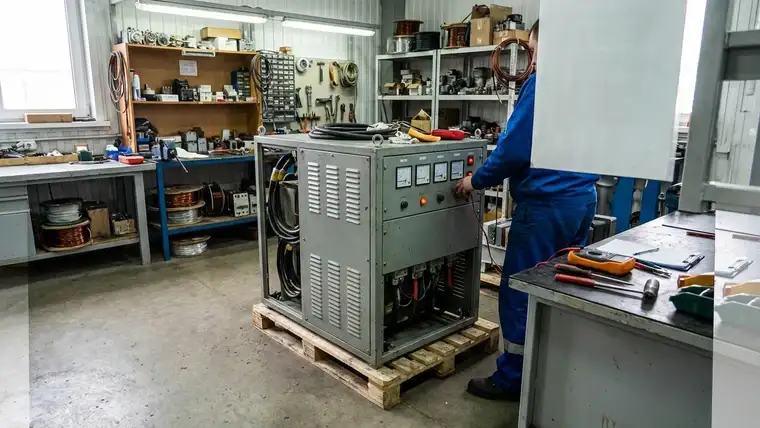
Nigeria’s utility grid rarely delivers stable 220V or 380V. Voltage can sag to 80V during peak demand or spike to 280V when load drops, and these swings destroy motor windings, trip inverters, and corrupt PLC memory. A 15KVA stabilizer with 80–280V input range is not a luxury—it’s the minimum specification to keep equipment running when the grid behaves unpredictably.
The Phase Configuration Decision
Single-phase 15KVA models suit residential villas, small offices, or single large appliances. Three-phase 15KVA stabilizers are mandatory for industrial motors, three-phase AC compressors, and any load that draws power across L1, L2, and L3. If your load list includes three-phase equipment, a single-phase stabilizer will fail to protect it regardless of total KVA capacity.
Local vs Global Manufacturer Trade-offs
Local Nigerian brands offer wide input tolerance and competitive pricing. However, they typically lack MCU-based precision control, ISO 9001:2015 or CE certifications, and advanced protections like motor safeguards or fan-failure cutoffs. Global manufacturers with documented compliance, ±2% output precision, and real-time monitoring command higher prices but deliver predictable performance and warranty support across 130+ countries. The decision hinges on whether your application tolerates ±5–10% output variation or requires servo-grade ±2% stability for sensitive loads.
Load Capacity and Sizing: What Can a 15KVA Stabilizer Carry?
A 15KVA stabilizer typically supports approximately 12KW of continuous equipment load. The sizing formula is straightforward: multiply your total connected load in kilowatts by a safety margin of 1.2 to 1.3, then match the result to the nearest stabilizer capacity. For example, if your facility runs 12KW of equipment (CNC machines, AC compressors, elevators), you calculate 12KW × 1.25 = 15KVA minimum capacity. For lighter loads under 3KW, see our guide on smaller capacity stabilizers for residential and small office applications.
Continuous Load vs Peak Demand
The 12KW guideline assumes resistive or balanced loads with minimal starting surge. Motors, compressors, and inductive equipment draw 3–7 times their rated current during startup, which can momentarily exceed the stabilizer’s continuous rating. A 15KVA unit with 120% overload capability can handle brief inrush currents, but if your load profile includes frequent motor starts or simultaneous equipment activation, size up to 20KVA or 30KVA to prevent nuisance trips.
Three-Phase Unbalanced Load Handling
Three-phase 15KVA stabilizers like YIY’s PRO-3 and SVC-3 series offer 100% unbalanced load capability, meaning each phase can carry its full share even when the other two phases are lightly loaded or idle. This matters in Nigeria’s industrial environments where single-phase equipment often connects to one leg of a three-phase supply. A stabilizer without this capability will trip or fail when phase imbalance exceeds 20–30%.
When to Size Up
Move to 20KVA or 30KVA when your load list includes high-inrush equipment (large motors, welding machines, laser cutters), when you plan to add capacity within 12–24 months, or when input voltage regularly drops below 160V. Low input voltage forces the stabilizer’s transformer to work harder, reducing effective output capacity. If your 12KW load operates in an environment where voltage sags to 140V, the stabilizer may only deliver 10–11KVA safely, making a 20KVA unit the correct choice. See our guide on 20KVA voltage stabilizer pricing for sizing up one capacity tier.
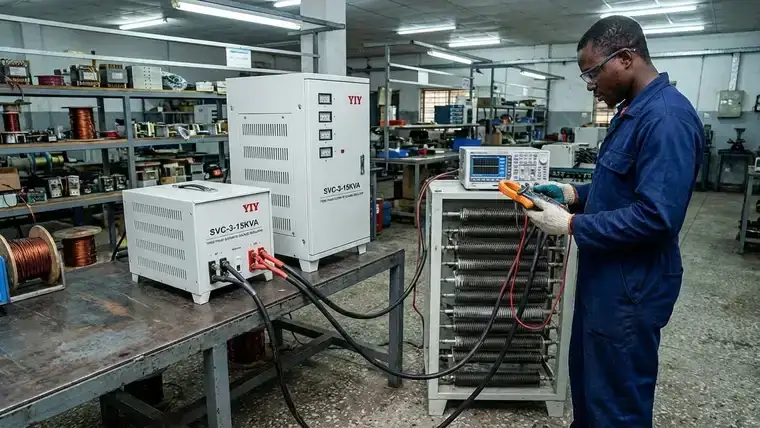
Technology Type: Servo, Relay, or IGBT—Which Affects 15KVA Stabilizer Price Most?
Technology choice is the single biggest variable in 15KVA stabilizer pricing after capacity. The three options—servo, relay, and IGBT—differ in precision, response behavior, and cost, and each targets a different application tier.
Relay Stabilizers: Fast but Coarse
Relay-based stabilizers switch between fixed voltage taps using electromagnetic relays. Response is fast (under 0.5 seconds), but output precision is only ±5–10%—acceptable for residential appliances and lighting, not for motors, CNC machines, or compressors. In Nigeria’s industrial context, ±10% output variation is enough to trip inverters and stress motor windings over time. Relay units are the cheapest option, but the precision gap makes them unsuitable for anything beyond residential or light commercial use.
Servo Stabilizers: The Industrial Standard for Servo Voltage Stabilizer 15KVA Price
Servo stabilizers use a servo motor to continuously adjust a variac’s turns ratio, delivering ±0.5–2% output precision with a 1–2 second response time. MCU control monitors voltage in real time and drives the correction loop, enabling features like motor protection, overload handling at ≥120% rated load, and fan-failure cutoff. This combination of precision, protection depth, and mid-range cost makes servo the correct choice for Nigerian industrial applications—CNC machines, elevators, three-phase AC compressors, and production-line controllers all benefit from ±2% stability without paying IGBT-level premiums.
The MCU also enables diagnostic visibility: colorful LED displays, thermistor over-heat protection, and isolated bypass switching are standard on units like YIY’s PRO-3 series. These aren’t luxury features—they’re the difference between a stabilizer that fails silently and one that alerts operators before damage occurs.
IGBT Stabilizers: Mission-Critical Only
IGBT stabilizers use solid-state switching for near-instantaneous response and output precision tighter than ±1%. They’re the right choice for medical imaging equipment, data centers, and precision manufacturing lines where any voltage deviation causes process failure. The trade-off is cost: IGBT units carry a significant price premium over equivalent servo models. For most Nigerian industrial buyers protecting motors, elevators, and HVAC systems, that premium buys precision they don’t need.
Technology Comparison: Stabilizer 15KVA 3 Phase Price vs Performance
| Technology | Precision | Response Time | Best Application | Price Tier |
|---|---|---|---|---|
| Relay | ±5–10% | <0.5s | Residential / light commercial | Lowest |
| Servo | ±0.5–2% | 1–2s | Industrial motors, CNC, HVAC | Mid |
| IGBT | <±1% | <0.1s | Medical, data center, precision mfg | Highest |
For a 15KVA stabilizer in Nigeria’s industrial environment, servo is the optimal specification. It delivers the precision industrial loads require, includes MCU-driven protections that prevent equipment damage, and prices below IGBT alternatives—making it the correct balance of performance and procurement cost.
Certifications, Compliance, and Manufacturer Scale
Certification status is one of the clearest price differentiators in the 15KVA stabilizer market—and one of the most consequential for industrial buyers who need documented quality assurance, not just a working unit on delivery day.
What Local Nigerian Brands Offer
Local brands like PRAG, Max, and Proton cover the basics: wide input ranges (80–280V or 100–260V) and competitive pricing around ₦620,000. But none carry ISO 9001:2015 quality management standard certification, CE marking, or IEC 60038 standard voltage ratings compliance documentation. Their control architecture typically relies on relay-based or basic servo circuits without MCU precision—meaning output regulation is mechanical rather than software-driven, and protection logic is limited to basic overcurrent cutoffs.
For procurement teams sourcing equipment for industrial facilities, the absence of third-party certification creates audit risk. Insurance underwriters, EPC contractors, and multinational plant operators increasingly require documented compliance before approving equipment for installation.
YIY’s Certification Stack
YIY holds ISO 9001:2015 (quality management), ISO 14001 (environmental management), and CE certification across its stabilizer product lines. These represent documented manufacturing process controls, third-party audits, and compliance with IEC 60038 voltage standards. When evaluating industrial voltage stabilizer manufacturers, look beyond price to manufacturing scale and quality systems—certification separates audit-ready equipment from basic voltage correction.
The PRO-3 series adds MCU-based control that relay-only designs cannot match: ±2% output precision, thermistor over-heat protection, fan failure cutoff, colorful LED status display, and overload handling at ≥120% rated load. The SVC-3 series provides the same servo-grade correction with isolated bypass switching and 100% unbalanced load capability. Both series are engineered to IEC standards, not just sized to local market price points.
Global OEM Scale vs Regional Suppliers
Servomax operates primarily in India with a government-sector focus—limited OEM capability for Nigeria or other export markets. TSI Power emphasizes outdoor and extreme-environment applications, which narrows its industrial indoor fit. YIY exports to 130+ countries with OEM/ODM customization, 1,000,000+ units annual production capacity, and a 30,000㎡ manufacturing facility. That scale means consistent component sourcing, documented quality control at every production stage, and warranty support that regional suppliers cannot replicate.
15KVA Stabilizer Price in Nigeria: Benchmarks and Quote Preparation
A 15KVA single-phase servo stabilizer in Nigeria’s local market typically lists around ₦620,000 for models with 80–280V input range. This baseline reflects entry-level servo units from brands like PRAG, Max, and Proton—adequate for basic voltage correction but lacking the MCU control, global certifications, and advanced protection circuits that industrial applications require. Price climbs when you add ±2% output precision, ISO 9001:2015 certification, motor safeguards, fan-failure cutoffs, and the manufacturing scale to support OEM customization and multi-country warranty coverage.
What Drives Price Variation
Technology type is the first variable: relay stabilizers cost less but deliver only ±5–10% precision, servo units balance cost and ±2% precision for industrial use, and IGBT models command premiums for <±1% precision in mission-critical environments. Certification status separates local suppliers from global manufacturers—ISO 9001:2015, CE marking, and IEC 60038/61000 compliance add cost but also audit-ready documentation and insurance underwriter acceptance. Protection depth matters: basic overcurrent cutoffs are standard, but thermistor over-heat protection, isolated bypass switching, and 100% unbalanced load capability require more sophisticated control architecture and drive unit cost up.
What to Provide for Accurate Quotes
Send your complete load list with equipment nameplates showing rated power and starting current—motors, compressors, and inductive loads draw 3–7× rated current during startup, which affects stabilizer sizing and cost. Specify your site’s input voltage window: if your facility sees 140V sags regularly, the stabilizer’s transformer works harder and you may need to size up one capacity tier. Clarify phase configuration (single-phase or three-phase) and whether your load is balanced across all three phases—unbalanced loads require stabilizers with per-phase correction, not just total KVA capacity.
YIY Differentiation and Volume Options
YIY’s PRO-3 and SVC-3 series deliver MCU-based ±2% precision, motor protection, overload handling at ≥120% rated load, and global certifications across 130+ export markets. Volume orders and OEM customization unlock pricing tiers below retail: 1,000,000+ units annual production capacity means YIY can accommodate bulk procurement. For industrial facilities requiring high-capacity servo stabilizer pricing, the same certification and technology principles apply at scale.
Frequently Asked Questions
What can a 15KVA stabilizer carry?
A 15KVA stabilizer typically supports approximately 12KW of continuous equipment load. This capacity suits industrial applications like CNC machines, commercial elevators, centralized AC units, and production-line controllers. The sizing rule: multiply your total connected load in kilowatts by 1.2 to 1.3 for safety margin. However, motors and compressors draw 3–7 times their rated current during startup, so if your load profile includes frequent motor starts or high-inrush equipment, size up to 20KVA or 30KVA to prevent nuisance trips.
How much is a 15KVA stabilizer in Nigeria?
Local Nigerian 15KVA servo stabilizers typically list around ₦620,000 for models with 80–280V input range from brands like PRAG, Max, and Proton. Price increases when you add MCU-based ±2% precision control, ISO 9001:2015 and CE certifications, motor safeguards, fan-failure cutoffs, and global warranty coverage. Technology type also affects cost—relay stabilizers are cheapest but deliver only ±5–10% precision, servo units balance cost and ±2% precision for industrial use, and IGBT models command premiums for <±1% precision in mission-critical environments.
What should buyers evaluate before choosing a 15KVA stabilizer?
Send your complete load list with equipment nameplates showing rated power and starting current. Specify your site’s input voltage window—if your facility sees 140V sags regularly, you may need to size up one capacity tier. Clarify phase configuration (single-phase or three-phase) and whether your load is balanced across all three phases. Verify certification requirements for insurance underwriters and EPC contractors—ISO 9001:2015, CE marking, and IEC 60038/61000 compliance documentation separate audit-ready equipment from basic voltage correction.
Single-phase vs three-phase 15KVA: which do I need?
Single-phase 15KVA stabilizers suit residential and light commercial loads—villas, small offices, single large appliances. Three-phase 15KVA stabilizers are required for industrial motors, three-phase AC compressors, elevators, and any equipment drawing power across L1, L2, and L3. If your facility has any three-phase equipment, a single-phase unit cannot protect it regardless of KVA rating. Always confirm phase configuration before requesting a quote.
Next Steps: Get a Sizing Review Based on Your Load Profile
Pricing for a 15KVA stabilizer in Nigeria comes down to four variables: actual load capacity and starting current, technology type (relay, servo, or IGBT), certification status, and manufacturer scale. Local brands around ₦620,000 cover basic voltage correction. Servo units with MCU control, ISO 9001:2015 certification, and ±2% precision cost more—but they’re the correct specification for industrial loads that can’t tolerate ±10% output variation or silent failures.
The right next step isn’t requesting a generic quote. It’s converting your load list into a specification: total connected load, motor starting currents, input voltage range at your site, phase configuration, and installation environment.
Share those details with YIY’s engineering team for a sizing review against the PRO-3 or SVC-3 series. That review costs nothing and eliminates the risk of undersizing.
About YIY
Zhejiang Yiyen Holding Group Co., Ltd. (YIY) is a professional voltage stabilizer manufacturer with 16+ years of experience. With a 30,000㎡ modern facility and an annual production capacity of 1,000,000+ units, our products are exported to 130+ countries. We provide OEM/ODM customization services and are ISO 9001:2015 certified, committed to delivering stable and reliable voltage protection solutions to global customers.
Contact Us
Email: yiyen@yiyen.com | Phone/WhatsApp: +86 13587452904 | Website: https://www.yiyavr.com/
For general three-phase sizing guidance: See the Three-Phase Voltage Stabilizer Guide (10–25 KVA) for technology comparison and sizing formulas applicable across all markets.
Nigeria Field Notes: Generator Pairing, Service Risk, and Quote Discipline
Nigeria buyers often make the wrong comparison by treating stabilizer price as a stand-alone appliance cost. In practice, the buying decision is tied to generator compatibility, maintenance logistics, and whether the supplier can still support the installation after commissioning. That is why two 15KVA quotes that look similar on paper perform very differently in the field.
- Estate and office buyers: focus on whether the site is really single-phase or already drifting toward three-phase distribution before locking into a 15KVA quote.
- Clinic and lab buyers: service support and tighter precision usually matter more than the cheapest naira figure.
- Generator-backed sites: confirm stabilizer input range, generator voltage behavior, and transition events together. A quote that ignores generator pairing is incomplete.
- Procurement checkpoint: ask for the real input window, output precision, bypass plan, and after-sales support terms in the same quotation pack — not as follow-up clarifications.
For generator-backed installations, compare against the generator protection page. If the site is already expanding beyond the 15KVA decision band, move to the 10-25 KVA three-phase guide.