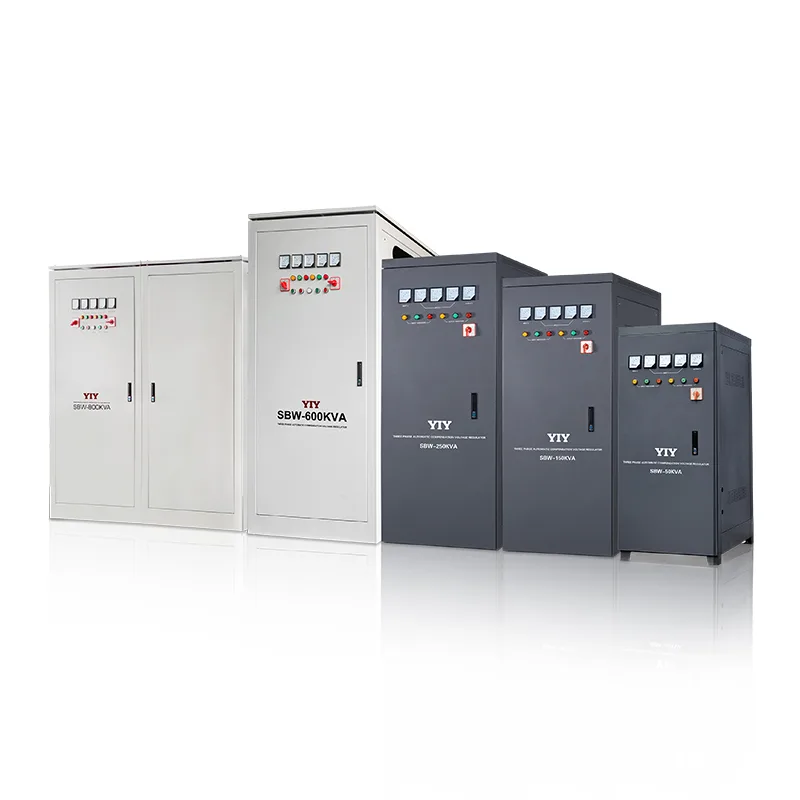
A surge protector clamps voltage spikes that last microseconds; a voltage stabilizer corrects high or low voltage that lasts seconds to hours. They solve different problems, so most industrial panels on an unstable grid need both.
Below, you’ll see what each device does, when a simple voltage protector is enough, and how to size a stabilizer — Relay, Servo, or IGBT — for your load.
Do You Need a Surge Protector, a Stabilizer, or Both?
Pick by the problem your site actually logs, not by the product name. Three devices get confused here, and only one of them keeps equipment running through a long sag.
| Device | What it handles | Event length | What it does | Where it goes |
|---|---|---|---|---|
| Surge protector (SPD) | Lightning and switching spikes | Microseconds | Diverts the spike to earth | Main and sub-distribution boards |
| Voltage protector | Extreme over- or undervoltage | Seconds to hours | Cuts the load off, reconnects after a delay | At non-critical loads |
| Voltage stabilizer (AVR) | Sags, swells, brownouts, phase imbalance | Seconds to hours | Corrects the voltage and keeps the load running | Between the SPD and the load |
A stabilizer isn’t a surge protector. Even the fastest IGBT unit corrects over milliseconds, while a lightning surge is over in microseconds, so surge protective devices tested to the IEC 61643 series stay on the incoming supply. If your logs show long sags or chronic low voltage, that’s stabilizer work — compare options in our voltage stabilizer range.
What Voltage Stabilizers and Protectors Actually Do
Voltage stabilizers and voltage protectors address grid instability through fundamentally different mechanisms. A voltage stabilizer—also called an Automatic Voltage Regulator (AVR)—actively corrects input fluctuations to deliver constant output voltage. For example, when mains supply swings between 90V and 260V, a stabilizer maintains steady 220-230V output by continuously adjusting internal taps or using servo motors or IGBT circuits to compensate in real time.
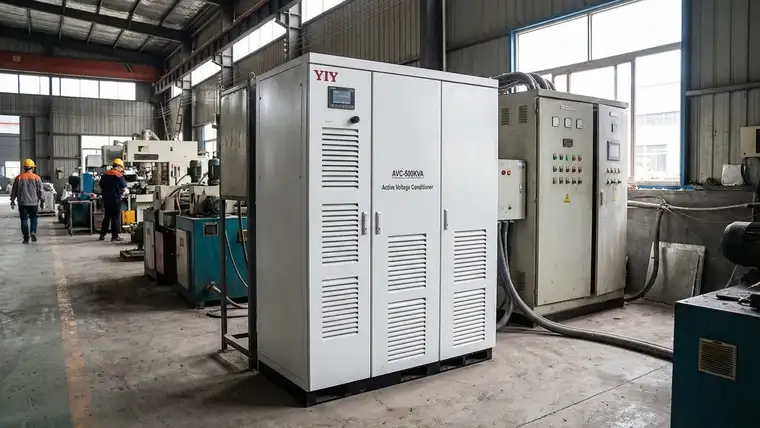
Voltage protectors, by contrast, operate as threshold switches rather than regulators. When input voltage exceeds preset upper or lower limits—typically ±15% of nominal—the protector disconnects the load entirely, then waits through a delay period (usually 30-180 seconds) before reconnecting once voltage returns to safe range. This cut-off approach prevents damage during extreme events but offers no correction for moderate sags or swells, as defined by the 136IEC 60038 standard for voltage tolerances.
Surge Protectors vs. Sustained Voltage Issues
Surge protectors handle a different problem: transient spikes lasting microseconds to milliseconds, often caused by lightning strikes or switching events. These devices divert high-voltage pulses to ground but cannot address sustained brownouts (prolonged low voltage) or overvoltage conditions that last seconds or minutes. Industrial equipment exposed to chronic voltage sags—common in areas with weak grid infrastructure or heavy load cycling—requires active regulation, not just spike suppression.
Grid Instability Scenarios and Equipment Impact
Four voltage disturbances threaten industrial operations: voltage sags (drops below nominal for seconds to minutes), surges (brief overvoltage spikes), brownouts (extended periods of reduced voltage), and swells (sustained overvoltage). CNC machines, inverters, and motor drives respond poorly to these conditions—sags cause nuisance trips and data loss, while surges degrade insulation and shorten component life. Protectors mitigate the worst extremes by disconnecting, but only stabilizers keep equipment running through moderate fluctuations, preserving uptime in environments where grid quality is inconsistent.
Who Needs Continuous Regulation vs Simple Cut-Off
The choice between a voltage stabilizer and a voltage protector hinges on one question: can your operation tolerate brief power interruptions, or does equipment need uninterrupted voltage correction? For facility managers and procurement teams, this translates directly into a trade-off between upfront cost and operational risk—protectors cost less but force downtime during voltage events, while stabilizers maintain continuity by correcting fluctuations in real time.
Applications That Demand Continuous Operation
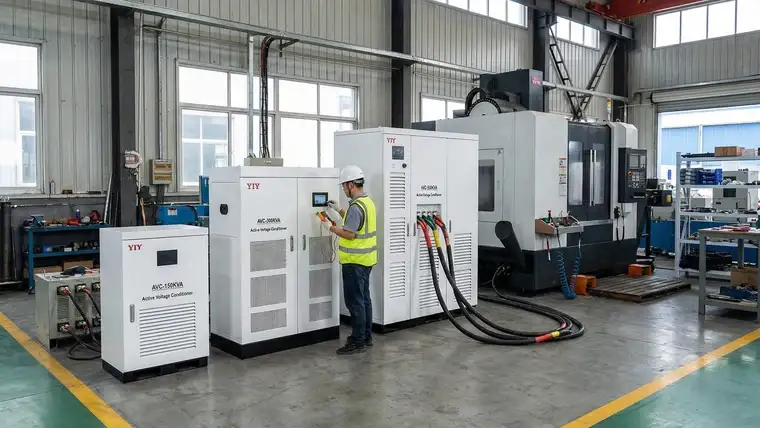
CNC machining centers, variable-frequency drives, and precision inverters cannot afford mid-cycle shutdowns. When a voltage protector trips during a sag, the CNC loses its tool path, the inverter faults, and the production line halts until voltage returns and the protector’s delay timer expires—typically 30 to 180 seconds. A voltage stabilizer, by contrast, rides through the same sag by adjusting output voltage on the fly, keeping the machine running and the part in tolerance.
Three-phase industrial systems face additional risk: unbalanced phase voltages can cause motor overheating and premature failure, conditions a stabilizer corrects but a protector ignores until voltage crosses its trip threshold. For detailed guidance, see our three-phase voltage stabilizer sizing guide.
The Cost-Downtime Calculus
Voltage protectors cost a fraction of an equivalent-capacity stabilizer, but the savings disappear quickly on a grid with frequent disturbances. Each protector trip costs minutes of downtime, scrapped work-in-progress, and restart labor. For a facility experiencing daily voltage sags, the cumulative cost of interruptions can exceed the price delta between a protector and a stabilizer within months.
Procurement teams evaluating total cost of ownership must factor in the cost per interruption, the frequency of grid events, and the value of continuous operation. Our 20 kVA stabilizer pricing guide walks through that calculation.
When Basic Protection Suffices
Voltage protectors make sense for non-critical loads that tolerate brief outages: lighting circuits, HVAC systems, and office equipment. These applications benefit from protection against extreme overvoltage or sustained brownouts without requiring seamless correction. If your site experiences only occasional, severe voltage events—and your equipment can restart cleanly after a trip—a protector delivers adequate protection at minimal cost.
Standards and Precision Requirements
IEC 60038 standard defines standard voltage tolerances for AC power systems, specifying that equipment must handle ±10% input variation from nominal voltage. This standard frames the operating window for both stabilizers and protectors: a 230V system should tolerate 207V to 253V without damage. Voltage stabilizers work within this range to maintain tighter output control, while protectors typically trip at the outer edges—around ±15% to ±20%—to prevent catastrophic failure rather than regulate performance.
Regulation Precision by Technology Type
Precision varies sharply across stabilizer architectures. Relay-based units deliver ±5% to ±8% output accuracy through discrete tap switching—adequate for lighting and HVAC but marginal for sensitive electronics. Servo stabilizers offer balanced precision, typically ±1% to ±3%, by continuously adjusting a variable transformer through motor-driven carbon brushes. IGBT stabilizers achieve ±0.5% regulation through pulse-width modulation and double-conversion topology, making them the precision standard for CNC machines, medical equipment, and process control systems where voltage deviation directly affects product quality or safety.
| Technology | Output Precision | Response Time | Typical Applications | Input Range |
|---|---|---|---|---|
| Relay | ±5-8% | 20-50ms | Lighting, HVAC, general loads | 140-260V |
| Servo | ±1-3% | 40-100ms | CNC, injection molding, process control | 90-280V |
| IGBT | ±0.5% | <10ms | Medical, semiconductor, precision instrumentation | 90-280V |
Response Time and Correction Speed
Response time separates reactive protection from active regulation. Voltage protectors introduce deliberate delay—typically 30 to 180 seconds—between detecting an out-of-range condition and reconnecting power, preventing rapid cycling that could damage contactors. Stabilizers correct continuously instead.
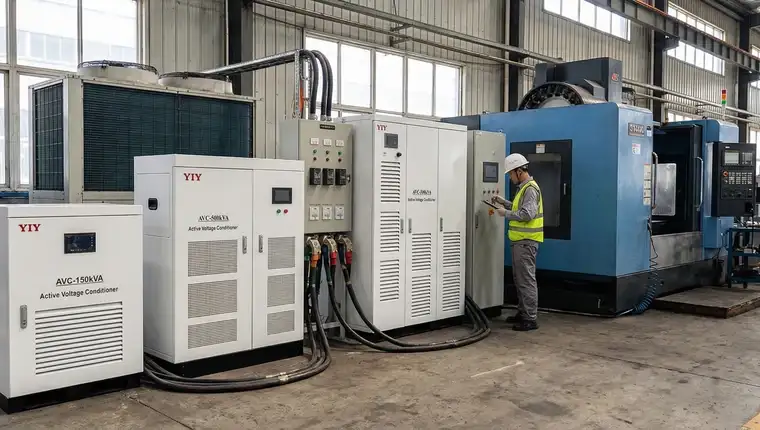
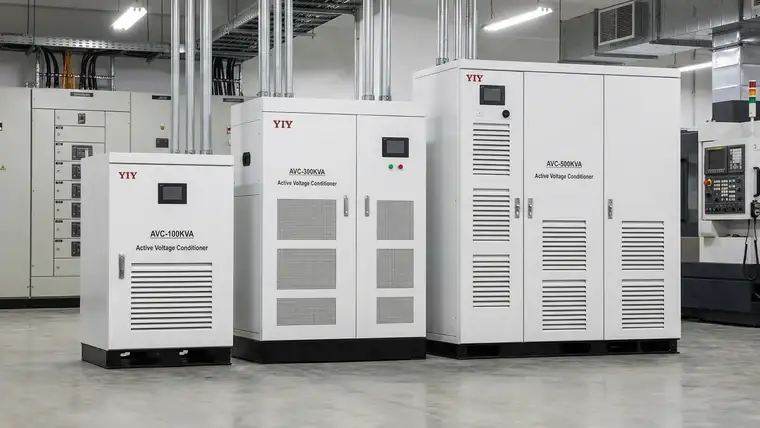
Relay types switch taps within tens of milliseconds. Servo units move a motor-driven brush, so they settle more slowly — YIY’s TWS servo series is specified at ≤2 seconds. IGBT units such as the AVC active voltage conditioner complete correction within half a cycle. For applications where even brief voltage sags cause data loss or process interruption, correction speed becomes a primary selection criterion.
Compliance and Certification Requirements
Industrial voltage regulation equipment must meet Iso 9001 Quality Management.htmlISO 9001:2015 quality management standards and carry CE marking for European markets, demonstrating conformity with Low Voltage Directive (LVD) and Electromagnetic Compatibility (EMC) requirements under EmcIEC 61000 EMC standards. EMC compliance ensures the stabilizer itself does not introduce harmonic distortion or electrical noise that degrades power quality for adjacent equipment—particularly critical in facilities with variable-frequency drives or precision instrumentation.
YIY Stabilizer Technologies vs Basic Protectors
Basic voltage protectors offer cut-off protection at a low entry cost, but they force downtime during every voltage event and provide no correction for the moderate sags and swells that degrade equipment performance over time. YIY’s three stabilizer architectures—Relay, Servo, and IGBT—deliver continuous voltage regulation across industrial load profiles, eliminating the interruption cost that makes protectors expensive in practice.
Relay Stabilizers: Fast Switching for Moderate Loads
Relay-based stabilizers use electromagnetic tap-switching to deliver ±5% to ±8% output precision with response times under 50 milliseconds. This architecture suits lighting systems, HVAC equipment, and general-purpose loads where cost-effectiveness matters more than sub-1% precision. Relay units handle moderate input swings—typically 140V to 260V for 220V nominal—without the mechanical wear of servo motors or the complexity of power electronics.
Servo Stabilizers: Balanced Precision for General Industrial Use
Servo stabilizers strike the middle ground: ±1% to ±3% regulation through motor-driven variable transformers, combining precision with proven reliability for CNC machines, injection molding equipment, and process control systems. The continuous adjustment mechanism responds within 40 to 100 milliseconds and tolerates wider input ranges than relay types, making servo units the workhorse choice for facilities with chronic grid instability but manageable precision requirements.
IGBT Stabilizers: Precision Regulation for Critical Loads
IGBT technology delivers ±0.5% output accuracy with 10-millisecond correction speed through double-conversion topology—AC input rectified to DC, then inverted back to clean AC output. This architecture provides galvanic isolation, suppresses harmonic distortion below 3% THD, and maintains regulation even during severe input transients. Medical equipment, semiconductor fabrication, and high-precision instrumentation demand this level of performance, where voltage deviation directly affects product yield or patient safety.
YIY’s Industrial Differentiation
YIY has built stabilizers since 2008, with a range spanning 0.5kVA to 3000kVA, exports to 130+ countries, three-phase capability, IGBT precision technology, and OEM customization services that basic protector suppliers cannot match. This global reach and manufacturing scale—backed by ISO 9001:2015 certification and CE compliance—positions YIY as the engineering partner for facilities that cannot afford the hidden cost of protector-induced downtime. For comprehensive guidance on Industrial Voltage Stabilizer Manufacturers Guideevaluating stabilizer manufacturers, see our procurement evaluation framework.
Sizing and Selection Framework
Converting load data and site conditions into a stabilizer specification requires five evaluation steps: calculating total load with safety margin, measuring actual input voltage range, profiling load characteristics, determining phase configuration, and applying environmental derating factors. This framework ensures the selected unit handles real-world conditions rather than nameplate assumptions.
Load Calculation and Safety Margin
Start with total connected load in kilowatts, then apply a 1.2 to 1.3 multiplier to account for simultaneous operation and future expansion. For example, a facility with 20KW total load requires 25 to 26KVA minimum capacity—in practice, specify the next standard size up, typically 30KVA. This margin prevents overload during peak demand and extends stabilizer service life by reducing thermal stress on components. For detailed 20kva Voltage Regulator Guide20KVA stabilizer selection guidance, our technical comparison guide provides capacity planning frameworks.
Input Voltage Range Assessment
Measure actual grid voltage at the installation site over 24 to 48 hours using a data logger, capturing minimum and maximum excursions rather than relying on utility nominal ratings. If site measurements show 160V to 270V swings on a 220V nominal system, the stabilizer’s input range must span that window—Relay types typically handle 140V to 260V, while Servo and IGBT units accommodate wider ranges. Undersized input range forces the stabilizer into bypass mode during extreme sags, defeating its purpose.
Load Profile Characteristics
Identify starting current and inrush behavior for motors, transformers, and capacitive loads. Induction motors draw 5 to 7 times running current during startup; if the load includes a 5KW motor (approximately 7KVA running), account for 35 to 50KVA inrush when sizing. Continuous loads require sustained capacity, while intermittent duty cycles allow thermal recovery between peaks—document the duty pattern to avoid over-specifying for short-duration surges.
Phase Configuration and Environmental Derating
Single-phase loads under 10KVA typically use single-phase stabilizers; three-phase industrial equipment demands three-phase units to prevent phase imbalance and neutral current issues. For Voltage Stabilizer 3 Kva Sizing Guidesmaller capacity stabilizer sizing, our 3KVA guide covers single-phase applications. Apply derating factors for ambient temperature above 40°C (reduce capacity 2.5% per 5°C), humidity above 90% (reduce 5%), and altitude above 1000m (reduce 1% per 100m). A 30KVA unit installed at 1500m elevation in 45°C ambient effectively delivers approximately 26KVA.
Frequently Asked Questions
Can a Voltage Stabilizer Replace a Surge Protector?
No. A lightning or switching surge has passed before any stabilizer can react. Keep an SPD on the board feeding the stabilizer, and treat any surge circuit inside the stabilizer as a second line of defence, not the first.
Does Built-In Surge Protection Remove the Need for an SPD?
Rarely for a whole installation. Built-in protection guards the stabilizer and the loads behind it, not the other circuits on that board. Ask the supplier for the surge rating in kA and the test standard, then compare it with the SPD class your electrical designer specified.
Where Should the Surge Protector Sit Relative to the Stabilizer?
Upstream, at the main or sub-distribution board that feeds it. Keep the SPD earth leads short and straight; long, looped leads add voltage during a surge and weaken the clamp.
Next Steps
Choosing between a voltage stabilizer and a voltage protector comes down to four evaluation points: whether your equipment tolerates interruptions, the actual site voltage range, load characteristics including starting current, and environmental conditions. Protectors suit non-critical loads in stable grids; stabilizers become essential when CNC machines, inverters, or three-phase systems require continuous operation through moderate voltage swings.
To convert this framework into a specification, document your total connected load, measure site voltage over 24-48 hours, identify motor starting currents, confirm phase configuration, and note ambient temperature and altitude. YIY’s engineering team can review these inputs and recommend the appropriate stabilizer type—Relay, Servo, or IGBT—with correct capacity and input range for your application.