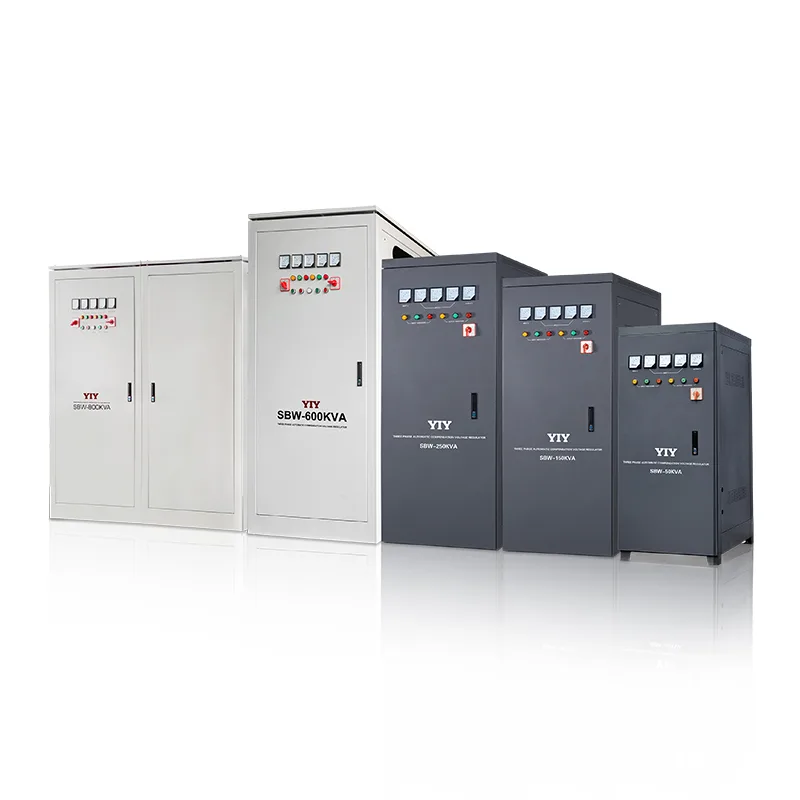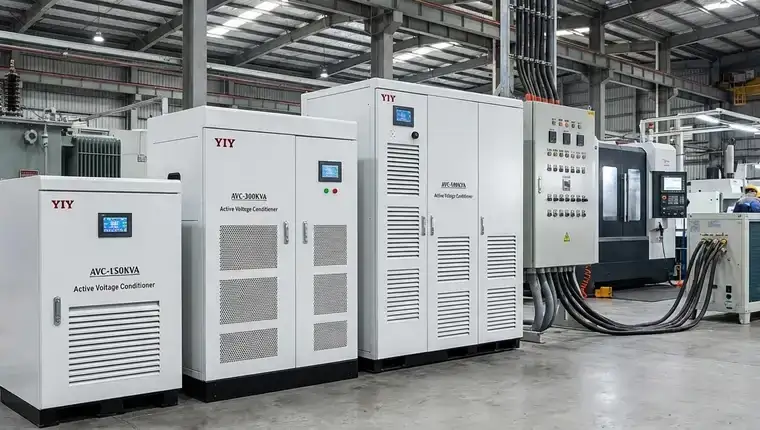
Industrial voltage fluctuations damage equipment and halt production—but choosing the wrong stabilizer technology compounds the problem. Procurement teams evaluating relay, servo, and IGBT stabilizer voltage regulators face precision tradeoffs that directly affect equipment lifespan and total cost of ownership.
A relay unit’s ±5-8% tolerance may suffice for general loads, while servo’s ±0.5-3% suits most industrial applications, and IGBT’s ±0.5% precision protects mission-critical systems.
This guide maps the decision criteria: technology principles, sizing calculations with safety margins, compliance requirements, and application fit. You’ll see where each type excels, how to calculate load with the 1.2-1.3x safety factor, and which standards separate verified solutions from generic claims.
What a Stabilizer Voltage Regulator Actually Does
A stabilizer voltage regulator—commonly called an automatic voltage regulator (AVR) or voltage stabilizer—maintains constant output voltage regardless of input fluctuations from the utility grid. When incoming voltage swings between 160V and 260V, the device corrects it to a stable 220V ±1-3%, depending on the technology. This correction happens continuously and automatically, without operator intervention.
The Core Problem: Grid Instability
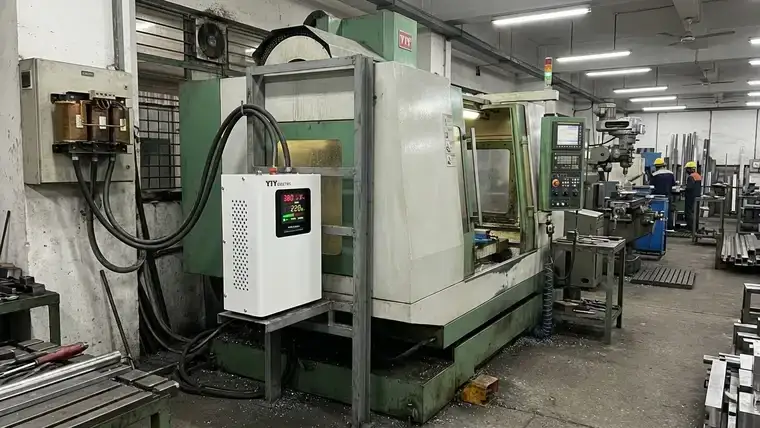
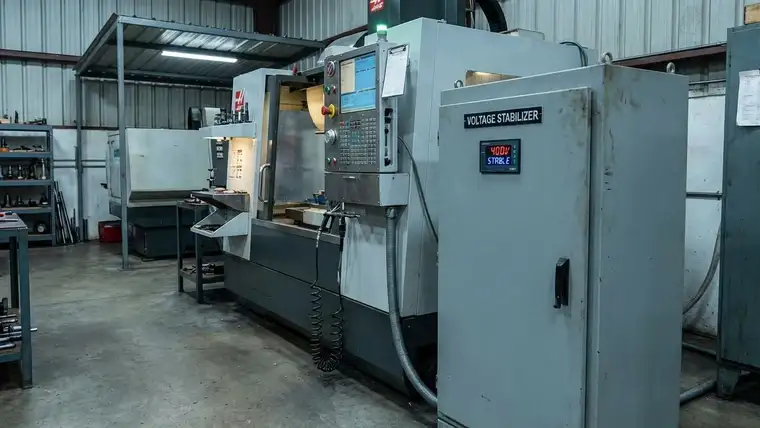
Utility grids deliver inconsistent voltage due to load switching, transformer tap changes, and transmission losses. Voltage sags drop below nominal for seconds or minutes, while surges spike above it. Brownouts—sustained low voltage—occur during peak demand. Each event stresses equipment: motors overheat, control circuits misfire, and power supplies fail prematurely. A CNC machine experiencing ±15% voltage swings may see spindle speed errors, servo faults, and shortened component life.
Terminology Overlap
“Stabilizer” and “regulator” are used interchangeably in industrial contexts, though “stabilizer” emphasizes correction range (±20-40% input tolerance) while “regulator” historically referred to narrower correction. Both terms describe the same function: delivering stable output from unstable input. The AVR designation is universal across IEC and IEEE standards.
Application Scope
Industrial facilities deploy stabilizers for CNC machines, injection molding, and process control. Commercial buildings protect HVAC systems, elevators, and IT infrastructure. Residential use centers on sensitive electronics and appliances in regions with chronic grid instability. Capacity ranges from 0.5KVA single-phase units to 3000KVA three-phase systems.
Who Needs Voltage Stabilization and Why
Industrial engineers and facility managers face a common challenge: protecting capital equipment from grid instability. When a CNC machine experiences voltage swings, spindle speed errors and servo faults follow—downtime that procurement teams measure in lost production hours and shortened component life. Medical facilities face even higher stakes, where voltage sags can trigger equipment shutdowns during critical procedures.
Equipment at Risk
Precision machinery operates within narrow voltage tolerances. CNC machining centers require stable power for servo drives and control circuits; voltage drops below 200V cause position errors and tool crashes. Medical imaging equipment—CT scanners, MRI machines, X-ray systems—shuts down or produces unreliable results when input voltage fluctuates beyond ±5%. Process control systems in manufacturing lose calibration, injection molding machines produce defective parts, and automated assembly lines halt when voltage sags persist for more than 100 milliseconds.
Grid Instability Scenarios
Voltage stabilization becomes necessary when utility supply swings exceed equipment tolerance. Industrial parks near heavy loads—steel mills, arc furnaces, large motor starts—see voltage sags of 15-25% lasting seconds to minutes. Rural facilities on long distribution lines experience chronic low voltage during peak demand. Regions with aging grid infrastructure face daily brownouts and surges from transformer tap changes and load switching.
Procurement Decision Context
Buyers evaluate stabilizers against three criteria: precision match to equipment tolerance, capacity sized with safety margin, and compliance with regional standards. The decision centers on balancing upfront cost against downtime risk—a calculation that depends on equipment value, production criticality, and grid reliability history.
Relay vs. Servo vs. IGBT: Technology Comparison
Three core technologies dominate voltage stabilization, each trading precision for cost and response characteristics. Understanding these tradeoffs determines which type protects your equipment without over-specifying—or under-protecting.
Relay Stabilizers: Fast and Cost-Effective
Relay stabilizers use electromagnetic contactors to switch transformer taps in discrete steps. When input voltage drops, the relay closes to select a higher tap; when voltage rises, it switches to a lower tap. This mechanical switching delivers ±5-8% output precision with response times under 20 milliseconds—fast enough for most general loads. The technology is mature, reliable, and cost-effective, making relay units the default choice for non-critical applications where moderate voltage swings are acceptable.
Servo Stabilizers: Industrial Workhorse
Servo stabilizers employ a motor-driven variable autotransformer (variac) controlled by a microcontroller. The servo motor continuously adjusts the brush position on the variac winding, delivering ±0.5-3% precision depending on load and input range. Response time is 1-2 seconds—slower than relay but sufficient for industrial machinery that tolerates brief transients. Servo units balance precision, reliability, and cost, which is why they dominate CNC machining, injection molding, and process control installations.
YIY’s servo line spans 0.5KVA to 3000KVA, covering single-phase and three-phase applications.
IGBT Stabilizers: Mission-Critical Precision
IGBT stabilizers use pulse-width modulation (PWM) with a double-conversion topology: AC input is rectified to DC, then inverted back to AC at the target voltage. This approach isolates the output from grid disturbances and achieves ±0.5% precision with sub-cycle response. The tradeoff is cost—IGBT units are 30-50% more expensive than equivalent servo models. They’re specified for medical imaging, semiconductor fabrication, and data centers where voltage deviation directly affects product quality or uptime.
Technology Selection Matrix
| Technology | Precision | Response Time | Cost | Best For |
|---|---|---|---|---|
| Relay | ±5-8% | <20ms | Lowest | General loads, lighting, HVAC |
| Servo | ±0.5-3% | 1-2s | Moderate | CNC, molding, industrial automation |
| IGBT | ±0.5% | <10ms | Highest | Medical, semiconductor, data centers |
YIY’s multi-technology portfolio addresses this spectrum, while competitors locked into a single technology force buyers to compromise. A facility with mixed loads—general HVAC, precision CNC, and mission-critical control systems—can deploy relay, servo, and IGBT units where each fits best, rather than over-specifying expensive IGBT protection for every circuit.
How to Size and Select the Right Capacity
Sizing a stabilizer voltage regulator starts with calculating total connected load across all equipment that will draw power simultaneously. Add the rated power of each device—motors, control systems, lighting, auxiliary equipment—then multiply by a safety margin of 1.2 to 1.3 to account for inrush current and future expansion.
For example, a facility with 15KW CNC machines, 2KW lighting, and 3KW auxiliary loads totals 20KW; applying a 1.25 safety factor yields 25KVA, so you’d specify a 30KVA unit as the next standard size.
Matching Precision to Application Requirements
Equipment tolerance dictates technology choice. General loads like HVAC, lighting, and non-critical machinery tolerate ±5-8% voltage variation, making relay stabilizers cost-effective. Industrial automation—CNC machining, injection molding, process control—requires ±0.5-3% precision, where servo stabilizers deliver the best balance of accuracy, reliability, and cost. Mission-critical applications such as medical imaging, semiconductor fabrication, and data centers demand ±0.5% precision with sub-cycle response, necessitating IGBT technology despite the 30-50% cost premium.
Environmental and Input Range Considerations
Operating environment affects stabilizer performance and lifespan. High ambient temperatures (above 40°C) require derating or forced ventilation; humidity above 90% demands conformal coating or sealed enclosures. Altitude above 1000 meters reduces cooling efficiency and may require capacity derating of 1% per 100 meters. Dust, corrosive atmospheres, and vibration in industrial settings favor sealed relay or IGBT units over servo models with exposed brush contacts.
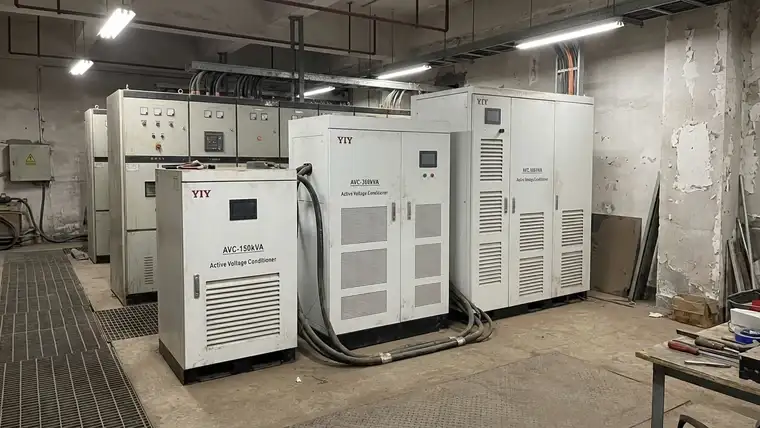
Input voltage range determines correction capability. Standard stabilizers handle ±10% input variation per IEC 60038, correcting 198-242V to 220V ±1-3%. Regions with chronic grid instability—voltage sags below 180V or surges above 260V—require wide-range models with ±20-30% correction capability. Verify that the stabilizer’s input tolerance envelope covers your site’s worst-case grid conditions, documented through voltage logging or utility records.
Standards, Certifications, and Compliance
Compliance documentation separates verified manufacturers from generic suppliers. When evaluating stabilizer voltage regulators, procurement teams should distinguish between mandatory requirements that affect market access and optional certifications that signal manufacturing maturity.
IEC 60038: Global Voltage Standards
IEC 60038 defines standard voltage levels and tolerances for electrical equipment worldwide. Stabilizers conforming to this standard accept ±10% input voltage variation—for example, 198V to 242V for a 220V nominal system—and maintain stable output within specified limits. This tolerance envelope determines whether a stabilizer can handle your site’s grid conditions. YIY stabilizers are designed to IEC 60038 specifications, with automatic alarms when input exceeds the correction range.
ISO 9001:2015 And Manufacturing Quality
ISO 9001:2015 certification verifies that a manufacturer maintains documented quality management systems for design, production, and testing. For stabilizers, this means controlled processes for transformer winding, component selection, and final testing. YIY holds ISO 9001:2015 certification, covering the full product lifecycle from engineering to delivery. This certification is voluntary but indicates process discipline that affects product consistency.
CE Marking for EU Market Access
CE marking is mandatory for stabilizers sold in the European Union. It declares conformity with EU safety, health, and environmental directives, including the Low Voltage Directive (LVD) and Electromagnetic Compatibility (EMC) Directive. YIY stabilizers carry CE marking, enabling direct deployment in EU facilities without additional certification.
ISO 14001 Environmental Management
ISO 14001 certification addresses environmental impact during manufacturing. While not required for product performance, it signals that the manufacturer manages waste, energy use, and material sourcing systematically. YIY maintains ISO 14001 certification as part of its environmental management framework.
GB/T Chinese Standards Gap
Specific GB/T standards for voltage stabilizers from China’s national standards database remain under collection. This gap will be addressed in future updates as regulatory requirements clarify.
Why YIY’s Multi-Technology Portfolio Matters
Most voltage stabilizer suppliers specialize in one technology. That forces buyers to either over-specify—deploying expensive IGBT units across general loads—or under-protect, using relay units where servo precision is required. YIY’s portfolio covers all three technologies across a single vendor relationship, which matters when a facility runs mixed loads with different protection requirements.
16+ Years Across the Full Capacity Spectrum
YIY has been manufacturing voltage stabilizers since 2008, accumulating over 16 years of application experience across industrial, commercial, and infrastructure deployments. The product range spans 0.5KVA single-phase units for sensitive electronics up to 3000KVA three-phase systems for large industrial facilities—a range few manufacturers cover end-to-end. This breadth means engineering teams can source relay, servo, and IGBT units from a single supplier without managing multiple vendor qualifications.
Three Technologies, One Supplier
Where competitors lock buyers into a single-technology catalog, YIY’s portfolio maps directly to the precision tiers covered earlier in this guide:
- Relay line: Fast response, lowest cost, suited for general loads
- Servo line: ±0.5-3% precision, the industrial workhorse for CNC and process control
- IGBT line: ±0.5% with sub-cycle response, for medical and mission-critical applications
A facility deploying all three types—HVAC on relay, CNC machines on servo, and a medical imaging suite on IGBT—can consolidate procurement, spare parts, and technical support under one manufacturer.
Manufacturing Scale and Global Reach
YIY operates a 30,000㎡ facility with annual production capacity exceeding 1,000,000 units. Products are exported to 130+ countries, with 120+ long-term distribution partners providing local support. ISO 9001:2015 certification covers the full product lifecycle from engineering through delivery, with a reported 99.5%+ factory pass rate on quality inspection. CE marking enables direct EU deployment without additional certification steps.
The combination of technology breadth, manufacturing scale, and certified quality processes is what separates a multi-technology portfolio from a catalog of unrelated products.
Frequently Asked Questions
What Is the Difference Between a Voltage Stabilizer and a Voltage Regulator?
In practice the two names mean the same device: it holds output voltage steady while the grid supply moves. Older catalogues used “regulator” for units with a narrow correction band, but the AVR label now covers both. When you compare suppliers, ignore the name on the nameplate and compare the output precision and input window each one guarantees.
When Is a Stabilizer Voltage Regulator Necessary?
Stabilization becomes necessary when utility voltage swings exceed your equipment’s tolerance. CNC machines, medical imaging systems, and process control equipment typically tolerate ±5% or less. Industrial parks near heavy loads—arc furnaces, large motor starts—see sags of 15–25%. Rural facilities on long distribution lines face chronic low voltage during peak demand. If your site’s voltage log shows swings beyond what your equipment spec allows, a stabilizer is not optional—it’s the difference between reliable operation and premature failure.
How Should I Size a Stabilizer Voltage Regulator for My Equipment?
List every load that runs at the same time and total it in kVA, then add headroom for motor inrush and planned expansion. Round up to the next standard frame size. On three-phase supplies, check the load on each phase separately, and make sure the rated input window spans the lowest and highest voltages your logger recorded.
If your load profile stays inside the medium industrial band, use our 10–25 KVA three-phase selection guide for a dedicated sizing walkthrough covering workshop panels, packaging lines, and CNC cells before stepping into larger-frame models.
Final Thoughts
Choosing the right stabilizer voltage regulator comes down to three decisions: match technology to your equipment’s precision tolerance, size capacity with a 1.2-1.3x safety margin, and verify compliance with regional standards. Relay units deliver fast, cost-effective protection for general loads. Servo stabilizers balance precision, reliability, and cost for industrial applications. IGBT technology provides mission-critical accuracy where voltage deviation directly affects product quality or uptime.
The decision isn’t about finding the “best” stabilizer—it’s about identifying which type protects your specific equipment without over-specifying or under-protecting. YIY’s multi-technology portfolio lets you deploy the right solution for each load rather than forcing a single-technology compromise across mixed applications.
Next step: Contact YIY’s engineering team for a comparison-based consultation. We’ll help you evaluate tradeoffs, review proof points, and build a shortlist based on your load profile, grid conditions, and compliance requirements.
If you found this article helpful, contact us for a sizing review or customized solution.
Related reading: 20Kva Voltage Stabilizer: Technical Guide.