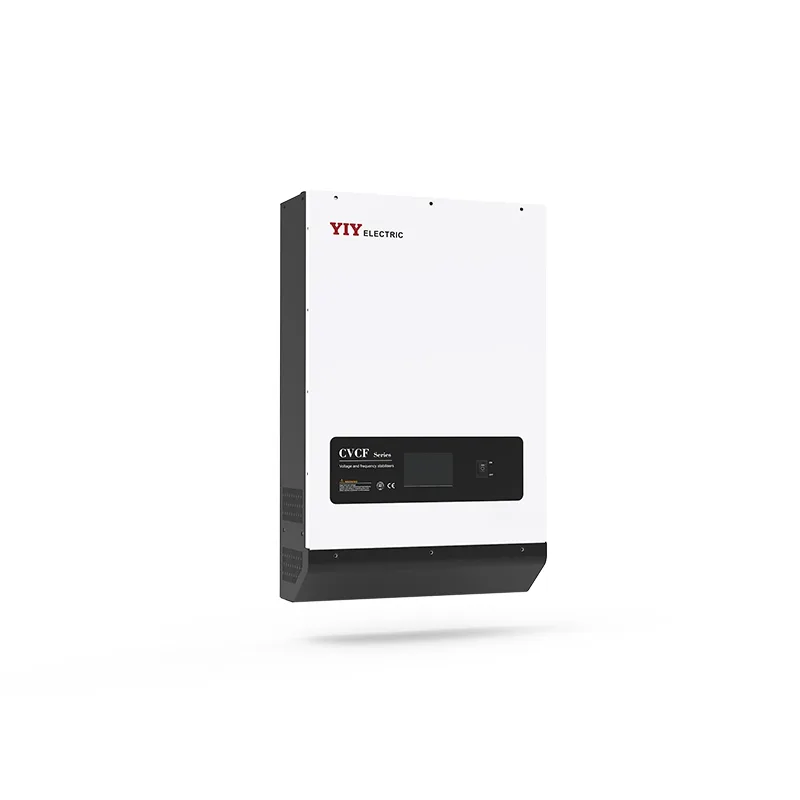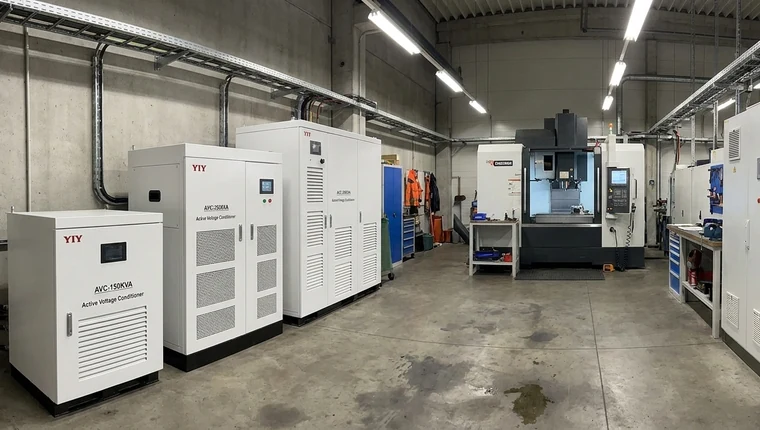
Choose a voltage stabilizer when your main problem is voltage fluctuation; choose a UPS when your load must keep running during a power cut.
The voltage stabilizer vs UPS decision is not about which device is “better” in general—it is about whether you are paying for voltage correction, battery runtime, or both.
What Are You Really Trying to Protect Against?
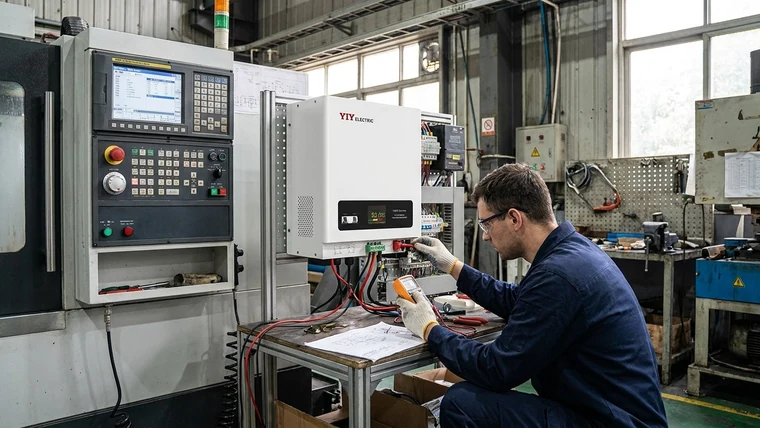
You are choosing between voltage quality protection and power continuity protection. If your grid stays on but voltage rises, drops, or fluctuates, an automatic voltage regulator or stabilizer is usually the right starting point; if even a short outage causes data loss, process interruption, or safety risk, you need UPS backup.
| Your site condition | Better-fit direction | What it means for you |
|---|---|---|
| Frequent low voltage, high voltage, or unstable mains | Voltage stabilizer / AVR | You correct the voltage without paying for battery runtime you may not need. |
| Short outages cause data loss, shutdown issues, or production loss | UPS | You get stored energy so the load can ride through or shut down safely. |
| Poor voltage quality plus outages | Stabilizer + UPS | You treat voltage fluctuation and interruption as separate risks. |
| Stable utility power but sensitive equipment trips on voltage swings | Servo or static stabilizer | You improve voltage consistency for CNC, telecom, medical, or control loads. |
| IT, telecom, PLC, or lab systems need minutes of autonomy | UPS | You specify runtime, batteries, bypass, and maintenance access. |
A voltage stabilizer, also called an AVR or automatic voltage regulator, corrects incoming voltage and keeps the output closer to the load’s required range. It does not provide stored energy. If the mains supply drops to zero, your load stops unless a UPS, generator, or another backup source takes over.
A UPS may include voltage regulation, but its defining feature is battery-backed runtime. That runtime matters when your equipment cannot tolerate even seconds of interruption.
For industrial voltage fluctuation, a servo voltage stabilizer is often a practical first option because it is designed to regulate sags, swells, and unstable input voltage for production equipment, CNC machines, workshops, and three-phase loads.
For nominal voltage context, IEC 60038 standard voltages provides internationally standardized AC voltage references. In practical terms, this helps you compare your local supply, equipment nameplate voltage, and acceptable operating tolerance before you size a stabilizer or UPS.
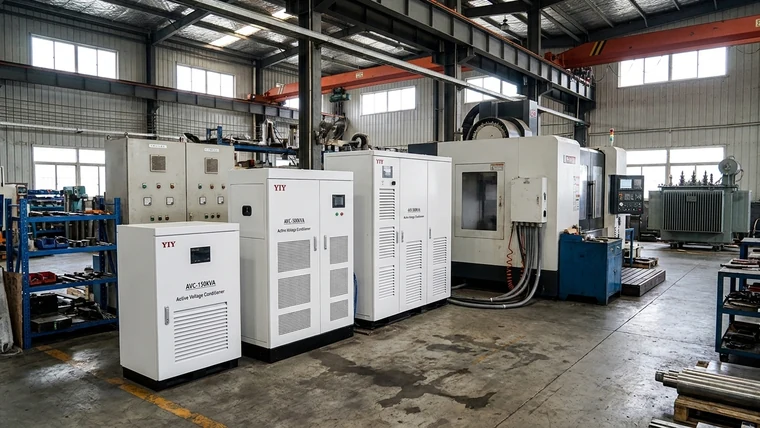
Can a UPS Work as a Stabilizer?
Only some can. IEC 62040-3 sorts UPS designs into three classes, and they treat voltage swings very differently. Ask which class a quoted UPS belongs to before you assume it will stabilize your supply.
| UPS class (IEC 62040-3) | Common name | What happens during a voltage swing | Can it replace a stabilizer? |
|---|---|---|---|
| VFD (voltage and frequency dependent) | Offline / standby | Passes mains through; switches to battery once input leaves its window | No. Frequent swings drain the battery |
| VI (voltage independent) | Line-interactive | Built-in AVR corrects moderate swings within a limited range | Partly, for small loads and moderate swings |
| VFI (voltage and frequency independent) | Online double-conversion | Rebuilds the output continuously, so input swings do not reach the load | Yes for its own load, at higher cost per kVA |
Use this quick decision path:
- Does the load have to keep running during a power cut? If no, start with a stabilizer.
- If yes, does the supply also swing often? If no, a UPS alone may be enough.
- If both, compare an online UPS sized for the load with a stabilizer feeding a smaller UPS, and check the stabilizer section below.
When Does a Voltage Stabilizer Fit Better Than a UPS?
A voltage stabilizer fits better when your power usually stays on, but the voltage is too unstable for your equipment. In that case, your buying problem is voltage correction—not battery autonomy.
You should lean toward a stabilizer when your site has:
- Frequent undervoltage or overvoltage
- Generator or transformer voltage variation
- CNC machine alarms caused by unstable input
- Motor controls, compressors, pumps, or production lines affected by sags
- Telecom, medical support, or control equipment that needs stable voltage but not long backup time
- A procurement goal to protect equipment without adding UPS battery maintenance
Typical servo stabilizer performance such as ±0.5%–3% output accuracy and ≤1–2 s response means the unit can correct gradual voltage movement tightly enough for many industrial loads. For you, that means fewer voltage-related trips and a more stable supply to connected equipment—provided the stabilizer is sized correctly and its input range matches your real site voltage.
A power conditioner vs stabilizer comparison depends on the actual product design. Some “power conditioners” are essentially voltage regulators. Others add filtering for electrical noise, spikes, or transients. If your site has sensitive electronics, generator power, or communication equipment, you should verify whether the device only regulates voltage or also provides filtering and surge protection.
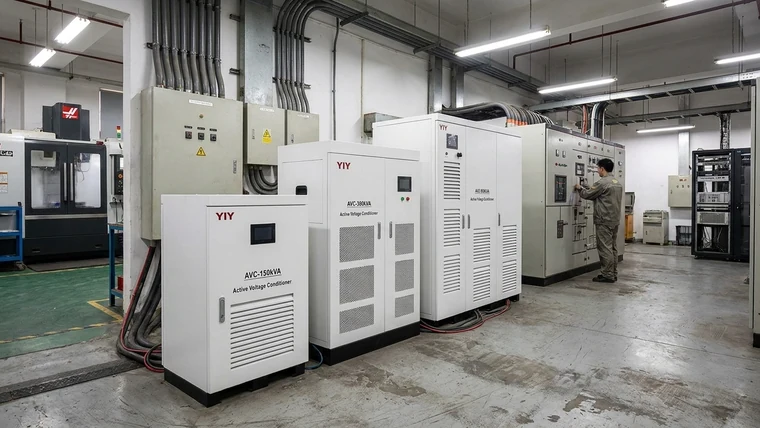
Be careful with terms such as “UPS stabilizer” or “servo UPS.” A pure servo stabilizer does not include batteries. If a supplier uses those terms, ask for the datasheet and confirm whether the device has a charger, inverter, batteries, transfer time, and runtime rating.
When Is a UPS the Better Choice?
A UPS is the better choice when your load must continue operating during an outage or shut down in a controlled way. If your risk is interruption rather than fluctuation, voltage regulation alone will not protect your process.
UPS systems are common for:
- Servers and data rooms
- Telecom racks and network cores
- PLCs, HMIs, and control computers
- Lab instruments and medical electronics
- Security systems and emergency communication equipment
- Any load where sudden shutdown creates data loss, restart delay, scrap, or safety risk
Your UPS specification should focus on runtime in minutes, battery type, load power factor, overload capacity, bypass design, recharge time, and maintenance access. A UPS with AVR may correct moderate voltage movement, but it is not automatically the best replacement for a dedicated stabilizer under severe or continuous fluctuation.
The standard IEC 61000-4-11 voltage dip and interruption immunity testing is relevant because it addresses dips, short interruptions, and voltage variation immunity. For you, the practical takeaway is simple: if your equipment cannot ride through dips or interruptions by itself, you must specify an external protection layer such as a UPS, stabilizer, or both.
How Do Stabilizer Technologies Compare with UPS Designs?
You should compare the regulation method, backup capability, precision, and maintenance burden before you compare price. A stabilizer manages voltage quality; a UPS manages voltage quality plus stored-energy runtime.
| Technology | Main function | Typical regulation behavior | Backup power | Maintenance focus | Best fit |
|---|---|---|---|---|---|
| Servo stabilizer | Voltage correction | Smooth correction, commonly ±0.5%–3% | No | Servo motor, variac/contact parts, ventilation | CNC, motors, production lines, workshops |
| Relay AVR | Voltage correction | Step-based tap switching, commonly ±5%–8% | No | Relay wear, tap switching tolerance | Less sensitive loads, smaller budgets |
| IGBT/static stabilizer | High-precision voltage correction | Electronic DSP/PWM regulation, often around ±0.5% | No | Cooling, electronics, filters | Sensitive electronics, telecom, medical support loads |
| UPS | Runtime plus conditioning | Varies by line-interactive or online topology | Yes | Batteries, fans, capacitors, bypass, runtime tests | Servers, PLCs, telecom, data, controlled shutdown |
A relay voltage stabilizer may be enough when your load can tolerate step changes and wider voltage tolerance. For you, that can reduce cost, but it may not be suitable for sensitive CNC controls, medical support equipment, or loads that require tighter regulation.
Servo stabilizers are often the middle ground for industrial sites: more precise than relay AVR designs, usually more economical than high-end UPS capacity when runtime is not required, and suitable for frequent sags and swells.
Static or IGBT stabilizers fit loads where precision and response matter more than mechanical simplicity. If your equipment is highly sensitive to voltage variation, harmonics, or waveform quality, this technology tier may deserve evaluation alongside online UPS options.
Which Sizing Checks Should You Complete Before Selecting Equipment?
Choose only after you measure your real load, input voltage range, phase type, startup current, power factor, environment, and runtime requirement. This prevents you from buying a device that looks correct on paper but fails during motor starts, voltage dips, generator operation, or maintenance events.
Start with a complete load list. Record each machine, control cabinet, pump, compressor, lighting circuit, telecom device, computer, or auxiliary load. Then convert kW to kVA where needed and allow margin.
A common stabilizer sizing rule is:
Required stabilizer capacity = total load × 1.2 to 1.3 safety margin
For example:
15 kW CNC + 2 kW lighting + 3 kW auxiliary load = 20 kW
20 kW × 1.25 = 25 kVA
In practical terms, you would evaluate a 25–30 kVA stabilizer class, then adjust for power factor, startup current, future expansion, and the manufacturer’s overload limits. The safety margin matters because your load rarely behaves like a steady spreadsheet number; motors, compressors, transformers, and CNC spindles can draw much higher current during startup.
For three-phase systems, use a more detailed 3 phase main line stabilizer sizing review before you finalize the kVA rating, wiring scheme, and protection settings.
| Check | Why it matters | If you skip it |
|---|---|---|
| Single-phase or three-phase supply | Determines topology, wiring, and load balancing | You may buy the wrong model or create unsafe installation conditions. |
| Measured input voltage range | Confirms whether the unit can regulate your real grid conditions | The stabilizer or UPS may bypass, alarm, or fail to correct voltage. |
| kW, kVA, and power factor | Ratings are often in kVA, while loads are listed in kW | A unit that seems large enough may overload in operation. |
| Startup or inrush current | Motors and compressors draw more during startup | You may see voltage dips, overload alarms, or failed starts. |
| Required UPS runtime | UPS sizing depends on minutes of autonomy | You may still lose the load during an outage. |
| Generator compatibility | Generator voltage and frequency can be unstable | UPS transfer faults or unstable stabilizer correction can occur. |
| Dust, humidity, heat, and ventilation | Environment affects cooling, cabinet design, and derating | Components may overheat, corrode, or fail early. |
| Bypass and maintenance access | Serviceability affects downtime | A small fault can become a long production stop. |
| Alarms, monitoring, and event logs | Maintenance teams need visibility into voltage events | Repeated disturbances may remain invisible until equipment trips. |
For a reusable RFQ checklist, your industrial voltage stabilizer selection process should include total load, power factor, startup current, input-voltage range, phase type, application sensitivity, cabinet environment, and service expectations.
Can You Connect a Stabilizer Before a UPS?
You can connect a stabilizer upstream of a UPS when your site has both unstable voltage and outage risk. The stabilizer improves incoming voltage quality; the UPS provides battery-backed ride-through when power fails.
This setup is common when:
- Utility voltage fluctuates frequently
- Generator voltage is unstable
- UPS input range is being stressed
- Sensitive equipment needs both clean voltage and runtime
- Battery-backed systems are exposed to frequent sags or swells
Before you implement this architecture, verify:
| Check | Why it matters | If you skip it |
|---|---|---|
| Stabilizer kVA rating | It must support the UPS input and downstream load | The stabilizer may overload before the UPS protects the load. |
| UPS input-voltage window | Confirms the stabilizer output matches UPS requirements | The UPS may transfer, alarm, or reject input power. |
| Grounding and neutral arrangement | Prevents protection conflicts and unsafe faults | You may create nuisance trips or safety hazards. |
| Bypass path | Allows maintenance without shutting down the load | Service work may require full load interruption. |
| Inrush and charger current | UPS chargers can add load demand | The stabilizer may be undersized during recharge. |
| Phase configuration | Three-phase systems need correct balancing | Wrong wiring can damage equipment or cause instability. |
| Protection coordination | Breakers and alarms must work together | One device may trip unpredictably before the other. |
For you, the key rule is to treat the stabilizer and UPS as a coordinated system, not two boxes connected casually in series.
What Should Procurement Verify Before Approving a Shortlist?
Your final approval should verify failure mode, capacity, environment, serviceability, and proof documents—not just brand and price. A lower initial price can become expensive if the unit cannot handle startup current, site voltage range, or maintenance requirements.
| Procurement screen | Why it matters | If you skip it |
|---|---|---|
| Failure mode confirmed: fluctuation, outage, or both | Matches the device to the real risk | You may buy batteries you do not need or miss outage protection. |
| Datasheet confirms input range and output accuracy | Validates technical fit | Marketing claims may not match site conditions. |
| kVA rating includes margin | Prevents overload during real operation | Trips, overheating, or unstable starts may occur. |
| Runtime specified for UPS options | Confirms backup duration | The UPS may shut down before your process is safe. |
| Bypass, alarms, and monitoring included | Supports maintenance workflow | Faults become harder to diagnose and service. |
| Environmental fit checked | Protects against dust, heat, humidity, and poor ventilation | Component life may shorten. |
| Certification and quality documents verified | Supports sourcing confidence | Procurement may approve a supplier without adequate documentation. |
YIY’s quality proof points should be verified through supplier documents, nameplates, and applicable certificates. If ISO 9001 is cited in your sourcing process, use the official ISO 9001:2015 quality management page as the reference for what the standard covers. For you, this means ISO 9001 supports confidence in quality management processes, but it does not replace product-specific electrical testing, sizing review, or installation verification.
Frequently Asked Questions
What Is the Difference Between a UPS Stabilizer and an Inverter for Industrial Loads?
A stabilizer or AVR corrects voltage fluctuation but has no battery backup. A UPS adds battery-backed runtime and may include AVR functions. An inverter converts DC battery power into AC output, but it does not always provide fast transfer, surge protection, bypass, or voltage regulation suitable for sensitive industrial equipment.
Before you approve a product described as a “UPS stabilizer,” check the datasheet for batteries, charger, inverter topology, transfer time, output regulation, and rated runtime.
Does a UPS Work as a Voltage Stabilizer for CNC Machines or Telecom Racks?
A UPS can regulate voltage within its designed input and output limits, especially line-interactive or online models. However, severe or continuous grid fluctuation may still justify a dedicated upstream stabilizer.
For verification, compare your measured minimum and maximum site voltage against the UPS input range, output regulation accuracy, overload rating, bypass behavior, and transfer time. If the site voltage regularly falls outside the UPS’s stable operating window, evaluate a dedicated stabilizer before the UPS.
Can I Connect a Stabilizer Before a UPS in an Industrial Power System?
Yes. Putting the stabilizer upstream of the UPS is a common layout where the site faces both unstable voltage and outages.
Before installation, verify stabilizer kVA, UPS input window, grounding, bypass path, phase configuration, neutral arrangement, protection coordination, and inrush current. Ask your supplier to confirm the wiring diagram and protection settings before energizing the system.
Which Is Better for CNC Equipment: UPS or Stabilizer?
If CNC machines suffer from sags, surges or a drifting supply, a stabilizer is usually the first device to evaluate. If your CNC controller, PC, or data system must remain powered during an outage, add UPS backup for those control loads.
For practical verification, separate the machine power circuit from the controller or computer load. You may need stabilizer capacity for the machine and UPS runtime only for the control/data portion.
What Is the Difference Between a Power Conditioner and a Stabilizer?
A stabilizer mainly regulates voltage. A power conditioner may regulate voltage and may also filter noise, spikes, or transients, depending on the design.
Do not rely on the label alone. Ask for the datasheet and confirm voltage regulation accuracy, filtering capability, surge protection rating, input range, output waveform quality, and applicable test reports. If the real question is spikes rather than sustained high or low voltage, see voltage stabilizer vs surge protector.
Final Decision: How Should You Move Forward?
You should choose the protection layer that matches your dominant risk: stabilizer for voltage fluctuation, UPS for outage continuity, and both when your site has both problems. That simple distinction prevents you from overbuying battery capacity or underprotecting critical loads.
If your load can shut down safely but suffers from sags, swells, or unstable generator input, start with a stabilizer review. If seconds of interruption create data loss, scrap, restart delays, or safety concerns, specify UPS autonomy. If both conditions appear in your site history, design the system as layered protection.
If you are moving toward a stabilizer shortlist, this guide can help you compare before buying a voltage stabilizer in a specific capacity tier.
As a low-friction next step, ask YIY for a first-pass comparison review. You can start with your load type, phase, approximate kW/kVA, measured voltage range, and whether runtime is required—then decide whether a stabilizer, UPS, or combined setup deserves a full technical quotation.