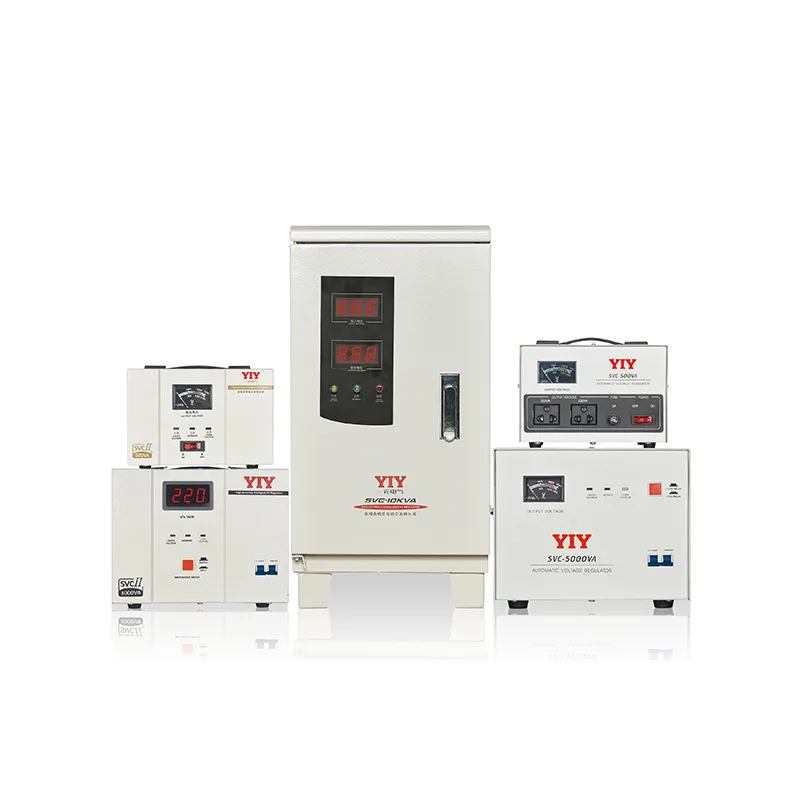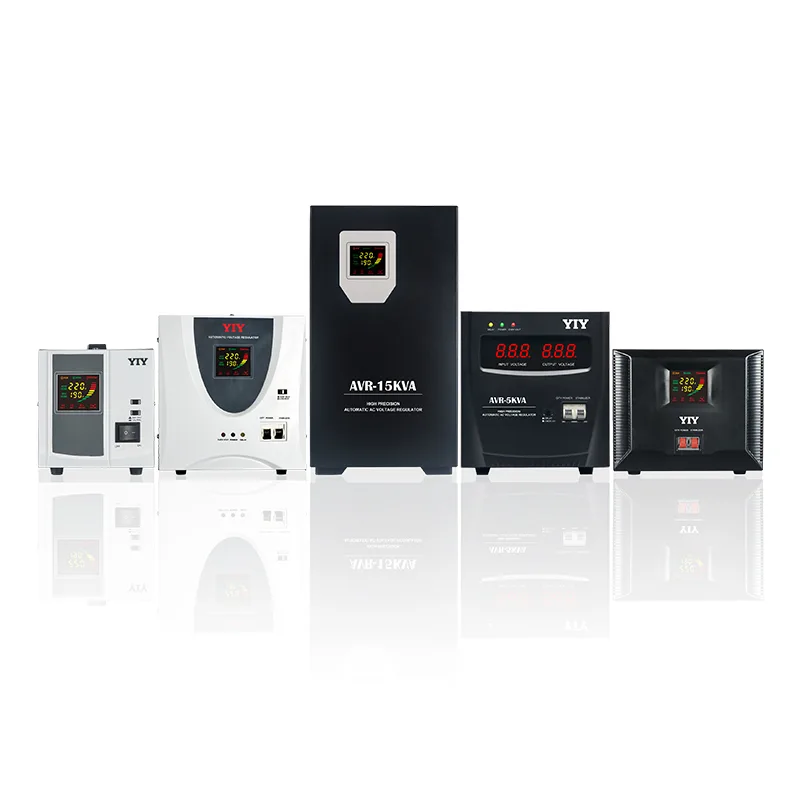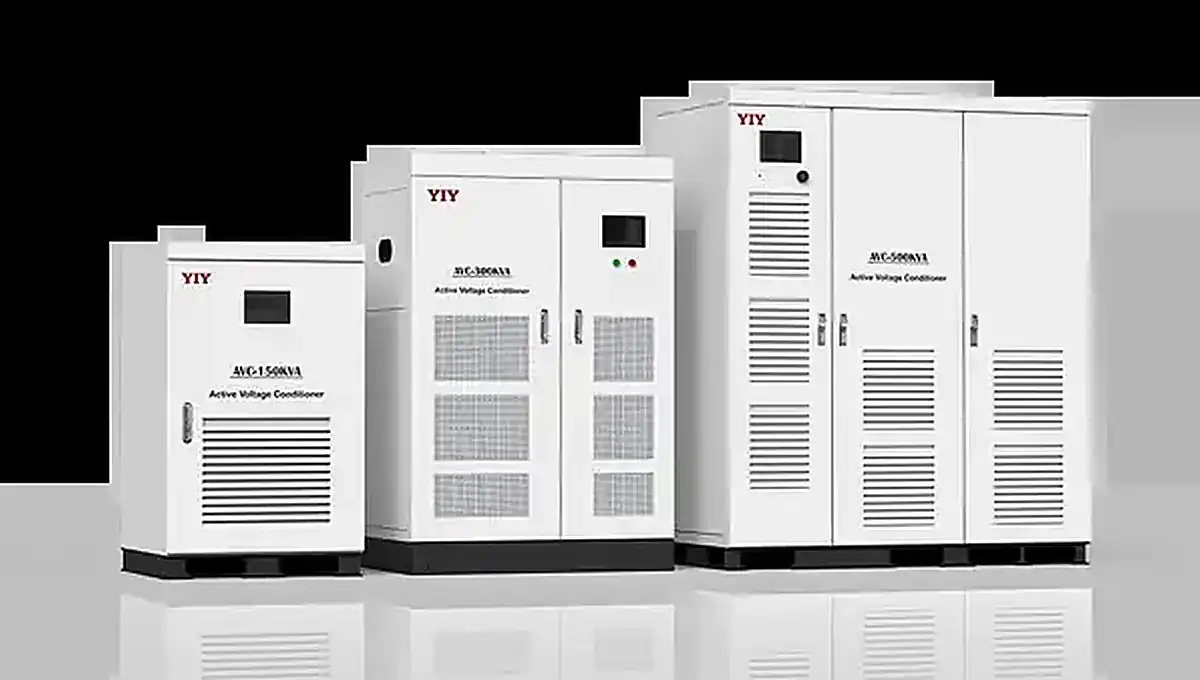
A servo stabilizer and a relay stabilizer are both automatic voltage regulators (AVRs), but differ in correction method: servo uses motorized brush adjustment for continuous ±0.5–3% output precision; relay switches fixed transformer taps in discrete steps at ±5–8% accuracy with lower upfront cost.
| Specification | Servo Stabilizer | Relay Stabilizer |
|---|---|---|
| Output Accuracy | ±0.5–3% | ±5–8% |
| Correction Speed | 3–5 seconds | 20–40 ms/step |
| Efficiency at Full Load | 96–98% | 95–97% |
| Input Voltage Range | ±25–40% | ±10–20% |
| Capacity Range (kVA) | 0.5–3,000 | 0.5–500 |
| Typical Service Life | 10–15 years | 15–20 years |
Performance benchmarks: servo models maintain ±1% regulation at 97% full-load efficiency, correcting a ±10% voltage swing in 3–5 seconds; relay units hold ±5% residual variance at 96% efficiency, switching each tap in 20–40 ms. Carbon brush replacement runs every 12 months at continuous duty; relay contacts average 100,000 switching cycles before service.
Servo stabilizer is a device that provides smooth voltage correction for industrial applications. Servo stabilizer is a device that provides smooth voltage correction for industrial applications. Choose servo for smooth industrial voltage correction; choose relay for simpler, lower-risk loads that tolerate stepped switching. The servo stabilizer vs relay stabilizer decision affects uptime, maintenance, output stability, and how accurately you can specify the right AVR before purchase.
This guide will help you compare correction behavior, load fit, sizing checks, maintenance requirements, and when servo, relay, IGBT, or CVT-style alternatives deserve a closer look.
If you need the broader industrial path behind this topic, start with Medium Capacity Voltage Stabilizers (15-100KVA).
What Does Servo Stabilizer Vs Relay Stabilizer Mean for Your Load?
You are choosing between continuous motor-driven correction and fixed tap switching.
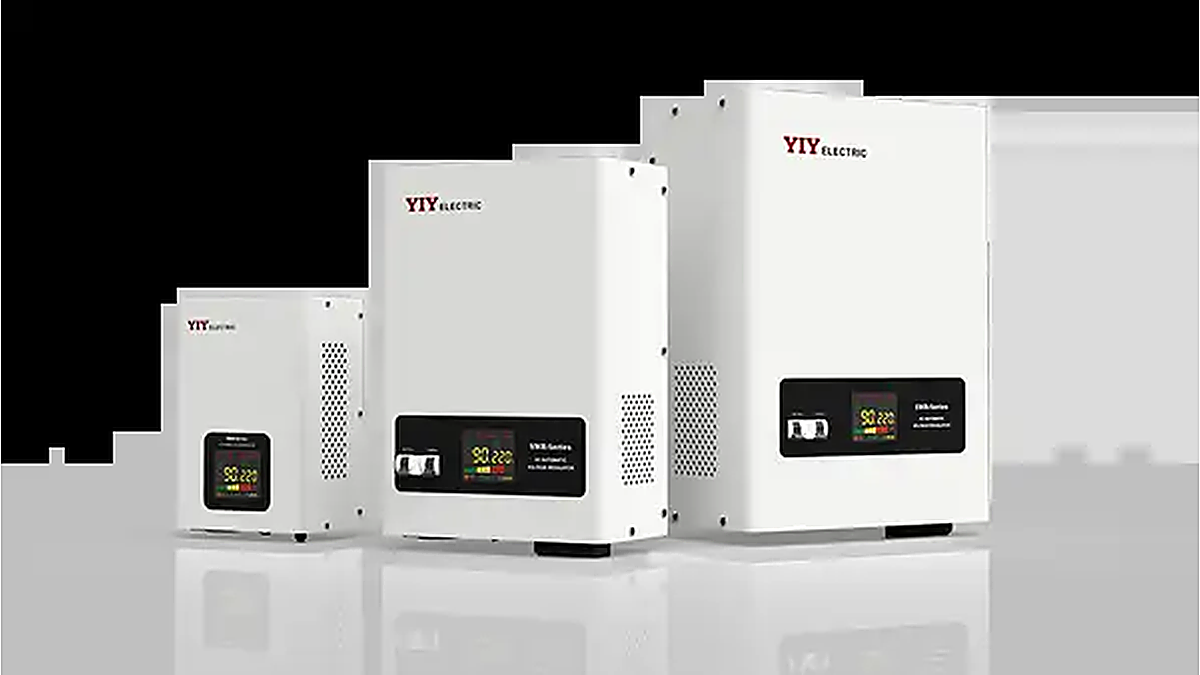
A servo stabilizer uses a controller, servo motor, carbon brush, and autotransformer or variac to adjust voltage gradually. A relay stabilizer detects voltage deviation and switches transformer taps through electromagnetic relays. For your equipment, the difference is not just “premium vs basic”; it is how the output voltage changes while your machines are running.
For model-by-model input ranges and output tolerance, compare the YIY servo voltage stabilizer range, which runs from 500VA single-phase units to 3000kVA three-phase cabinets.
| Decision Point | Servo Stabilizer | Relay Stabilizer | What It Means For You |
|---|---|---|---|
| Correction Behavior | Smooth, continuous adjustment | Stepped tap switching | Servo is usually gentler for sensitive controls |
| Typical Load Fit | CNC, motors, telecom, medical, lab, industrial distribution | Basic appliances, simple circuits, low-risk loads | Relay may be enough if voltage tolerance is wide |
| Maintenance Focus | Brush, motor, ventilation, transformer condition | Relay contacts and tap-switching wear | Your service plan should match the topology |
| Buying Priority | Precision, stability, capacity, maintainability | Lower cost and simple protection | Your lowest quote may not be the lowest operating risk |
If your project sits in the 15-100 kVA industrial range, use YIY’s Medium Capacity Voltage Stabilizers (15-100KVA) as an early orientation point, then confirm whether servo, relay, or IGBT fits the actual load. For nominal voltage alignment, check the installation market against IEC 60038 standard voltages before final sizing; this helps you avoid specifying a catalog voltage that does not match the site supply.
A relay voltage stabilizer can still be the right choice when your load is simple, the voltage range is moderate, and the connected equipment can tolerate output steps. The risk appears when relay switching is applied to sensitive industrial controls that react badly to abrupt correction.
Before you finalize sizing or implementation details, review Three Phase Stabilizer Selection Guide for Industrial Loads.
When Should You Choose Servo Instead of Relay or Static Designs?
You should choose servo when your equipment needs smoother correction than relay and a more cost-practical solution than many static or IGBT systems.
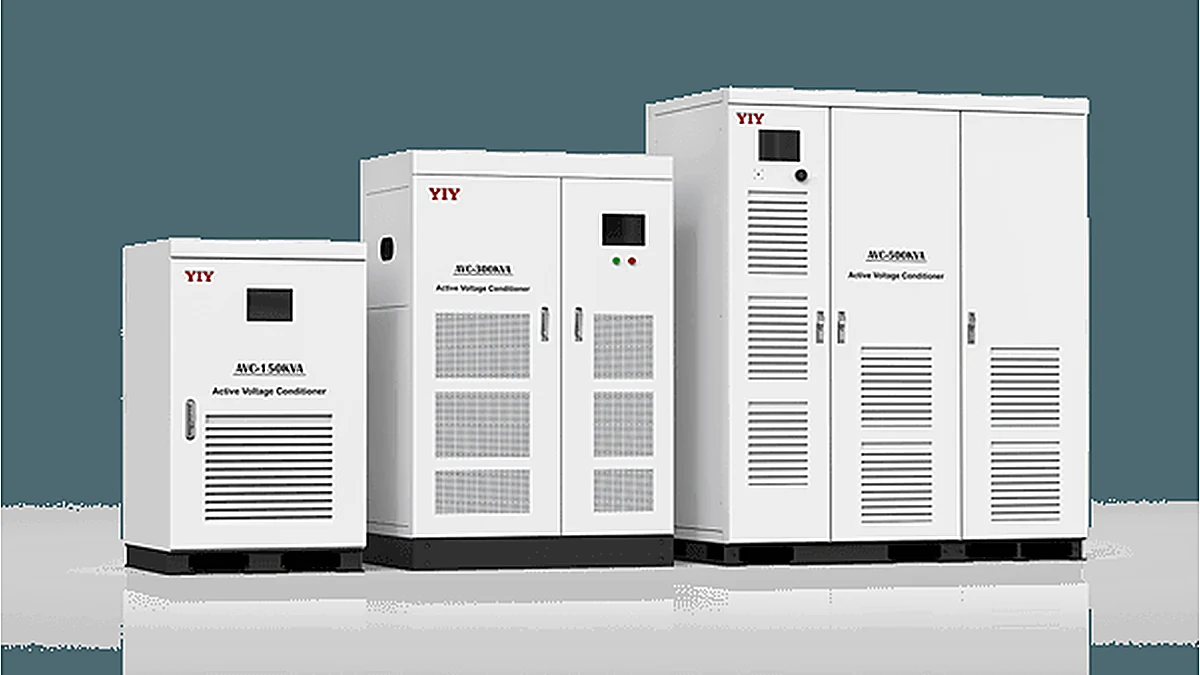
Servo is often the balanced industrial choice because it improves output stability without jumping immediately to the cost and service complexity of high-speed electronic regulation. That makes it suitable for factories, workshops, telecom rooms, pump systems, medical support equipment, and OEM machinery where voltage fluctuation is frequent but the project still needs maintainable hardware.
| Topology | Best Fit | Main Advantage | Main Check Before Buying |
|---|---|---|---|
| Servo | Industrial loads, fluctuating grids, uneven three-phase systems | Smooth correction and broad capacity coverage | Brush service, ventilation, bypass, site environment |
| Relay | Budget-sensitive simple loads | Lower cost and simple construction | Output steps, relay wear, load tolerance |
| Static / IGBT | Critical electronics and fast correction needs | Very fast electronic response | Higher cost, service skill, spare parts |
| CVT | Specific constant-voltage conditioning cases | Isolation and waveform conditioning in some designs | Load range, heat, efficiency, application fit |
If you are comparing CVT vs servo stabilizer options, treat CVT as a special application decision rather than a default industrial replacement. Your connected load, efficiency expectations, heat limits, and maintenance capability should decide whether a CVT-style solution is appropriate.
For mainline three-phase distribution, topology selection also depends on how your phases behave under real load. If one phase carries more motors or intermittent load than the others, a mainline servo stabilizer may need independent phase correction or a different configuration. For a deeper phase-level review, use the 3 phase main line stabilizer sizing guide before freezing the topology.
For a concrete product reference while you compare options, review relay voltage stabilizer.
How Do Industrial Servo Voltage Stabilizers Work?
You get smoother voltage correction because the servo system adjusts the transformer ratio gradually instead of jumping between fixed taps.
Inside the unit, the controller monitors input and output voltage. When the output drifts from the set range, it commands the servo motor to move the brush along the transformer winding. This changes the turns ratio and brings the output back toward the target voltage band.
The practical sequence is:
- Sensing: The controller detects voltage deviation.
- Decision: The control circuit determines whether to raise or lower output.
- Correction: The servo motor moves the brush across the winding.
- Stabilization: The output returns toward the rated voltage range.
For you, this matters most when connected machines have control boards, drives, sensors, relays, or motor starters that dislike abrupt voltage changes. Smooth correction cannot fix every power-quality issue, but it can reduce unnecessary stress caused by repeated stepped switching.
Servo designs still need the right environment. Dust, humidity, high ambient temperature, poor ventilation, and weak grids can affect service life. If your site has harsh conditions, specify cabinet protection, airflow clearance, surge protection, alarm visibility, and a bypass arrangement at the RFQ stage rather than treating them as afterthoughts.
How Should You Size and Specify the Right Industrial Stabilizer?
You should size the stabilizer from measured voltage, real load current, starting behavior, phase balance, and future expansion—not from kVA alone.
A stabilizer that looks correct on paper can still fail in service if it ignores motor starting current, duty cycle, site temperature, or phase imbalance. After you collect the basic load list, confirm whether the quoted rating is suitable for continuous duty and whether the correction range matches the worst input voltage you actually measure.
| Check | Why It Matters | If You Skip It |
|---|---|---|
| Input Voltage Minimum And Maximum | Confirms whether the AVR can correct your real grid fluctuation | Output may still fall outside equipment tolerance |
| Continuous Load Current | Shows the real operating demand | The unit may run hot or trip under normal use |
| Motor Or Compressor Starting Current | Captures inrush and acceleration load | Startup may cause overload or voltage dip |
| Phase Current Balance | Reveals hidden stress in three-phase systems | One phase may become the failure point |
| Ambient Temperature And Ventilation | Affects transformer, motor, and brush life | Service life can shorten in hot or enclosed rooms |
| Bypass Requirement | Allows maintenance without stopping critical loads | Service may require production shutdown |
| Monitoring And Alarms | Helps operators see voltage events early | Faults may only be noticed after downtime |
For three-phase industrial loads, compare your early findings with the Three Phase Stabilizer Selection Guide for Industrial Loads. This gives you a more practical execution check for phase system, load type, and installation conditions before you issue a final RFQ.
A useful sizing conversation should include your nominal voltage, measured low and high voltage, load list, phase system, continuous current, starting current, power factor where known, operating hours, enclosure requirements, and expansion plan. Each number changes the practical recommendation: voltage range affects correction design, current affects capacity, and site conditions affect cabinet and cooling.
What Maintenance and Procurement Checks Matter Before Purchase?
You should verify serviceability, protection functions, documentation, and supplier support before comparing final prices.
A relay unit may look attractive because it is simple and lower cost, but relay contact wear and stepped output should be acceptable for your load. A servo unit may protect your process better, but you must confirm brush inspection, spare parts, ventilation, and bypass access. For IGBT or static systems, you should check service skill, spare modules, and diagnostic support.
Use this procurement screen before approval:
| Check | Why It Matters | If You Skip It |
|---|---|---|
| Topology Named In The Quote | Prevents “normal stabilizer” ambiguity | You may receive a different design than expected |
| Rated Input Range And Output Accuracy | Confirms performance under site fluctuation | The unit may not solve the actual problem |
| Protection Functions | Over/under-voltage, overload, short-circuit, surge, delay | Connected equipment may remain exposed |
| Manual Or Automatic Bypass | Keeps loads running during service | Maintenance may interrupt production |
| Spare Parts And Service Procedure | Reduces downtime after wear or fault | Repair delays can exceed purchase savings |
| Test Report And Wiring Diagram | Supports inspection and installation | Commissioning becomes guesswork |
| Warranty Scope | Clarifies coverage for parts and labor | Disputes can appear after a fault |
For procurement, ask the supplier to identify the actual topology, not only the product name. Request the datasheet, wiring diagram, factory test report, maintenance schedule, bypass description, and spare-part list. If the project is exported, verify voltage and frequency for the destination market before approving labels or final configuration.
Who Needs This Comparison Most?
You need this guide if your role connects voltage risk to uptime, machine behavior, or procurement accountability.
Electrical engineers usually focus on voltage range, phase balance, correction accuracy, and how the stabilizer interacts with motors, drives, and control circuits. Maintenance managers care about service access, bypass, brush inspection, alarm display, and whether the unit can be maintained without stopping production. Technical buyers and OEM teams must turn those requirements into a repeatable specification that avoids field complaints.
| Your Role | Main Decision | Practical Question To Ask |
|---|---|---|
| Electrical Engineer | Correction topology and sizing | Can the load tolerate stepped output? |
| Maintenance Manager | Uptime and service access | Can the unit be inspected without stopping production? |
| OEM / ODM Buyer | Repeatable integration | Will this topology work across target markets? |
| Procurement Manager | Supplier and documentation risk | Does the quote prove what is included? |
Competitors often emphasize single application areas such as telecom, outdoor power, or industrial backup. Your stronger evaluation path is broader: compare servo, relay, mainline, static/IGBT, and application-specific options against measured site conditions. That helps you avoid treating every voltage problem as the same product decision.
When Should You Ask YIY for A Technical Review?
You should ask for a review when the load is sensitive, the grid is unstable, the phase system is uneven, or the quotation is based only on kVA.
A low-friction first step is a quick fit conversation. You can start with nominal voltage, approximate load, single-phase or three-phase supply, observed voltage fluctuation, and the application type. Detailed logs are helpful later, but you do not need to prepare a full internal dataset before asking whether servo, relay, or IGBT is the likely direction.
YIY can review voltage range, load behavior, installation environment, bypass needs, and maintenance expectations across servo, relay, and static/IGBT stabilizer options. If you are evaluating a common industrial capacity tier, the 50 KVA voltage stabilizer buying guide is a useful next step before you request a final quotation.
Servo vs Relay at a Glance
What: Both are AVRs, but use different voltage-correction methods.
Servo: Motorized brush, ±0.5–3%, 3–5 s — precision loads.
Relay: Tap-switching, ±5–8%, 20–40 ms — general loads.
Choose servo: For CNC, medical, and laboratory equipment.
Choose relay: For offices, retail, and budget-driven projects.
Capacity: Both available from 0.5 kVA to 3,000 kVA.
Efficiency: 96–98% at full load for both technologies.
Certified: CE + ISO 9001, shipped to 130+ countries.
Frequently Asked Questions
How Should You Size This Power-Protection Setup for Your Actual Load Profile?
Start by recording running current on each phase during normal production, then capture the lowest and highest input voltage during different shifts or grid conditions. If motors, compressors, lifts, pumps, or welders are present, note their starting sequence and whether multiple loads start together. For follow-up, ask the supplier to mark which assumption controls the final kVA: continuous current, inrush, voltage range, ambient temperature, or expansion margin.
Which Compliance, Reliability, or Maintenance Checks Matter Before Procurement?
Before purchase approval, verify the nameplate voltage, frequency, wiring diagram, test report, warranty terms, bypass mode, and spare-part availability. A concrete action is to compare the quoted rated voltage and frequency against the installation country, then file the supplier datasheet with the project RFQ. If ISO or factory quality claims are part of vendor approval, request the certificate number and validity period rather than accepting a logo on a brochure.
What Should You Know About Servo Stabilizer Vs Relay Stabilizer?
Servo regulation is usually better for sensitive or industrial loads because correction is gradual, while relay regulation is simpler and switches fixed taps. Your next unresolved check is load tolerance: ask the equipment supplier or maintenance record whether voltage steps have caused resets, trips, alarms, or contactor chatter. If those symptoms exist, do not decide on price alone.
What Is Servo Stabilizer Vs Normal Stabilizer?
A servo stabilizer is a defined AVR topology using a servo motor and variable transformer mechanism. “Normal stabilizer” is not a technical specification; it may describe relay, servo, static, or basic tap-changing designs. For your next quote comparison, ask every supplier to state topology, correction range, output accuracy, duty rating, protection list, and maintenance items in writing.
Final Thoughts
Choose servo when smooth correction and uptime outweigh initial cost; relay suits simpler loads that tolerate stepped output. Compare site conditions and load behavior, then ask YIY for a fit review before committing to a topology.
About YIY
Zhejiang Yiyen Holding Group Co., Ltd. (YIY) is a professional voltage stabilizer manufacturer with 16+ years of experience. With a 30,000sqm modern facility and an annual production capacity of 1,000,000+ units, our products are exported to 130+ countries. We provide OEM/ODM customization services and are ISO 9001:2015 quality management systems certified, committed to delivering stable and reliable voltage protection solutions to global customers.
Contact Us
Email: yiyen at yiyen.com
Phone/WhatsApp: +86 13587452904
Website: https://www.yiyavr.com/
If you found this article helpful, contact us for a sizing review or customized solution.
If you are moving from evaluation toward supplier shortlisting or buying review, use 50 KVA voltage stabilizer buying guide as your next step.
Related Engineering Entry Points
Use this decision map as the topology checkpoint, then move to the matching YIY sourcing or application page for capacity, phase, and OEM details.
- Voltage stabilizer product hub for relay, servo, IGBT, single-phase, 3-phase, and capacity families.
- CNC voltage stabilizer guide for machine-tool loads, servo drives, and production continuity.
- OEM/ODM voltage stabilizer service for private-label, custom voltage range, enclosure, and factory test requirements.
- Voltage regulator manufacturer comparison for buyer-side supplier evaluation.