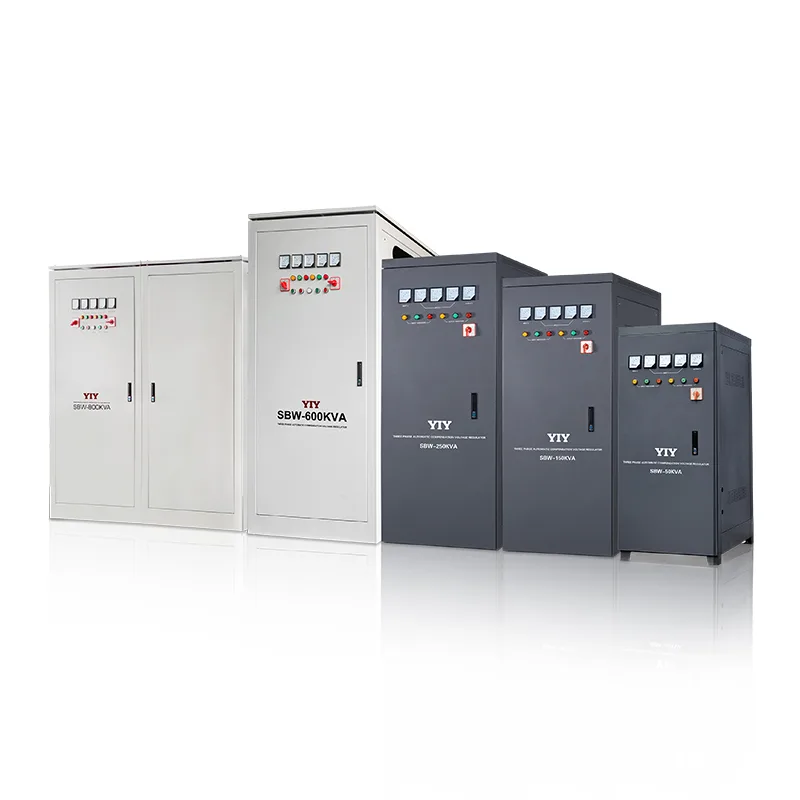
Before buying a 3 phase stabilizer 20 kva, compare your measured load profile, starting current, input-voltage window, phase balance, AVR technology, protection design, installation environment, and supplier evidence.
A correct 20 kVA three-phase AVR is not just a matching nameplate; it is a risk-control device for motors, CNC controls, lifts, pumps, compressors, medical equipment, automation panels, and main distribution loads.
You will get the best result when your RFQ answers four questions: whether 20 kVA is truly enough, which correction technology fits your load, what site conditions can limit performance, and what verification evidence you should ask the supplier to provide.
If your site already has recurring voltage fluctuation, brownouts, over-voltage events, or nuisance trips, treat this capacity tier as an engineering selection problem. YIY’s documented stabilizer range spans 0.5KVA-3000KVA across servo, relay, and IGBT designs, and its quality-system evidence can be checked against ISO 9001:2015 quality management. For your first product orientation, YIY groups servo, relay, and IGBT/static options under its three-phase stabilizers category, so you can compare the technology family before narrowing the exact model.
When Does a 20 kVA Three-Phase Stabilizer Make Sense for Your Site?
You should consider a 20 kVA three-phase stabilizer when your combined three-phase load is near this capacity band and voltage instability can affect equipment operation, process quality, or machine reliability.
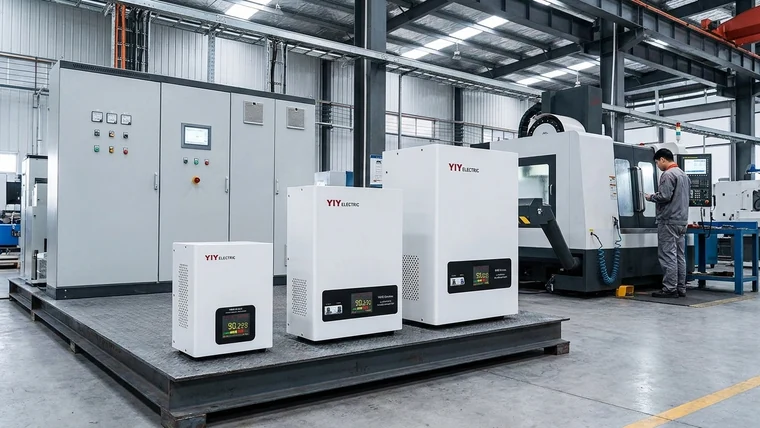
For your site, the stabilizer is an automatic voltage regulator for a three-phase supply. It senses incoming voltage deviation, compares it with the target output, and corrects the supply through servo, relay, or IGBT/static regulation. In practical terms, it reduces how much grid sag, surge, or instability reaches your connected equipment.
A 20 kVA label means the unit is rated for 20 kilovolt-amperes of apparent power. That matters because your machines do not only consume kW; motors, compressors, drives, and inductive loads also carry power factor effects. If your connected real power is 16 kW at 0.8 PF, the apparent power is already 20 kVA, because kVA = kW / power factor.
For you, that means a nominally correct rating can still leave no margin for motor starting current, future load growth, or severe voltage correction.
Your application fit is stronger when the protected load includes:
- CNC machines, PLC panels, automation lines, and control circuits that fault during low voltage.
- Lifts, pumps, compressors, HVAC, and other motor loads with starting-current stress.
- Medical, laboratory, testing, or process equipment that requires tighter output tolerance.
- Main line panels where one stabilizer protects several simultaneous loads.
- Sites with repeated low-grid periods, generator transitions, or phase-voltage variation.
Voltage planning should also align with the equipment supply ratings used in your market. The official IEC 60038 standard voltages publication is the reference for standardized system voltages; in practice, you should compare your target output voltage and allowable tolerance against what your machines are designed to receive, not only against a local utility label.
Which AVR Technology Fits Your Precision and Budget Requirements?
You should choose servo for many mixed industrial loads, relay only when the load is tolerant and cost pressure is high, and IGBT/static regulation when fast correction and tight precision matter more than the lowest upfront price.
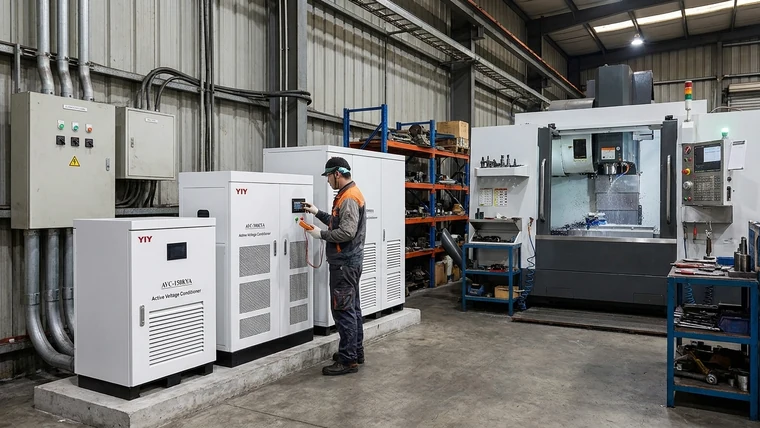
For your 20 kVA three-phase AVR shortlist, the technology choice affects output accuracy, correction speed, service needs, and suitability for sensitive equipment. Do not compare price before you compare the electrical problem each design is meant to solve.
| AVR design | Typical output precision | Response behavior | Correction method | Where it usually fits | What it means for you |
|---|---|---|---|---|---|
| Servo stabilizer | +/-0.5% to +/-3% | Around 1-2 seconds | Motor-driven variac / transformer correction | Motors, compressors, mixed workshops, general industrial panels | You get a strong accuracy-to-cost balance, but you should plan periodic inspection for moving parts |
| Relay stabilizer | +/-5% to +/-8% | Step-based correction | Discrete tap switching through relays | Less sensitive loads, utility areas, cost-controlled applications | You may reduce upfront cost, but your output voltage band is wider and correction is less smooth |
| IGBT / static stabilizer | Around +/-0.5% | Fast electronic correction | PWM-based static regulation with double-conversion AC-DC-AC logic | CNC controls, medical equipment, automation, unstable-grid sites | You get tighter and faster correction where trips, scrap, or controller faults are expensive |
These precision figures describe how closely the output stays to the target voltage. For you, tighter regulation matters more when your load includes PLCs, CNC controllers, diagnostic equipment, test systems, or other electronics that react poorly to voltage movement. Response behavior tells you whether the stabilizer can keep up with fast grid events; if your site has short dips or generator transitions, slower correction may still allow nuisance trips.
A servo 3 phase stabilizer often fits the middle of the market because it balances regulation accuracy and cost for industrial loads. Relay designs can be acceptable for less sensitive equipment where wider output variation will not harm operation. IGBT/static designs become easier to justify when one voltage-related stop can create scrap, restart labor, service callouts, or missed delivery risk.
If you want a deeper capacity-focused comparison after this technology screen, use YIY’s 20kva voltage stabilizer guide to expand your review into capacity margin, power factor, and input-voltage correction limits.
How Do You Size a 20 kVA Three-Phase AVR Before Quotation?
You should size this power class from measured simultaneous load, power factor, starting current, voltage logs, and phase balance before you ask for a final quote.
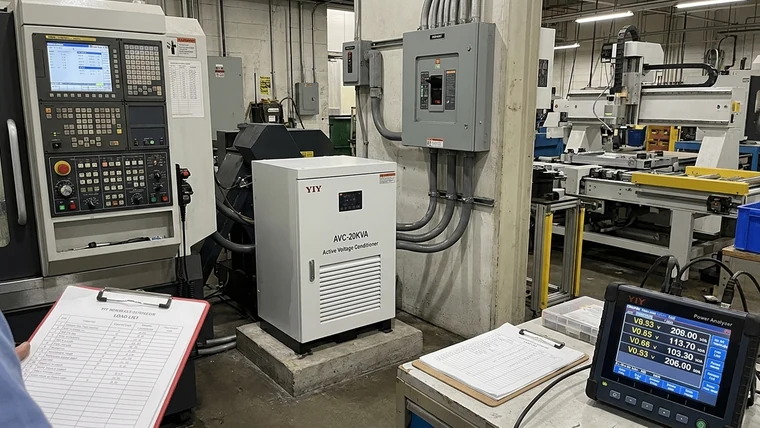
Start with your load list. Record every connected machine, its kW or kVA rating, whether it runs continuously or intermittently, and whether it starts while other loads are already operating. Then convert real power to apparent power with kVA = kW / power factor. If your measured or calculated load reaches the full 20 kVA level, you should discuss a larger unit rather than forcing the project into this exact rating.
Step 1: Measure Running Current per Phase
Measure current on L1, L2, and L3 during normal operation and peak production. For you, this reveals whether the load is evenly distributed or whether one phase is already carrying more stress than the others.
Step 2: Log Input Voltage over Real Work Cycles
Record L1-L2, L2-L3, and L3-L1 voltage during startup, steady production, low-grid periods, and any generator or large-load transitions. This tells you the real input-voltage window your stabilizer must correct.
Step 3: Add Motor Inrush and Starting Method
List pumps, compressors, lifts, HVAC, and machine tools separately. Their starting current can briefly dominate the stabilizer requirement, especially if several loads start close together.
Step 4: Check Phase Balance, Neutral, and Earthing
A stabilizer can correct voltage fluctuation, but it should not hide poor wiring, loose terminals, overloaded phases, or weak earthing. For your installation, a basic electrical inspection can prevent the AVR from being blamed for site defects.
Step 5: Apply Realistic Expansion Margin
If your calculated load is already close to 20 kVA, future expansion or frequent starts may move the recommendation toward 25-30 kVA. That practical margin helps you avoid buying a unit that works on paper but struggles in real operation.
| Sizing check | Why it matters | If you skip it |
|---|---|---|
| Running current per phase | Shows real load distribution and phase stress | One phase may overload while total kVA looks acceptable |
| kW, kVA, and power factor | Converts your load into the rating the AVR must support | A 20 kVA quote may be undersized |
| Motor starting current | Confirms startup tolerance and short overload behavior | Output may dip or trip during starts |
| Input-voltage window | Confirms whether the AVR can correct your real grid range | The unit may hit its correction limit during low voltage |
| Required output tolerance | Matches the stabilizer to CNC, PLC, medical, or test loads | Sensitive controls may still fault |
| Expansion margin | Allows for future equipment and production changes | You may outgrow the unit soon after installation |
For panel-level projects, compare your simultaneous load, bypass arrangement, and phase distribution against YIY’s 3 phase main line stabilizer sizing guidance before you approve the RFQ. That execution step is especially useful when your AVR protects a main line rather than one standalone machine.
What Should Your RFQ and Installation Screen Include?
Your RFQ should include the electrical data, installation constraints, protection requirements, and compliance evidence that affect whether the stabilizer will work reliably at your site.
For your first supplier review, do not send only “stabilizer 20 kva 3 phase, 380V output.” Send the measured load and site context. A complete RFQ helps the supplier judge whether servo, relay, or IGBT/static technology fits your risk level and whether the 20 kVA rating is appropriate.
| Check | Why it matters | If you skip it |
|---|---|---|
| Load list with simultaneity | Shows what runs together and what only runs occasionally | Supplier may size from total nameplate instead of real operation |
| Input-voltage logs | Defines the correction range required | Quote may not cover your low-grid or high-grid periods |
| Output voltage and tolerance | Aligns the AVR with your equipment requirement | Your machines may still see unacceptable variation |
| Starting-current data | Checks motor, lift, compressor, and pump behavior | The stabilizer may trip during startup |
| Bypass requirement | Allows maintenance or emergency operation | One AVR fault can stop the protected line |
| Protection functions | Covers overload, short circuit, over/under-voltage, surge, and phase loss needs | Fault isolation and equipment protection may be incomplete |
| Environment | Dust, heat, humidity, ventilation, and enclosure needs affect reliability | The unit may derate or fail prematurely |
| Certification evidence | Supports procurement, audit, and market-access review | Your purchasing file may lack required proof |
For certification evidence, ask for current documents rather than relying on a brochure statement. If your project enters the EU market, verify the supplier’s declaration and applicable directives against the European Commission’s official CE marking guidance. For your procurement file, save the certificate, model scope, issuing body, validity dates, and product label photos.
Installation details also shape performance. Specify breaker coordination, cable sizing, neutral and earthing condition, ventilation clearance, ambient temperature, dust or humidity exposure, enclosure/IP expectations, manual or automatic bypass, and service access. For broader plant selection logic, YIY’s industrial voltage stabilizer selection guide can help you connect site voltage logs, protection needs, and maintenance access before the purchase order is finalized.
How Would a YIY Shortlist Change with Real Site Data?
Your shortlist should narrow from the measured site problem to the stabilizer technology, not from the 20 kVA label alone.
Imagine your small CNC cell logs three-phase input swinging from 342V to 428V. One compressor start creates a short sag, and one phase runs lower during peak production. The load mix includes a CNC controller, coolant pump, small air compressor, control auxiliaries, and an automation panel.
For you, the sizing question is not only “Can the stabilizer carry 20 kVA?” It is also “Can the stabilizer correct the real voltage window, tolerate the start event, and protect sensitive controls without creating a maintenance burden?”
| Site finding | Specification implication | What to ask YIY or another supplier |
|---|---|---|
| 342V-428V measured input window | Confirm input range and correction margin | Can the AVR regulate across the lowest logged voltage without derating? |
| Compressor start causes a short sag | Check short overload and startup behavior | What starting-current data is needed for confirmation? |
| CNC and PLC control loads | Tighter output tolerance may matter | Should you compare servo against IGBT/static instead of relay only? |
| Phase mismatch during peak production | Phase balance and wiring inspection are required | Does the unit regulate phases independently or as a combined three-phase system? |
| Dusty, warm electrical room | Cabinet ventilation and enclosure choice matter | What clearance, fan access, and ambient-temperature limits apply? |
A relay AVR may fit if your protected loads are tolerant and voltage fluctuation is slow. A servo unit is often a practical middle option when you want good accuracy for mixed industrial loads and can accept mechanical correction time. An IGBT/static AVR becomes the stronger discussion when your logs show rapid dips, frequent generator transitions, or controller faults during short voltage events.
YIY can review this type of application across Servo, Relay, and IGBT options within its documented 0.5KVA-3000KVA stabilizer range, with global supply experience in 130+ countries and OEM/ODM support.
What Final Checks Should You Complete Before Approving the Purchase?
You should approve the purchase only after the supplier confirms capacity margin, correction range, protection design, installation limits, and documentation scope in writing.
For your acceptance review, use the same decision structure you used during RFQ. This keeps procurement, engineering, and maintenance aligned before the unit ships.
| Check | Why it matters | If you skip it |
|---|---|---|
| Confirm final kVA rating | Verifies margin beyond simultaneous load | You may buy a unit that is overloaded from day one |
| Confirm input and output voltage range | Ensures the stabilizer matches your logged grid behavior | The unit may not regulate during worst-case voltage |
| Confirm regulation technology | Aligns servo, relay, or IGBT with load sensitivity | You may overpay or under-protect the load |
| Confirm phase regulation mode | Matters for imbalance and three-phase load behavior | Voltage may remain uneven under certain conditions |
| Confirm bypass and alarms | Supports maintenance and troubleshooting | You may lose visibility during faults |
| Confirm certificate scope | Supports compliance and audit needs | Documents may not match the supplied model |
| Confirm installation drawings | Helps panel builders prepare cable, breaker, and space requirements | On-site installation may be delayed |
Before you approve a final quote, ask for a wiring diagram, terminal layout, mechanical dimensions, weight, cooling/clearance requirements, protection list, output tolerance, input range, overload behavior, bypass design, and certificate package. If the measured load grows beyond the 20 kVA band, you may want to compare before buying a voltage stabilizer in a higher kVA class rather than stretching this capacity tier too far.
Frequently Asked Questions
How Does a 3 Phase Stabilizer Work?
It measures each incoming phase, compares it with the set output voltage and pushes the output back into tolerance, using a servo-driven transformer, relay taps or IGBT electronics depending on the design. For your verification, ask whether the unit regulates each phase independently or as one three-phase system, then compare the stated input range, output tolerance, and response behavior against your voltage logs.
What Is the Difference Between a Single-Phase Stabilizer and a 3-Phase Stabilizer?
A single-phase stabilizer protects one live-neutral supply, while a 3-phase stabilizer protects a three-phase industrial supply used by motors, lifts, CNC lines, pumps, compressors, and main distribution panels. Before you choose, check your machine nameplate, breaker arrangement, supply type, and whether your equipment requires phase-to-phase voltage stability.
Does 3 Phase Power Need to Be Balanced Before Installing a Stabilizer?
Yes, your three-phase power should be reasonably balanced before you rely on a stabilizer. It evens out supply swings; it is not a fix for bad wiring, loose terminals or phases that are overloaded or badly shared. Send the supplier your per-phase voltage and current readings from both normal and peak production.
How Do You Balance a 3 Phase Load for a 20 kVA Stabilizer Installation?
You balance the load by measuring running current per phase, identifying overloaded phases, and redistributing single-phase auxiliary loads where practical. For your 20 kVA installation, also verify simultaneous load, motor starting current, neutral condition, earthing, and peak production readings before approving the final AVR configuration.
How Should You Compare a 3 Phase 20 kVA Servo Voltage Stabilizer Price?
You should compare the price together with input range, output tolerance, overload capability, bypass design, cabinet build, certification evidence, and service support. A lower quote may be acceptable for tolerant loads, but for your sensitive equipment, a cheaper unit with a narrow correction range or weak protection package can become the more expensive choice after repeated trips or maintenance issues.
Final Thoughts
A 20 kVA three-phase stabilizer is the right purchase only when its capacity, correction technology, protection design, and installation limits match your site’s real voltage behavior and load profile.
For your buying decision, do not treat the nameplate rating as the finish line. Compare the actual input-voltage window, phase balance, motor starting current, power factor, output tolerance, bypass/protection requirements, ambient conditions, and supplier engineering support. This practical screen helps reduce the risk of nuisance trips, overheated equipment, unstable controls, and avoidable downtime.
Start with a low-friction quick-fit review. YIY can review your load list, starting current, input-voltage window, and installation conditions first, then advise whether this three-phase servo setup, a relay unit, an IGBT/static design, or a higher kVA class is the better fit.
About YIY
Zhejiang Yiyen Holding Group Co., Ltd. (YIY) is a professional voltage stabilizer manufacturer with 16+ years of experience. With a 30,000sqm modern facility and an annual production capacity of 1,000,000+ units, YIY exports products to 130+ countries. The company provides OEM/ODM customization services and ISO 9001:2015 certified voltage protection solutions for global customers.
Contact Us
Email: yiyen@yiyen.com
Phone/WhatsApp: +86 13587452904
Website: https://www.yiyavr.com/
For this application, the PWR-3 Three-Phase Servo Voltage Stabilizer is a matched product option worth evaluating.