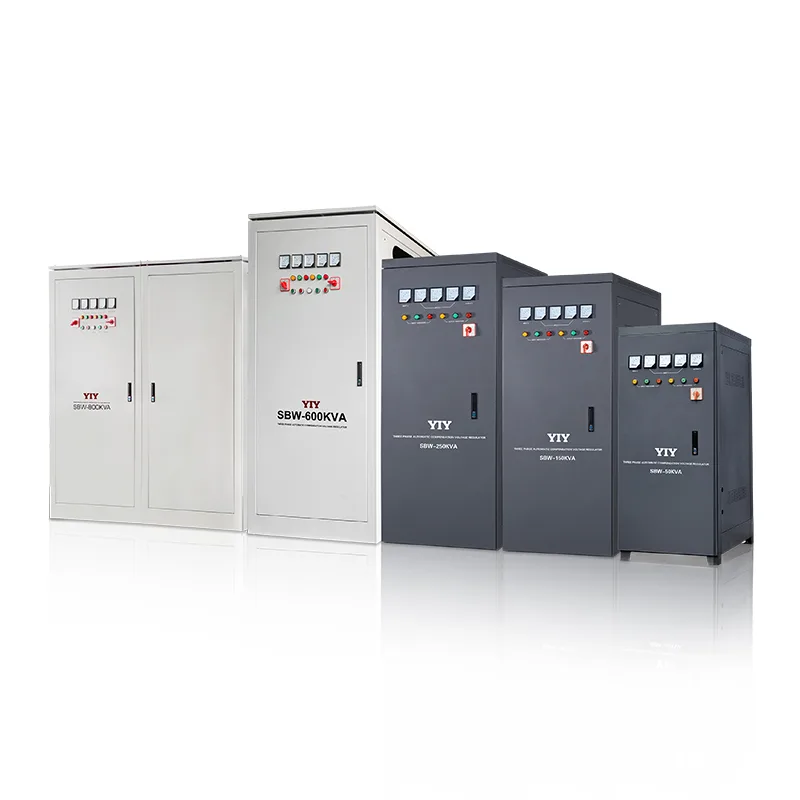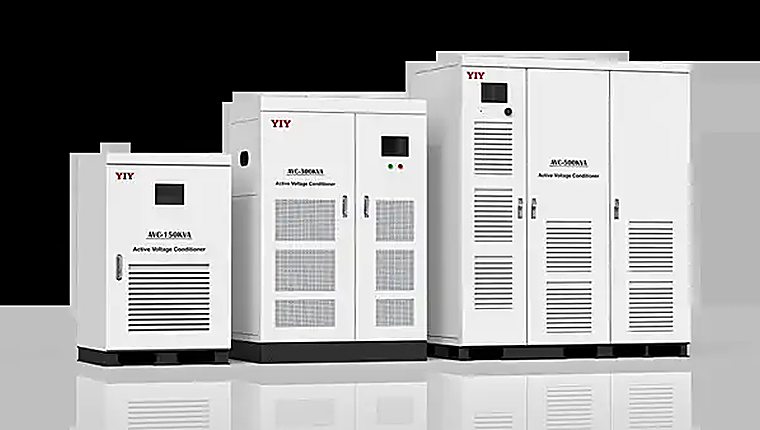
A 3 phase main line stabilizer is the right choice when several three-phase loads share one unstable incoming supply and you want one central correction point instead of a unit per machine.
Sizing, technology, the YIY series shortlist, and installation all follow from that decision.
When Does a 3 Phase Main Line Stabilizer Make Sense for Your Site?
You should choose a main-line unit when several three-phase loads share the same unstable incoming supply and you want centralized voltage correction before the loads. This approach is common for factories, CNC workshops, packaging lines, HVAC plant rooms, water treatment systems, elevators, printing equipment, and OEM electrical panels.
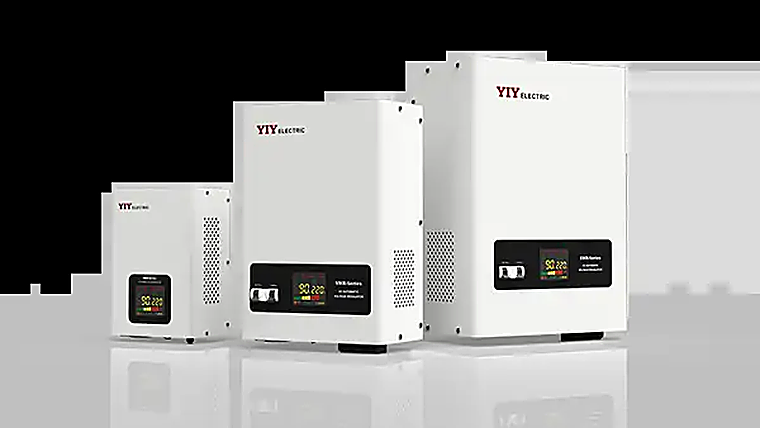
A point-of-load stabilizer protects one machine. A main-line stabilizer protects a distribution branch, production zone, or entire low-voltage incoming line, depending on your electrical design. For you, the practical difference is procurement scope: one correctly sized industrial unit can simplify maintenance and standardize protection, but it also means the capacity calculation must be more careful.
When comparing industrial options, start with the correct phase category and load profile. YIY’s three-phase stabilizers hub is the most relevant starting point if your incoming system is 380 V, 400 V, 415 V, or another three-phase low-voltage standard used in your market. Nominal system voltages vary by country and grid design, so it is useful to reference IEC 60038 standard voltages when your project documentation uses international voltage terminology.
For you as a buyer, the key point is simple: do not specify the stabilizer only by “three phase.” Confirm the actual line voltage, frequency, neutral requirement, input fluctuation range, and maximum simultaneous load before you ask for a quotation.
How Do You Size a 3 Phase Main Line Stabilizer?
You size this capacity tier by calculating the maximum simultaneous running load, adding allowance for motor starting and load expansion, then selecting the nearest suitable kVA rating above that requirement. If you size only from the total nameplate power of all equipment, you may overbuy; if you size only from today’s average running current, you may under-protect the line.
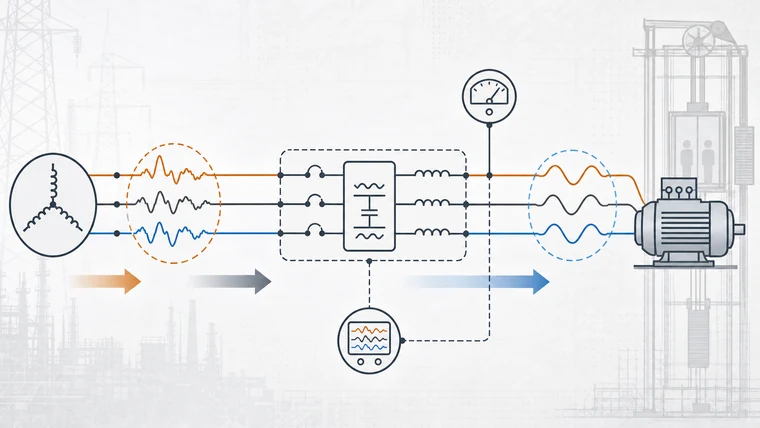
Start with three values:
1. Connected load: the total rated load connected downstream. 2. Simultaneous load: the maximum load likely to run at the same time. 3. Starting or surge demand: short-duration current from motors, compressors, pumps, elevators, or welding equipment.
For three-phase apparent power, the common calculation is:
kVA = √3 × line voltage × line current ÷ 1000
For example, if your measured maximum line current is 150 A on a 400 V three-phase system:
kVA = 1.732 × 400 × 150 ÷ 1000 = 103.9 kVA
In practical terms, you would not normally select a 100 kVA stabilizer for this load if motors start frequently or expansion is expected. You would discuss the next suitable rating, operating duty, and overload tolerance with the manufacturer.
Sizing input What you should check Practical meaning for your order Nominal voltage 380 V / 400 V / 415 V / custom The stabilizer must match your local three-phase system, not just the generic product label. Maximum running current Measured current at peak operation This is often more reliable than catalog power ratings for an existing site. Load power factor Motor-heavy, heating, mixed, rectifier load Low power factor can increase current demand for the same kW output. Starting current Pumps, compressors, elevators, large motors You may need higher capacity or special overload handling. Simultaneous operation Which loads run together Your stabilizer should cover real peak demand, not unrealistic full-nameplate totals unless all equipment runs at once. Expansion margin Planned new machines or line upgrades A margin prevents immediate replacement when your production line grows.
A typical buyer mistake is treating kW and kVA as interchangeable. They are not. kW is real power; kVA is apparent power. Because voltage stabilizers are commonly rated in kVA, your specification should either provide measured current data or clearly state the load power factor so the manufacturer can recommend the correct capacity.
Which Stabilizer Technology Fits Your Precision and Budget Requirements?
You should compare relay, servo, and IGBT-based designs based on load size, voltage accuracy, response expectations, and sensitivity of the downstream equipment. For industrial main-line use, servo technology is often the practical middle ground because it supports higher capacities and continuous voltage correction more naturally than small relay units.
A relay voltage stabilizer can be suitable for smaller and less demanding applications where step correction is acceptable. However, many factory main-line applications need smoother regulation, broader capacity options, and stronger protection functions.
A servo voltage stabilizer uses a motor-driven regulating mechanism to adjust output voltage continuously. This makes it a strong fit when your site faces sustained undervoltage or overvoltage and your machines need a stable supply over long operating hours.
For sensitive production, medical, laboratory, or critical-power environments, you may also compare an IGBT voltage stabilizer when faster electronic correction or more advanced conditioning is required. The practical decision is not “which technology sounds best,” but which one matches your voltage disturbance pattern, load sensitivity, and maintenance expectations.
Technology Best fit for your application Strengths Watch-outs Relay stabilizer Small loads, simpler applications, cost-sensitive projects Compact, economical, fast step switching Output changes in steps; usually not the first choice for large industrial main lines. Servo voltage stabilizer Factory main lines, motors, mixed industrial loads, OEM panels Smooth correction, broad capacity range, strong industrial suitability Mechanical regulation requires proper maintenance and environment control. IGBT / digital stabilizer Sensitive loads, critical processes, fast correction needs Fast electronic response, advanced control options Higher specification and cost may exceed basic factory requirements.
For you, the selection rule is practical: use relay designs only when the load and accuracy requirement are modest; use servo designs for most industrial three-phase main-line projects; evaluate IGBT-based options when downtime risk, sensitive electronics, or correction speed justify the higher specification.
What Voltage Range and Protection Functions Should You Specify?
You should specify the real input fluctuation range at your site, not only the nominal voltage. A stabilizer cannot correct a voltage condition outside its designed input window, so your quotation request should include measured minimum and maximum input voltage under actual operating conditions.
Common nominal three-phase systems include 380 V, 400 V, and 415 V, but unstable grids may swing far below or above those values. If your site sees 320 V at peak demand, a standard input range may not be enough. If your site sees frequent overvoltage at night, you should also confirm high-voltage cutoff behavior.
Voltage dips, short interruptions, and voltage variations are treated in formal testing contexts such as IEC 61000-4-11:2020 voltage dips and interruptions. For your procurement work, that does not mean every stabilizer is certified to this exact test. It means you should describe the disturbance type clearly: sag, swell, interruption, fluctuation, or unbalance. The supplier can then tell you whether stabilization alone is suitable or whether additional power-quality equipment is needed.
Ask for these protection functions when your equipment is valuable or production downtime is costly:
Protection item Why it matters to you What to confirm Overvoltage protection Prevents excessive output from reaching downstream equipment Trip threshold, alarm behavior, restart mode Undervoltage protection Avoids running motors and controls at unsafe low voltage Minimum output threshold and recovery logic Overload protection Protects the stabilizer when load exceeds rating Overload percentage and permitted duration Short-circuit protection Reduces risk during downstream faults Breaker coordination and fault response Phase loss protection Protects three-phase motors and equipment Whether the unit detects missing phase and shuts down Phase sequence protection Helps prevent wrong motor rotation after wiring changes Whether phase sequence detection is included Bypass function Allows maintenance or emergency operation Manual or automatic bypass design
In practical terms, a cheaper unit without the right protection package may look acceptable on a quotation sheet but create more risk after installation. You are not only buying voltage correction; you are buying a controlled failure response when the grid or load behaves badly.
What Load Conditions Can a Voltage Stabilizer Not Solve by Itself?
You should not expect a voltage stabilizer to correct every power-quality problem in your electrical system. It is designed primarily to regulate voltage level, not to remove all harmonics, compensate all reactive power, or replace a UPS during outages.
Nonlinear loads such as variable frequency drives, rectifiers, welders, UPS systems, and switching power supplies can create harmonic distortion. If your problem is overheating neutral conductors, distorted waveforms, nuisance breaker trips, or transformer noise, voltage stabilization may be only one part of the solution. In that case, you may need harmonic assessment, filtering, or power-factor correction. The IEEE 519 harmonic control guidance is a useful reference when your engineering team is evaluating distortion limits in an industrial electrical system.
This matters for you because the wrong diagnosis leads to the wrong purchase. If your machines trip because input voltage falls to 300 V during peak load, a properly selected industrial voltage stabilizer may help. If your machines fail because of severe harmonics from large nonlinear loads, a stabilizer alone may not solve the root cause.
Before you order, collect these site details:
- Minimum and maximum input voltage over several operating periods
- Voltage difference between phases
- Load current on each phase
- Power factor if available
- Harmonic measurements if nonlinear loads dominate
- Fault history from machines or protection devices
- Whether the issue happens at startup, peak load, night operation, or randomly
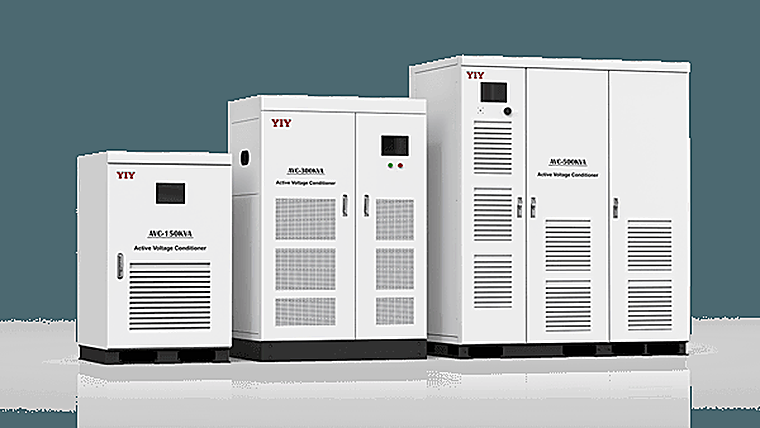
Which YIY Three-Phase Series Should You Shortlist for a Main Line?
Match the series to the feeder. For weak or remote supplies across a whole feeder, quote the wide-input PWR-3 early; for precision lines, PRO-3; for general distribution with unbalanced phases, SVC-3.
| Published spec | SVC-3 | PRO-3 | PWR-3 |
|---|---|---|---|
| Capacity range | 1.5–100 kVA | 1.5–100 kVA | 45–150 kVA |
| Output precision | ±3% | ≤2% | ±3% |
| Control | Servo motor compensation | MCU control | MCU control |
| Input range (380 V class) | 278–433 V | 278–433 V | 285–475 V or 266–494 V |
| Unbalanced load | 100% unbalanced capability | Confirm with datasheet | 100% unbalanced capability |
Sources: YIY SVC-3, PRO-3, and PWR-3 product pages (Last verified: 2026-10-10).
Plant-Level Buying Notes
A feeder stabilizer is chosen around distribution behavior, startup concurrency, bypass routing, and service isolation, so quoting it like a bigger machine unit goes wrong.
Confirm the bypass route, feeder protection, and maintenance isolation before you lock the model, because machine-level comparisons usually leave them out. If the load starts to look like a central plant project, move up to the 200–500 kVA guide; for workshop-scale loads, compare against the 10–25 kVA three-phase guide.
What Should OEM Buyers and Distributors Confirm Before Procurement?
You should treat the procurement review as a technical acceptance screen, not just a price comparison. A three-phase main-line stabilizer usually becomes part of your customer’s electrical infrastructure, so incorrect assumptions can create warranty disputes, installation delays, or field-service costs.
Check Why it matters If you skip it Confirm nominal voltage and frequency Ensures compatibility with the local grid and equipment The unit may not match the site’s electrical system. Confirm input voltage range Determines whether the stabilizer can correct the real fluctuation The unit may fail to regulate during the worst voltage conditions. Confirm capacity in kVA Matches the stabilizer to actual load current Undersizing can cause overload trips; oversizing can waste budget. Confirm load type Motors, heaters, compressors, rectifiers, and mixed loads behave differently Starting current or harmonics may be underestimated. Confirm protection functions Protects downstream equipment and the stabilizer itself Fault events may pass through without proper shutdown. Confirm bypass requirements Supports maintenance and emergency operation Service work may require unnecessary shutdowns. Confirm enclosure and cooling Matches indoor, dusty, hot, or humid environments Heat and contamination may shorten service life. Confirm cable entry and installation space Avoids panel-room installation problems Your installer may need costly site modifications. Confirm documentation language and labels Helps distributors and OEMs deliver locally End users may reject unclear documentation. Confirm after-sales parts and support Reduces downtime risk over the product life A minor component issue can become a long outage.
For OEM buyers, the stabilizer may need to fit inside a broader machine system or electrical package. In that case, ask for drawings, wiring diagrams, cabinet dimensions, heat dissipation information, and recommended clearance. For distributors, standardizing a few input ranges, capacities, and protection packages can make inventory easier while still covering common customer needs.
How Should You Prepare Installation and Commissioning?
You should prepare installation around safety, ventilation, cable sizing, bypass design, and measured voltage verification before the stabilizer arrives. A technically correct product can still perform poorly if the site installation is rushed or the upstream/downstream protection is mismatched.
Work with a qualified electrician or electrical contractor to confirm:
- The installation point in the main distribution path
- Upstream breaker and downstream protection coordination
- Cable size based on rated current and local code
- Neutral and grounding requirements
- Ventilation clearance around the cabinet
- Ambient temperature, dust, humidity, and vibration
- Whether bypass wiring is required
- Safe access for inspection and maintenance
Installation Limits, Bypass Planning, and Environmental Factors
Environment and cables. Check the rated ambient temperature on the datasheet against your room, keep ventilation paths clear, and specify a sealed or anti-condensation enclosure for humid floors. Size incoming cables for continuous full-load duty; undersized runs heat at the lugs and add voltage drop that the regulator then has to chase.
Bypass. For non-stop production, use a mechanically interlocked manual bypass so crews can isolate the stabilizer for servo servicing while the load stays powered. The bypass path must match the main panel’s interrupting rating.
Upstream protection. Coordinate the stabilizer’s overload setting with upstream breakers so legitimate motor inrush passes but sustained overload trips, align time-delay curves for selective tripping, and add coordinated surge protection upstream of the control boards.
After installation, record input voltage, output voltage, line current, load condition, and alarm status during commissioning. For you, this creates a baseline. If a voltage complaint appears later, you can compare the new measurement against the original commissioning record instead of guessing whether the stabilizer, grid, or load changed.A useful first acceptance test is simple: measure output voltage under no-load, partial-load, and normal production-load conditions. If output stays within the agreed range and protection functions respond as specified, you have stronger evidence that the unit is correctly selected and installed.
Frequently Asked Questions
How Do I Size a 3 Phase Main Line Stabilizer?
You calculate the maximum simultaneous running load, convert measured line current into kVA, add allowance for motor starting current, and include a realistic expansion margin. As a verification action, ask your electrician to measure peak current on all three phases during normal production and send those values with your quotation request.
When Should You Choose a Servo Voltage Stabilizer for a Factory Main Line?
You should choose a servo voltage stabilizer when your factory needs continuous voltage correction, higher three-phase capacity, and stable output for mixed industrial loads. It is especially relevant when your site experiences regular undervoltage or overvoltage rather than rare one-time events.
What Input Voltage Range Should You Request?
You should request a range based on measured grid conditions, not assumptions. For example, if your nominal system is 400 V but your site drops near 330 V during peak operation, tell the supplier that measured minimum value so they can confirm whether a standard or wide-range model is required.
Is a Three Phase Voltage Stabilizer the Same as a UPS?
No. A three phase voltage stabilizer regulates voltage but does not normally provide battery backup during a power outage. If your load must continue running through interruptions, you may need a UPS, generator, or integrated power continuity design in addition to stabilization.
What Should Distributors Verify Before Placing a Bulk Order?
Distributors should verify local voltage standards, common capacity demand, protection package, documentation requirements, warranty process, spare parts availability, and cabinet design. A concrete action is to prepare a one-page order checklist covering input range, output voltage, kVA rating, phase configuration, frequency, enclosure, bypass, and protection functions for every customer order.
Your Next Step
You can make a better stabilizer decision by starting with a quick technical fit review instead of a full engineering package. Gather your nominal voltage, measured minimum and maximum input voltage, estimated or measured peak current, load type, and installation environment.
If you want a first-pass recommendation, contact YIY for voltage stabilizer specification support. You can share a short checklist first, and YIY can help you narrow the suitable capacity range, technology type, and protection configuration before you move into detailed quotation work.