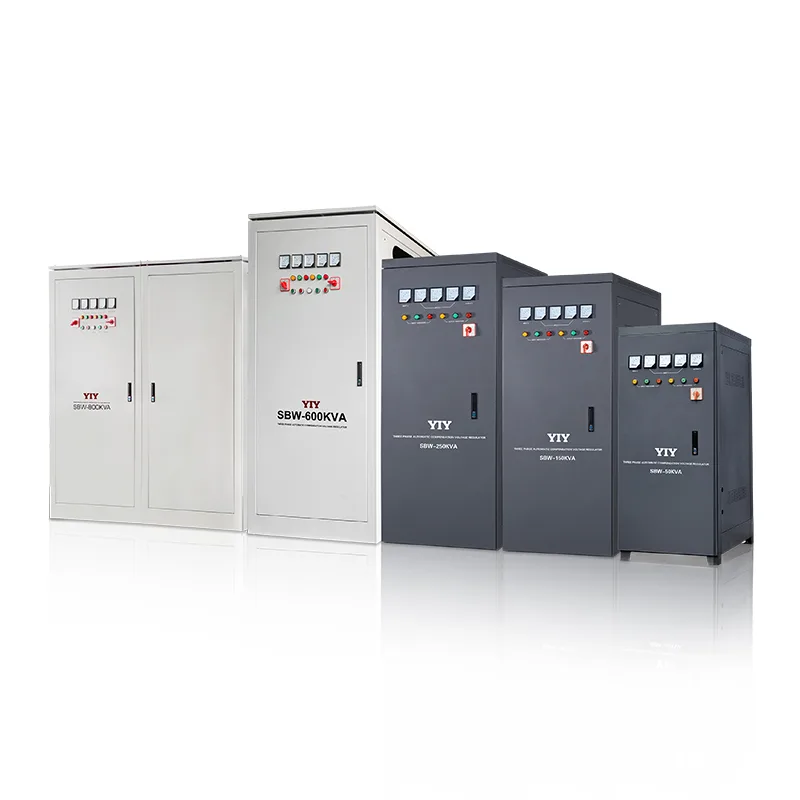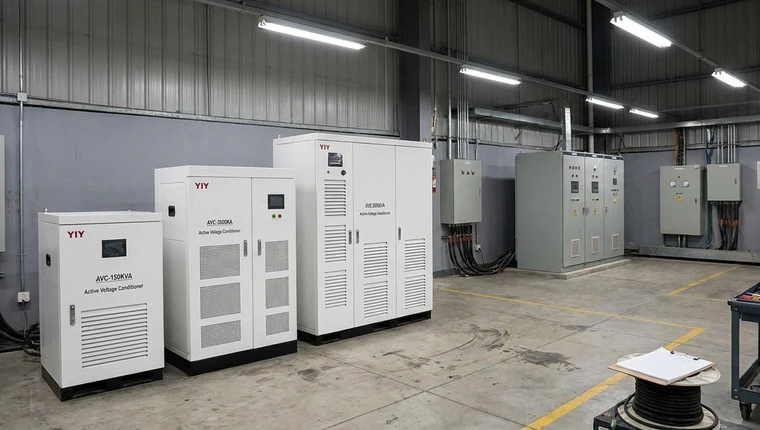
An ac voltage conditioner for generators is worth specifying when your generator output can sag, overshoot, drift, or become unbalanced before it reaches sensitive equipment. Before you send an RFQ, check the generator voltage range, load-start behavior, correction topology, sizing headroom, bypass design, site environment, and supplier proof.
This guide walks you through when generator power quality becomes a real risk, how a conditioner differs from a generator AVR, which technology fits your load, and what to verify before procurement approval.
When Does Generator Power Quality Become a Real Risk for You?
You should treat generator power quality as a real risk when voltage movement can trip, damage, or destabilize your protected load. A diesel or gas generator may look stable during light testing, then sag during motor starting, overshoot after load shedding, or become unbalanced when single-phase loads are unevenly distributed across a three-phase system.
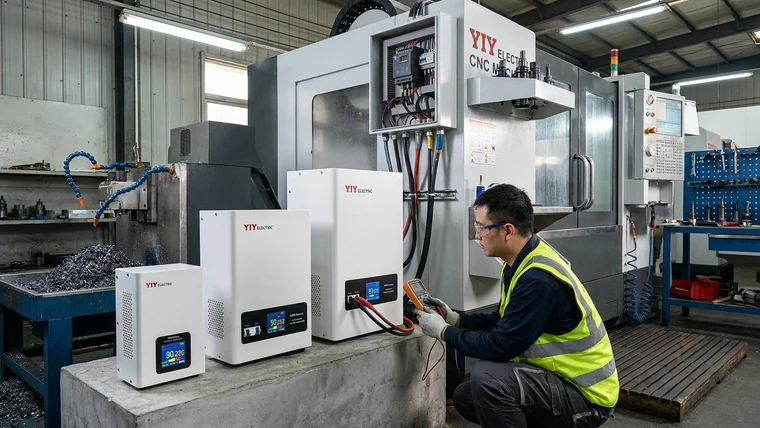
If your generator feeds CNC machines, telecom equipment, medical-support loads, PLC panels, pumps, compressors, HVAC drives, rectifiers, or mixed industrial distribution, you are not only buying “stable voltage.” You are deciding how much disturbance your equipment can tolerate before production, service continuity, or asset life is affected.
For industrial three-phase projects, start your product fit review with voltage range, kVA, phase balance, bypass, and protection functions. YIY’s three-phase stabilizers are a practical reference point when your generator feeds mixed plant loads and you need a structured way to compare capacity, topology, and protection features.
| Generator behavior to check | Why it matters | What it means for you |
|---|---|---|
| Voltage sag during motor start | Starting current can pull voltage below equipment tolerance | Your PLC, drive, contactor, or controller may reset even when generator kVA appears adequate |
| Overvoltage after load shedding | Generator control may overshoot when a large load disconnects | Sensitive power supplies can see stress during ordinary load changes |
| Phase imbalance | Mixed single-phase loads can overload or underfeed one phase | One machine may fault while another appears normal |
| Frequency variation | Engine speed and load response affect frequency-sensitive equipment | Some electronics and drives may trip even if voltage looks acceptable |
| Harmonic or nonlinear loading | UPS, VFDs, chargers, and rectifiers distort current draw | Transformers, cables, and controls may run hotter or behave unpredictably |
| Poor site conditions | Heat, dust, humidity, and vibration affect real operating life | A cabinet that works in a clean room may fail early beside a generator set |
The practical point is simple: your conditioner should be specified against the worst normal operating condition, not against the cleanest generator test result.
What Should an AC Voltage Conditioner Do Between Your Generator and Load?
An AC voltage conditioner should stabilize usable voltage, reduce disturbances within its design scope, and protect your downstream equipment from generator-side instability. It sits between your generator output and the protected load, so it sees the practical problems that may not be fully corrected at the alternator terminals.
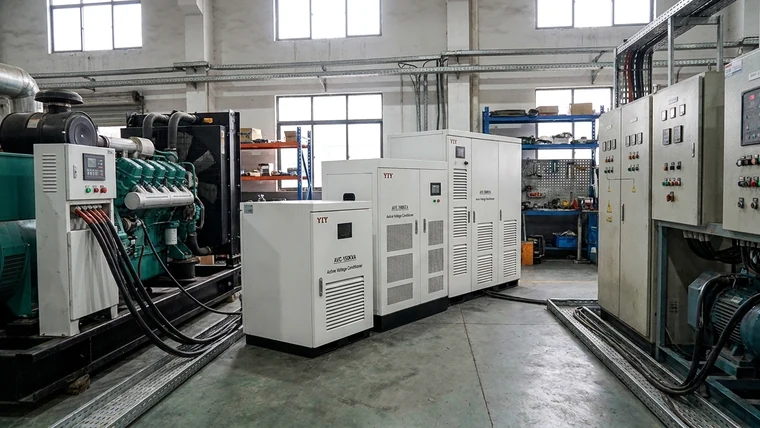
A generator AVR regulates output voltage at the alternator control level. That is useful, but it does not automatically solve downstream cable drop, phase imbalance, fast load transitions, poor neutral conditions, or sensitive load tolerance. A generator power conditioner, line voltage conditioner, servo stabilizer, static stabilizer, or active voltage conditioner works closer to the equipment you want to protect.
Think of the signal path as:
Sense incoming AC voltage -> compare against target -> correct output -> protect against abnormal conditions -> alarm or bypass when required.
Those steps matter because you need more than a nameplate kVA match. You need to know what the device does when the generator is hot, the load starts suddenly, the phase balance shifts, or the cabinet reaches its thermal limit.
Key specification figures include input voltage window, output regulation accuracy, correction speed, overload capacity, phase system, bypass mode, cooling design, enclosure protection, alarms, and test evidence. In practical terms, these tell you whether the unit can survive your real generator behavior instead of only passing a factory demonstration under stable input power.
How Do AVR, Servo, Static, IGBT, and Active Conditioning Compare?
You should choose the topology by matching correction speed, load sensitivity, budget, and maintenance expectations rather than by choosing the most advanced label. A servo unit may be the right fit for many industrial loads, while static, IGBT, or active conditioning may be better when events are fast and tolerance is narrow.
| Option | Best fit | Strength | Watchpoint for you |
|---|---|---|---|
| Generator AVR | Basic alternator voltage regulation | Built into many generator systems | It may not correct downstream disturbance at the load panel |
| Servo voltage stabilizer | General industrial loads, pumps, HVAC, many support circuits | Smooth correction and practical capacity range | Mechanical response is not ideal for very fast sags |
| Relay stabilizer | Smaller or less critical loads with wider tolerance | Lower complexity and cost | Stepped correction can be unsuitable for precision equipment |
| Static / IGBT stabilizer | Sensitive electronics, telecom, medical-support loads, fast fluctuation sites | Faster electronic correction | Specification should confirm response time, overload curve, and thermal design |
| Active voltage conditioner | Critical loads exposed to sags, swells, and selected transients | Fast compensation for continuity-focused applications | It is not a substitute for fixing poor generator sizing, earthing, or severe frequency instability |
When your load has narrow voltage tolerance or fast sag exposure, review an IGBT voltage stabilizer as a mid-body comparison point. For you, the key distinction is not only “digital” versus “mechanical”; it is whether the correction method reacts within the time window your equipment can actually tolerate.
An active voltage conditioner is closer to power-quality compensation than basic voltage trimming. It may be considered when your protected load cannot tolerate short voltage events, but you still need to verify the event type, depth, duration, recovery behavior, rated kVA, and bypass plan.
Which Standards and Proof Points Should You Ask for?
You should use standards as reference language for nominal voltage, immunity context, and supplier documentation, not as a shortcut for application engineering. Standards help you ask better RFQ questions, but your final decision still depends on generator behavior, load tolerance, and installation conditions.
For nominal voltage systems, IEC 60038 standard voltages gives the reference context for standard AC voltage levels. For you, this helps keep the RFQ clear when you specify systems such as 220 V, 230 V, 380 V, 400 V, 415 V, or other regional nominal voltages instead of using vague wording such as “normal industrial voltage.”
For voltage dips and interruptions, IEC 61000-4-11 voltage dip and interruption immunity testing helps frame how equipment immunity is evaluated. In practical terms, you can ask whether your protected equipment is expected to ride through the event by itself, or whether the supply side needs conditioning before the event reaches the load.
For supplier process control, ISO 9001:2015 quality management systems defines quality-management requirements. For procurement, this does not prove that one model fits your generator, but it helps you separate a documented manufacturing process from a quote that only lists price and capacity.
Ask for datasheets, wiring diagrams, rated input range, overload curves, protection functions, test records, certification documents where relevant, warranty terms, spare-parts support, and installation requirements. Your best supplier response should explain the limits of the device as clearly as the benefits.
How Should You Size a Conditioner Before RFQ?
You should size the conditioner from real load behavior, starting current, phase configuration, power factor, duty cycle, and expansion margin. Nameplate kVA alone is not enough because generator-fed loads often create short, harsh events that are larger than steady running demand.
Start with your generator rating, voltage system, frequency, phase type, connected loads, continuous running current, starting current, load sequence, power factor, site temperature, and future expansion. If your load includes motors, compressors, transformers, UPS systems, rectifiers, or VFDs, your sizing review should include both steady-state and transient behavior.
For detailed execution work, use YIY’s industrial voltage stabilizer selection guide when you are turning an application review into a technical specification. If your project is a main-line three-phase installation, the 3 phase main line stabilizer sizing guide is the more direct next step for load aggregation, phase balance, and distribution-level sizing.
| Check | Why it matters | If you skip it |
|---|---|---|
| Generator kVA and voltage system | Confirms the source capacity and nominal voltage | You may overspecify cost or underspecify protection |
| Continuous load current | Shows normal thermal demand | The unit may run hot in daily operation |
| Starting or inrush current | Captures motor, compressor, or transformer energizing | Voltage sag, bypass trips, or failed starts may continue |
| Load power factor | Affects real current and thermal stress | kVA may look acceptable while current stress is too high |
| Phase balance | Confirms each phase remains inside tolerance | One phase may fault before the total load appears high |
| Correction range and response time | Matches the conditioner to your disturbance pattern | Sensitive loads may trip before correction is complete |
| Bypass and protection design | Keeps service and fault response manageable | Maintenance may require shutdown or create unclear accountability |
| Cooling and enclosure | Matches the cabinet to heat, dust, humidity, and access | Premature failure or derating may occur in the generator room |
After you collect these numbers, translate them into an RFQ that states the real operating case: generator model and kVA, voltage and frequency, protected load list, largest starting load, expected simultaneous load, phase system, environment, required output tolerance, bypass preference, alarms, and documentation requirements.
What Should Your Procurement Screen Include?
You should screen the supplier and model against both engineering fit and service evidence before comparing final price. A lower quote can become expensive if the unit lacks overload headroom, bypass access, event visibility, or documentation for your installation team.
| Procurement check | Why it matters | If you skip it |
|---|---|---|
| Confirm topology recommendation | Shows whether servo, static, IGBT, or active conditioning fits your event profile | You may buy speed you do not need or miss speed you do need |
| Verify input voltage range | Confirms the conditioner can handle generator variation | The unit may drop out during normal generator operation |
| Review overload curve | Shows how the unit handles starts and short peaks | It may trip during the exact event you are trying to solve |
| Check bypass mode | Supports maintenance and fault response | A minor service issue can stop the protected load |
| Ask for protection functions | Covers over/under-voltage, overload, short circuit, phase loss, and thermal protection | Faults may transfer risk downstream |
| Confirm enclosure and cooling | Matches the site to temperature, dust, humidity, and clearance | Reliability may fall after installation |
| Request test records and documents | Supports acceptance review and accountability | You may have no evidence when troubleshooting |
| Confirm spares and service access | Reduces recovery time after a fault | Small failures may cause long downtime |
A good RFQ does not need to be complicated, but it must be specific. Include your operating environment, protected load type, generator voltage behavior, and any known nuisance trips. If you have measured voltage logs, share them; if you do not, describe the symptoms and load sequence honestly.
What Verification Should You Complete Before Acceptance?
You should verify the installed conditioner under realistic generator operation before handing it over as “accepted.” Factory data is useful, but your site test confirms whether the selected unit performs with your generator, your load sequence, and your ambient conditions.
During commissioning, record input voltage, output voltage, load current, phase balance, frequency, alarms, temperature rise, bypass operation, and recovery after load changes. Run the largest normal starting event if site safety allows it. If your project has critical loads, coordinate the test plan with your electrical engineer, equipment owner, and maintenance staff before energizing.
Your acceptance review should answer four practical questions: does the conditioner stay online during normal generator behavior, does the protected load remain within tolerance, does bypass work as expected, and can your maintenance workflow identify the cause of a future trip?
If the answer is unclear, do not close the issue with “generator fluctuation” as a generic explanation. Ask for event records, meter readings, protection status, and wiring verification so you can separate generator behavior, conditioner behavior, and downstream load behavior.
Frequently Asked Questions
What Does a Voltage Conditioner Do for Generator-Fed Equipment?
A voltage conditioner stabilizes generator-supplied AC power before it reaches your equipment. It reduces the impact of voltage sag, overvoltage, load-starting transients, and selected power-quality disturbances within its design scope. Before you approve one, verify the input voltage range, protected load tolerance, overload capacity, bypass mode, and site cooling clearance.
What Is an Active Voltage Conditioner?
An active voltage conditioner is a fast power-quality device that compensates for voltage sags, swells, and selected transient events. You normally consider it for critical industrial, telecom, medical-support, or commercial loads where a basic line voltage conditioner may not react quickly enough. Ask the supplier to verify response time, correction range, rated kVA, overload behavior, alarm outputs, and generator compatibility.
Should I Leave My Power Conditioner on All the Time with a Generator?
A power conditioner can usually remain on during normal generator operation if it is correctly rated, installed, ventilated, and maintained. Your verification action is to check the supplier operating manual, confirm continuous-duty rating, test bypass operation, inspect cooling clearance, and document shutdown steps for planned generator service.
What Is the Difference Between an AVR and a Power Conditioner for Generator Power?
The generator’s AVR controls the alternator’s excitation to hold its terminal voltage, while a power conditioner works closer to your protected load and can address a broader set of downstream voltage-quality risks depending on design. For procurement, compare input voltage window, regulation accuracy, response time, transient protection, harmonic limitations, bypass design, and test evidence.
Can a Conditioner Fix an Undersized Generator?
No, a conditioner should not be used to hide an undersized generator. If your generator cannot support the load, starting current, power factor, or frequency stability, the conditioner may trip, bypass, overheat, or fail to protect the load. Verify generator sizing first, then select the conditioner around the remaining voltage-quality problem.
What Should You Do Before Requesting a Quote?
You should request a quick fit review before asking for a final model and price. That first-pass review helps you avoid quoting the wrong capacity tier, wrong correction topology, or wrong enclosure for the site.
For procurement comparison, it also helps to compare before buying a voltage stabilizer so your team can align topology, overload headroom, documentation, and installation conditions before approval.
Share your generator rating, voltage and frequency, phase system, protected load list, largest starting load, observed voltage behavior, installation environment, and any required alarms or bypass preferences. YIY can then recommend a practical deployment path for your generator-fed load without forcing you into a full engineering package before the basic fit is clear.