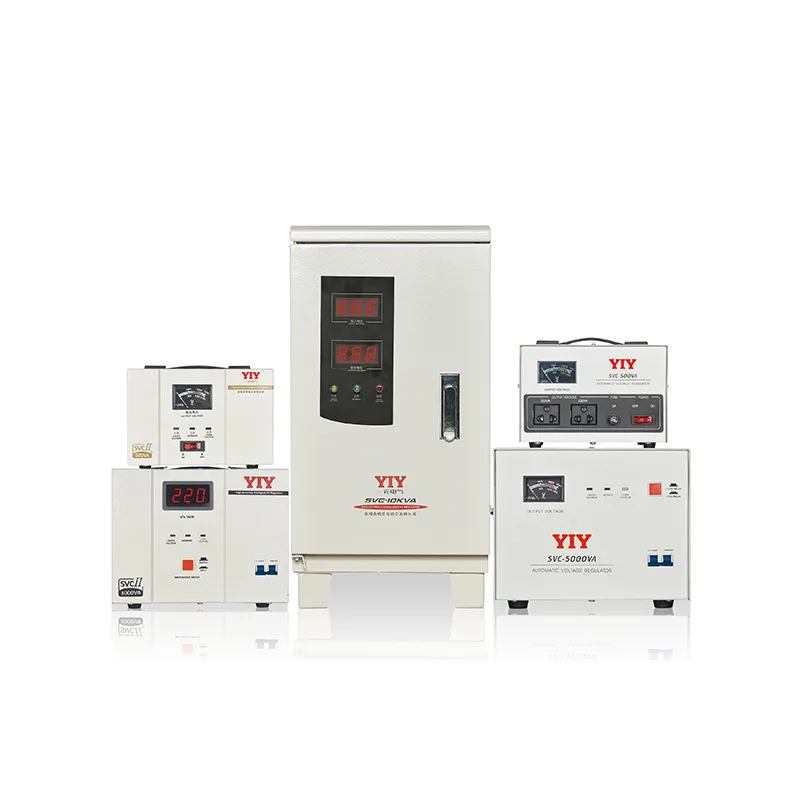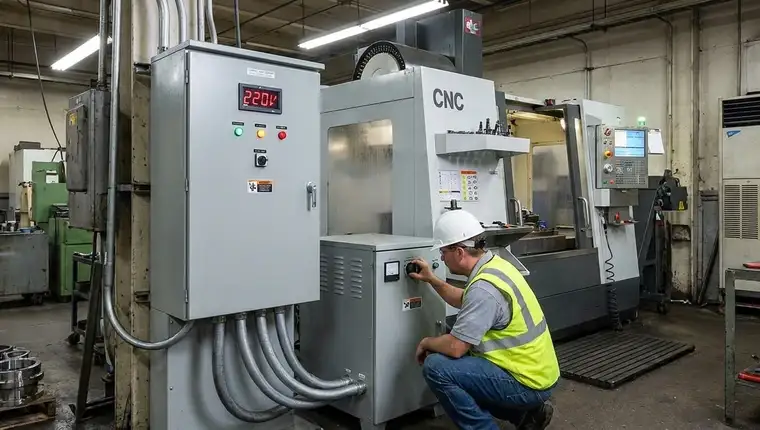
A 5kva stabilizer for main line voltage protects every circuit behind the board, so compare it on measured input range, starting current, topology, and documented compliance, not the kVA label. On 230 V single phase, 5 kVA is about 21.7 A before margin.
Before comparing quotations for a 5 kVA main-line unit, review the factors behind a 5 kVA voltage stabilizer price, from technology type to winding material.
For product-level context, see YIY’s IGBT Voltage Stabilizer — Overview.
This guide covers when main-line fluctuation becomes critical, why 5 kVA fits some feeders, how many amps it draws, which topology to pick, and what to put in the RFQ.
When Does Main Line Fluctuation Become Critical?
If your facility is already seeing nuisance trips, unstable mains are no longer a background condition; they are a procurement variable you need to price and control. Main line voltage instability protects nothing by default, and repeated sags or swells compound into unplanned downtime, scrap, and faster component erosion. Treat this section as the threshold test for deciding when a stabilizer moves from optional hardware to mandatory infrastructure.
Downstream Equipment Vulnerabilities
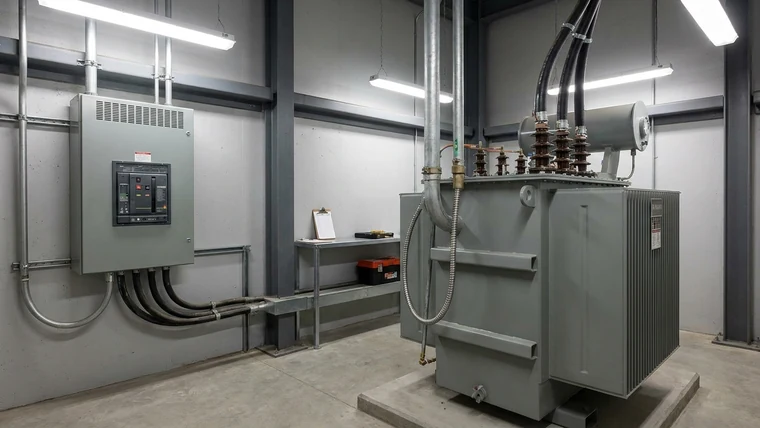
Unprotected mains compromise downstream control panels, HVAC systems, and sensitive industrial IoT devices by exposing precision electronics to erratic supply delivery. Frequent voltage sags trigger unpredictable PLC communication timeouts and data corruption within edge computing nodes. Meanwhile, sustained overvoltage conditions degrade motor winding insulation and reduce the mean time between failures for critical rotating machinery, directly inflating maintenance work orders and extending warranty processing times.
Systemic Instability Versus Localized Faults
Technical teams must differentiate between temporary branch-line issues and systemic main-line instability that requires facility-wide intervention. Isolated circuit faults typically emerge during heavy inductive load switching and dissipate once the specific machine cycle completes. Conversely, systemic instability manifests as persistent baseline variance across multiple distribution panels, indicating that localized surge protection or isolated transformers cannot resolve the root cause.
The operational threshold becomes critical when voltage deviation exceeds ±10% consistently or correlates with recurring hard fault trips on critical machinery. In this scenario, facility managers must balance equipment longevity, compliance mandates, and operational resilience against the mounting cost of reactive repairs. Deferring upstream stabilization essentially converts predictable capital planning into volatile operational risk, making facility-wide regulation a mandatory engineering baseline.
Why Is a 5kVA Stabilizer the Right Protection Window?
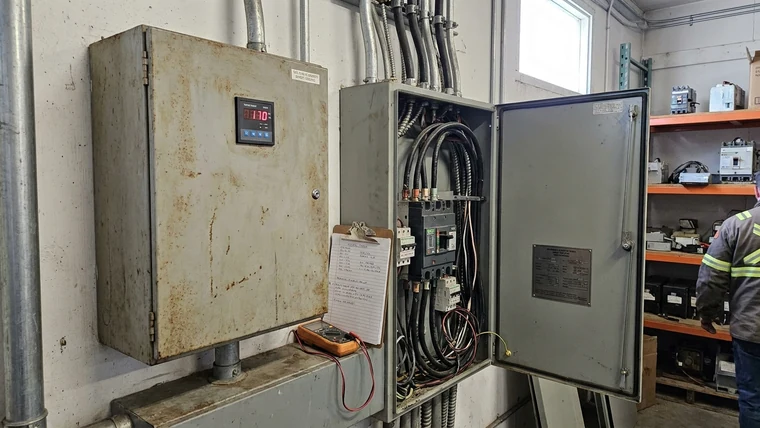
If you are protecting a compact production feeder or mixed commercial load, a 5kVA unit often sits in the sweet spot between underbuilt branch protection and overcapitalized industrial hardware. Start with a 3 phase main line stabilizer sizing guide when you need to verify whether your actual panel conditions justify this tier. A correctly specified 5kVA stabilizer maintains constant output across input variance without forcing you to pay for unnecessary capacity headroom.
Shifting from Reactive Suppression to Proactive Regulation
Many facilities still rely on basic surge suppressors that only absorb transient spikes after the grid has already faulted. This reactive approach fails to address the chronic sags and brownouts that progressively degrade embedded microprocessors. By integrating a dedicated regulation unit onto the main distribution line, operators transition to proactive conditioning that neutralizes continuous grid deviations before they cascade downstream. This architectural shift eliminates unexpected hard fault trips and secures continuous uptime across automated production shifts.
Global Digital Precision Versus Legacy Hardware
Sourcing often stalls when teams compare old catalogs against current requirements. IGBT topologies give the tightest regulation and the fastest correction, without the mechanical lag of relay switching. That matters most for mission-critical loads.
Extending Asset Lifecycle and Cutting Maintenance Costs
Precise voltage regulation directly translates to reduced thermal stress on motor windings and sensitive control boards. When input power stays strictly within operational tolerances, insulation breakdown slows dramatically and semiconductor fatigue drops. This extended equipment lifespan directly shrinks your predictive maintenance budget and prevents costly production scrap. Accurate regulation is not just a compliance metric; it is a direct capital preservation strategy.
How Many Amps Is a 5kVA Stabilizer?
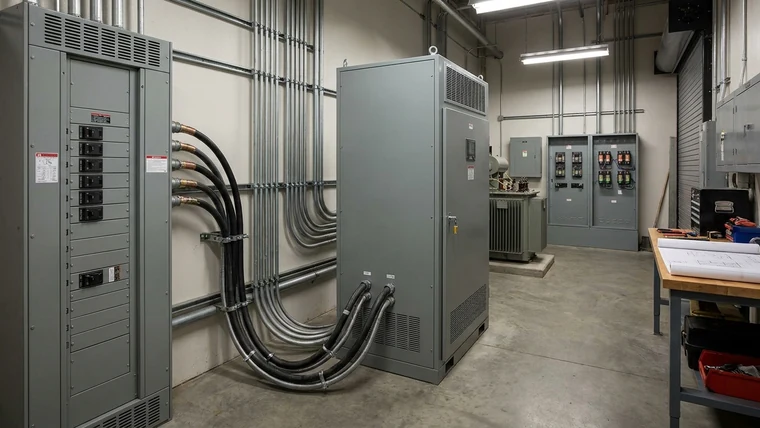
A 5kVA stabilizer carries about 21.7 A at 230 V single phase, 22.7 A at 220 V, or 7.2 A per phase at 400 V three phase, before any margin.
| Supply type | Formula | Approximate current |
|---|---|---|
| Single phase 230 V | 5,000 VA ÷ 230 V | 21.7 A |
| Single phase 220 V | 5,000 VA ÷ 220 V | 22.7 A |
| Three phase 400 V | 5,000 VA ÷ (1.732 × 400 V) | 7.2 A per phase |
These figures drive cable size, breaker rating, terminals, and bypass design, but they are not an installation design. Check local code, ambient temperature, and motor inrush before you finalize.
Which Topology Should You Choose: IGBT, Servo, or Relay?
If you are comparing quotations that all claim “automatic correction,” topology is the line item that actually determines response behavior, wear profile, and long-term operating cost. Use this section to decide whether your site needs fast solid-state correction, smoother servo control, or a lower-cost relay architecture before you sign off on a vendor shortlist.
| Topology | Response Time | Accuracy Range | Efficiency & THD Profile | Best Application Fit |
|---|---|---|---|---|
| IGBT (Double-Conversion) | Sub-cycle (<20 ms) | ±0.5% | ~96% efficiency / <3% THD | Mission-critical PLCs, servers, medical devices |
| Servo (Electromechanical) | 1–2 seconds | ±0.5% – ±3% | ~94% efficiency / <5% THD | Heavy motors, CNC machines, mixed commercial loads |
| Relay (Tap-Switching) | Fast stepping (discrete jumps) | ±5% – ±8% | ~92% efficiency / <8% THD | General lighting, non-critical auxiliary circuits, budget constraints |
Harmonic, Efficiency, and Wear Implications
IGBT systems keep harmonic distortion low, which protects logic controllers, but run warmer inside. Servo designs are efficient but their carbon brushes wear with continuous tracking and need inspection. Relay stepping adds small transients that sensitive loads may need filtered.
How Should You Size, Verify Compliance, and Compare Suppliers?
If you are preparing an RFQ, use this section as your minimum engineering filter before you compare price tables. You need to separate actual operating requirements from marketing claims, then verify that every shortlisted unit can survive your site conditions without hidden compliance or maintenance risk.
- Confirm your lowest and highest measured input-voltage window before you compare correction ranges.
- Confirm your continuous load, startup current, and future expansion margin before you approve kVA sizing.
- Confirm the standards, warranty terms, and after-sales commitments you must see in writing before you move to commercial negotiation.
Load Calculation and Capacity Mapping
Sizing starts with the main distribution board: sum all connected resistive and inductive loads, then add headroom for motor starts and future circuits so the unit never runs at its rated limit.
Standardized kVA ratings must be deliberately mapped to your specific operational footprint rather than selected arbitrarily. For lighter mains supporting administrative zones or isolated lighting circuits, downscaling to a voltage stabilizer 3 kva eliminates unnecessary footprint and reduces baseline conversion losses. Conversely, production floors deploying heavy compressor banks or welding equipment must upscale to a 6kva stabilizer for main line voltage to absorb repetitive high inrush-current machinery without triggering internal breaker trips.
When evaluating higher capacity options for expanding production lines, reviewing a comprehensive 20kva voltage stabilizer technical guide ensures your scaling path aligns with modular infrastructure planning.
For facilities with three-phase industrial machinery and heavy motor loads transitioning beyond single-phase boundaries, evaluating a 3 phase voltage stabilizer 10kva becomes necessary to balance phase loads and prevent neutral-current overheating. When scaling up protection requirements for larger distribution panels, referencing a proven 20kva voltage regulator architecture provides clear benchmarks for thermal dissipation and bypass routing design.
Compliance Benchmarks and Feature Verification
Hardware validation requires documented proof that the unit survives extreme grid stress without violating regional safety mandates. Require vendor datasheets that demonstrate strict adherence to IEC 60038 standard voltage tolerances, guaranteeing reliable automatic correction across a ±10% input range. Simultaneously, verify compliance with IEC 61000 electromagnetic compatibility guidelines when discussing harmonic distortion and feature verification to prevent rapid switching topologies from injecting electrical noise back into your sensitive control networks.
The most common procurement failure occurs when teams conflate certified power-performance metrics with optional convenience features. Distinguish verified compliance documentation from secondary upgrades like remote telemetry modules, color touchscreens, or custom enclosure finishes. Isolating true regulatory alignment from cosmetic add-ons prevents the costly mistake of over-specifying on non-essential interfaces while dangerously under-protecting the main distribution panel against chronic voltage sags.
What Main-Line Questions Should Buyers Resolve Before Ordering?
If your team is still debating topology, installation scope, or ROI assumptions, answer these questions before you release the purchase order. They capture the last practical objections that usually surface between technical approval and commercial signoff.
Can I Use a Standard AC Stabilizer for Main Line?
Standard appliance stabilizers lack the fault-current tolerance required for facility-wide distribution. Tying low-capacity units directly to the main board often trips internal breakers during heavy motor startup. Main line applications demand purpose-built hardware with reinforced contactors and dedicated bypass circuitry to sustain continuous grid stress.
How to Choose the Right Main Line Stabilizer for Home or Light Commercial Use?
Selection depends on actual downstream load profiles rather than building square footage. For mixed environments running inverters alongside resistive heating, IGBT or servo topologies deliver precise regulation without over-engineering capacity. Always verify continuous kVA output ratings rather than peak surge claims to prevent chronic thermal throttling during peak demand cycles.
What Should the RFQ Include?
Send every supplier the same input sheet, then compare the offers on the same rows:
| RFQ input | What to specify | Why it changes the quote |
|---|---|---|
| Load size | kVA, kW, power factor, running amps | Prevents undersizing and overload disputes |
| Phase and voltage | Single or three phase, 220/230/380/400 V | Changes current, wiring, and model |
| Input range | Measured minimum and maximum voltage | Sets correction range and alarm logic |
| Load type and inrush | Motors, compressors, electronics; simultaneous starts | Affects technology and reserve margin |
| Site environment | Heat, dust, humidity, cabinet location | Affects enclosure and cooling |
| Protection needs | Bypass, surge, overload, alarms, thermal | Changes hardware and safety behavior |
| Documentation | Datasheet, wiring diagram, test record, warranty | Supports approval and handover |
Main-Line Input Vs. Downstream Routing
Installation architecture dictates protection scope. Mounting the unit at the primary utility entry shields every downstream circuit, eliminating cascading failures across mixed distribution panels. Branch-line routing only isolates specific control rooms while leaving broader infrastructure exposed to grid transients. Centralized main-line deployment consistently reduces maintenance tickets and simplifies regulatory compliance audits.
Submit verified load profiles, historical input voltage ranges, and your preferred correction topology to accelerate engineering validation. Providing these operational baselines allows our team to bypass generic catalog matching and generate precise, application-ready quotes aligned with your exact uptime targets.
Frequently Asked Questions
How Do You Size a Mains Stabilizer for Mixed Motor and Control Loads?
Start with the real connected load on the distribution board, then add headroom for starting current and future expansion. If inductive equipment produces repeated inrush peaks, check the stabilizer against the highest transient draw, not the average running load.
When Should You Choose Servo Instead of IGBT or Relay on the Main Line?
Choose servo when you need tighter output regulation than relay can offer but do not need the fastest solid-state switching profile. It is usually the better fit when your team wants a balanced trade-off across accuracy, maintenance, and capital cost for continuous industrial duty.
Can a Home-Use AC Stabilizer Protect a Full Main Distribution Board?
No. Home-use AC stabilizers are not designed for the fault-current levels, bypass expectations, or continuous duty profile of a facility-wide incoming line. If you need to protect the main board, specify hardware engineered for sustained mains instability and upstream installation.
Final Thoughts
Choose a 5kva stabilizer for main line voltage by sizing with headroom for motor starts, matching topology to load sensitivity, and checking documented IEC compliance over marketing claims.
Move forward by sharing your verified connected load profile, historical input voltage ranges, and preferred correction architecture. Submitting these operational parameters enables YIY engineering to bypass generic catalog assumptions and rapidly scope a targeted 5kVA configuration engineered for your exact facility uptime requirements.