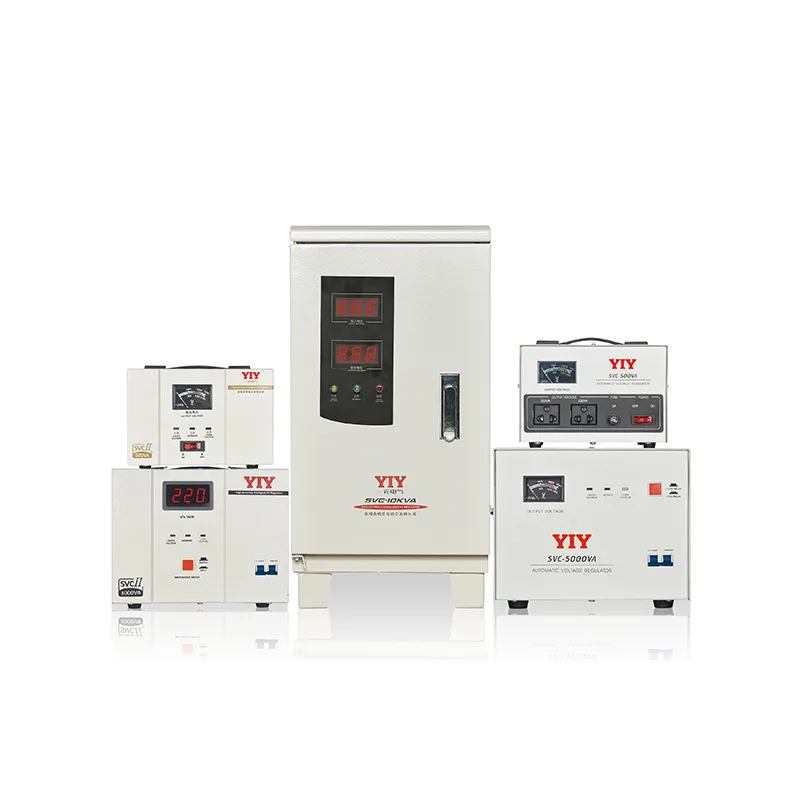
A stabilizer 10 kVA 1 phase holds output steady while the grid swings. YIY’s 10 kVA SVC model, for example, accepts 150–250 V input and delivers 220 V ±3% at 8,000 W output. The kVA label alone won’t tell you whether a unit suits your site.
This guide covers who needs one, how to size it, which specs and technology to compare, and which certifications to require before you order.
Who Actually Needs a 10 KVA Single Phase Stabilizer
A 10 kVA single phase stabilizer sits at a specific intersection: loads heavy enough to cause real damage from voltage swings, but served by a single-phase supply that makes three-phase protection irrelevant. If your connected load runs between 6 and 8 kW on one phase, this is your category.
You can compare 10kVA options across servo, relay and IGBT technology on the single-phase voltage stabilizer range.
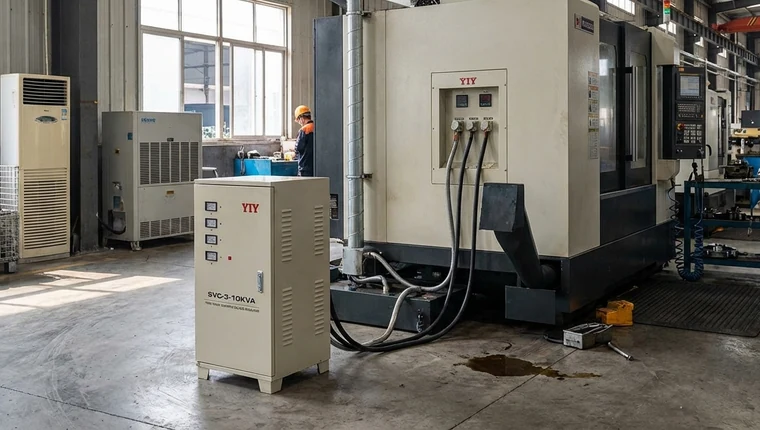
Light Industrial: CNC and Compressor Loads
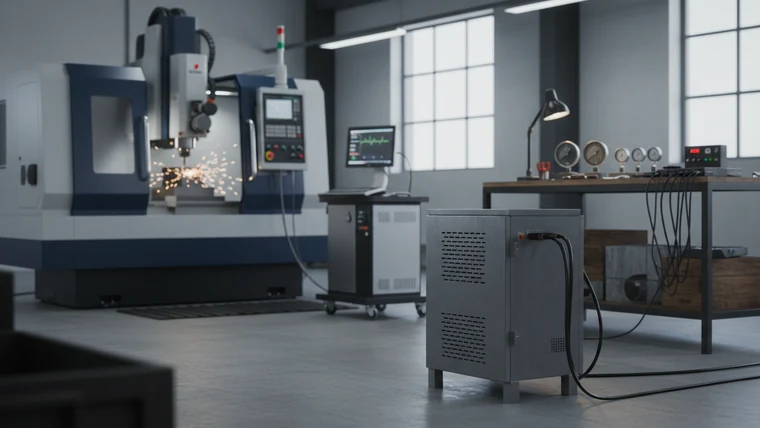
CNC machines are the textbook case. A 5–7 kW spindle motor draws 3–5× rated current at startup, and even brief voltage sags during that inrush window can trigger fault codes or damage servo drives. A single-phase stabilizer rated at 10 kVA — with roughly 8 kW usable capacity — covers that load with the 20–25% headroom that motor starting currents demand. Small air compressors and single-phase welding equipment fall into the same profile.
Commercial: Lighting Panels and HVAC
Facility managers protecting a lighting bank or a packaged HVAC unit on a dedicated single-phase circuit are a common buyer. A 10 kVA unit handles 8–10 kW of resistive or lightly inductive commercial load cleanly. The key qualifier: the load must be on one phase. If your HVAC is already three-phase, a single-phase stabilizer is the wrong tool regardless of kVA rating.
Residential High-Load Scenarios
High-end residential installations — server rooms, home workshops, medical equipment — occasionally reach 8–10 kW on a single phase. These buyers typically prioritize quiet operation and compact footprint over industrial-grade protections.
When Single-Phase Is the Right Call
Single-phase protection makes sense when your utility supply is single-phase, when the load is physically isolated on one circuit, or when upgrading to three-phase infrastructure isn’t cost-justified. Choosing a 3 Phase Voltage Stabilizer 20kva Type Selection3 phase voltage stabilizer 10kva for a single-phase load wastes capacity and adds unnecessary complexity.
Buyer Profiles
The three buyers who typically specify this category: facility managers protecting a single critical circuit, panel builders sizing protection for a specific machine feed, and EPC procurement teams sourcing stabilizers for distributed single-phase loads across a site. Each has a different decision trigger, but the same core requirement — reliable 220V output from an unstable grid.
How to Size a Stabilizer 10 KVA 1 Phase Correctly
Getting the kVA rating wrong is the most common procurement mistake. Undersizing causes nuisance tripping; oversizing wastes capital and increases footprint. The formula is straightforward — but motor loads add a layer most buyers miss.
The Core Sizing Formula
Start with your total connected load in kilowatts, divide by the power factor, then apply a 1.25× safety margin:
Required kVA = Total Load (kW) ÷ Power Factor × 1.25
Power factor for resistive loads (lighting, heating) is typically 1.0. For inductive loads (motors, compressors, HVAC), use 0.8–0.85 unless you have a measured value.
Motor Starting Current: Size for Peak, Not Steady State
This is where most sizing calculations break down. Single-phase motors draw 5–7× their rated current during startup — a 2 kW motor pulling 9A at steady state can spike to 45–63A for 2–5 seconds at inrush. A stabilizer sized only for steady-state load will trip or saturate on every motor start.
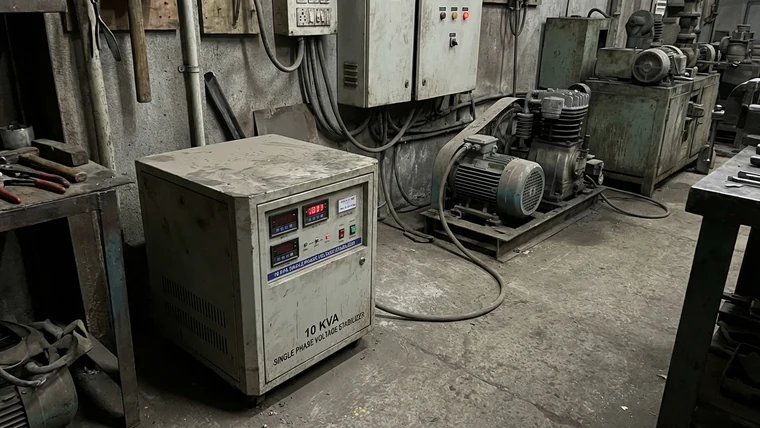
The rule: identify your largest motor, calculate its inrush current, and confirm the stabilizer’s peak capacity covers it. For servo-type stabilizers, check the overload rating — units with ≥120% continuous overload tolerance handle motor starting currents more reliably than relay-type units.
Worked Example
A small CNC workshop has the following single-phase loads:
- CNC spindle motor: 5.5 kW at 0.85 PF
- Coolant pump: 1.5 kW at 0.80 PF
- Control panel + lighting: 0.5 kW at 1.0 PF
Total apparent load:
- Spindle: 5.5 ÷ 0.85 = 6.47 kVA
- Pump: 1.5 ÷ 0.80 = 1.88 kVA
- Panel: 0.5 ÷ 1.0 = 0.5 kVA
- Subtotal: 8.85 kVA
- With 1.25× margin: 8.85 × 1.25 = ~11.1 kVA
Result: a 10 kVA unit is borderline. Choose 10 kVA only if the spindle and pump never start simultaneously. If they can, step up to 15 kVA.
When to Step up to 15 or 20 KVA
Four conditions justify moving to the next rating:
1. Mixed loads — resistive and inductive loads on the same circuit push the effective demand higher than nameplate math suggests
2. Future expansion — adding even one 1.5 kW motor later will push a 10 kVA unit into its overload zone
3. High-inrush equipment — welding machines, large compressors, or soft-starter-less motors with 6–7× inrush
4. Calculated result lands within 10% of the rated kVA — always round up, not down
Stepping up one rating costs less than a nuisance trip on a CNC mid-cycle.
Key Specs to Compare: Input Range, Output Precision, and Technology Type
Four specification axes determine whether a 10 kVA 1 phase stabilizer will actually perform on your site. Getting any one of them wrong means nuisance trips, equipment damage, or a unit that’s technically running but not protecting anything.
Input Voltage Window
YIY’s 10 kVA SVC servo stabilizer is rated for 150–250 V input (product page, Last verified: 2026-10-10). If your logs drop below the low end of a model’s window during peak demand, as often happens on rural grids or at the end of a long feeder, ask for a wide-input model.
Before specifying, pull at least two weeks of voltage logs from your distribution panel. A stabilizer sized for a 160–250V window will saturate or trip on a grid that regularly hits 140V. The input range on the datasheet is not a worst-case tolerance — it’s the operating boundary.
Output Regulation Accuracy
This is where technology type directly determines load compatibility:
| Technology | Output precision | Response | Maintenance | Cost profile | Best for |
|---|---|---|---|---|---|
| Servo | 220 V ±3% on YIY SVC (product page) | Continuous, seconds | Periodic brush inspection | Moderate | CNC, servo drives, mixed motor loads |
| Relay (tap-switching) | Stepped, wider tolerance | Fast steps | Contact wear | Lowest | Lighting, HVAC, resistive loads |
| Static / IGBT | Tightest of the three | Fastest | Sealed electronics, lowest | Highest | Sensitive electronics, lab instruments |
Servo stabilizers deliver the tightest regulation and are the standard choice for industrial single-phase loads. Relay-type units are cheaper but step in discrete voltage increments — acceptable for lighting panels, not for spindle drives or medical equipment. Static/IGBT units match servo precision with faster response times, at a higher price point.
Technology Type Trade-Offs
Servo units use a motorized variac to adjust output continuously; the trade-off is slower correction and a moving part. IGBT static units correct fastest with no wear parts but cost noticeably more for the same capacity. Relay units cost least and correct in steps, so use them only where a wider output tolerance is acceptable.
Protection Feature Checklist
A compliant 10 kVA 1 phase unit should include all four of these:
- Overload protection sized for your motor starting current
- High/low voltage cutoff — disconnects load when input exceeds the operating window
- Delay restart (YIY SVC: 3–6 s, or 3–6 min optional) — prevents compressor and motor damage on power restoration
- Thermal protection — thermistor or thermal relay to prevent overheating in enclosed installations
Certifications and Standards That Should Be Non-Negotiable
Not every certification on a datasheet carries equal weight. For B2B procurement, the distinction between verified requirements and optional best practices determines whether a supplier qualifies or gets cut from the shortlist.
ISO 9001:2015 — the Manufacturing Quality Floor
ISO 9001:2015 certification is not a differentiator — it’s a baseline. For any stabilizer entering a B2B supply chain, this certification confirms that the manufacturer operates a documented quality management system covering design, production, and service. A supplier without ISO 9001:2015 has no auditable process behind their spec claims. Treat it as a pass/fail filter before evaluating anything else.
YIY holds ISO 9001:2015 certification across its stabilizer manufacturing operations, covering the full range from 0.5 kVA to 3000 kVA.
IEC 60038 — Input Tolerance Is a Standard, Not a Feature
IEC 60038:2009 defines the nominal voltage levels and permissible tolerances for utility supply systems. The ±10% input tolerance standard it establishes is the reference point for stabilizer input range specifications. A 150–250 V window on a 220 V system covers it; a unit that only covers a few percent either side is undersized for most real grids.
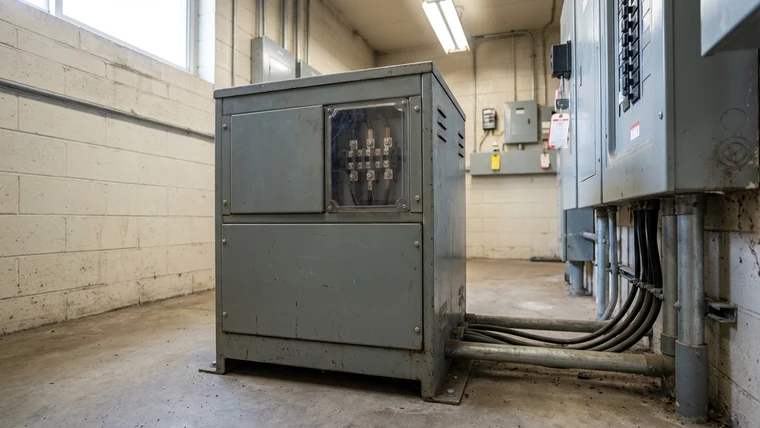
When reviewing datasheets, confirm the input range explicitly maps to or exceeds IEC 60038 tolerances. “Wide input range” without a voltage figure is not a specification.
CE and IEC 61000 — Required for Export, Critical for Sensitive Loads
CE marking is mandatory for stabilizers entering EU markets and signals compliance with relevant Low Voltage and EMC directives. For most industrial procurement outside the EU, CE is a strong quality signal but not a legal requirement. IEC 61000 EMC compliance matters specifically when the stabilizer will operate near sensitive electronics — servo drives, PLCs, medical equipment — where conducted or radiated emissions can cause interference.
Supplier Qualification Checklist
Ask every supplier for these before issuing a PO:
- ISO 9001:2015 certificate — current, with scope covering stabilizer manufacturing
- IEC 60038 compliance confirmation — input range stated in volts, not percentages
- Factory test reports — per-unit or batch, covering output regulation and overload rating
- Overload protection rating — as stated on the datasheet; confirm it’s tested, not just claimed
- CE certificate or equivalent — required for EU; recommended for all export procurement
- IEC 61000 EMC test report — required if load includes variable-frequency drives or sensitive control systems
Suppliers who cannot produce test reports on request are not ready for B2B procurement, regardless of price.
Why YIY Is Worth Comparing for a 10 KVA 1 Phase Application
YIY exports to 130+ countries with 1,000,000+ units of annual capacity and ISO 9001:2015 certification across its stabilizer manufacturing, which matters for teams that need repeat orders, custom specs, and export documentation.
That scale matters for procurement teams sourcing outside India, or for EPC contractors who need a supplier that can handle repeat orders, custom specs, and export documentation without friction.
YIY’s Single-Phase 10 KVA Option
The SVC range includes a 10 kVA single-phase model, plus 10–30 kVA tower versions. Published specs (product page, Last verified: 2026-10-10):
- Output: 220 V ±3% (or 127 V ±3%), 8,000 W at 10 kVA
- Input: 150–250 V (or 176–264 V)
- Protection: low/over-voltage cutoff, fuse or MCB, 3–6 s or 3–6 min restart delay
- Environment: −5 °C to 40 °C, 20–90% humidity
For a CNC spindle or compressor, check the restart delay and the input window against your logs first.
OEM/ODM Is the Actual Differentiator
Fixed-catalog competitors give you what’s on the shelf. YIY’s OEM/ODM capability means the input voltage window, enclosure rating, protection spec, and labeling can be configured to your project requirements. For panel builders integrating a stabilizer into a custom MCC, or EPC teams sourcing for a specific site condition, that flexibility has real procurement value.
How YIY Configures a 10 KVA Solution
YIY’s engineering team can spec a 1-phase 10 kVA solution based on your load list, starting current profile, and input voltage window. The technology is proven; the configuration is the conversation. If your shortlist includes fixed-catalog suppliers, comparing against a configurable servo platform is worth the RFQ.
Frequently Asked Questions
What Should Buyers Evaluate Before Choosing a Stabilizer 10 KVA 1 Phase?
Start with a two-week voltage log from your distribution panel, then the load list with power factors and the largest motor’s starting current. If that motor can start while other loads run, size for the peak, not steady state. Add the installation conditions and you have what a supplier needs.
When Is a Stabilizer 10 KVA 1 Phase Necessary Vs. Optional?
Necessary when a 6–8 kW single-phase load sees swings beyond ±10% of nominal (below 198 V or above 242 V on 220 V), especially with CNC drives, servo controllers, or medical equipment. Optional for purely resistive loads on a stable supply. If equipment has already faulted during a grid event, it’s no longer optional.
What Data Do You Need for an Accurate Quote?
Four things: a load list with each item’s kW and power factor, the largest motor’s starting current, logged minimum and maximum input voltage, and installation conditions such as ambient temperature and enclosure. Without the voltage log and inrush data, any quote is a guess.
Final Thoughts
Size a stabilizer 10 kVA 1 phase from load, starting current, and logged input voltage, then pick the technology. Send your load list through the YIY contact page for a sizing review.