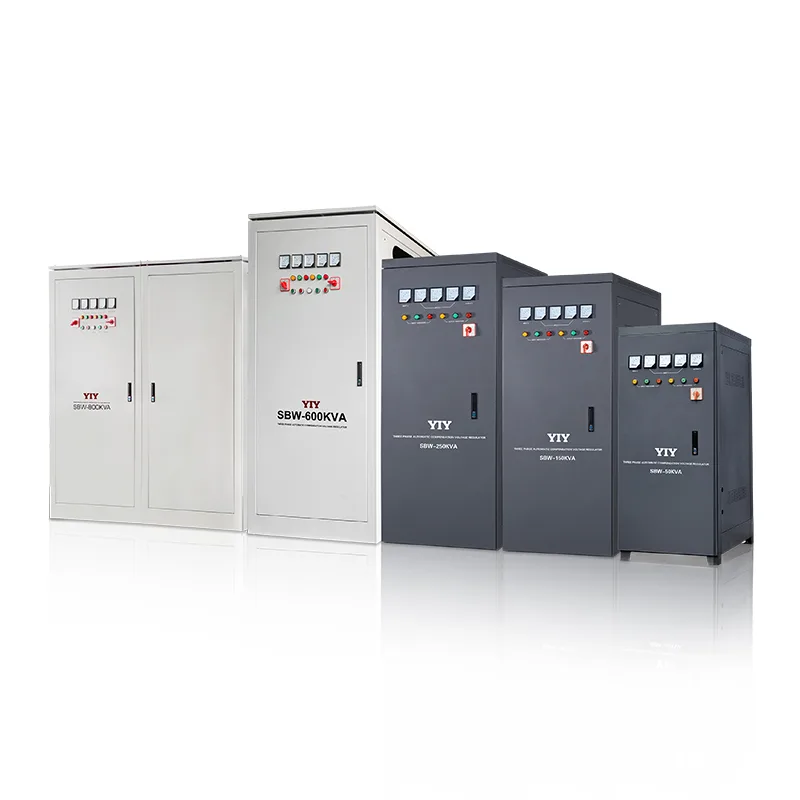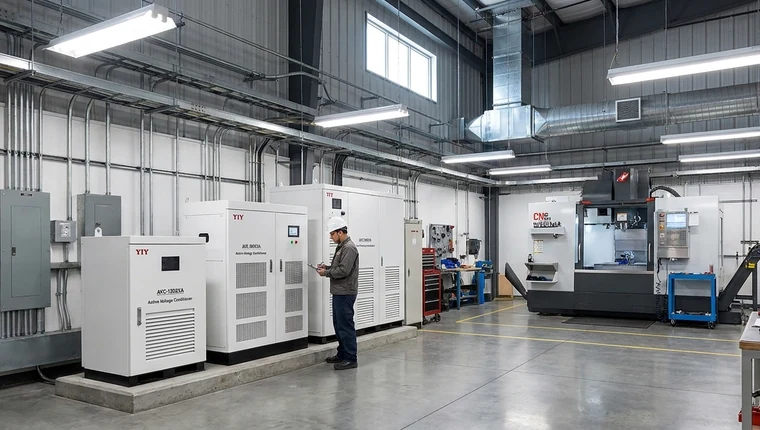
Industrial voltage stabilizer price is mainly affected by your kVA capacity, regulation technology, output precision, input voltage range, site environment, compliance requirements, and supplier testing depth, not by a universal catalog rate.
If you compare quotes only by headline price, you may miss the technical assumptions that decide whether the unit will pass commissioning and protect your load.
Here’s what you will be able to decide: which cost drivers matter most, how Relay, Servo, and IGBT designs compare, what proof to ask from industrial voltage stabilizer manufacturers, and how to build an RFQ that gets accurate pricing.
For larger three-phase industrial systems, start your product orientation with three-phase stabilizers after you have your load profile, input voltage range, enclosure requirements, and compliance files clear.
Why Does a Low Industrial Voltage Stabilizer Price Become Expensive Later?
You pay more later when a low quote ignores your real load behavior, startup current, power factor, duty cycle, environment, and grid conditions. The lowest unit price can turn into nuisance trips, overheating, delayed commissioning, warranty disputes, or a second purchase cycle.
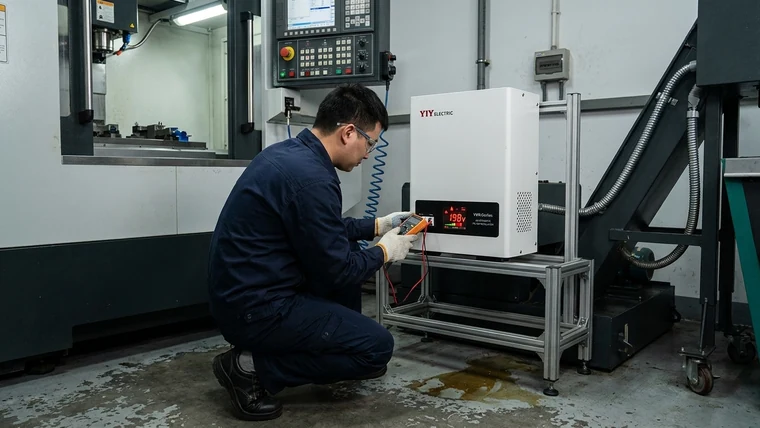
Your procurement decision should start with fit, not price alone. A voltage stabilizer industrial unit may look correct if the label says 100 kVA, 200 kVA, or 500 kVA, but the actual risk depends on how your equipment starts, runs, and reacts to voltage variation.
For example, your RFQ should confirm:
- Continuous running load and peak load
- Motor, compressor, pump, welder, CNC, HVAC, or mixed-load behavior
- Minimum and maximum measured input voltage
- Power factor and startup current
- Single-phase or three-phase supply
- Required output precision
- Ambient heat, dust, humidity, ventilation, and enclosure needs
- Destination market documentation and inspection requirements
A nominal 220V / 380V / 400V / 415V label tells you the expected voltage class, but it does not prove that the stabilizer fits your site. IEC 60038 standard voltages defines recognized voltage levels; in practical terms, you should confirm the stabilizer matches the region where it will operate, not just the country where it is purchased.
If your site has repeated voltage dips, a weak utility grid, or motor-heavy startup behavior, your supplier should discuss correction range, protection logic, bypass design, and alarm handling. These details may raise the quotation, but they help you avoid a cheaper unit becoming the weakest point in your power system.
Which Cost Drivers Should You Compare Before Shortlisting Suppliers?
You should compare capacity, topology, precision, input range, protection design, enclosure, factory testing, certification, documentation, and support before you shortlist suppliers. A quote is only comparable when each supplier is pricing the same technical duty.
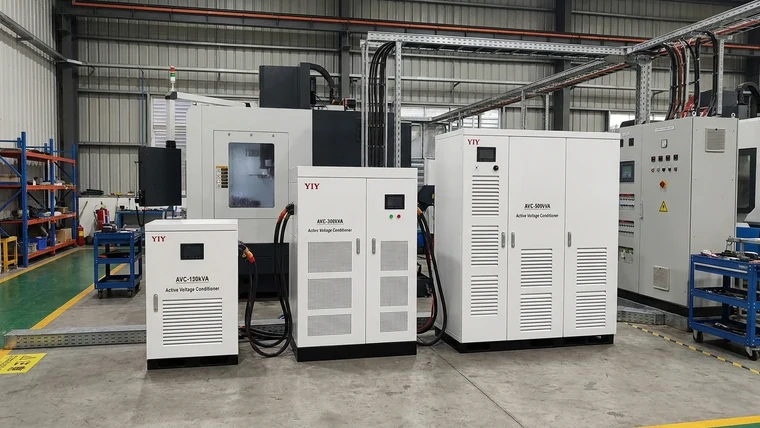
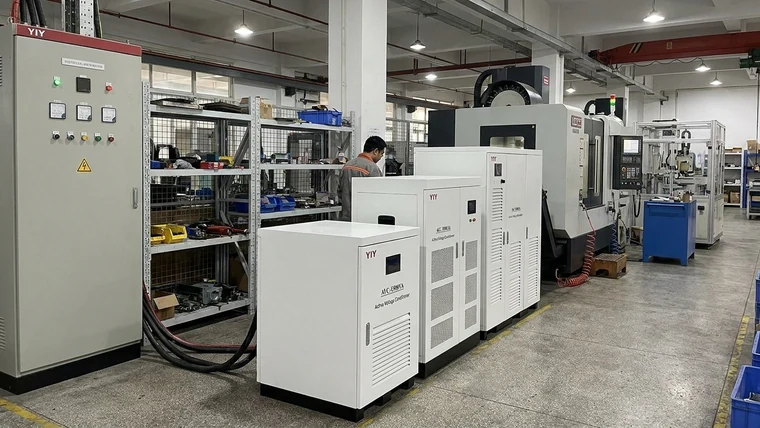
YIY manufactures voltage stabilizer units from 0.5KVA to 3000KVA across Relay, Servo, and IGBT designs, with precision from ±5% to ±0.5% depending on topology. In practical terms, a small light-duty unit and a high-capacity industrial servo voltage stabilizer do not share the same material cost, cabinet size, transformer design, cooling requirement, or test workload.
| Cost driver | What changes in the quote | What it means for you |
|---|---|---|
| kVA capacity | Transformer size, copper/aluminum use, cabinet size, cooling, shipping weight | Higher capacity usually raises cost, but undersizing can cause trips and overheating |
| Regulation topology | Relay, Servo, or IGBT/static design | You pay for the correction method, response behavior, and precision level your load requires |
| Output precision | Typical tiers such as ±5%, ±3%, ±1%, or ±0.5% | Tighter precision usually costs more because control and components must be more capable |
| Input voltage range | Wider correction window and stronger design margin | A weak grid may require a more robust unit than a stable utility supply |
| Protection package | Bypass, phase loss, over/under-voltage, surge, overload, over-temperature | Better protection reduces commissioning and downtime risk |
| Enclosure and cooling | IP level, ventilation path, fan design, service access | Harsh environments need more than a standard cabinet |
| Testing and documents | Factory test report, wiring diagram, nameplate data, inspection records | Documentation helps your engineer verify the unit before shipment and installation |
For three-phase industrial loads, compare nominal kVA against continuous demand, startup current, power factor, and safety margin. If you are specifying a plant main line or central stabilizer, the 3 phase main line stabilizer sizing process can help you check whether your capacity assumption matches real load behavior.
The practical lesson is simple: a quote based only on “100 kVA three-phase stabilizer” is incomplete. Your supplier should know whether the load includes motors, compressors, elevators, welders, CNC machines, rectifiers, medical equipment, or sensitive automation.
Which Technology Fits Your Precision and Budget Requirements?
You should choose Relay for less sensitive and lighter-duty loads, Servo for most general industrial loads, and IGBT/static designs for precision or critical applications. This choice has a direct effect on your RFQ because each topology uses different components, control methods, and test requirements.
| Technology | Typical use | Precision tier | Price effect | Main buying risk |
|---|---|---|---|---|
| Relay | Light-duty or less sensitive loads | ±5% to ±8% | Lower upfront cost | Step regulation may be too coarse for sensitive equipment |
| Servo | Workshops, production lines, factories, mixed industrial loads | ±0.5% to ±3% | Practical middle tier | Poor sizing can still cause overheating or slow correction |
| IGBT/static | CNC, medical, laboratory, semiconductor, precision automation | Around ±0.5% | Higher component and control cost | Overbuying can waste budget if your process does not need this precision |
Servo stabilizers usually offer a practical cost-to-performance balance for general industrial loads. For sensitive or high-precision applications, an IGBT voltage stabilizer may fit better because it is designed for tighter voltage control and faster electronic regulation.
After you see a precision number, translate it into your production risk. A ±3% output range may be acceptable for many industrial machines, while ±0.5% is more relevant when voltage variation can affect accuracy, process repeatability, test results, or sensitive electronics.
This is also where many low-priced quotations become misleading. If one supplier quotes Relay technology and another quotes Servo or IGBT/static technology, you are not comparing equivalent products. Ask each supplier to state the topology, correction speed, output precision, overload capacity, protection functions, and input voltage range in the same format.
How Do Standards, Certification, and Testing Affect Quotation Quality?
You should treat standards, certification, and factory testing as quotation evidence, not decoration. They show whether the supplier can connect your RFQ to repeatable production, inspection, and market-entry documentation.
When a project has voltage-dip or immunity requirements, IEC 61000-4-11 voltage dip testing is a relevant reference. For you, this means the discussion moves beyond “the product works” and toward how equipment behaves during short interruptions, voltage dips, and voltage variations.
Quality management also matters. ISO 9001:2015 quality management systems support repeatable procedures, corrective action, inspection control, and traceability. In practical procurement terms, you should ask whether the certificate scope applies to the quoted product activity, not just whether the supplier has a certificate image.
Use this acceptance screen before you approve an industrial automatic voltage stabilizer quote:
| Check | Why it matters | If you skip it |
|---|---|---|
| Factory test report | Confirms output voltage, protection action, and final inspection | You may discover instability only after installation |
| Wiring diagram | Helps your engineer verify connection, bypass, grounding, and phase arrangement | Commissioning delays become more likely |
| Nameplate data | Confirms model, capacity, voltage, phase, frequency, and rating | The delivered unit may not match the purchase order |
| Certificate scope | Shows whether ISO or compliance files apply to the quoted activity | Procurement approval may fail late |
| Protection list | Defines overload, phase loss, over/under-voltage, surge, and temperature behavior | A cheaper unit may lack the safeguards your site expects |
| Burn-in or load testing where applicable | Adds stress verification before shipment | Early failure risk moves from the factory to your site |
Factory capability consumes real time and resources. Testing fixtures, inspection labor, load testing, documentation, and engineering review all influence price. YIY reports 16+ years of voltage stabilization experience, a 30,000 square meter factory, 1,000,000+ units annual capacity, exports to 130+ countries, and ISO 9001:2015 support.
For you, the practical question is not “does the supplier look large?” It is “can the supplier provide model-specific proof for the exact capacity, phase, enclosure, protection package, and market documentation I am buying?”
How Should You Build an RFQ That Gets Accurate Pricing?
You should send measured site data, load details, operating environment, target market, and compliance expectations before asking for a final price. A complete RFQ helps industrial voltage stabilizer manufacturers quote the same engineering problem instead of guessing.
Selection should begin with measured site conditions and real load behavior, including total load, power factor, startup current, safety margin, actual input voltage range, phase type, and application sensitivity. If you want a broader execution checklist, use this industrial voltage stabilizer selection guide before you freeze the RFQ.
| RFQ input | What to provide | Why it affects price |
|---|---|---|
| Load list | Motors, compressors, CNC machines, welders, pumps, HVAC, rectifiers, mixed loads | Different loads create different startup and correction demands |
| Measured voltage | Minimum and maximum input voltage across real operating shifts | Wider fluctuation may require a stronger design |
| Phase and frequency | Single-phase or three-phase, 50Hz or 60Hz | The design must match your electrical system |
| Capacity data | kVA, kW, running current, power factor, startup current | Prevents under-sizing and quote-to-quote inconsistency |
| Precision target | ±3%, ±1%, ±0.5%, or application-specific requirement | Tighter regulation changes technology and component cost |
| Environment | Dust, humidity, heat, altitude if relevant, ventilation, indoor/outdoor location | Harsh sites may require enclosure and cooling upgrades |
| Compliance market | Destination country, customer documentation, IEC references, ISO expectations | Documentation depth affects engineering and acceptance work |
| Commercial terms | Quantity, sample needs, packaging, shipping terms, lead-time expectation | Batch size and logistics affect total landed cost |
After you send the data, ask the supplier to separate confirmed specifications from assumptions. This is especially important for OEM buyers because your branding, labeling, manual, packaging, voltage/frequency setting, and target-market files may affect quotation scope.
Modern RFQs should also ask about monitoring, alarm visibility, event logging, and maintenance access. For your team, this means fault history is easier to diagnose after a voltage event, rather than relying on guesswork when production has already stopped.
What Should You Verify Before Approving the Lowest Quote?
You should approve the lowest quote only after you verify that capacity, topology, input range, precision, protection, enclosure, testing, documentation, and support are equivalent. If one quotation omits these items, it is cheaper partly because risk has moved to you.
A useful procurement screen is to ask each supplier the same questions:
| Check | Why it matters | If you skip it |
|---|---|---|
| Is the capacity based on real kVA/kW, power factor, and startup current? | Confirms the unit can handle your load, not just the nameplate | Normal startup may trip the stabilizer |
| Is the topology clearly stated? | Relay, Servo, and IGBT/static units do not perform the same way | You may compare unlike-for-like quotations |
| Is the input voltage range based on site data? | Weak grids need different correction capability | The output may remain unstable during low-voltage periods |
| Are enclosure and cooling suitable for your environment? | Dust, heat, and humidity shorten service life | Components may overheat or fail early |
| Are factory test files model-specific? | Proof should match your exact ordered configuration | Generic files may not satisfy your customer or inspector |
| Is after-sales support defined? | You need wiring, commissioning, spare parts, and troubleshooting support | Warranty disputes can delay recovery |
This is where procurement discipline protects your budget. A cheaper but poorly specified stabilizer can create downtime, rejected commissioning, or repeat purchasing. Before you sign off, it is worth using a practical comparison workflow such as compare before buying a voltage stabilizer to check whether the quote is complete enough for approval.
Frequently Asked Questions
You can use these answers to tighten your procurement notes before you request a quotation.
What Should OEM Buyers in the USA Check Before Choosing an Industrial Voltage Stabilizer Manufacturer?
OEM buyers should verify engineering fit, production capability, compliance documentation, and after-sales support before choosing a manufacturer. As a concrete action, ask for model-specific factory test reports, certificate scope, wiring diagrams, nameplate data, and the exact voltage/frequency configuration for USA-bound projects.
Also confirm enclosure, labeling, packaging, manual language, warranty handling, and any customer-required documentation before approving the RFQ. This prevents a quote that looks acceptable commercially but fails your importer or end-customer review.
Can YIY Support OEM Buyers with Custom Voltage Stabilizer Specifications?
YIY can support OEM voltage stabilizer projects by reviewing your load profile, voltage range, capacity, precision, enclosure, branding needs, and target-market requirements. You should send kVA or kW demand, power factor, startup current, input voltage fluctuation, phase type, quantity, compliance files, and required labeling details.
This first-pass review helps separate confirmed specifications from assumptions before YIY prepares a quotation.
How Should an Industrial Voltage Stabilizer Be Sized for Real Load Conditions?
An industrial voltage stabilizer should be sized from measured load behavior, not only the nominal kVA on a machine list. Check running load, peak load, motor inrush, power factor, phase balance, duty cycle, minimum input voltage, and maximum input voltage.
Add an engineering margin for compressors, welders, pumps, elevators, CNC machines, or mixed factory loads. In practical terms, this margin helps the unit survive normal startup instead of tripping when your process begins.
When Is an Industrial Automatic Voltage Stabilizer Necessary for a Factory?
An industrial automatic voltage stabilizer is necessary when voltage fluctuation threatens equipment reliability, production continuity, product quality, or process accuracy. It is especially relevant for weak grids, motor-heavy workshops, CNC lines, compressors, elevators, medical equipment, and precision automation.
To verify the need, log incoming voltage across operating shifts and compare the results with your equipment’s acceptable voltage range. If your voltage repeatedly falls outside that range, a stabilizer becomes a practical protection decision rather than an optional accessory.
How Should You Move from Price Checking to RFQ Fit?
You should move from price checking to RFQ fit by confirming your load, voltage range, technology tier, documentation needs, and supplier proof before asking for a final number. This keeps your buying process low-friction while still protecting you from incomplete quotations.
Industrial voltage stabilizer price becomes reliable only when your quote is built from real site data, suitable Relay/Servo/IGBT selection, verified compliance expectations, and factory testing proof. A weak specification can turn a low purchase price into commissioning delays, downtime, warranty disputes, or repeat procurement.
For a simple next step, send YIY your load profile, measured input voltage range, phase type, target market, and compliance requirements. The team can provide a quick first-pass fit review before you spend time preparing detailed logs or full internal datasets.