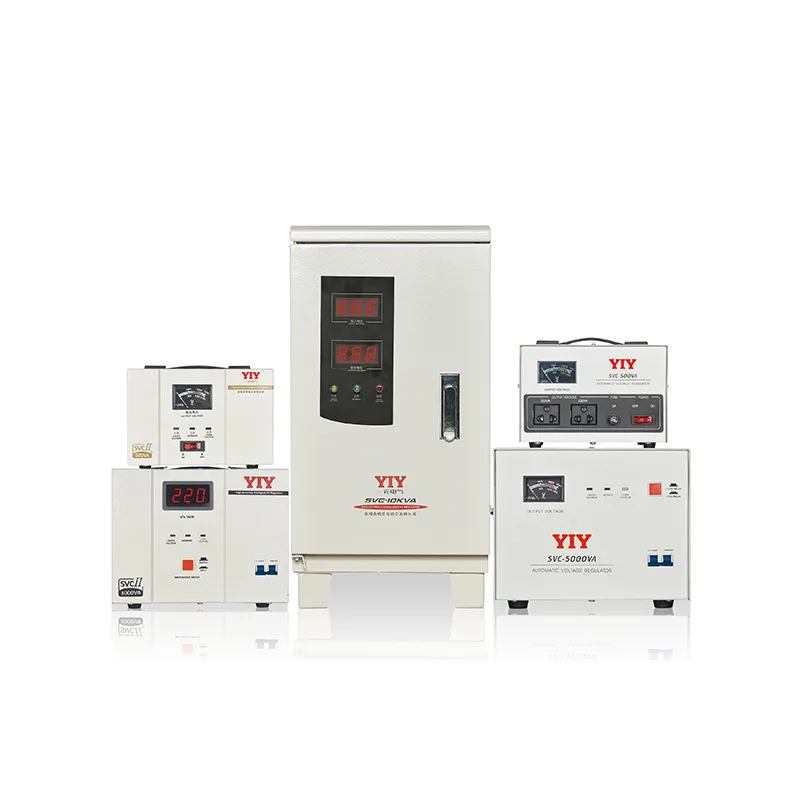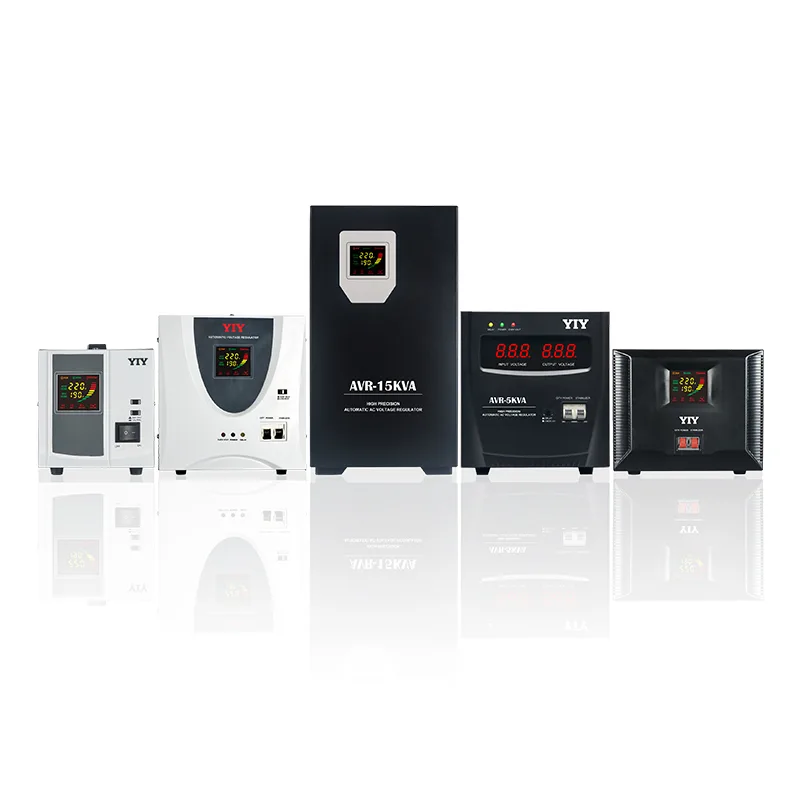

For most 1 kVA single-phase loads, the right 1 kva voltage stabilizer type—relay, servo, or IGBT/static AVR—depends on fluctuation depth, load sensitivity, startup current, and budget, not the kVA rating alone. IEC 60038 frames common low-voltage supply variation around nominal system voltages, often discussed with ±10% context.
Once the load type and startup demand are known, review the 1 kVA small-capacity stabilizer models alongside the wider 0.5–10 kVA range before choosing relay or servo control.
Decision Snapshot
– Relay AVR: cost-sensitive, less sensitive loads, moderate correction needs.
– Servo AVR: better fit when you need steadier output for mixed appliances or light commercial loads.
– IGBT/static AVR: suitable when fast correction and tight regulation matter more than entry price.
If your load includes compressors, motors, PCs, control boards, or export-market appliances, treat this power class as a specification decision. Next, we’ll compare application scenarios, type-level features, specification checks, installation conditions, and the FAQ points buyers usually raise before shortlisting a single-phase automatic voltage regulator.
When does a 1 kVA stabilizer actually fit the application?
A 1 kVA stabilizer fits your application when the connected single-phase load, adjusted for power factor and startup current, stays within the unit’s real usable capacity. For you, that means it is suitable for small, defined loads—not a whole facility, a three-phase machine, or a mixed production line.
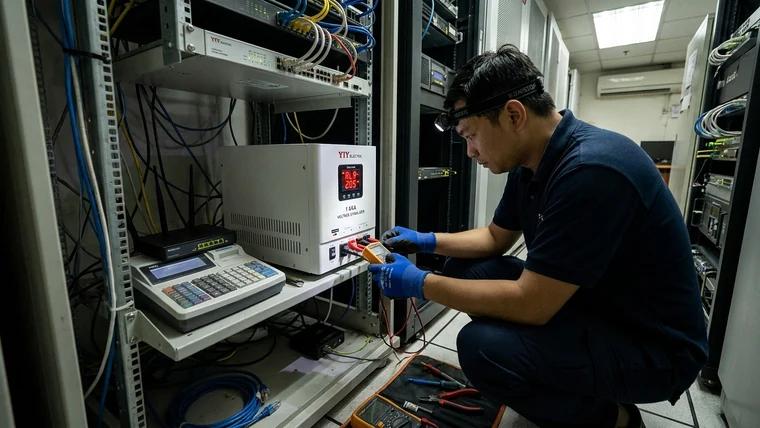
Typical fits include office electronics, routers, POS systems, lab instruments, control-panel auxiliaries, small refrigerators, low-power appliances, and light-duty OEM integration. If your site voltage varies within the stabilizer’s stated input window, this power class can protect sensitive electronics without overspending on capacity you do not use.
| Load scenario | Likely risk if misapplied | Preferred stabilizer approach |
|---|---|---|
| Routers, POS, office electronics | Data loss, rebooting, nuisance complaints | Relay or servo AVR, depending on fluctuation depth |
| Small control panel or lab instrument | Control errors, calibration drift | Servo or static AVR for steadier output |
| Small refrigerator or low-power appliance | Compressor startup overload | Check inrush current before choosing 1 kVA |
| High-start motor, lift, compressor, welder, CNC | Overheating, tripping, warranty claims | Use a higher-rated or application-specific unit |
| Three-phase production line | Phase imbalance, undersizing failure | Evaluate Three-Phase Voltage Stabilizers |
The practical sizing check is simple: measure running VA, confirm power factor, then verify starting current. If a “700 W” load has a 0.7 power factor, it may draw about 1,000 VA; in practice, that leaves little margin for heat, low-voltage operation, or startup surge.
This capacity tier is not for CNC machines, lifts, welding machines, high-start compressors, or three-phase machinery. Wrong sizing turns a low-cost purchase into field complaints, nuisance tripping, overheating, replacement cost, and avoidable warranty pressure.
Also check the supply environment before you specify the type. Dust, humidity, poor ventilation, cabinet heat, and unstable grids may require better enclosure protection, spacing for airflow, alarm output, or custom over/under-voltage protection.
For sensitive or service-heavy sites, visibility matters. A small AVR with clear status indication, alarms, or event logging helps your maintenance workflow identify whether failures come from the grid, the load, or the stabilizer itself.
Use IEC voltage context as a reference point when reviewing nominal supply assumptions; IEC 60038 standard voltages defines standard system voltage values used internationally.
Which product features separate relay, servo, and IGBT types?
Relay, servo, and IGBT/static stabilizers separate mainly by correction method: relay types fit cost-sensitive basic loads, servo types fit general loads needing smoother regulation, and IGBT/static types fit sensitive electronics requiring tighter and faster correction. For your shortlist, treat the technology as a risk-control choice, not just a price tier.
Published relay specifications, including 45V low-end input on selected models and 60ms AVR response, are collected on the relay voltage stabilizers page.
YIY’s documented range covers relay, servo, and IGBT/static AVR platforms, which gives you more specification flexibility than suppliers positioned around only one regional or single-technology product line. YIY documents relay regulation around ±5–8%, servo regulation around ±0.5–3%, and IGBT/static regulation around ±0.5% where specified.
| Type | Correction method | Output accuracy | Response behavior | Best-fit load | Procurement watchout |
|---|---|---|---|---|---|
| Relay AVR | Transformer taps switched by relays | Typically ±5–8% | Stepped correction; economical but less smooth | Basic appliances, routers, lighting, non-critical small loads | Check relay quality, tap count, noise, and voltage step size |
| Servo AVR | Motor-driven variac with control circuit | Typically ±0.5–3% | Smooth correction; often around 1–2 seconds where supported by product documentation | Mixed office, retail, light commercial, and general single-phase loads | Confirm brush/variac serviceability, response time, and low-voltage input window |
| IGBT/static AVR | Electronic/PWM double-conversion style correction | Around ±0.5% where specified | Fast electronic correction for rapid disturbances | Sensitive electronics, control boards, instruments, IT-adjacent loads | Check heat dissipation, EMC design, bypass logic, and alarm visibility |
Those figures mean something practical: ±5–8% may be acceptable for tolerant loads, while ±0.5–3% gives your connected equipment a steadier supply. A 1 kva servo stabilizer is often the balanced option when you want better output quality without moving to a higher-cost static design.
For dusty, humid, hot, or poorly ventilated sites, specify enclosure, airflow, thermal margin, and protection logic early. A compact single phase automatic voltage stabilizer can still fail prematurely if installed inside a sealed, hot cabinet with no service clearance.
Modern procurement should also look beyond voltage correction. Clear status LEDs, alarms, event records, and integration with your maintenance workflow help you prove whether nuisance trips come from the grid, the load, or the automatic voltage regulator itself.
What specifications should buyers verify before shortlisting a unit?
You should shortlist a unit only after verifying real load VA, power factor, startup current, input-voltage range, output tolerance, protection functions, cooling, and documented compliance evidence. For your RFQ, these checks matter more than the “1 kVA” label because a small automatic voltage regulator can fail early if the load or grid condition is misread.
Start with usable capacity, not nameplate watts
Use this sizing logic: VA = watts ÷ power factor, then add a practical safety margin and startup-current allowance. In plain terms, a 700 W load at 0.7 PF already equals about 1,000 VA, so your 1 kVA unit may have no reserve for heat, low voltage, or motor inrush.
For compressors, pumps, refrigerators, and small motors, ask for starting-current data rather than assuming the running wattage is enough. If you skip this step, the cost is usually nuisance tripping, overheated windings, repeat returns, or avoidable downtime at the customer site.
| Check | What to verify | Why it matters for you |
|---|---|---|
| Running load | Watts, VA, and power factor | Prevents hidden overload |
| Startup load | Inrush multiple or locked-rotor current | Avoids trip at startup |
| Input range | Site minimum/maximum voltage | Matches the unit to your grid |
| Output tolerance | ±3%, ±5–8%, or tighter | Protects sensitive electronics |
| Protection | OV/UV, overload, short-circuit, thermal, bypass, alarm, delay | Reduces field failure risk |
Match the input window to the actual grid
A site that drops to 140 V needs a different stabilizer than one that stays within 170–270 V. Market examples such as 140–280 V or 150–250 V input and 220 V ±3% output appear in some supplier listings, but treat them as model-specific references, not universal specifications.
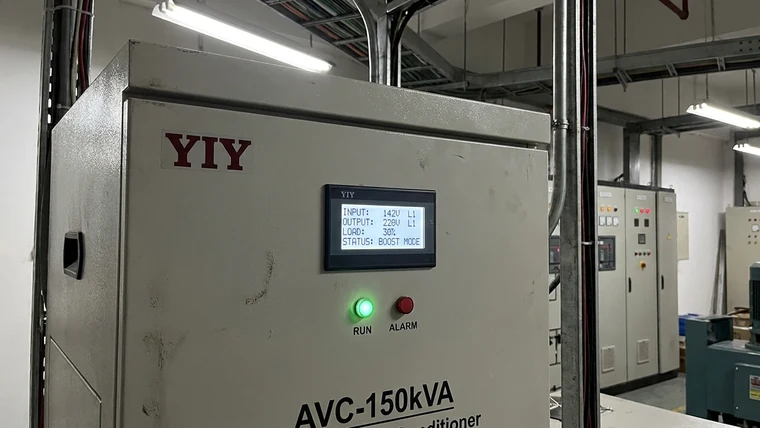
Output tolerance should follow load sensitivity. ±5–8% may suit tolerant appliances, ±3% is safer for mixed office or appliance loads, and tighter regulation is better for control boards, instruments, or unstable generator supply. YIY documentation lists relay regulation around ±5–8%, servo regulation around ±0.5–3%, and IGBT/static regulation around ±0.5% where specified.
Verify protection, environment, and compliance proof
Your minimum protection checklist should include over-voltage, under-voltage, overload, short-circuit, thermal protection, bypass, alarm, and time-delay functions. Delay protection is especially useful for compressors because it prevents rapid restart after voltage recovery.

For dusty, humid, hot, or weak-grid locations, confirm ventilation clearance, enclosure suitability, PCB protection, and thermal derating. Modern units should also give clear alarm visibility, status indication, and preferably event information that helps your maintenance workflow separate grid faults from load faults.
Use IEC 60038 standard voltages as the official reference for nominal voltage context when comparing regional supply assumptions.
For supplier qualification, request documented ISO 9001:2015 quality management, ISO 14001 environmental management, and CE evidence only where the exact model or production process is covered.
How should installation conditions change the final choice?
You should change the final stabilizer type when the site is hot, dusty, humid, poorly ventilated, weakly earthed, or exposed to frequent voltage swings, because those conditions can make a correctly sized 1 kVA unit fail early. In practice, installation quality can decide whether a relay AVR is enough, a servo design is safer, or a static/IGBT unit needs extra thermal and enclosure planning.
Before approval, treat the site survey as part of your specification, not a post-purchase task. For enclosure selection, IEC 60529 IP Code for enclosure protection defines ingress-protection ratings against solids and water; in plain language, it helps you decide whether dust, splash, or humidity protection is necessary instead of assuming an indoor casing is enough.
| Check | Why it matters | If you skip it |
|---|---|---|
| Ambient temperature, especially above 40°C | Heat reduces component life and can force derating | Overload trips, early capacitor or relay failure |
| Ventilation clearance | Servo motors, transformers, and static modules need airflow | Thermal rise, nuisance shutdowns, warranty disputes |
| Dust level and filter access | Dust insulates hot parts and contaminates contacts | Relay contact wear, fan blockage, tracking risk |
| Humidity and enclosure/IP need | Moisture affects PCBs, insulation, and terminals | Corrosion, leakage current, unstable output |
| Mounting position | Wall, floor, or cabinet mounting changes cooling and service access | Poor airflow and difficult maintenance |
| Earthing quality | Stabilizers and connected electronics need a safe fault path | Shock risk, unstable reference, protection failure |
| Cable size and breaker coordination | The protective device must match load current and cable capacity | Hot terminals, false trips, unsafe fault clearing |
| Min/max voltage over time | A short reading may miss deep night or startup sags | Wrong input range and repeated low-voltage cutout |
| Sag/surge frequency and generator use | Generators can add frequency and waveform variation | Hunting, alarms, or incompatibility under load |
Commissioning should confirm input voltage, output voltage, load percentage, bypass operation, alarm behavior, thermal rise, and startup behavior. A 1 kVA unit that runs at 85–95% load during normal operation has little reserve for low-voltage input or motor inrush, so your practical risk is overheating rather than nameplate mismatch.
Maintenance access also changes the better choice. Relay units need contact-wear checks, servo models need brush and variac inspection, and static AVRs need clean cooling paths for power modules. Where available, specify alarm visibility, event logs, or dry-contact/communication outputs so your maintenance workflow can separate grid events from stabilizer faults before downtime becomes a repeat cost.
What final checks should you complete before you decide?
Complete five checks before you decide: confirm necessity, real load size, input-voltage range, stabilizer type, and price drivers against your site conditions. For your purchase file, record: running VA, startup current, lowest/highest measured voltage, output tolerance, and installation environment.
What should you evaluate before choosing a 1 kva voltage stabilizer?
Evaluate the load, grid, and protection risk first. Check watts, power factor, startup current, input-voltage window, output accuracy, delay protection, overload protection, and alarm visibility. If your load includes electronics or a compressor, ask the supplier to confirm whether 1 kVA still leaves safe margin under low-voltage input.
When is this capacity class actually necessary?
It is necessary when your single-phase equipment experiences voltage sag, surge, brownout, rebooting, overheating, or nuisance trips. Measure voltage over several operating periods, not just once. If readings stay outside the equipment’s safe operating range, a compact AVR can reduce avoidable downtime and service complaints.
How should you size or specify the unit?
Size it by VA, not only watts: VA = W ÷ power factor. In practice, a 700 W load at 0.7 PF is already about 1,000 VA, leaving little headroom. Add margin for heat, low input voltage, and motor inrush before approving this power class.
What affects 1 KVA servo stabilizer single phase price?
Price is affected by input range, copper/aluminum winding choice, output tolerance, servo motor quality, display/alarm functions, enclosure, certifications, and order quantity. Ask for a comparable quote basis: same voltage range, same ± output accuracy, same protection list, and same warranty terms. Otherwise, a cheaper offer may simply remove engineering margin.
Which type should you choose at the end?
Choose relay for tolerant low-cost loads, servo for smoother general-purpose regulation, and IGBT/static AVR for sensitive electronics or fast voltage disturbances. Use IEC 60038 standard voltages as nominal voltage context when comparing regional supply assumptions.
Frequently Asked Questions
How should you compare pricing for 1 kva servo stabilizer single phase?
Pricing should be compared on the same electrical and commercial basis. Ask each supplier to quote the same input-voltage range, output accuracy, protection list, winding material, display/alarm package, enclosure type, warranty period, and order quantity. Verify the datasheet and quotation line by line before approval. If one offer is much cheaper, check whether it removed copper content, protection functions, testing, or after-sales support.
When is a small-capacity AVR necessary for single-phase loads?
A small-capacity AVR is necessary when one defined single-phase load is affected by voltage sag, surge, brownout, or unstable grid supply. Use it for equipment such as POS systems, routers, control boards, lab instruments, small appliances, or light commercial electronics. Before buying, measure the lowest and highest site voltage during real operation, then confirm the load’s VA, power factor, and startup current.
Should sensitive electronics use relay, servo, or IGBT regulation?
Sensitive electronics usually need servo or IGBT/static regulation rather than basic relay correction. Relay AVRs can suit tolerant loads, but their stepped output may be too rough for control boards, instruments, or IT-adjacent equipment. Choose servo when you need smoother general regulation at a balanced cost. Choose IGBT/static AVR when fast correction, tighter output tolerance, and cleaner regulation are more important than entry price.
Final Thoughts
The right 1 kVA stabilizer type is determined by load sensitivity, startup current, voltage fluctuation range, and required output tolerance, not by the 1 kVA rating alone.
Choose a relay AVR when the load is basic, tolerant, and cost-sensitive. Choose a servo stabilizer when you need a practical balance of smoother regulation, reliability, and commercial value. Choose an IGBT/static AVR when sensitive electronics, control boards, instruments, or rapid voltage changes make faster correction more important than entry price.
Acting on this logic matters because undersizing or choosing the wrong regulation method can create nuisance trips, overheating, warranty claims, and avoidable downtime. As a low-friction next step, use a quick-fit checklist or request a first-pass YIY sizing review. Then share your load list, starting current, input-voltage window, output tolerance, and installation conditions for a more accurate recommendation.
About YIY
Zhejiang Yiyen Holding Group Co., Ltd. (YIY) is a professional voltage stabilizer manufacturer with 16+ years of experience. With a 30,000sqm modern facility and an annual production capacity of 1,000,000+ units, our products are exported to 130+ countries. We provide OEM/ODM customization services and are ISO 9001:2015 certified, committed to delivering stable and reliable voltage protection solutions to global customers.
Contact Us
Email: yiyen@yiyen.com
Phone/WhatsApp: +86 13587452904
Website: https://www.yiyavr.com/
If you found this article helpful, contact us for a sizing review or customized solution.