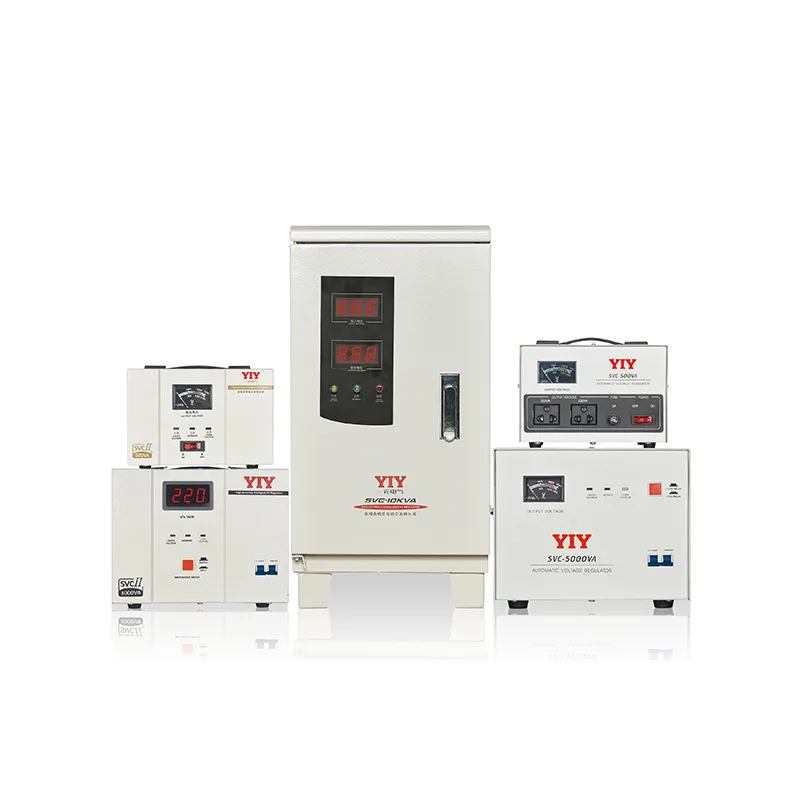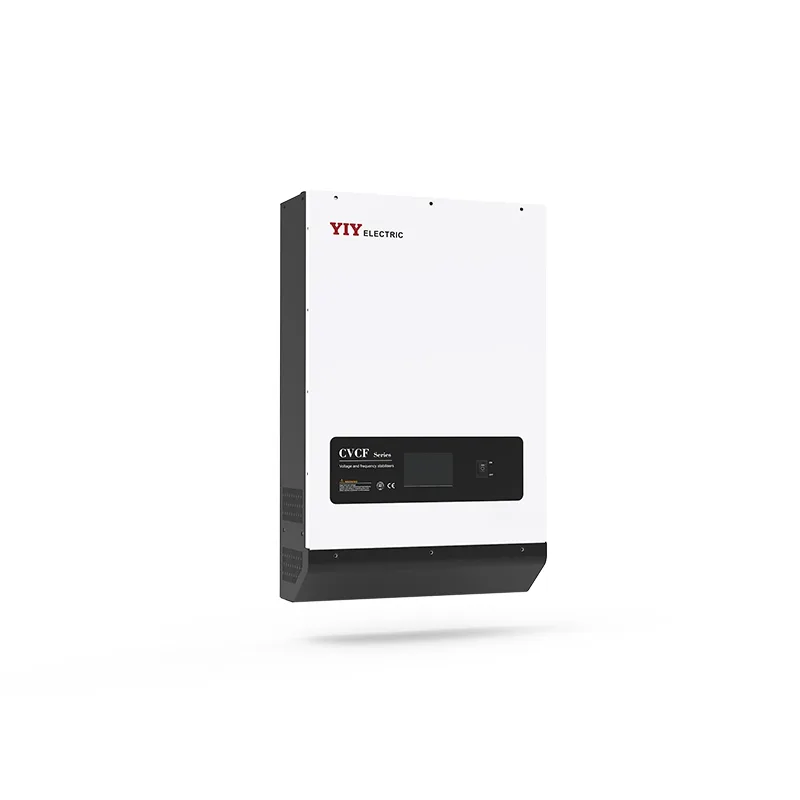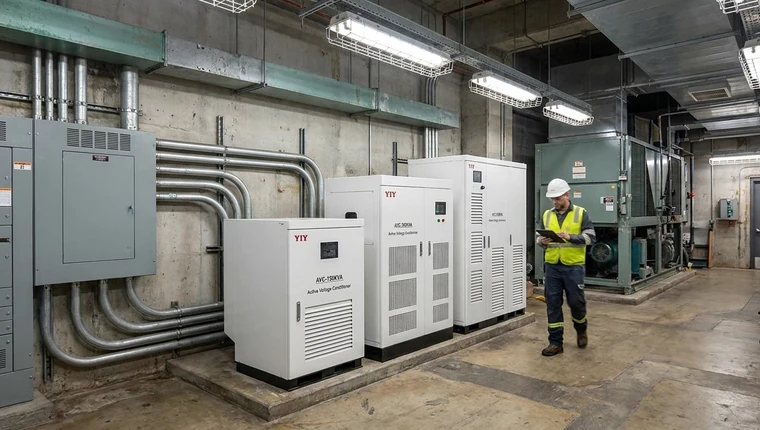
Choose a digital servo stabilizer when your equipment faces recurring voltage fluctuation and you need smoother correction, stronger output stability, and a practical industrial alternative to basic relay regulation or higher-cost IGBT/static systems.
In this guide, you’ll decide when servo control fits your load, how it compares with relay and IGBT options, what specifications affect sizing and price, and which installation checks you should complete before requesting a quotation.
When Does a Digital Servo Stabilizer Fit Your Application?
You should choose a digital servo stabilizer when voltage fluctuation is frequent enough to affect machine reliability, product quality, or uptime.
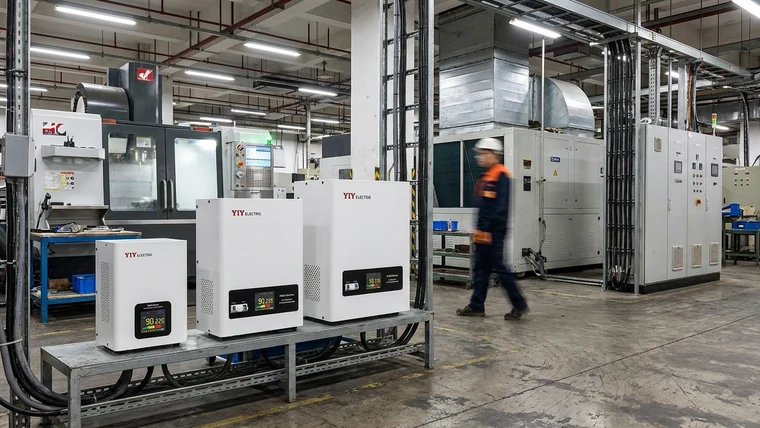
Servo-controlled AVR systems are commonly used for CNC machines, motors, HVAC systems, pumps, compressors, elevators, production lines, and three-phase distribution panels. Your strongest reason to use servo is not simply that the grid is “unstable”; it is that your actual voltage swings are wide or frequent enough to create alarms, overheating, trips, resets, or process variation.
A servo design is especially practical when you need smoother voltage correction than a relay stabilizer can provide, but your application does not require the ultra-fast electronic correction of an IGBT/static stabilizer. For a product-level view of servo-controlled AVR options, you can review YIY’s servo voltage stabilizer range early in your selection process.
Many industrial projects define rated supply assumptions against IEC 60038 standard voltages, especially for export equipment and three-phase systems. Practically, this means you should confirm the voltage your machine is designed to receive before you size or quote the stabilizer; otherwise, you may buy a unit matched to a catalog voltage instead of your real electrical system.
| Your application scenario | Why servo may fit | Practical meaning for you |
|---|---|---|
| CNC machines and production lines | Smooth correction supports stable controller operation | You reduce the chance of nuisance alarms caused by supply variation |
| Motors, pumps, compressors, HVAC | Servo correction handles repeated sag/rise events better than simple tap switching | Your motor-driven loads are less exposed to unstable input voltage |
| Elevators and lifts | Output consistency supports drive and control reliability | You protect service continuity where voltage variation can interrupt operation |
| Main distribution panels | A mainline servo stabilizer can protect several downstream loads | You may solve site-wide fluctuation with one engineered installation |
| OEM machine packages | Wider voltage tolerance can be built into exported equipment | Your machine is easier to deploy in regions with unstable grids |
If your fluctuation is site-wide, you may also need to review 3 phase main line stabilizer sizing before selecting a single large unit. A mainline stabilizer can simplify protection, but only if your downstream loads are compatible and your starting currents are understood.
How Does Servo Control Differ from Relay and IGBT Regulation?
Servo control is usually the balanced choice when you want industrial-grade voltage stability, scalable kVA capacity, and manageable maintenance cost.

A digital servo stabilizer uses voltage sensing, a control board or MCU, a servo motor, and a variac/autotransformer mechanism. The controller compares output voltage with the target setpoint, then commands the servo motor to move a carbon brush along the winding to raise or lower voltage. For you, the key benefit is continuous correction rather than abrupt fixed-step switching.
Relay stabilizers switch between taps. That can be economical and effective for simpler loads, but the correction is step-based. If your load is small, non-critical, and cost-sensitive, a relay voltage stabilizer may still be the more suitable option.
IGBT or static regulation uses electronic switching for very fast correction and high precision. That can be the better choice for ultra-sensitive equipment, fast disturbance correction, or applications where moving parts are not preferred. The tradeoff is usually higher product cost and greater dependence on electronic design quality.
| Selection point | Relay stabilizer | Servo-controlled stabilizer | IGBT/static stabilizer |
|---|---|---|---|
| Correction style | Step switching | Continuous motor-driven correction | High-speed electronic correction |
| Typical cost position | Lowest | Mid-range industrial balance | Higher |
| Output stability | Suitable for basic loads | Strong fit for many industrial loads | Often strongest for critical precision loads |
| Maintenance profile | Relay wear over time | Brush and motor inspection required | Less mechanical wear, more electronic complexity |
| Best fit | Simple home, commercial, or non-critical loads | CNC, motors, production lines, three-phase equipment | Ultra-sensitive, fast-response, high-precision applications |
The practical decision is not “which technology is best in every case?” It is “which technology gives your load enough stability without adding unnecessary cost or maintenance complexity?”
What Are the 7 Checks Before You Choose?
You should confirm seven items before you request a quotation: voltage range, phase type, load profile, kVA margin, protection design, bypass needs, and maintenance access.
These checks prevent the most common sourcing problem: comparing stabilizers that look similar by kVA but are not technically equivalent. A 25 kVA servo stabilizer for a clean workshop, a 40kVA servo voltage stabilizer for a mixed three-phase panel, and a 5 kVA dedicated machine unit may all use servo technology, but your electrical and mechanical requirements can be very different.
| Check | Why it matters | If you skip it |
|---|---|---|
| Input voltage range | Defines how much correction the unit must handle | Your stabilizer may fail to regulate during real low/high events |
| Output accuracy | Matches equipment sensitivity, often expressed as a tolerance such as ±1% to ±3% | Your controllers, drives, or process equipment may still see unacceptable variation |
| Single-phase or three-phase supply | Determines topology, wiring, phase protection, and cabinet design | You may receive unusable quotations |
| Running current, starting current, and power factor | Converts real load behavior into correct kVA | Undersizing can cause heating, overload alarms, or bypass operation |
| Overload and duty cycle | Confirms continuous operation capability | A unit that works briefly may not survive your real production schedule |
| Manual or automatic bypass | Keeps power available during service or stabilizer fault handling | Maintenance may require full shutdown |
| Service access and environment | Covers brush inspection, ventilation, dust, humidity, and cabinet placement | The unit may become difficult to maintain or may derate in service |
For a broader procurement framework, use YIY’s industrial voltage stabilizer selection guide when you prepare your RFQ. It helps you turn site conditions into comparable supplier requirements instead of relying on headline capacity alone.
A simple sizing formula is:
kVA = Voltage × Current × √3 ÷ 1000 for three-phase loads.
For you, this formula means nameplate kW is not enough. You should also share current, power factor, starting behavior, and whether the load includes motors, compressors, drives, PLCs, UPS inputs, or mixed downstream panels. If your load has high inrush current or poor power factor, the stabilizer may need a larger kVA rating than the running load suggests.
How Should Installation Conditions Change Your Choice?
Your site conditions should change the stabilizer design, because heat, dust, humidity, airflow, grounding, cable sizing, and bypass arrangement can decide whether the unit works reliably after commissioning.
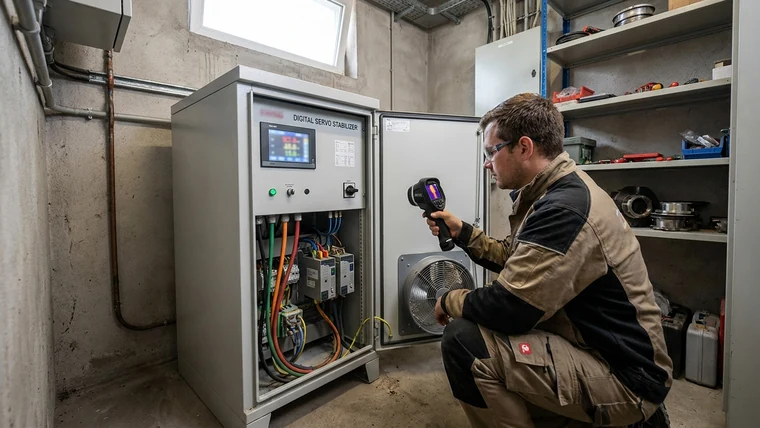
A stabilizer that is correctly sized on paper can still perform poorly if your electrical room is hot, blocked, dusty, or difficult to service. If ambient temperature is high, ask the supplier to confirm derating assumptions and ventilation clearance. If the room regularly approaches or exceeds 40°C, you should discuss forced ventilation, oil-cooled options, or a larger capacity margin. In practical terms, this protects you from buying a unit that can carry the load only under ideal catalog conditions.
For dusty, humid, coastal, or corrosive environments, your specification should include suitable enclosure treatment, filters, anti-condensation measures, coated boards where needed, and serviceable cabinet layout. These details may look secondary during quotation, but they often determine whether your maintenance team can keep the unit clean, cool, and safe.
Step 1: Collect Voltage Logs
You should collect 7–14 days of voltage logs where possible, including low-voltage events, high-voltage events, phase imbalance, and time of day. This gives your supplier evidence instead of estimates.
Step 2: Prepare a Real Load List
List each load with kW or kVA, running current, starting current, power factor, and sensitivity. For you, this prevents a supplier from sizing only against nominal capacity.
Step 3: Confirm Your Power Topology
Check whether your supply is single-phase or three-phase, whether neutral is available, and whether phase sequence matters. This avoids wiring and protection errors later.
Step 4: Share Installation Photos
Send photos of the panel location, cable path, floor space, ventilation, dust exposure, humidity risk, and access direction. Your supplier can then confirm cabinet layout and service clearance before shipment.
Step 5: Define Operating Constraints
Clarify operating hours, shutdown windows, spare-part expectations, and whether maintenance can occur during production breaks. This helps you decide whether manual bypass is enough or automatic bypass is required.
Step 6: Confirm Protection and Wiring Design
Specify input breaker, output breaker, cable size, grounding, neutral handling, overload protection, under/over-voltage protection, short-circuit protection, phase loss protection, and delay settings. These are not just accessories; they shape how the stabilizer responds when the grid or load misbehaves.
Step 7: Segment Mixed Loads When Needed
Avoid combining heavy motor starts and highly sensitive controls on one stabilizer without engineering review. If you mix them incorrectly, one load’s starting event may disturb another load’s operation.
What Affects 5 kVA, 25 kVA, and 40 kVA Servo Selection?
Your capacity tier should be selected from measured load behavior, not from a rough equipment label or a price list.
A 5 kVA servo unit is often used for a dedicated machine, small workshop load, light commercial equipment, or a specific single-phase application. If you are comparing “servo stabilizer 5kva price,” make sure every supplier quotes the same input range, output tolerance, protection level, bypass design, and enclosure. Otherwise, the lowest offer may simply exclude the features your site needs.
A 25 kVA model may fit a compact production cell, a small three-phase load group, or a controlled equipment package. Your main check at this level is starting current: motors, compressors, and drives can demand more than their running current during startup, so your kVA margin must reflect real operation.
A 40 kVA unit is more likely to serve larger three-phase equipment groups or a small distribution section. With this capacity class, you should pay closer attention to cable sizing, ventilation, floor space, bypass arrangement, and maintenance access. The larger the unit, the more expensive a wrong installation decision becomes.
| Capacity discussion | Typical use case | What you should verify |
|---|---|---|
| 5 kVA | Dedicated machine, small workshop, light commercial load | Phase type, input range, output tolerance, protection level |
| 25 kVA | Compact production cell or equipment group | Starting current, power factor, duty cycle, expansion margin |
| 40 kVA | Larger three-phase load group or distribution section | Cable sizing, bypass design, ventilation, service clearance |
Price is affected by transformer design, copper content, voltage range, output accuracy, protections, enclosure, cooling method, bypass, certifications, customization, order quantity, packaging, freight, and support. For you, this means a quotation should be judged by total specification match, not only by the number beside “kVA.”
How Should You Compare Supplier Quotations?
You should compare quotations only after every supplier has priced the same technical target.
Ask each supplier to state the input voltage range, output accuracy, rated kVA, overload capacity, phase type, cooling method, enclosure, bypass type, protection functions, service requirements, warranty, packing terms, and freight scope. If one supplier quotes a wider input range, stronger protection package, or heavier transformer design, the higher price may reflect a real specification difference rather than markup.
A useful procurement screen is:
| Check | Why it matters | If you skip it |
|---|---|---|
| Datasheet matches quotation | Prevents verbal promises from replacing written specs | You may approve a model that differs from the offer |
| Voltage range is stated clearly | Confirms real correction capability | The unit may not cover your site’s worst voltage events |
| Bypass type is identified | Defines service and uptime behavior | Maintenance planning becomes uncertain |
| Factory test report is available | Gives you shipment-stage verification | You rely only on catalog claims |
| Spare parts are listed | Supports future maintenance | Brush or control-board replacement may be delayed |
| Warranty and support scope are written | Clarifies responsibility after delivery | Disputes become harder to resolve |
Before final approval, it is also useful to compare before buying a voltage stabilizer using a structured quotation review. Even if your capacity is not 50 kVA, the same comparison logic helps you check derating, ventilation clearance, bypass, and supplier assumptions.
Frequently Asked Questions
How Should You Compare Pricing for Servo Stabilizer 5kva?
You should compare 5 kVA pricing only after the voltage range, phase type, output accuracy, protection level, enclosure, bypass, warranty, and shipping terms are the same. As a concrete verification step, place the quotation, datasheet, and nameplate information side by side and mark any mismatch before approving the supplier.
When Is a Digital Servo Stabilizer Necessary for Industrial Loads?
A digital servo stabilizer becomes necessary when repeated voltage fluctuation causes CNC alarms, motor overheating, compressor trips, PLC resets, drive faults, or unstable three-phase operation. Before buying, log your site voltage for 7–14 days and compare the minimum and maximum readings with your equipment nameplate tolerance.
Should You Choose Servo, Relay, or IGBT Voltage Regulation?
You should choose servo for many industrial loads that need smoother correction and stable output at a practical cost. Relay fits simpler low-cost loads, while IGBT/static regulation fits ultra-sensitive applications that require very fast correction. Verify this by matching each technology against your load type, correction speed requirement, maintenance plan, and budget.
What Affects Servo Stabilizer 5KVA Price in B2B Sourcing?
Servo Stabilizer 5KVA price is affected by input range, output tolerance, transformer design, copper content, protections, bypass, enclosure, certification, order quantity, freight, spare parts, customization, and after-sales support. Ask for a full technical datasheet, factory test report, warranty statement, and packing list before procurement approval.
How Do You Verify Compliance and Manufacturer Quality?
You should request the supplier’s quality-system certificate, product test report, and model-specific datasheet, then check whether the certificate number, company name, and scope match the manufacturer. If ISO 9001:2015 is cited, verify the claim against the official ISO 9001:2015 quality management standard and ask for a current certificate copy from the supplier.
What Should You Do Next?
You should start with a quick-fit technical review before you ask for a final price.
Send your basic voltage condition, load list, phase type, target capacity range, and installation environment to YIY, and ask whether servo, relay, or IGBT regulation is the best fit for your application and maintenance context. You do not need a perfect engineering package for the first conversation; a first-pass review can quickly identify whether this three-phase servo setup, a smaller dedicated unit, or another topology is the better path.
A digital servo stabilizer is the right choice when your site needs stable industrial voltage correction with practical cost, serviceability, and broad compatibility across motors, CNC equipment, production lines, and three-phase loads. The better your inputs are, the easier it becomes to select the right topology, avoid undersizing, and compare supplier quotations fairly.
About YIY
Zhejiang Yiyen Holding Group Co., Ltd. (YIY) is a professional voltage stabilizer manufacturer with 16+ years of experience. With a 30,000sqm modern facility and an annual production capacity of 1,000,000+ units, YIY products are exported to 130+ countries. YIY provides OEM/ODM customization services and ISO 9001:2015-certified quality management to support stable voltage protection solutions for global customers.
Contact YIY
Email: yiyen at yiyen.com
Phone/WhatsApp: +86 13587452904
Website: https://www.yiyavr.com/