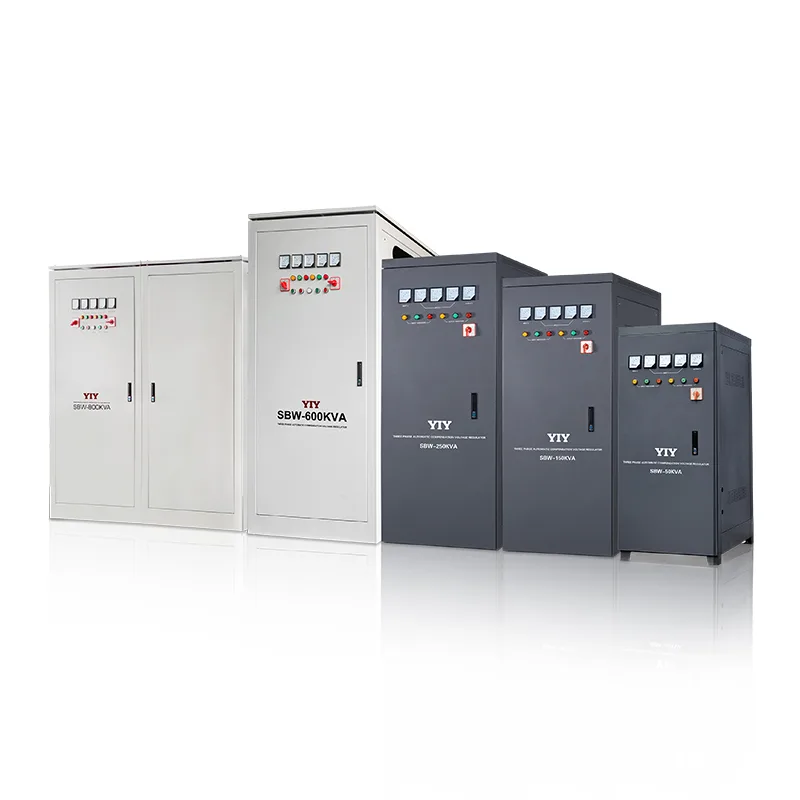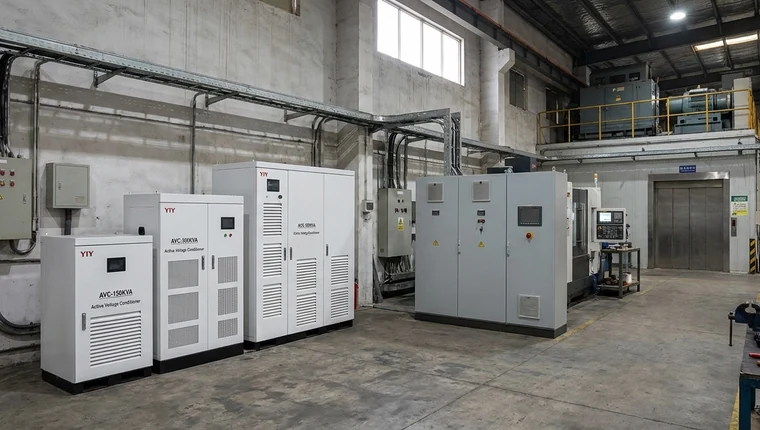
A servo stabilizer is usually the right choice when your industrial load faces recurring voltage fluctuation and you need smooth correction, practical kVA capacity, and maintainable hardware rather than the lowest-cost or fastest-switching design.
You are not just choosing an AVR; you are choosing how your site will respond to undervoltage, overvoltage, phase imbalance, motor starting current, nuisance trips, and long-term maintenance. This guide will help you decide when servo technology fits, when relay or IGBT correction may be better, what specifications to verify, and what information to prepare before you request a technical review.
When Does Unstable Site Voltage Justify a Servo Stabilizer?
You should consider a servo stabilizer when voltage fluctuation is frequent enough to affect equipment reliability, process continuity, or maintenance workload. If your operators already see contactor dropouts, PLC faults, VFD alarms, overheated motors, failed starts, or unexplained shutdowns, the voltage problem has moved from an inconvenience to an engineering risk.
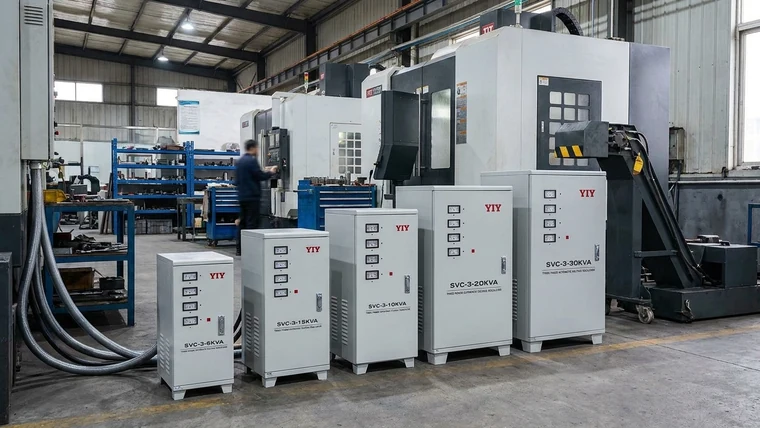
Nominal supply context matters. The official IEC 60038 standard voltages define standard voltage systems such as common 230/400 V references. For you, that means the key question is not whether your site is “supposed” to be 230 V or 400 V; it is whether your measured voltage stays inside the usable range required by your machines during real operating hours.
A one-time multimeter reading is rarely enough. Your data logger, incoming feeder measurements, fault history, and machine nameplates give a better picture of whether voltage correction is needed. For example, a workshop may look stable at noon but drop heavily during peak production, while a rural or generator-supported site may see wide swings during motor starts.
Common signs that voltage correction is becoming urgent include:
- Repeated undervoltage during peak load hours, causing weak motor torque, compressor start failure, or contactor chatter.
- Overvoltage during light-load periods, increasing heat stress on control boards, power supplies, and insulation.
- Three-phase imbalance, where one phase runs noticeably higher or lower and motors heat unevenly.
- Nuisance trips that disappear when grid conditions improve, pointing to power quality rather than machine failure.
- Maintenance callouts after visible voltage events, especially around CNC support equipment, packaging lines, elevators, pumps, compressors, or automation panels.
If your site matches these symptoms, begin with product-level context for a servo voltage stabilizer before you compare quotations. That gives you a clearer baseline for how servo-based correction, capacity ranges, and industrial configurations are typically positioned.
When Should You Choose Servo Instead of Relay, Static, or IGBT Designs?
You should choose servo when your load needs a balanced industrial solution: smoother correction than relay, simpler maintenance than many fully electronic systems, and practical capacity for mixed three-phase equipment. Servo is often the middle path when your voltage fluctuation is recurring but your process does not require ultra-fast electronic correction.
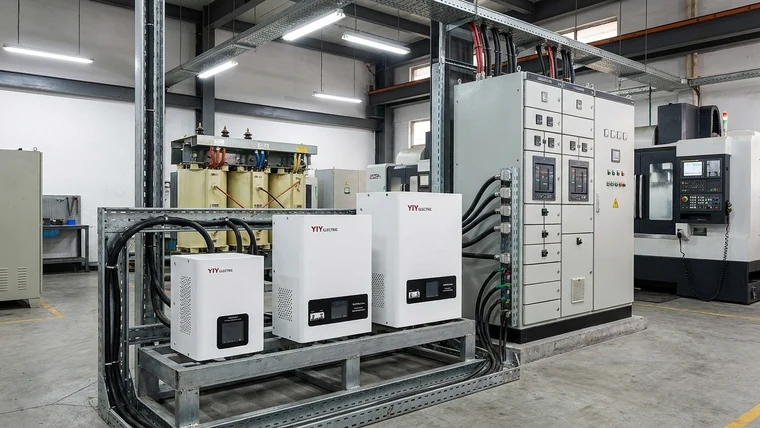
| Stabilizer type | Correction style | Best fit for your load | Main advantage | Main tradeoff |
|---|---|---|---|---|
| Servo | Servo motor moves a carbon brush across a variac or autotransformer | General industrial loads, motors, compressors, CNC support equipment, elevators, mixed panels | Smooth continuous correction with practical capacity | Has moving parts that require inspection |
| Relay | Step switching through transformer taps | Smaller loads, mild fluctuation, cost-sensitive applications | Low cost and simple structure | Output changes in steps rather than smoothly |
| Static / IGBT | Electronic correction through solid-state switching and digital control | Critical, high-precision, medical, laboratory, or sensitive automation loads | Faster response and tighter control potential | Higher cost and greater electronic complexity |
This comparison matters because different voltage problems need different correction behavior. Relay units can be suitable when your fluctuation is mild and your load is not very sensitive. A servo type voltage stabilizer is better when your incoming voltage drifts over seconds or minutes and your equipment benefits from progressive correction rather than tap jumps. Static or IGBT systems fit when your process needs faster response, tighter precision, or fewer mechanical wear items.
For you as a buyer, the wrong topology often looks cheaper only on the first quotation. If the selected unit cannot handle motor starts, high ambient temperature, phase imbalance, or harsh site conditions, the real cost appears later as trips, overheated components, rejected output, or emergency maintenance.
An IGBT voltage stabilizer becomes more relevant when your load is highly sensitive, your correction-speed requirement is strict, or your maintenance strategy favors electronic control over electromechanical service. Servo remains attractive when your priority is a maintainable, industrial-capacity solution for recurring fluctuation.
How Does an Industrial Servo Voltage Stabilizer Correct Voltage?
You can understand a servo voltage stabilizer as a closed-loop correction system that continuously senses voltage and adjusts a transformer ratio to bring output back toward the setpoint. Instead of switching between a few relay taps, the servo mechanism trims voltage progressively.
The basic correction sequence is:
- Voltage sensors read the input, output, and phase condition.
- The controller compares the measured output with the target output.
- If the output is too high or too low, the controller drives the servo motor.
- The servo motor moves the carbon brush along the variac or autotransformer winding.
- The changing turns ratio raises or lowers the output voltage.
- Protection circuits respond to overload, phase loss, abnormal voltage, overheating, or other fault conditions.
In practical terms, this mechanism suits your site when voltage drift is continuous rather than momentary. Motors, compressors, lifts, packaging equipment, and mixed industrial panels often benefit from smoother voltage correction because the output does not jump abruptly between wide steps.
The tradeoff is maintenance. Because a servo controlled voltage stabilizer includes moving parts, your inspection plan should include the carbon brush, contact surface, servo motor, limit switches, cooling fans, terminals, ventilation path, and dust buildup. In clean, moderate-duty conditions, inspection intervals may be longer; in dusty, hot, humid, or high-duty environments, you should inspect more often.
Digital servo stabilizer designs can also support your maintenance workflow with meters, alarms, event visibility, and optional monitoring contacts. Those functions matter because they help you see whether the unit is correcting unstable grid conditions or whether the load itself needs a deeper electrical review.
What Should You Confirm Before Specifying a Servo Model?
You should confirm measured voltage range, load behavior, phase configuration, environment, protection needs, bypass requirements, and maintenance access before you request a final model. A nameplate kVA match alone is not enough for an industrial servo stabilizer.
| Check | Why it matters | If you skip it |
|---|---|---|
| Input voltage range | Confirms whether the unit can correct your lowest and highest measured supply conditions | The stabilizer may stay in cutoff or fail to reach stable output |
| Output voltage target | Matches your equipment requirement, such as 230 V, 400 V, or another site standard | Your machines may still see voltage outside their acceptable range |
| kVA/kW and power factor | Converts real load demand into a practical stabilizer rating | Undersizing can cause overload, heat, and nuisance trips |
| Motor starting current | Motors, pumps, compressors, and lifts can draw several times running current at startup | The unit may trip even when steady-state kVA appears acceptable |
| Single-phase or three-phase wiring | Matches your incoming supply, load distribution, and phase-balance requirement | You risk poor correction, wrong cabinet design, or phase-related faults |
| Nonlinear or unbalanced loads | VFDs, welders, rectifiers, and uneven phase loading can increase heating and stress | Output voltage may look acceptable while internal components run hot |
| Bypass arrangement | Lets your process continue during inspection or service | A service event can become full production downtime |
| Protection functions | Overload, short-circuit, over/under-voltage, phase loss, and temperature protection reduce risk | Faults may escalate before operators see a clear alarm |
| Environment | Dust, humidity, heat, and airflow affect enclosure choice and component life | A correctly rated unit may fail early in the wrong cabinet conditions |
For three-phase industrial loads, starting current deserves special attention. A motor may draw several times its rated current during startup, and that surge can cause voltage dip, overload alarms, or correction instability if the stabilizer is sized only from running kVA. If your load includes pumps, compressors, lifts, or larger motors, use a dedicated 3 phase main line stabilizer sizing review to check phase imbalance, starting method, and main-line capacity.
The practical meaning of kVA is simple: it describes the apparent power your stabilizer must carry, not just the useful mechanical or electrical output of the load. If your equipment list is in kW, you must account for power factor and starting behavior. For example, a motor-heavy load with poor power factor may require more stabilizer capacity than the kW number suggests.
Environment also changes the specification. In dusty rooms, you may need filtered ventilation or a higher-protection cabinet. In humid areas, anti-condensation measures may be necessary. In hot electrical rooms, airflow clearance and fan capacity matter because heat shortens component life.
If you want a broader procurement framework after this topology decision, use YIY’s industrial voltage stabilizer selection guide to structure capacity, protection, application, and installation requirements before you compare suppliers.
What Should Your Procurement Screen Include?
You should screen each quotation against your real operating conditions, not only against price, kVA, and delivery time. A low-cost offer can still be risky if it omits bypass, protection, environmental design, or service access.
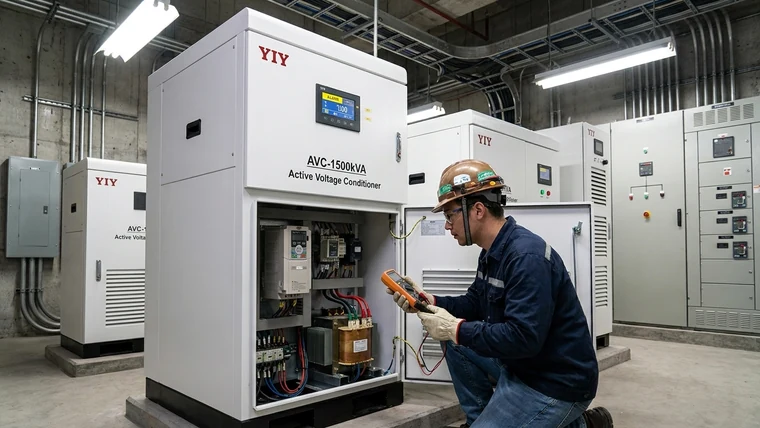
| Check | Why it matters | If you skip it |
|---|---|---|
| Confirm voltage logs are reviewed | Your worst-case voltage swing determines the required input range | The selected unit may not correct your real site condition |
| Confirm overload capability | Industrial loads rarely behave like a fixed resistor | Motor starts or load steps may cause shutdowns |
| Confirm correction accuracy | Sensitive controls may need tighter output stability than basic machinery | You may still see PLC, VFD, or control-board faults |
| Confirm response behavior | Servo, relay, and IGBT correction behave differently | You may buy speed you do not need or miss speed you do need |
| Confirm maintenance parts | Brushes, fans, meters, and control boards should be serviceable | Small wear items can become long downtime |
| Confirm bypass design | Maintenance should not always stop production | Every inspection becomes a shutdown event |
| Confirm documentation | Wiring diagrams, protection settings, test data, and manuals support commissioning | Your electrician may install correctly rated equipment incorrectly |
| Confirm supplier scope | OEM/ODM support, cabinet customization, and application review matter for nonstandard sites | You may receive a generic unit that does not fit the panel, airflow, or load profile |
Some suppliers emphasize railway, government, or isolation-transformer packages. That may be relevant for certain projects, but your broader evaluation should include topology coverage, customization capability, alarm visibility, service support, and whether the supplier can discuss relay, servo, and IGBT options instead of forcing every application into one product story.
A good procurement conversation should end with a clear answer to three questions: Can this unit correct your measured voltage range? Can it carry your load during startup and normal operation? Can your maintenance team inspect and service it without unnecessary downtime?
When Is Servo Not the Best Choice?
You should not choose servo automatically when your application needs the fastest possible correction, the tightest electronic regulation, or minimal mechanical maintenance. Servo is strong for many industrial loads, but it is not the universal answer.
Choose relay when your load is light, your fluctuation is mild, and your budget is the main constraint. Choose IGBT or static correction when your load is highly sensitive to short-duration voltage variation, your process requires faster electronic response, or your maintenance preference strongly favors solid-state control.
You should also be careful with servo if your site has severe dust, corrosive atmosphere, high humidity, or poor ventilation and you are not prepared to specify the cabinet and maintenance plan around those conditions. The technology can still work, but only if the enclosure, cooling, inspection schedule, and installation space match the environment.
Generator-supported sites need extra review. A servo unit can work with generators when voltage range, frequency stability, neutral arrangement, and load-step behavior stay within design limits. If your generator frequency swings widely or your load steps are severe, the stabilizer may need different sizing, protection settings, or a different topology.
How Can YIY Help You Make the First-Pass Decision?
You can start with a simple technical fit review before you prepare a full engineering package. Share your load type, phase, approximate kVA or kW, site voltage symptoms, and environment, and YIY can help identify whether servo, relay, or IGBT correction is the most reasonable direction.
For a more accurate review, prepare:
- Incoming voltage logs or minimum/maximum voltage records.
- Load list with kW, kVA, power factor, and duty cycle where available.
- Motor HP/kW, starting method, and startup sequence.
- Single-phase or three-phase wiring details.
- Generator kVA, frequency behavior, and neutral arrangement if used.
- Ambient temperature, dust, humidity, cabinet location, and ventilation notes.
- Required protections, bypass preference, monitoring needs, and panel photos.
YIY can then help you avoid two common mistakes: overspecifying a costly topology when servo is enough, or underspecifying a basic stabilizer when your load needs faster correction, wider input range, or a more robust cabinet. If you are already comparing quotations, use this guide together with compare before buying a voltage stabilizer to check whether each offer is technically equivalent before you focus on price.
Frequently Asked Questions
Can a Servo Voltage Stabilizer Handle Three-Phase Motor Loads with High Starting Current?
Yes, a servo voltage stabilizer can handle three-phase motor loads if it is sized for starting current, not only running kVA. Motors, compressors, pumps, and lifts may draw several times their rated current during startup, so you should verify motor HP or kW, starting method, duty cycle, and measured voltage dip before model confirmation.
A concrete verification action: ask the supplier to review your motor nameplate, starting method, and maximum simultaneous startup condition before confirming the stabilizer rating.
Does a Servo Type Voltage Stabilizer Work with Generators or Weak-Grid Power?
Yes, a servo type voltage stabilizer can work with generators or weak-grid power when the input voltage range, frequency stability, load-step behavior, and neutral arrangement stay within the unit’s design limits. Generator pairing needs extra care because sudden load changes can make correction harder.
Before purchase, verify generator kVA, frequency variation, worst-case voltage swing, grounding/neutral configuration, and whether large motors start while the generator is already carrying other loads.
Is a Servo Controlled Voltage Stabilizer Better Than a Static Stabilizer for Industrial Equipment?
A servo controlled voltage stabilizer is often better for general industrial equipment when you need practical capacity, smooth correction, maintainable hardware, and balanced cost. A static or IGBT design is usually better when your load needs very fast electronic correction or tighter precision.
Check response speed, correction accuracy, load sensitivity, maintenance capability, and downtime risk before deciding. If the process is highly sensitive, do not choose only by kVA and price.
What Documents Should You Prepare Before Asking for a Quotation?
Prepare voltage logs, load list, kVA or kW, power factor, phase configuration, motor starting current, generator details, ambient temperature, dust or humidity notes, required protections, and machine nameplates. Panel photos are also useful because they show wiring, space, ventilation, and installation constraints.
A practical verification action: compare your load schedule against actual nameplates and mark which loads start at the same time. That helps prevent undersizing.
Final Thoughts
A servo stabilizer fits best when your site needs continuous, smooth, maintainable voltage correction for industrial loads and your voltage problem is recurring enough to affect reliability. Relay may fit lighter and more cost-sensitive loads, while IGBT or static correction may fit highly sensitive processes that need faster electronic response.
Your next step does not need to be a full specification package. Start with a first-pass technical review: share your load type, voltage symptoms, phase, approximate capacity, and environment. YIY can help you confirm whether servo, relay, or IGBT is the best fit before you invest time in detailed logs, drawings, or internal approval documents.
About YIY
Zhejiang Yiyen Holding Group Co., Ltd. (YIY) is a professional voltage stabilizer manufacturer with 16+ years of experience. With a 30,000 sqm modern facility and annual production capacity of 1,000,000+ units, YIY supports customers in 130+ countries with voltage protection products, OEM/ODM customization, and application engineering support. YIY is certified to the ISO 9001:2015 quality management standard, which gives you an additional quality-system reference when evaluating industrial power protection suppliers.
Contact Us
Email: yiyen@yiyen.com
Phone/WhatsApp: +86 13587452904
Website: https://www.yiyavr.com/