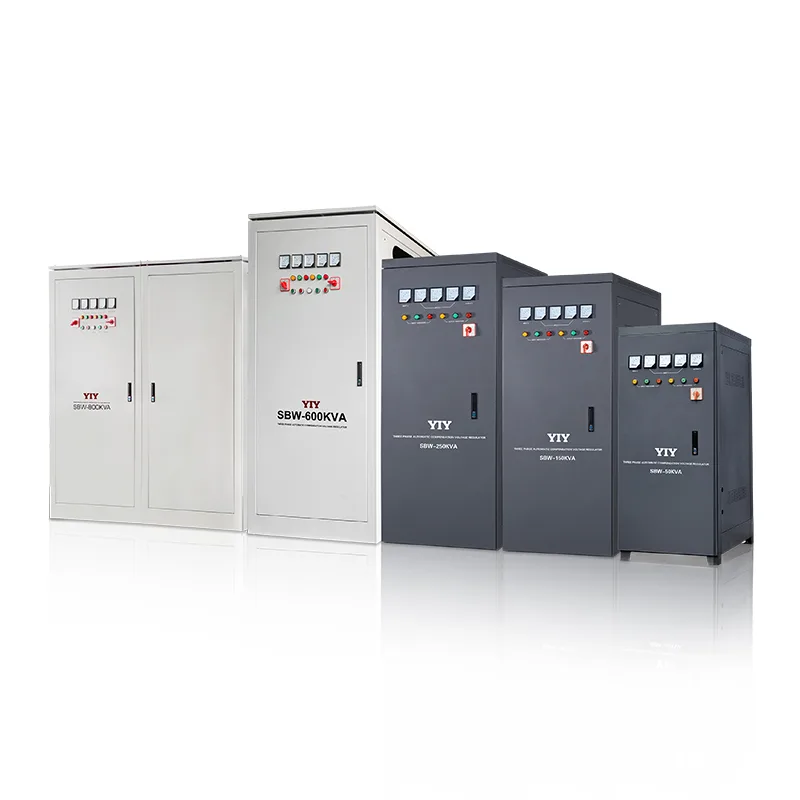
A servo stabilizer 10kva price three phase quote is set by winding material, enclosure rating, input range, and protection package. This guide explains what affects the price at this capacity and what to send for an accurate quote.
Shortlist models from the three-phase stabilizers range once those four are fixed.
What Affects the Price of a 10 kVA Three-Phase Servo Stabilizer?
Quotes in this power class vary with manufacturing inputs and engineering tolerances. Ask every supplier for an itemized quote against the same specification.
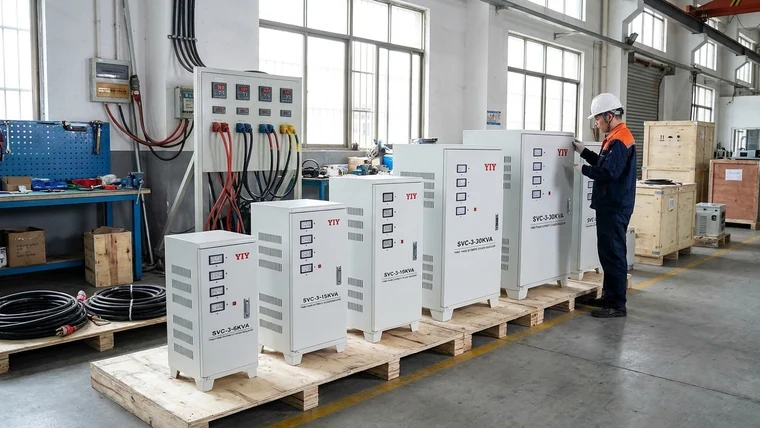
Copper versus aluminum winding is the biggest material variable, and copper usually costs more. It conducts heat better and runs cooler under heavy load cycles, which helps the brush track and the winding last.
Enclosure rating is the next layer: clean control rooms can use standard cabinets, while dusty machining zones need sealed housings. A manual bypass switch adds cost too, but it lets you isolate the stabilizer for maintenance without stopping downstream production.
Third-party dip testing to IEC 61000-4-11:2020 or similar type tests can appear as separate line items; ask whether test reports are included or charged.
How Does a Total-Cost Evaluation Compare to Short-Term Budgeting?
Evaluate total cost of ownership. A cheaper unit that trips the line or resets controllers costs more over its life than a correctly specified one.
| Evaluation Dimension | Short-Term Budget Approach | Long-Term TCO Framework |
|---|---|---|
| Upfront Capital Outlay | Minimized hardware price | Optimized for oxygen-free copper and IP54 enclosure sealing |
| Maintenance Cadence | Reactive brush replacements | Predictive scheduling driven by thermal cycle logging |
| Downtime Exposure | High vulnerability to grid sags | Mitigated by an input range matched to measured site voltage |
Running a cabinet in hot conditions without proper airflow speeds up insulation ageing, and the resulting line stops quickly exceed any hardware saving.
Remote alarms and event logging turn emergency call-outs into scheduled maintenance. Sizing from measured site voltage rather than catalog ratings keeps the servo mechanism working well inside its thermal limits.
What Technical Principles Justify the Premium of Servo-Controlled AVRs?
You are paying for a closed-loop electromechanical system that tracks grid fluctuations under inductive load. A servo motor drives a carbon brush along the variable transformer winding, adjusting the turns ratio whenever the controller detects drift.
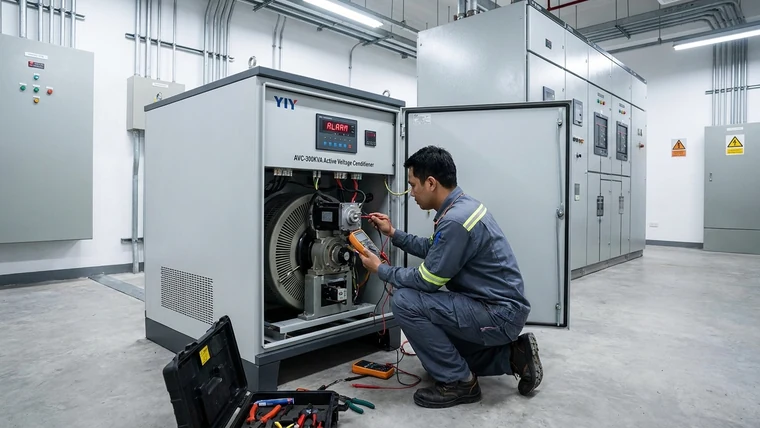
Correction is continuous but mechanical, so it takes seconds rather than milliseconds; YIY publishes ±3% output for SVC-3 and ≤2% for PRO-3. Nominal voltage bands for the supply side are defined in IEC 60038:2009.
Which hardware decides long-term accuracy? Three parts: the controller that samples output voltage, the drive motor that moves the brush, and the autotransformer winding that carries the load. An undersized drive motor can lag during fast utility swings and cause nuisance trips, so ask what motor and brush assembly the quoted model uses.
| Technology | Output precision | Response | Relative cost tier | Typical fit |
|---|---|---|---|---|
| Relay switching | Stepped, wider tolerance | Fast steps | Low (budget) | Lighting, resistive heating, non-critical auxiliaries |
| Servo control | ±3% (SVC-3) / ≤2% (PRO-3), YIY product pages | Seconds, continuous | Moderate (baseline) | CNC controllers, PLC panels, continuous production lines |
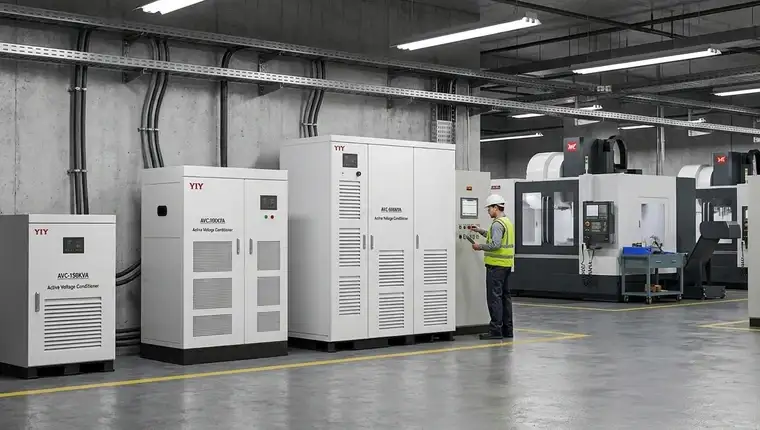
| IGBT static | Tighter than servo | Within half a cycle (YIY AVC) | High (premium) | Semiconductor, imaging, sensitive lab loads |
Relay units cost less but their stepped correction keeps sensitive drives near the edge of their voltage window. IGBT gives the tightest output, but the premium rarely pays back unless the process needs sub-cycle recovery. For most 10 kVA three-phase loads, servo is the practical middle ground.
To check whether an adjacent capacity tier gives better thermal margin, see the 20kVA stabilizer technical guide.
What Specification Checkpoints Must Your Site Verify Before Signing Off on a Purchase?
Finalize the PO only after verifying phase balance, startup margin, and bypass configuration. Treat the 10 kVA nameplate as a starting point checked against real grid behavior and machine inrush.
| Check | Why it matters | If you skip it |
|---|---|---|
| Phase Balance Tolerance | Keeps L1/L2/L3 deviation within the tolerance your loads accept. | Uneven motor heating and accelerated carbon brush wear on dominant phases. |
| Startup Current Margin | Absorbs measured motor inrush during cold starts without tripping internal breakers. | Servo motor stalls and nuisance line trips during peak operational cycles. |
| kW vs kVA Load Calculation | Derates active power using your facility’s measured power factor to prevent core saturation. | Autotransformer overheating and rapid winding insulation breakdown under reactive loads. |
| Actual Input Voltage Range | Matches logged local grid minimum and maximum, not catalog assumptions. | Chronic tracking saturation and continuous output drift during seasonal utility swings. |
| Cooling & Bypass Setup | Deploys forced-air IP54 seals or oil-immersed tanks plus a maintenance isolation route. | Premature brush carbonization in dusty zones and unscheduled downtime during routine inspections. |
Cross-check published datasheets against your own meter logs before you authorize delivery, and ask for alarm or telemetry outputs so engineering staff see grid anomalies early. For feeder-level projects, follow the 3 phase main line stabilizer guide.
Note on YIY ratings: the SVC-3 three-phase servo stabilizer spec table lists 1.5, 3, 4.5, 6, 9, and 15 kVA in its smaller range, with no 10 kVA model (Last verified: 2026-10-10). A 10 kVA requirement is therefore quoted as the 9 kVA or 15 kVA model, depending on your starting-current margin.
How Do You Request an Accurate Quote?
YIY quotes 10 kVA three-phase servo stabilizers per project; there is no public price list. Send your nominal voltage, logged minimum and maximum input voltage, load list with starting current, and installation environment through the YIY contact page or WhatsApp +86 13587452904, and the engineering team will reply with a recommended model and an itemized quotation.
Frequently Asked Questions
What Exactly Is the Difference Between a Single Phase Stabilizer and a 3 Phase Stabilizer?
Three-phase models manage voltage across live lines simultaneously while single-phase units regulate only one conductor at a time, making isolated regulation risky for balanced factory loads. You must verify your main distribution panel and downstream motor configurations match the correct phase input before finalizing any hardware purchases.
How Does a Servo-Controlled Stabilizer Actually Regulate Voltage Under Heavy Industrial Loads?
The controller samples the supply continuously and drives a motor that moves the brush along the autotransformer, correcting within seconds. That suits gradual utility sags; for fast sub-cycle dips, check whether your PLCs ride through them.
What Is the Safest Way to Connect a Three Phase Stabilizer to an Existing Distribution Panel?
You should verify phase rotation with a dedicated phase-sequence meter, match all line-to-line voltages, and size copper cabling for your measured peak load current before energizing any downstream circuits. Checking your wiring layout against IEC 60364 electrical installation standards confirms your grounding and protection coordination meet international safety requirements.
Can a 10kVA Unit Safely Handle High Inrush Currents from CNC Machinery and Induction Motors?
Inductive drives typically draw cold-start surges multiple times higher than steady-state operation, which frequently overwhelms base continuous ratings. You must verify the specific inrush tolerance and mechanical brush travel limits directly on your technical datasheet before installation to prevent saturation and tracking failures.
How Should You Evaluate Quotes for a 10 kVA Three-Phase Servo Stabilizer?
Compare specifications before price. Ask for a line-item breakdown that separates the standard cabinet from enclosure upgrades, then check each supplier’s input correction window, winding material, and output accuracy against your logged voltage extremes.
Final Thoughts
Tie the 10 kVA budget to load cycles, input window, and cooling. Shortlist from YIY’s servo voltage stabilizers and ask for a first-pass sizing review.