A servo stabilizer carbon brush has to come out before it wears to its shunt wire, or it arcs on the transformer track — the one part that never comes back cheap. Below: what it does, when to check and replace it, and what to keep on the shelf.
What Does the Carbon Brush Do in a Servo Stabilizer?
The carbon brush is the moving contact that sets the output voltage. A small servo motor drives the brush along the exposed copper track of a variable autotransformer, and the tapped voltage feeds a buck-boost transformer that corrects the supply.
Every correction is a physical movement. A site with frequent small swings wears brushes faster than a heavily loaded site on a steady supply, and the hour meter never shows it.

This applies to brush-driven designs such as the SVC servo voltage stabilizer and the SBW three-phase servo range. Relay voltage stabilizers switch transformer taps instead, so they have no brush to service.
What Makes a Brush Wear Faster Than Expected?
Most premature wear comes from the operating environment, not the brush. Check these causes before you blame the supplier.
| Cause | What you see | What to do |
|---|---|---|
| Hunting (constant small corrections) | Servo motor runs almost continuously; uneven wear marks | Send the supplier the input log and ask them to widen the sensitivity band |
| Dust and fibers | Grey deposits on the track and inside the holder | Improve cabinet filtration; vacuum, do not blow dust deeper |
| Weak or uneven springs | Sparking, burn marks on brush edges | Measure spring force and replace springs as a set |
| Silicone vapors | Rapid wear with no other visible cause | Remove silicone sealants and sprays near the unit |
| Overload heat | Discolored shunt wire, brittle brush | Check load current against the rating |
Spring force is the factor teams most often skip. For rotating machines, the Mersen motor maintenance guide recommends 18–20 kPa for electrographite brushes on slip rings and accepts no more than 10–15% difference between brushes. Uneven pressure means uneven contact and arcing on a stabilizer track too.
If your site logs steady voltage and the brushes still wear out, change the springs before blaming the grid.
How Often Should Your Team Inspect the Brush?
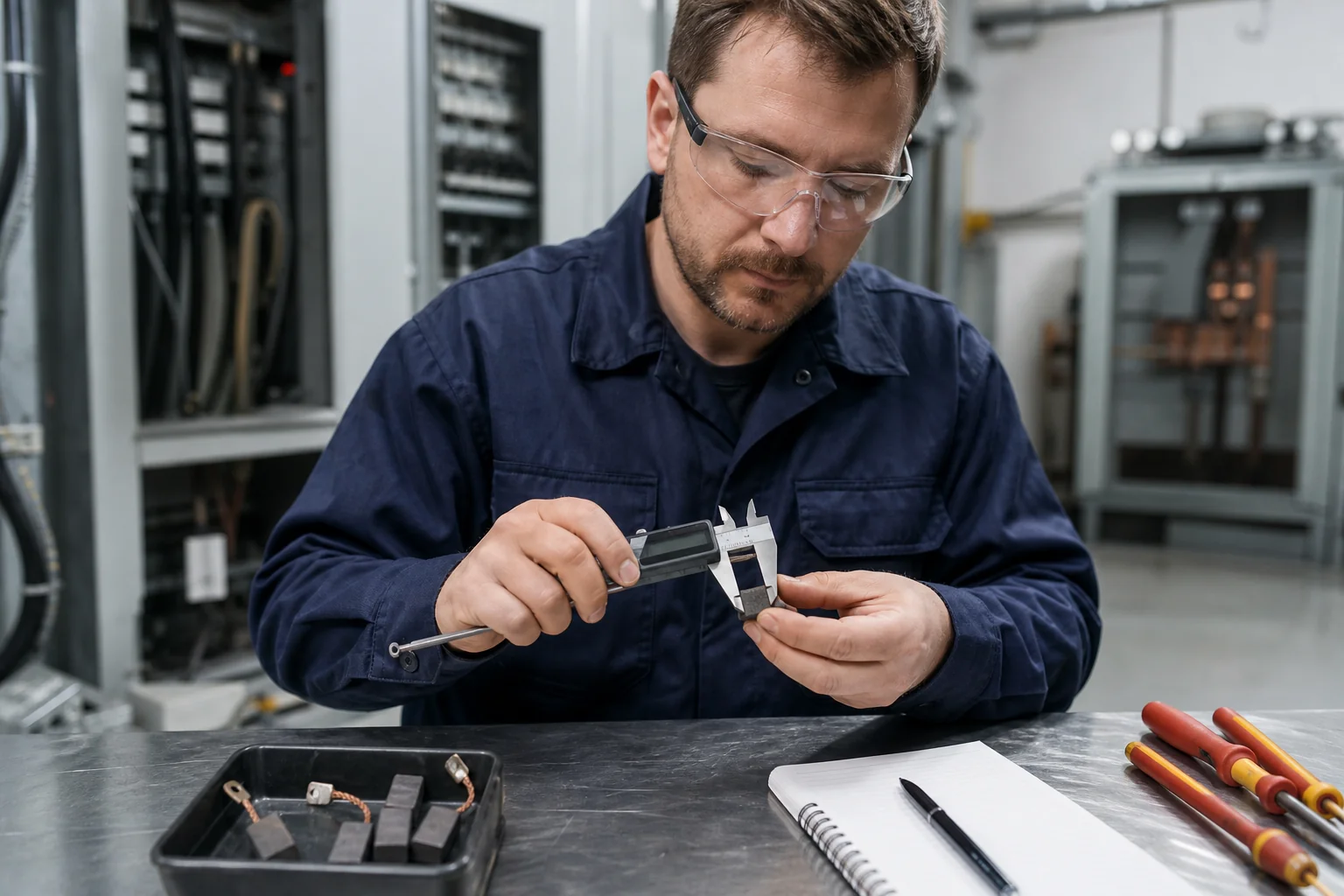
Start with a fixed interval, then adjust it using the wear you actually measure. A logged trend tells you far more than any generic schedule.
| Site condition | Starting interval | Tighten the interval if |
|---|---|---|
| Clean electrical room, stable grid | Every 6 months | Measured wear exceeds the previous period |
| Dusty, humid, or textile plant | Every 3 months | Deposits appear between visits |
| Weak grid with frequent swings | Every 3 months | The servo motor runs for most of the shift |
| After an overload trip or flood | Immediately | — |
During each visit, work through the same checks so results stay comparable between technicians.
| Check | Why it matters | If you skip it |
|---|---|---|
| Remaining brush length | Shows the wear rate per period | The brush runs to its wire and scores the track |
| Brush edges and sides | Burn marks or shiny sides signal sparking or vibration | Arcing spreads to the winding track |
| Shunt wire condition | A frayed or dark shunt means overheating | Contact resistance rises and output drifts |
| Track surface | Blackened spots reveal arcing points | The track needs costly rework or replacement |
| Spring force | Uneven force causes uneven wear | One brush wears out long before the others |
When Should You Replace the Carbon Brush?
Replace the brush well before it reaches the shunt wire or rivet. Helwig Carbon’s brush guide warns that running brushes to the wire damages the contact surface. On a stabilizer, that surface is the transformer winding.
Plan a replacement when you find any of the following:
- Remaining length near the minimum mark or the shunt entry point
- Chipped edges, burn marks, or polished sides on the brush
- A discolored, loose, or frayed shunt wire
- Output voltage that jumps instead of moving smoothly during correction
A safe replacement sequence protects both the technician and the unit:
- Switch the load to bypass, isolate the stabilizer, and lock out the supply
- Remove the cover and photograph the brush position before touching anything
- Vacuum the track and holder; don’t apply lubricant or contact spray
- Fit a brush of the same grade and size, and replace the whole set if there is more than one
- Confirm the brush slides freely and the spring sits centered on its top
- Run the unit without load, then check the track and log the new length
Which Spares Should a Distributor Keep in Stock?
If you sell or service servo stabilizers, a small spares kit turns a site visit into a same-day fix. Stock by model, because brush sizes differ across capacities.
| Spare | Why stock it | Information to order it correctly |
|---|---|---|
| Carbon brush set | The most frequent wear part | Model, serial number, brush grade, dimensions (t × a × r) |
| Brush holder and spring | Weak springs cause repeat failures | Holder type and spring force |
| Servo motor | Fails after long periods of hunting | Voltage, gear ratio, mounting |
| Limit switches | Prevent the arm from overrunning the track | Switch type and rating |
| Control board | Sets sensitivity and time delay | Board version printed on the PCB |
Brush suppliers describe size using the t × a × r designation from IEC 60136:2024, the standard for carbon brush dimensions, marking, and testing. Quoting those three dimensions with the grade avoids most wrong-part orders.
To build a kit for your fleet, send us your model list and serial numbers and ask for a matched spares list.
When Is It Time to Choose a Brushless Design?
If a site needs a new brush set more than twice a year, the stabilizer is telling you something about the grid. Frequent, fast dips keep a servo mechanism moving almost constantly.
For those sites, compare a contactless option. IGBT voltage stabilizers and the AVC active voltage conditioner correct electronically, so there is no brush or track to wear. The trade-off is a higher purchase price against lower routine maintenance.

Frequently Asked Questions
Can a Generic Motor Brush Replace the Original One?
Don’t. A brush with the right size but the wrong grade changes contact resistance and wear rate. Get the part number tied to your serial number and fit that grade only.
Why Does a New Brush Spark During the First Hours?
Its contact face hasn’t matched the track yet. Run the unit without load first, look again after two working days, and check for an even contact patch with no new burn marks.
How Should Wear Records Be Kept?
Record the date, remaining length, servo running hours if the display shows them, and one photo of the track. A plain spreadsheet per serial number is enough to show the visit where wear speeds up.
Final Thoughts
Brush life reflects site conditions. Inspect on a logged schedule, replace before the shunt, and stock matched spares. Compare models in our servo voltage stabilizer range when planning your next project.