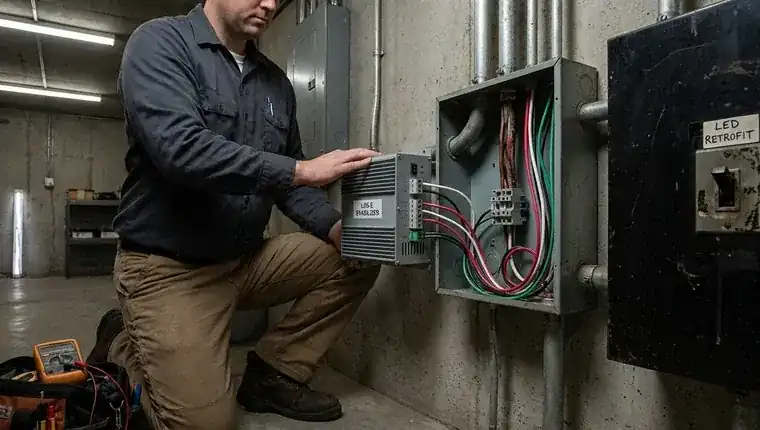
LED dimming stabilizer is a device that prevents flickering or partial lighting in LEDs by resolving triac incompatibility issues. If your LEDs flicker or stay partially lit after a retrofit, the fix isn’t a new dimmer or new fixtures — it’s an LED dimming stabilizer. The root cause is triac incompatibility: legacy triac-based dimmers were designed for the resistive load of incandescent bulbs, and low-wattage LEDs don’t draw enough current to keep the triac firing cleanly. An LED dimming stabilizer solves this by inserting a small resistive load in parallel with the fixture, giving the dimmer circuit the minimum load it needs to operate correctly.
This guide walks through exactly when an LED dimming stabilizer is the right call, who should use one, how to size it for your installation, and where to look when selecting a model for your application.
What an LED Dimming Stabilizer Actually Does
An LED dimming stabilizer is a small resistive load device engineered to solve a specific electrical mismatch: legacy triac-based dimmers were designed for incandescent bulbs, which draw current continuously and predictably. LEDs draw far less current — often too little to keep the triac firing cleanly across each AC half-cycle. The result is the flickering and ghost illumination (fixtures staying partially lit at zero setting) that contractors encounter after a retrofit.
The Root Cause: Triac Minimum Load
A triac is a bidirectional switch that fires when current through it exceeds a minimum holding threshold. Incandescent bulbs — purely resistive loads — naturally satisfy this threshold. A modern LED fixture, drawing only a few watts, often falls below it. The triac misfires or drops out mid-cycle, producing visible flicker or preventing full shutoff.

Patent US10251228B1 (LED Dimming Stabilizer Apparatus and Method) documents this mechanism precisely: the stabilizer inserts a low-impedance resistive load in parallel with the LED fixture, providing the supplemental current draw needed to keep the triac firing cleanly on every AC cycle. The patent notes the device operates only during the brief intervals when the triac needs stabilization, keeping power dissipation minimal — worst-case around 2W, well within the thermal budget of a standard single-gang box.
What the Device Delivers
- Eliminates flickering by ensuring the triac fires consistently across the full dimming range
- Resolves incomplete shutoff — fixtures go fully dark when the dimmer is at zero
- No dimmer or fixture replacement required — the stabilizer works with existing hardware
- One stabilizer covers multiple fixtures on the same dimmer circuit, so a single device can resolve an entire room’s worth of retrofit issues
The parallel wiring topology is critical here. The stabilizer connects between the load (hot) and neutral wires — not in series. Series installation blocks current to the fixture entirely.
As the patent states, this device can be manufactured and sold at a fraction of the cost of replacing a dimmer switch, LED fixtures, or the labor to do either — making it the correct first intervention when triac incompatibility is the diagnosed root cause.
Who Should Use One — and When It’s the Right Call
An LED dimming stabilizer is a targeted fix for a specific failure mode. Before specifying one, contractors and facility managers need to confirm which of three trigger scenarios applies — because the wrong diagnosis leads to the wrong solution.
Trigger 1: Flickering at Mid-Range Dimmer Settings
If LEDs flicker, strobe, or pulse when the dimmer is set anywhere between 20% and 80%, the triac is misfiring. This is the most common post-retrofit complaint and the clearest signal that the dimmer’s minimum load threshold isn’t being met. A stabilizer resolves it without touching the dimmer or the fixture.
Trigger 2: Ghost Lighting at Zero
LEDs that stay faintly lit when the dimmer is fully off — sometimes called “ghost lighting” or “phantom glow” — indicate residual current leaking through the triac. The fixture never fully shuts off because the circuit can’t reach a true zero-current state with a low-wattage LED load. A stabilizer provides the supplemental draw needed to pull the circuit below the triac’s holding threshold, achieving complete shutoff.
Trigger 3: Retrofit Constraints Make Replacement Impractical
When a contractor discovers dimming issues after installation — fixtures already in the ceiling, dimmers already wired — the cost calculus shifts sharply. Patent US10251228B1 states directly that an LED dimming stabilizer “can be manufactured and sold at a very low cost relative to the cost of a LED dimmer switch, the LED fixtures, or the labor cost to replace either.” A single stabilizer added in parallel resolves the entire circuit without a return visit to swap hardware.
When NOT to Use One
Skip the stabilizer in two scenarios:
- New installations with LED-compatible dimmers — modern dimmers designed for LED loads already handle the minimum-load problem natively. Adding a stabilizer is redundant.
- 0-10V or DALI commercial dimming systems — these are current-signal protocols, not triac-based switching. The stabilizer’s resistive load insertion has no effect on signal-controlled dimming and won’t address compatibility issues in those architectures.
The decision rule is simple: if the dimmer is triac-based and the symptoms appeared after swapping incandescent for LED, a stabilizer is the correct first intervention. If the system was designed for LEDs from the start, look elsewhere.
Installation Basics and Load Capacity Rules
Getting the wiring right is the single most important step. Connect the stabilizer in parallel between the RED (load) wire and the WHITE (neutral) wire using standard wire nuts — no programming, no configuration, no tools beyond what’s already in your kit. The device sits alongside the fixture, not in series with it.
The One Mistake That Kills the Circuit
Never install in series. Series installation interrupts current flow to the fixture entirely — the LED goes dark and stays dark. This is the most common installation error in the field, and it’s easy to make if you’re working quickly. If your LED is completely off after adding a stabilizer, check the wiring topology first.
Load Capacity by Configuration
Maximum load depends on how many stabilizers you’re running and what box they’re in:
| Configuration | Max Load |
|---|---|
| 1 stabilizer, single-gang box | 400W |
| 2 stabilizers, single-gang box | 300W |
| 2 stabilizers, double-gang box | 400W |
Two stabilizers in a single-gang box reduces the per-circuit ceiling to 300W — the tighter thermal environment limits headroom. Moving to a double-gang box restores the 400W ceiling for dual-stabilizer setups.
Thermal Budget and Box Safety
Power dissipation is 1.4W at full brightness and drops at lower dimmer settings. Worst-case dissipation is 2W — well within the thermal limits of a standard single-gang box, which is rated to handle the dimmer’s own 5W dissipation plus additional load. There’s no derating required for typical residential or light commercial installations.
Multi-Fixture Coverage
One stabilizer handles all fixtures on the same dimmer circuit. You don’t need one device per fixture — the stabilizer’s resistive load correction applies to the entire circuit simultaneously. For a room with six recessed LED cans on a single dimmer, one stabilizer resolves flickering and ghost lighting across all six.
The practical implication: size your stabilizer count to the box configuration and total wattage, not to the fixture count.
How to Select the Right Model for Your Application
Choosing the right LED dimming stabilizer comes down to four variables: voltage rating, total circuit load, box configuration, and fixture/dimmer compatibility. Get these right and the selection is straightforward.
Match Voltage Rating First
Standard residential LED dimming stabilizers are rated for 120V — the North American residential standard. Verify your circuit voltage before ordering. A 120V stabilizer on a 240V circuit is a wiring hazard, not a fix. This is the one spec that must match exactly; everything else involves sizing judgment.
Size by Total Circuit Load, Not Individual Fixture Wattage
The stabilizer’s load rating applies to the entire dimmer circuit, not per fixture. Add up the wattage of every LED fixture on that dimmer. A circuit with six 10W recessed cans runs 60W total — well within a single stabilizer’s 400W ceiling. Where contractors get into trouble is treating the stabilizer as a per-fixture device and under-specifying for high-load circuits.
For circuits approaching 400W, move to a double-gang configuration with two stabilizers. Two stabilizers in a single-gang box drops the ceiling to 300W due to thermal constraints; the same two stabilizers in a double-gang box restore the 400W rating.
| Configuration | Max Load |
|---|---|
| 1 stabilizer, single-gang | 400W |
| 2 stabilizers, single-gang | 300W |
| 2 stabilizers, double-gang | 400W |
Model Variants: Test-and-Keep Is a Valid Strategy
Multiple models exist — for example, the LDS-E (yellow) and LDS-R (blue) variants from LED Dimming Solutions perform differently depending on the specific fixture and dimmer combination in the field. There’s no universal “best” model across all installations. The practical approach: order a sample of each variant, install, and keep the one that eliminates flickering cleanly. Suppliers typically offer sample packs for exactly this reason.
Box Type Determines Stabilizer Count
Single-gang boxes accommodate one stabilizer at full 400W capacity. If you need two stabilizers — either because one isn’t resolving the issue or because the circuit load demands it — a double-gang box is required to maintain thermal headroom. Don’t force two stabilizers into a single-gang box and expect rated performance.
Where YIY’s Voltage Stabilization Expertise Applies
Most vendors selling LED dimming stabilizers come from the dimmer-switch side of the market — they understand switching circuits but not power quality. YIY’s background is the inverse: 16+ years engineering servo, relay, and IGBT-based voltage stabilizers for industrial and commercial loads. That engineering overlap matters more than it might appear.
Engineering Overlap: Resistive Load Stabilization
Servo and relay stabilizer design requires precise control of resistive load behavior under variable input conditions — exactly the physics at play in an LED dimming stabilizer. The core challenge (maintaining stable current delivery through a switching element with a low-impedance load) maps directly to triac-based dimmer stabilization. YIY’s engineers aren’t learning a new discipline; they’re applying existing power quality expertise to a smaller-scale application.
This is the differentiation that commodity dimmer-switch vendors can’t replicate. A dimmer manufacturer optimizes for switching speed and UI. A voltage stabilization manufacturer optimizes for load stability, thermal management, and circuit reliability under variable conditions — which is precisely what an LED dimming stabilizer demands.
OEM/ODM Capability for Custom Configurations
The LED dimming stabilizer market is fragmented. Most products are designed for generic 120V residential use, with limited customization for specific fixture-dimmer combinations. YIY’s manufacturing scale — 30,000㎡ facility, 1,000,000+ units/year capacity — enables OEM/ODM development of stabilizers engineered for specific load profiles, voltage ranges, or enclosure requirements.
For procurement teams sourcing at volume, this matters. A custom stabilizer designed around your fixture wattage and dimmer protocol eliminates the trial-and-error model selection problem that plagues off-the-shelf products.
Quality and Supply Chain Validation
ISO 9001:2015 certification and active export to 130+ countries means YIY’s quality systems and logistics infrastructure are already validated for international procurement. For facility managers and engineers evaluating supply chain risk, that’s a meaningful baseline — not a marketing claim.
The value proposition aligns with YIY’s broader positioning: cost-effective, retrofit-compatible power protection solutions that don’t require replacing existing infrastructure. An LED dimming stabilizer is, at its core, a power quality device. That’s YIY’s home territory.
Frequently Asked Questions
Do LED lights need a voltage regulator?
Not always — but they do need compatible dimmer control when used with triac-based dimmers. A standard voltage regulator addresses input voltage fluctuation; an LED dimming stabilizer addresses a different problem: the triac’s minimum load threshold. If your LEDs flicker or won’t fully shut off on an existing dimmer, the stabilizer is what you need, not a voltage regulator.
How to stabilize LED lights?
Add a resistive load stabilizer in parallel with the LED fixture on the dimmer circuit. Connect it between the RED (load) wire and WHITE (neutral) wire using standard wire nuts — no programming required. One stabilizer covers all fixtures on the same dimmer circuit, so a single device resolves flickering across an entire room.
How to reduce voltage for an LED?
A dimming stabilizer doesn’t reduce voltage — that’s a different device class. The stabilizer’s job is to stabilize the triac’s firing signal by supplementing the circuit’s resistive load. If you need actual voltage reduction (e.g., running 12V LEDs from a higher supply), you need a DC-DC converter or a dedicated LED driver, not a dimming stabilizer.
What should buyers evaluate before choosing an LED dimming stabilizer?
Four variables determine the right spec:
- Dimmer type — triac-based only; 0-10V and DALI systems are incompatible
- Circuit voltage — standard residential units are rated 120V; verify before ordering
- Total circuit load — sum all fixture wattages on the dimmer, not per-fixture
- Box configuration — single-gang vs. double-gang determines how many stabilizers fit and at what load ceiling
How should it be sized or specified?
Match voltage rating first (120V for North American residential). Then calculate total fixture load on the dimmer circuit. A single stabilizer handles up to 400W in a single-gang box. If you need two stabilizers, use a double-gang box to maintain the 400W ceiling — two units in a single-gang box drops to 300W due to thermal constraints. Size to the circuit, not the fixture count.
Frequently Asked Questions
Do LED lights need a voltage regulator?
Not always — but they do need compatible dimmer control when used with triac-based dimmers. A standard voltage regulator addresses input voltage fluctuation; an LED dimming stabilizer addresses a different problem: the triac’s minimum load threshold. If your LEDs flicker or won’t fully shut off on an existing dimmer, the stabilizer is what you need, not a voltage regulator.
How to stabilize LED lights on a triac dimmer?
Add a resistive load stabilizer in parallel with the LED fixture on the dimmer circuit. Connect it between the RED (load) wire and WHITE (neutral) wire using standard wire nuts — no programming required. One stabilizer covers all fixtures on the same dimmer circuit, so a single device resolves flickering across an entire room without touching the dimmer or the fixtures.
How should an LED dimming stabilizer be sized or specified?
Match voltage rating first — standard residential units are rated 120V. Then calculate total fixture load on the dimmer circuit, not per fixture. A single stabilizer handles up to 400W in a single-gang box. If you need two stabilizers, use a double-gang box to maintain the 400W ceiling; two units in a single-gang box drops to 300W due to thermal constraints.
What should buyers evaluate before choosing an LED dimming stabilizer?
Four variables determine the right spec: dimmer type (triac-based only — 0-10V and DALI systems are incompatible), circuit voltage (verify 120V before ordering), total circuit load (sum all fixture wattages on the dimmer), and box configuration (single-gang vs. double-gang determines how many stabilizers fit and at what load ceiling).
Final Thoughts
Use an LED dimming stabilizer when your symptoms are triac-specific — flickering at mid-range settings, ghost lighting at zero, or a retrofit where replacing hardware isn’t practical. If the dimmer is triac-based and the problem appeared after swapping incandescent for LED, a stabilizer is the right first move; if the system runs 0-10V or DALI, look elsewhere.
The sizing logic is straightforward: match voltage (120V), calculate total circuit load, and choose your box configuration accordingly.
If you’re evaluating options for a specific installation, share your load profile, site conditions, and target output requirements with YIY’s team — we’ll recommend the right model. Reach us at yiyen at yiyen.com, +86 13587452904, or yiyavr.com.
—
About YIY
Zhejiang Yiyen Holding Group Co., Ltd. (YIY) is a professional voltage stabilizer manufacturer with 16+ years of experience. With a 30,000sqm modern facility and an annual production capacity of 1,000,000+ units, our products are exported to 130+ countries. We provide OEM/ODM customization services and are ISO 9001:2015 certified, committed to delivering stable and reliable voltage protection solutions to global customers.
Contact Us
Email: yiyen at yiyen.com
Phone/WhatsApp: +86 13587452904
Website: https://www.yiyavr.com/
If you found this article helpful, contact us for a sizing review or customized solution.
Related reading: How Voltage Stabilizer Works: Relay, Servo & IGBT Guide.