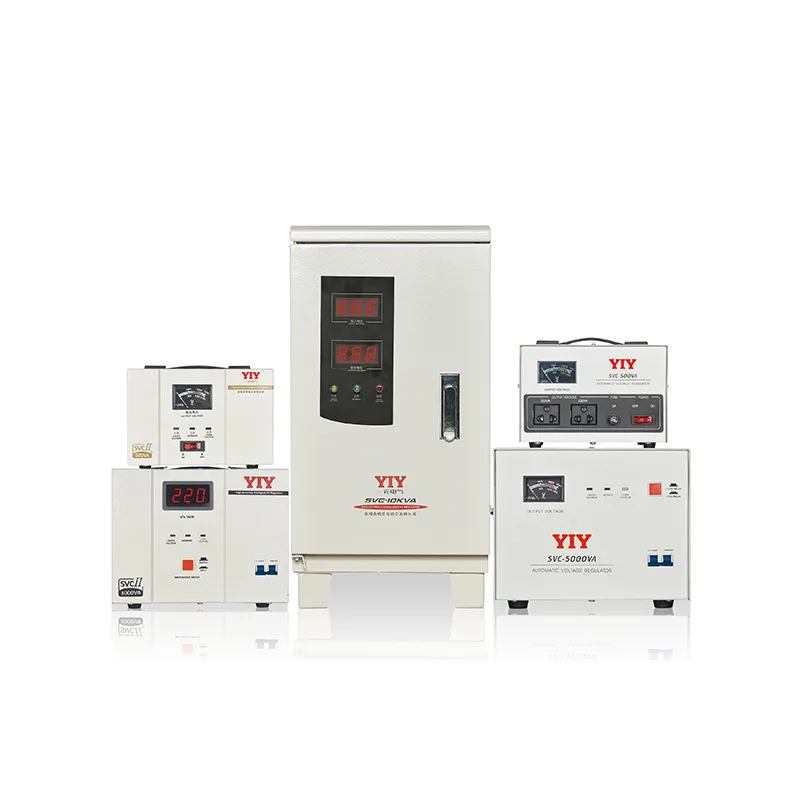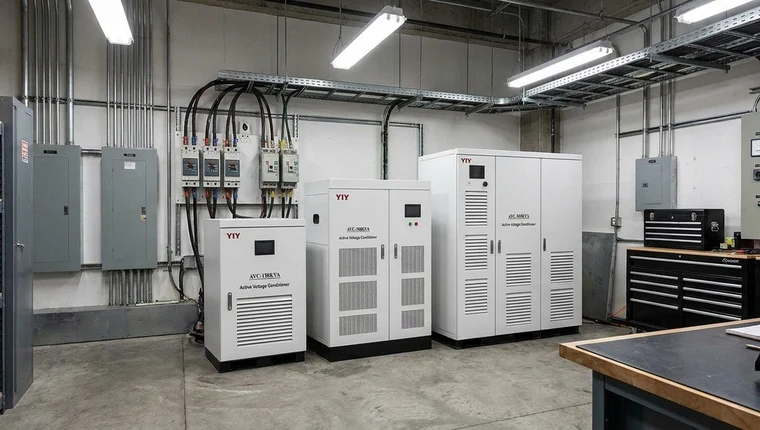
If you are comparing a premier voltage stabilizer 500va, start with the load risk: relay suits basic protection, servo gives tighter everyday regulation, and IGBT/static technology fits precision-sensitive electronics.
For small home, office, retail, and light commercial loads, 500VA can protect one selected device or a small low-power setup, but it should not be treated as a whole-building stabilizer.
Here’s what you’ll decide in this guide: whether 500VA is enough for your load, which relay/servo/IGBT technology fits your voltage problem, what specifications and documents you should verify, how to install and test the unit, and when local retail buying is enough versus OEM/ODM sourcing.
When Does a 500VA Stabilizer Make Sense for Your Load?
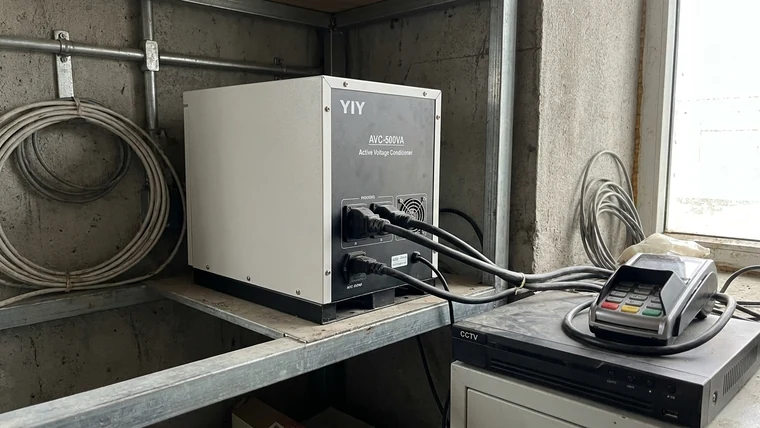
You should choose a 500VA voltage stabilizer when you need device-level protection for low-power electronics, not main-line voltage correction. If your problem is one PC, router, POS terminal, display, CCTV DVR, small printer, or light office device suffering from sag, brownout, surge, or recurring voltage fluctuation, this compact automatic voltage regulator can be a practical fit.
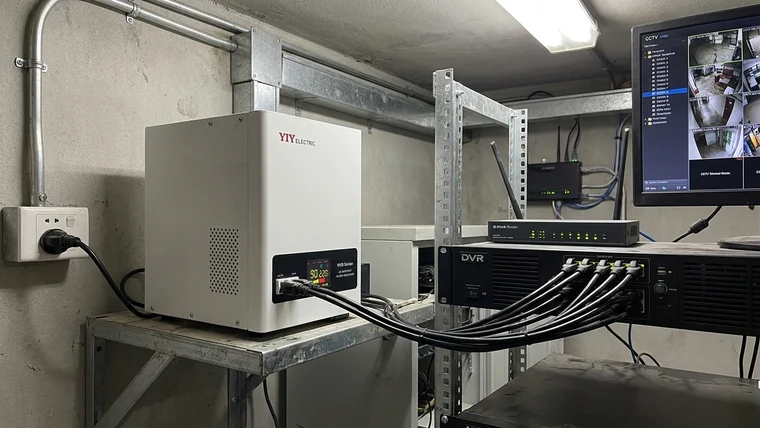
A 500VA AVR, voltage stabilizer, or small line conditioner is designed to maintain a steadier output while the input supply moves within the correction range stated on the model label or datasheet. For you, that means the stabilizer can reduce harmful voltage swings, but it cannot fix every utility, generator, wiring, or overload problem.
For global procurement, confirm nominal voltage against the operating country and real site measurements; IEC 60038 standard voltages defines standard AC supply voltage systems used internationally. In practical terms, the nameplate voltage is only your starting point. Your real decision depends on what the outlet delivers during peak load, low load, generator changeover, and unstable-grid periods.
Servo deserves an early look when your shortlist includes automatic voltage regulator, AVR, line conditioner, or a phrase such as stabimatic 500VA servo motor voltage stabilizer. For the working principle and product family context, use YIY’s servo voltage stabilizer overview as your orientation point.
Practical Load Mapping
You should size 500VA conservatively. A simple check is:
Required VA = load watts ÷ power factor
Then add a safety margin, commonly 20–30% for small electronics. That reserve gives your stabilizer breathing room instead of forcing it to run at its limit all day.
| Load type | 500VA fit | What it means for you |
|---|---|---|
| Desktop PC, router, modem, CCTV DVR, POS terminal | Usually suitable | Confirm combined watts and power factor before connecting multiple devices |
| Displays, AV equipment, barcode scanner, small office electronics | Usually suitable | Check plug type, input range, and output voltage before purchase |
| Small inkjet printer | Often suitable | Avoid adding other loads if startup draw is unknown |
| Laser printer, compact pump, small compressor load | Borderline | Check startup current, not only running watts |
| Air conditioner, large compressor loads, heaters, production machinery, whole-room circuits | Not suitable | Step up to a higher VA/kVA class or main-line stabilizer |
The compressor point matters because compressor-start current can briefly exceed running current by a wide margin. For you, the practical rule is simple: do not size only from running wattage. Check startup current, locked-rotor current, or the appliance manufacturer’s recommended stabilizer capacity.
Which Technology Fits Your Precision and Budget Requirements?
Relay is usually the economical choice for basic residential loads, servo is the balanced option when you want tighter correction, and IGBT/static regulation fits precision or mission-critical electronics. If your 500VA load is a PC, router, display, POS terminal, small printer, or sensitive controller, the key differences are regulation topology, output precision, response behavior, and protection depth.
To compare relay models by input window and mounting style, see the relay voltage stabilizer range, which covers portable PR, desktop AVR and wall-mounted TRS and SWR units.
| Stabilizer type | How it regulates voltage | Typical output precision | Practical fit at 500VA | Main tradeoff |
|---|---|---|---|---|
| Relay | Switches transformer taps through relays | ±5–8% | General residential electronics where cost and fast tap switching matter | Wider output band and step changes |
| Servo | MCU controls a servo motor that moves a carbon brush on an autotransformer | ±0.5–3%, response around ≤1–2 seconds | Small office, light commercial, and sensitive appliance loads needing steadier output | Mechanical movement and slower correction than relay/static types |
| IGBT/static | Uses DSP/PWM or electronic regulation | Around ±0.5% | Sensitive electronics, instruments, medical-adjacent devices, and voltage-critical loads | Higher complexity and cost |
In plain language, ±5–8% means your connected device may still see a wider voltage window, but that can be acceptable for basic appliances. ±0.5–3% gives your load a narrower output band, which can reduce nuisance resets and power-supply stress when the grid is unstable. Around ±0.5% is a precision tier for loads where voltage stability matters more than lowest purchase cost.
Ask suppliers to confirm these protection features before you compare price:
- Over-voltage and under-voltage cutoff
- Overload and short-circuit protection
- Thermal protection, especially for hot cabinets or poor ventilation
- Startup delay for compressors or sensitive electronics
- Manual or automatic bypass, where applicable
- LED/LCD indicators, alarms, or fault codes
For harsh sites, check dust exposure, humidity, ambient temperature, ventilation clearance, and enclosure suitability. A low-cost AVR placed in a hot, dusty corner can fail before its electrical design is the limiting factor. If your load is highly sensitive or medical-adjacent, compare the servo option against an IGBT voltage stabilizer so you can judge whether static regulation is worth the added complexity.
YIY supports relay, servo, and IGBT paths from the 500VA entry class through large-capacity stabilizer projects. That breadth helps you match the topology to the risk instead of forcing one design onto every load.
What Specifications Should You Verify Before Shortlisting?
You should shortlist a 500VA AVR by verified load VA, input voltage range, output accuracy, correction behavior, protection functions, certification documents, and supplier datasheets—not by the 500VA rating alone. You are buying risk control for your equipment, so a cheap mismatch can still create downtime through nuisance trips, overheated windings, or unprotected voltage events.
Start with capacity math. If your connected load is 350W at 0.7 power factor, the required apparent power is:
350W ÷ 0.7 PF = 500VA
That means the stabilizer is already at its nominal limit before safety margin. For you, this is a warning sign: either reduce the connected load or move to a larger capacity tier.
| Check | Why it matters | If you skip it |
|---|---|---|
| Total load VA and power factor | Confirms whether 500VA is enough after margin | Overload trips, heat, shortened service life |
| Startup current | Motors and compressors draw more at startup than during running | Nuisance trips or motor stress |
| Input voltage range | Market listings may advertise ranges such as 130–270V, but your site may differ | The unit may not correct your real grid lows/highs |
| Output voltage, phase, and frequency | Must match your equipment, such as 220/230V single-phase 50/60Hz or local alternatives | Wrong output can damage or refuse connected loads |
| Output accuracy | Relay, servo, and IGBT designs allow different output bands | Sensitive electronics may still reset or fail early |
| Correction speed / response time | Determines how quickly voltage fluctuation is corrected | Fast dips may still reach the load |
| Efficiency, waveform compatibility, and noise | Helps estimate heat, losses, and suitability for SMPS, audio, or IT loads | Hidden heat, hum, or compatibility issues |
| Protection functions | Over/under-voltage, overload, short-circuit, thermal, surge, and delay protection reduce abnormal-event risk | One voltage event can become equipment downtime |
| Enclosure and ambient limits | Dust, humidity, heat, and poor airflow change real reliability | A compliant unit may fail in the wrong environment |
| Certificates and RFQ documents | Confirms declared compliance, warranty, wiring, and test basis | You compare catalog claims instead of evidence |
For voltage dips or interruption immunity, IEC 61000-4-11 voltage dip testing is a useful reference where relevant. In practical terms, this kind of standard helps you ask better questions about how the equipment behaves during short supply disturbances instead of relying only on “wide input range” claims.
For supplier qualification, request current certificates for ISO 9001:2015 quality management systems, plus ISO 14001 or CE documentation where your market requires them. Exact 500VA model names, pricing, efficiency values, input ranges, plug formats, and case metrics should be confirmed by datasheet, nameplate photo, test report, or written quotation before approval. For broader sizing logic, use the industrial voltage stabilizer selection framework as a cross-check.
How Should You Install and Test a 500VA Stabilizer Before Handover?
You should install a 500VA stabilizer close to the protected load, verify wiring and grounding, measure input/output voltage under real load, and document a basic acceptance test before relying on the unit. This keeps the AVR protecting the equipment you actually intended to protect—not an overloaded socket, unknown extension board, or poorly identified branch circuit.
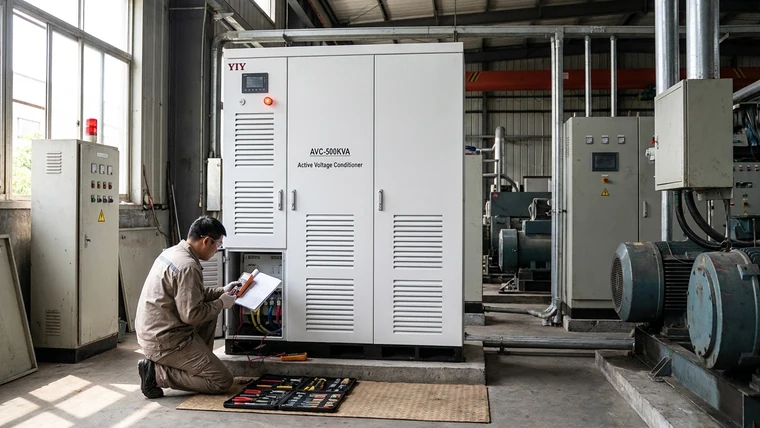
Before energizing, confirm the basics:
- Load nameplate: total watts/VA, voltage, frequency, and startup current if a motor or compressor is connected
- Capacity margin: avoid running near 500VA continuously; a practical 20–30% reserve helps reduce heat and nuisance trips
- Plug/socket rating: socket, cord, fuse, and stabilizer rating should match the load current
- Grounding: protective earth should be continuous and correctly terminated
- Input voltage: measure actual supply voltage at the installation point, not only at the panel
- Environment: allow ventilation clearance, avoid direct heat, and check dust, humidity, and ambient temperature limits
Installation and Acceptance Test Sequence
Use the manufacturer’s 500VA voltage stabilizer manual as the controlling document. It should include the wiring diagram, delay settings, alarm codes, fuse rating, bypass instructions, protection behavior, and maintenance intervals.
- Power off the source and protected load.
- Connect stabilizer input correctly: line, neutral, and earth.
- Connect only the intended protected load; avoid multi-device overload.
- Power on the stabilizer and observe LED/LCD indicators or alarms.
- Measure no-load output voltage.
- Apply normal load and measure loaded output voltage.
- If safe and permitted, verify abnormal-input response with approved test equipment.
- Check heat, vibration, transformer hum, odor, and fan operation where fitted.
- Confirm overload, fuse, bypass, delay, or trip behavior only as the manual allows.
- Record input voltage, output voltage, load, ambient condition, serial number, date, and test result.
For device-level protection, this sequence is usually enough to catch obvious mismatches. If your measured load has grown beyond one device, or if you are trying to stabilize a circuit, workshop, or building, move from a plug-in 500VA review to 3 phase main line stabilizer sizing or the appropriate single-phase main-line path.
Handover is complete only when your measured results match the datasheet and the user understands the indicators, reset process, bypass position, and maintenance interval. That small record can prevent a support dispute or avoidable outage later.
Should You Buy Locally or Source Through OEM/ODM?
You should use local retail availability for urgent single-unit replacement, but choose OEM/ODM manufacturer sourcing when you need repeatable specifications, private labeling, documentation, and stable long-term supply. Searches such as “500va voltage stabilizer Home Depot” or “500va voltage stabilizer nearby” usually mean you want fast pickup, small quantity, a familiar return policy, and minimal procurement paperwork—not necessarily the best configurable AVR for export or repeat deployment.
| Sourcing path | Best fit | What to verify before buying |
|---|---|---|
| Local retail / marketplace | One-off replacement, urgent home or office use, small quantity | Nameplate VA, input/output voltage, plug type, return policy, manual, protection functions |
| OEM/ODM manufacturer | Export projects, repeat procurement, private label programs, distributor supply | BOM stability, custom voltage range, enclosure, regional plug, labeling, certificates, test reports, packaging |
| Engineering-led supplier shortlist | Commercial rollouts, mixed load types, unstable-grid markets | Load data, voltage profile, service expectations, warranty process, customization limits |
Retail is practical when downtime is immediate and the load is simple: a router, PC, POS terminal, display, or small office device. Still, avoid assuming a nearby listing matches your grid. Check 500VA, 220/230V or 110/120V, frequency, input range, ventilation needs, and whether the manual explains alarms, delay, overload, and reset behavior.
Direct manufacturer sourcing becomes more suitable when your risk moves from “one device is down” to “many units must behave the same across markets.” For OEM/ODM, ask for a stable BOM, custom input/output range, regional socket or plug options, enclosure color, private label artwork, carton marking, user manual, wiring diagram, certificate pack, and pre-shipment test records.
YIY supports OEM/ODM projects across a 500VA–3,000KVA voltage stabilizer range, including servo, relay, and IGBT technology paths. The company was founded in 2008 and documents a 30,000㎡ facility, 1,000,000+ annual capacity, and exports to 130+ countries. For you, those figures matter only when they are tied to the exact model, test documents, warranty process, and delivery requirements in your RFQ.
What Final Checks Should You Complete Before You Decide?
You should complete your final check by matching VA, watts, power factor, input range, protection functions, documentation, and startup current against your actual load. You are not buying the retailer name or the label; you are buying risk control for your equipment.
| Final check | Why it matters | If you skip it |
|---|---|---|
| Confirm connected load in watts and VA | Ensures the 500VA unit is not overloaded | Trips, heat, short service life |
| Add 20–30% reserve where practical | Keeps the unit from running at its limit | Nuisance overload and thermal stress |
| Measure real input voltage | Confirms whether the advertised range fits your site | The stabilizer may not correct actual lows/highs |
| Confirm output voltage and frequency | Matches the protected device | Equipment may malfunction or be damaged |
| Check startup current for motors/compressors | Prevents undersizing | Compressor or pump may trip the unit |
| Review the official manual | Verifies wiring, fuse, delay, alarms, and reset steps | Installation errors and support disputes |
| Request datasheet/certificate evidence | Separates proven specs from catalog claims | Procurement compares marketing rather than proof |
If the numbers point beyond this capacity tier, step up instead of forcing 500VA to do a larger stabilizer’s job. For a higher-capacity procurement path, you can compare before buying a voltage stabilizer and adapt the same evidence-based checks to larger systems.
Frequently Asked Questions
Is a 500VA Voltage Stabilizer from Home Depot a Good Option for Small Electronics?
A 500VA stabilizer from a retail channel can be suitable for small electronics if its nameplate matches your load and local supply. Before buying, verify the rated VA, input voltage range, output voltage, frequency, plug type, fuse rating, protection functions, and return policy. Your concrete action is to compare the store listing against the physical nameplate and manual before you connect the load.
How Do I Find a Reliable 500VA Voltage Stabilizer Nearby Without Choosing the Wrong Model?
A nearby 500VA stabilizer is reliable only if its specifications match your measured outlet voltage and connected load. Check the store listing, then inspect the physical nameplate before purchase. Confirm VA rating, single-phase voltage, frequency, delay timer, protection functions, ventilation requirements, manual availability, and warranty terms.
Where Should I Verify the Official Manual for a 500VA Voltage Stabilizer?
Verify the official manual through the manufacturer, authorized distributor, or the QR code or URL printed on the product label. Cross-check the model number, voltage range, fuse rating, wiring diagram, delay setting, alarm codes, overload behavior, and maintenance interval. If the manual and datasheet conflict, ask the supplier for written confirmation before installation or procurement approval.
Can a 500VA Stabilizer Run a Compressor or Another Motor-Start Load?
A 500VA stabilizer is often borderline for compressor and other motor-start loads because compressor startup current can be much higher than running current. Check the appliance nameplate and manufacturer data for starting current, locked-rotor current, or recommended stabilizer capacity. If that data is unavailable, choose a higher VA tier to reduce nuisance trips and avoid stressing the motor.
Is a Stabimatic 500VA Servo Motor Voltage Stabilizer Different from a General 500VA AVR?
Yes, if it is truly servo-based. A servo unit regulates by motor-driven autotransformer adjustment, often giving tighter output precision than basic relay AVRs, but response may be slower than relay or static designs. Verify the topology, output accuracy, response time, input range, and protection functions in the datasheet before assuming it fits your load.
Final Thoughts
You should choose the 500VA stabilizer type by load risk: relay for basic protection, servo for balanced precision and cost, and IGBT/static regulation for precision-sensitive electronics. Your final decision should come from measured load VA, real input-voltage range, startup current, protection functions, documentation quality, and supplier support—not from the capacity label alone.
If you underspecify this power class, the business impact can show up as nuisance resets, service calls, warranty disputes, or avoidable replacement work. Keep the choice operational: protect the equipment that affects continuity, transactions, monitoring, or customer service.
A low-friction next step is to run a first-pass fit review with YIY. Share the connected load, local voltage, preferred plug/output format, and whether you are comparing relay, servo, or IGBT options; YIY can help you build a shortlist around tradeoffs, proof points, and procurement risk before you request a detailed quotation. For a 500VA-class relay unit, see the YIY AVR single-phase relay voltage stabilizer; its product page lists a 500VA model, so confirm it against your load.
Dealers and wholesale buyers can request distributor terms through the YIY contact page.