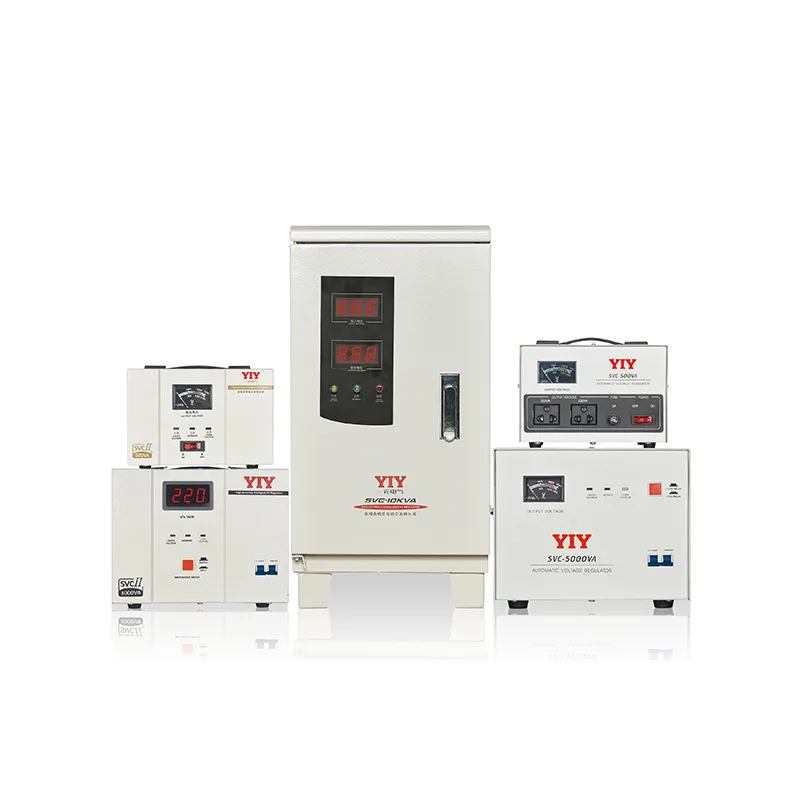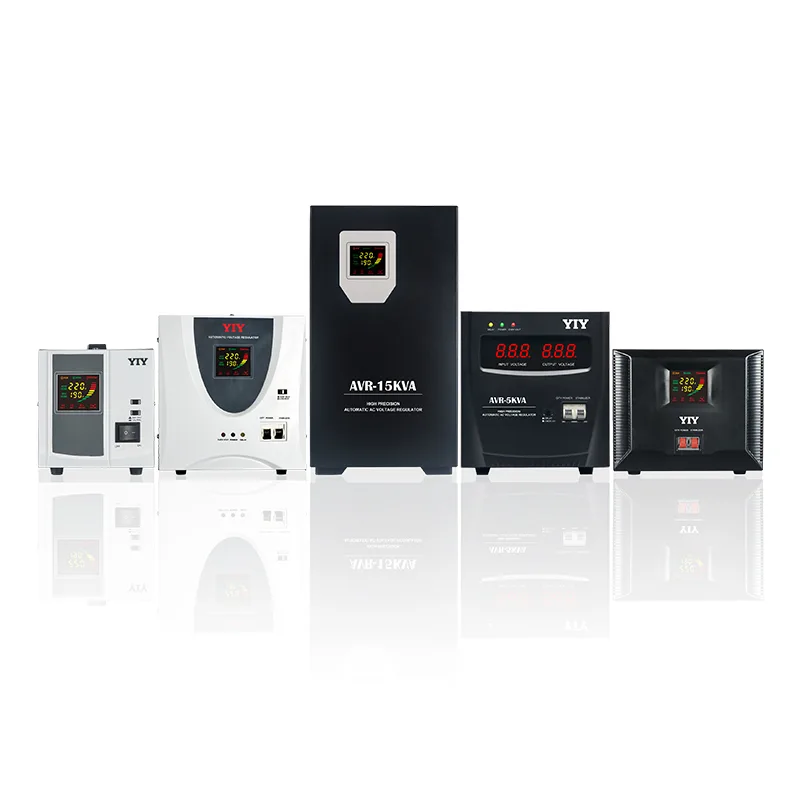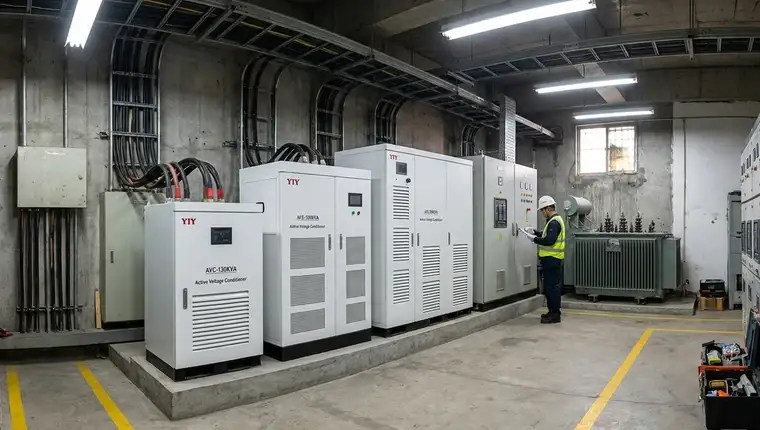
Servo stabilizers usually fit sensitive industrial loads better, while relay stabilizers fit tolerant, budget-driven circuits.
In a servo stabilizer vs relay stabilizer decision, your core trade-off is precision versus simplicity: servo designs typically provide continuous correction around ±0.5% to ±3%, while relay voltage stabilizers often regulate in wider steps around ±5% to ±8%.
If your CNC machine, medical device, lab instrument, production line, HVAC panel, or commercial load reacts badly to voltage movement, the lowest-cost AVR may not be the lowest-risk choice. This guide helps you compare how servo and relay stabilizers work, where each type fits, how static or IGBT options change the decision, what sizing checks you should complete, and which procurement evidence you should verify before buying.
Why Does the Servo Stabilizer vs Relay Stabilizer Choice Matter?
You should choose the stabilizer topology by matching voltage precision to the risk of your connected load. If your equipment can tolerate wider voltage steps, a relay stabilizer may be enough; if your process depends on stable voltage, a servo stabilizer is usually the safer industrial choice.
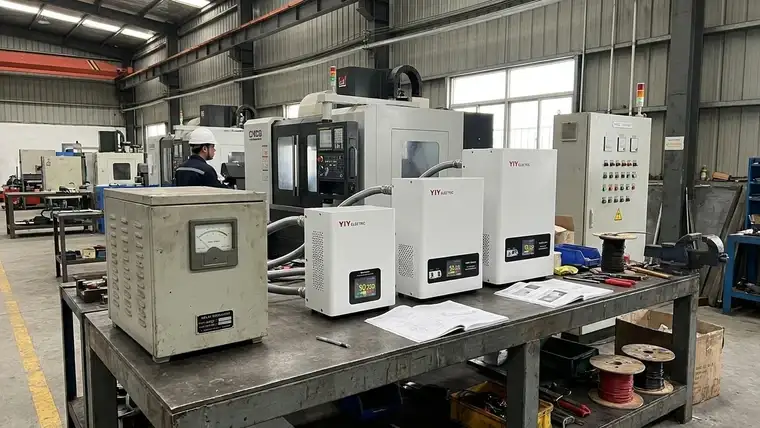
A servo stabilizer corrects output continuously. A servo motor moves a carbon brush across an autotransformer under feedback control, so the AVR trims voltage smoothly instead of jumping between fixed taps. A relay stabilizer uses electromagnetic relays to switch transformer taps, which keeps the design simpler and often cheaper, but the output changes in steps.
For your procurement file, the practical meaning of ±0.5% to ±3% is that connected equipment sees a narrower operating band. The practical meaning of ±5% to ±8% is that your load must tolerate larger voltage movement without nuisance trips, overheating, measurement drift, or process instability.
IEC 60038 standard voltages gives the nominal voltage context buyers use when checking whether a supply voltage and stabilizer output band are acceptable. For you, that means the equipment nameplate voltage is only the starting point; you still need to confirm the actual operating window your machines can accept.
For servo applications, start with the engineering baseline for a servo voltage stabilizer and then map the technology to your site voltage, load type, phase configuration, and tolerance requirement.
| Decision point | Servo stabilizer | Relay stabilizer | What it means for you |
|---|---|---|---|
| Correction method | Continuous motor-driven adjustment | Fixed transformer tap switching | Servo is smoother; relay is step-based. |
| Typical output accuracy | ±0.5% to ±3% | ±5% to ±8% | Servo suits tighter equipment tolerance; relay suits tolerant loads. |
| Response behavior | Smooth correction, commonly specified around 1-2 seconds depending on model and voltage swing | Fast tap change, but less fine-grained | Relay may switch quickly, but your equipment still sees stepped correction. |
| Main wear points | Servo motor, carbon brush, autotransformer contact path | Relay contacts and switching mechanism | Your maintenance plan should match the wear mechanism. |
| Typical use | CNC, medical, lab, precision machinery, industrial lines | Lighting, simple HVAC, pumps, non-sensitive commercial circuits | Your load sensitivity should drive the choice. |
How Do Servo and Relay Stabilizers Regulate Voltage Differently?
Servo stabilizers regulate voltage continuously, while relay stabilizers regulate voltage in fixed steps. That difference explains most of what you will feel in real operation: smoother voltage correction from servo units, simpler tap-switching from relay units.
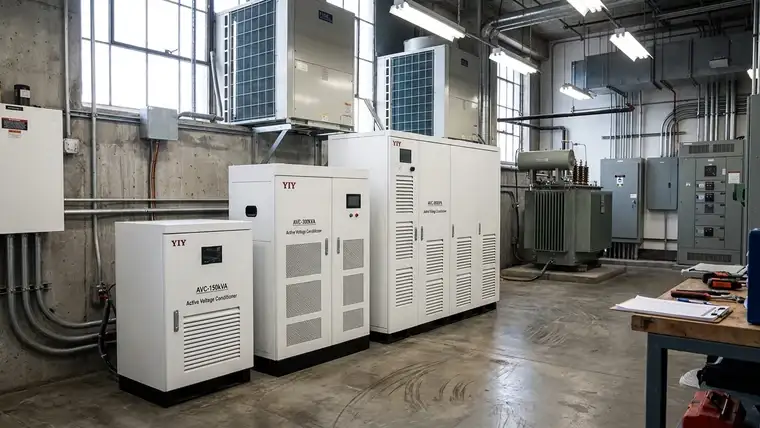
In a servo stabilizer, the control circuit monitors output voltage, compares it with the target value, and commands a servo motor to move a carbon brush along an autotransformer. That movement changes the transformer turns ratio gradually. For your sensitive equipment, this reduces abrupt voltage movement and keeps the output closer to the set value.
A relay voltage stabilizer monitors the input or output voltage and energizes relays to select different transformer taps. This design can be economical and suitable for many light-duty loads, but the output lands on the nearest available tap rather than a continuously adjusted point. For your circuit, that means regulation may be acceptable for lighting, basic pumps, or simple HVAC, but less suitable for precision production or diagnostic equipment.
The maintenance profile also differs. Servo stabilizers need periodic inspection of the servo motor, brush, contact path, ventilation, and dust exposure. Relay stabilizers need attention to relay contacts, switching frequency, clicking noise, and contact wear, especially where grid voltage fluctuates often. If your site has heat, humidity, dust, or unstable supply, enclosure protection, filtered ventilation, surge protection, bypass, alarms, and event logging become part of the specification rather than optional extras.
Which Technology Fits Your Load: Servo, Relay, Static, or CVT?
You should choose servo for precision industrial loads, relay for non-sensitive loads, and static or IGBT designs only when your response-speed or wear requirements justify the higher specification. CVT may appear in searches such as “cvt vs servo stabilizer,” but you should not treat it as interchangeable without application-specific load data.
| Load or site type | Better fit | Why it fits | Watch-out |
|---|---|---|---|
| CNC machines, test benches, lab instruments, medical equipment | Servo stabilizer | Continuous correction supports tighter output accuracy and reduces voltage drift risk. | Verify input range, output tolerance, bypass, and maintenance access. |
| Mixed industrial machinery and production panels | Three-phase servo configuration | Handles larger or mixed loads better when voltage stability affects uptime. | Check phase balance, startup current, power factor, and future expansion. |
| Lighting, simple HVAC, pumps, basic commercial panels | Relay stabilizer | Lower upfront cost can be acceptable where wider voltage steps do not affect performance. | Avoid using relay units for precision controllers or sensitive electronics without tolerance checks. |
| Highly sensitive electronics or wear-intolerant sites | Static or IGBT stabilizer | Electronic correction can suit very fast regulation needs and avoids servo brush wear. | Confirm the higher cost is justified by the load’s sensitivity and disturbance profile. |
| Sites with frequent dips, interruptions, or poor grid quality | Servo, static, or custom-protected design | Topology alone may not solve the problem; protection, monitoring, and correction range matter. | Ask for correction range, overload behavior, alarms, logs, and service support. |
If your equipment must tolerate voltage dips or interruptions, compare the stabilizer choice with the connected equipment’s immunity requirements. IEC 61000-4-11 voltage dip testing defines voltage dip and interruption immunity testing for electrical and electronic equipment; for your decision, this means you should evaluate disturbance behavior against the equipment’s tolerance, not only the AVR nameplate.
Static or IGBT designs are worth considering when your load needs very fast electronic correction or when mechanical wear is unacceptable. If that applies to your site, use the IGBT voltage stabilizer overview as a deeper comparison point before you decide whether servo correction is enough.
For most general industrial loads, servo remains the practical middle ground. It gives you tighter regulation than relay designs without automatically moving you into the higher complexity of static technology.
What Should You Verify Before Sizing Capacity, Phase, and Tolerance?
You should size the stabilizer from measured site data, not from the equipment nameplate alone. Your real input voltage range, startup current, power factor, load sensitivity, and phase configuration determine whether the selected AVR will protect your equipment under normal and abnormal conditions.
A useful baseline formula is:
required kVA = total load kW / power factor + startup and expansion margin
For example, a 40 kW load at 0.8 power factor is already 50 kVA before extra margin. For you, that means a nameplate-only purchase can be undersized even before you account for motor starting, compressors, transformers, lifts, or future load growth.
| Check | Why it matters | If you skip it |
|---|---|---|
| Actual input voltage range across working shifts | Confirms whether the stabilizer can correct your real low and high voltage points. | The AVR may reach its correction limit and pass unstable voltage to your load. |
| Total kW, kVA, and power factor | Apparent power determines stabilizer capacity more accurately than kW alone. | You may undersize the unit and trigger overload, heat, or nuisance trips. |
| Startup or inrush current | Motors, compressors, lifts, and transformers can draw several times running current briefly. | Your stabilizer may sag, trip, or fail to support repeated starts. |
| Single-phase or three-phase configuration | Phase type affects wiring, load balance, neutral requirements, and cabinet design. | You may create installation rework or unstable output. |
| Required output tolerance | Sensitive loads may need ±0.5% to ±3%; tolerant loads may accept wider relay regulation. | You may overpay for precision or under-protect critical equipment. |
| Bypass, overload, alarms, and event logs | Maintenance needs visibility into voltage events and fault history. | Troubleshooting becomes guesswork after downtime. |
| Heat, humidity, dust, ventilation, and service clearance | Environment affects cooling, contact wear, corrosion, and inspection access. | Lifecycle risk rises even if the electrical rating looks correct. |
Use industrial voltage stabilizer selection as an audit trail for your specification, not just as a product filter. If you are protecting a three-phase production line or main distribution load, also verify phase balance, bypass rating, and startup behavior with a 3 phase main line stabilizer sizing method before final approval.
What Should Your Procurement Screen Include Before Approval?
You should approve the stabilizer only after the supplier confirms topology fit, measured input range, capacity, overload behavior, output tolerance, phase configuration, protection features, and documentation. A good procurement screen protects you from buying a unit that looks correct on paper but fails under your actual load profile.
| Check | Why it matters | If you skip it |
|---|---|---|
| Written topology recommendation | Confirms why servo, relay, static, or IGBT was selected for your load. | You may buy by price instead of application fit. |
| Input voltage correction range | Shows whether the AVR can handle your site’s worst voltage conditions. | The unit may stop correcting when the grid swings too far. |
| Output accuracy commitment | Links the stabilizer specification to your equipment tolerance. | Sensitive equipment may still see unacceptable voltage movement. |
| Overload and startup support | Confirms whether the unit can handle inrush current and repeated starts. | Motors or compressors may fail to start cleanly. |
| Bypass and protection design | Keeps service and emergency operation manageable. | Maintenance may need to shut down more equipment than expected. |
| Certification and quality documents | Supports your supplier audit and internal approval process. | Procurement risk increases if documentation is informal or incomplete. |
| Spare parts and service access | Determines how quickly your site can recover from wear or fault events. | Small service items can become downtime delays. |
For supplier review, ISO 9001:2015 quality management systems can be used as one audit signal. For you, it does not replace technical verification, but it helps confirm that the manufacturer’s quality process is documented and externally certifiable.
YIY supports a broad stabilizer range from small commercial units to high-capacity industrial systems, including servo configurations for single-phase and three-phase loads. If you are already comparing quotations in a defined capacity tier, the guide to compare before buying a voltage stabilizer can help you review specification differences before you sign off.
Frequently Asked Questions
You can use these answers to resolve common procurement questions before you request a quotation or technical review.
What Is the Practical Difference Between a Servo and Relay Voltage Stabilizer?
A servo stabilizer corrects voltage continuously, while a relay stabilizer switches transformer taps in fixed steps. For your load, servo usually means tighter output accuracy and smoother correction; relay usually means simpler construction, lower upfront cost, and wider voltage steps. Note that faster relay switching does not mean better protection: each step still moves the output voltage, so a process that needs tight accuracy is better served by smoother servo regulation.
Are Relay Stabilizers Acceptable for Commercial or Light Industrial Loads?
Yes, relay stabilizers can be acceptable for commercial or light industrial loads that tolerate wider voltage movement. Before you approve one, compare the relay output band with the equipment manual’s allowed voltage range and verify relay contact rating, input range, and expected switching frequency.
When Is a Servo Stabilizer Necessary over a Relay Stabilizer?
A servo stabilizer is usually necessary when your equipment is sensitive to voltage drift, process interruption, measurement error, or nuisance trips. Verify this by checking the connected equipment’s allowable input voltage band, then asking the supplier to confirm output accuracy under your measured input range.
How Should You Size a Servo Stabilizer for Startup Current and Voltage Variance?
Size from apparent power, surge current, and measured voltage range. Start with required kVA = total kW / power factor, then add margin for motors, compressors, transformers, lifts, future expansion, and repeated starts. Ask the supplier to confirm overload capacity, bypass rating, correction range, and phase configuration in writing.
When Should You Consider Servo vs Static Voltage Stabilizer Selection?
Consider static or IGBT technology when your load requires very fast electronic correction, zero brush wear, or tighter disturbance handling than a servo unit can provide. To verify the need, review the equipment tolerance, disturbance history, downtime impact, and whether your site can justify the higher specification.
Final Decision: Which Option Fits Your Load Better?
You should choose servo if voltage stability protects production quality, uptime, diagnostics, or precision control. Choose relay if the load is non-sensitive, the voltage variation is moderate, and wider regulation will not create trips, heat, or quality problems.
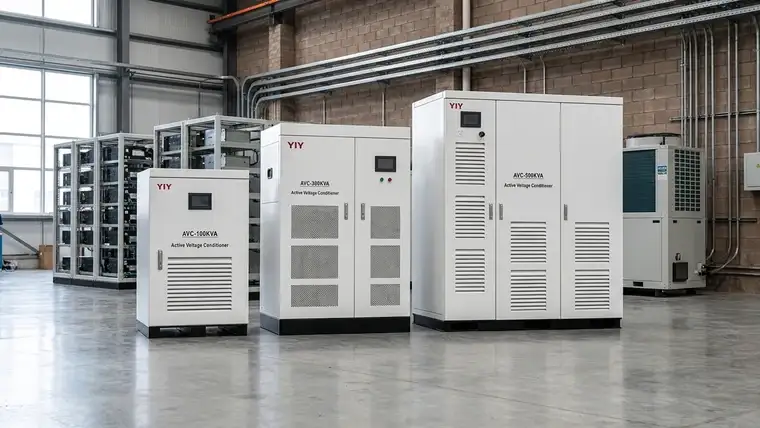
For sensitive industrial equipment, the stronger specification usually points toward servo correction. For lighting, simple HVAC, pumps, and low-risk commercial circuits, relay tap-switching can still be practical. For highly sensitive or wear-intolerant applications, static or IGBT technology may deserve a closer look.
Start with a quick-fit review before collecting detailed logs. Share your load type, approximate kW or kVA, phase type, site voltage range, and the equipment you need to protect, and YIY can help you confirm the most suitable topology for your load profile.
About YIY
Zhejiang Yiyen Holding Group Co., Ltd. (YIY) is a professional voltage stabilizer manufacturer with 16+ years of experience. With a 30,000sqm modern facility and an annual production capacity of 1,000,000+ units, YIY products are exported to 130+ countries. YIY provides OEM/ODM customization services and ISO 9001:2015 certified manufacturing support for stable voltage protection solutions.
Contact Us
Email: yiyen@yiyen.com
Phone/WhatsApp: +86 13587452904
Website: https://www.yiyavr.com/