To vet industrial voltage stabilizer manufacturers, ask for proof before price: factory identity, test records, certificate scope, design ownership, and an engineering review of your load and voltage data. A supplier that can’t produce these is a reseller, whatever its catalog says.
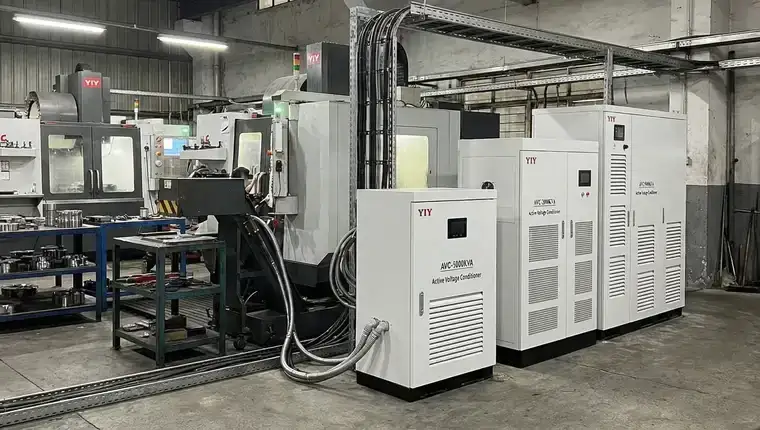
That difference shows up later on CNC lines, telecom shelters, and automation panels as commissioning risk, downtime, and weak after-sales support.
This guide gives the checks in order. To apply them to real supplier groups, use the shortlist of top voltage stabilizer manufacturers.
Why Manufacturer Selection Affects Project Risk
Voltage stabilizers exist to keep output voltage stable when the utility side is not. In industrial environments, that is not a minor convenience. Brownouts, voltage swings, and unstable supply can reduce equipment life, increase defects, trigger nuisance shutdowns, and make troubleshooting more expensive than it should be.
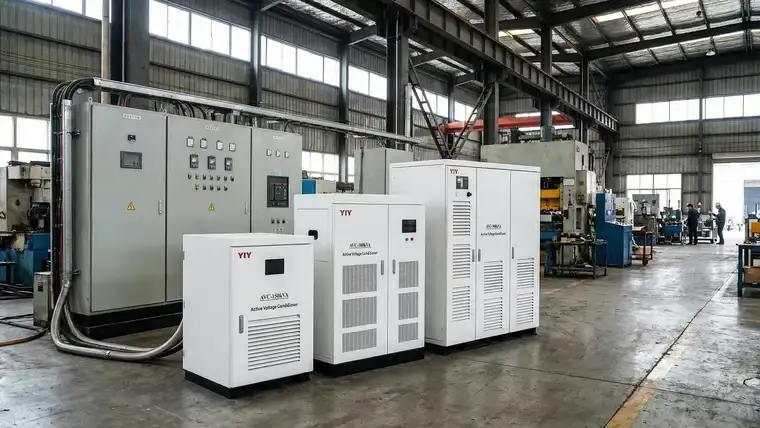
A qualified manufacturer should therefore be able to do more than quote a kVA number. They should explain:
- which technology fits the load profile
- what input range the unit is designed to handle
- how accuracy and response time affect the application
- what protections are included
- how the product will be tested before shipment
Key point: a supplier without application review often becomes a sourcing risk, even when the initial quotation looks attractive.
That matters because industrial buyers are rarely purchasing a generic household AVR. They are evaluating equipment that may need to support three-phase systems, harsh site conditions, motor starting current, unbalanced loads, bypass requirements, export documentation, and local compliance expectations.
What Separates a Manufacturer from a Reseller
When you compare industrial voltage stabilizer manufacturers, the first screen should be factory capability. A serious manufacturer can usually document production scope, test flow, engineering support, and quality systems in a way that resellers cannot.
Use the checklist below early in the RFQ process.
| Checkpoint | What to verify | Why it matters |
|---|---|---|
| Technology coverage | Servo, relay, and IGBT options or a clear specialization | Helps match product design to application instead of forcing one solution |
| Capacity range | Real product coverage by single-phase and three-phase models | Confirms the supplier can support future expansion and larger projects |
| Input/output spec clarity | Voltage range, precision, response time, overload limits, THD where relevant | Prevents quotation comparisons that mix unlike specifications |
| Testing process | Incoming inspection, load testing, burn-in, final inspection, records | Reduces the risk of field failures and shipment inconsistency |
| Compliance readiness | ISO systems, CE or market-specific documentation, relevant standards references | Important for procurement approval and export projects |
| Engineering review | Load calculation support, sizing guidance, wiring and bypass recommendations | Lowers the chance of mis-specified models |
| Service model | Spare parts, troubleshooting support, OEM/ODM capability, lead time discipline | Matters long after PO placement |
If a supplier cannot explain how it verifies performance under real load conditions, you should treat the quotation carefully. Industrial loads are rarely forgiving, especially when voltage fluctuations interact with motors, PLCs, medical devices, or line-side equipment.
For example, servo designs are typically favored for industrial applications because they balance precision, reliability, and cost well. IGBT-based designs can be the better fit for applications that demand tighter correction speed or power quality. A manufacturer that understands the tradeoff can guide you toward the right topology instead of pushing a single catalog item.
That is one reason a page on servo vs. IGBT technology is useful during qualification: it helps buyers see whether the vendor can discuss engineering tradeoffs with confidence.
Factory Capability, Testing, and Compliance Checkpoints
Ask for evidence of both product quality and document quality. These are the factory checks to request before you negotiate price:
| Check | Why it matters | If you skip it |
|---|---|---|
| Incoming component inspection | Confirms breakers, meters, boards, relays, and cabinet parts match the BOM | Inconsistent batches or substituted parts |
| Transformer quality | Winding, insulation, varnishing, temperature rise, and terminals drive reliability | Heat, noise, and insulation stress shorten service life |
| Servo motor and brush access | Wear parts need spares and clear maintenance access | Avoidable shutdowns for your crew |
| Control board and protection logic | Firmware, thresholds, alarms, and display accuracy affect operation | Faults are hard to diagnose after installation |
| Final functional test | Confirms output accuracy, bypass, overload response, and protections | A unit passes visual inspection but fails under load |
| Aging or sustained run test | Exposes heat, wiring, and unstable-control problems | Early failure risk moves from the factory to your site |
| Export packaging and documents | Confirms labels, case strength, manuals, and shipping paperwork | Clearance delays or transit damage |
A capable manufacturer should also walk you through sizing: total load, margin for motor starts, duty cycle, and transient behavior. If it can’t, the risk moves to your side of the table.
Remember: specifications must match actual operating conditions, not nominal ratings.
Compliance proof also needs to be practical. Buyers should look for evidence such as ISO 9001:2015 process control, ISO 14001 environmental management, CE documentation for relevant markets, and familiarity with standards references such as IEC 60038 or EMC-related requirements.
That does not mean every project needs the same paperwork, but it does mean the manufacturer should know what the target market expects.
For YIY specifically, the documented company profile strengthens this part of the conversation. The group has specialized in voltage stabilization since 2008 and reports a 30,000 square meter facility, annual production capacity above 1,000,000 units, exports to 130+ countries, and ISO-certified manufacturing systems. Whether you eventually buy from YIY or not, this is the level of evidence procurement teams should expect from any serious supplier shortlist.
How to Compare Quotations Without Falling for the Lowest Number
Low quotations often look competitive because one or more assumptions are hidden. The most common examples are narrow input range, lower correction accuracy, weaker overload capability, unclear bypass design, limited documentation, or post-sale support that becomes slow once the shipment has left port.
To compare quotations properly, normalize the evaluation around six items:
- input voltage range
- output accuracy
- response time
- load type and starting current
- protections and alarms
- support terms and documentation
If one supplier quotes based on a narrower input range and another quotes on a wider industrial range, those offers are not equivalent. If one supplier supports engineering review for a mixed load including motors, automation, and electronics, while another only quotes from a catalog, those offers are not equivalent either.
Data-driven decisions outperform assumption-based choices.
This is where internal technical content helps procurement. A guide on voltage stabilizer selection is valuable because it turns the quotation review into a structured review of range, margin, and application fit instead of a spreadsheet of prices alone.
You should also compare technology fit directly:
- Servo stabilizers are often the strongest general choice for industrial environments that need solid precision and robust cost-performance balance.
- Relay stabilizers may fit lighter-duty or cost-sensitive scenarios, but they are not always the best choice for demanding industrial loads.
- IGBT stabilizers can justify higher investment where precision, speed, or power conditioning requirements are stricter.
If the manufacturer can explain where each technology should and should not be used, that is a positive buying signal. If every application receives the same answer, qualification is incomplete.
What Factory Proof and RFQ Data Should Your Request Include?
Your RFQ should ask for evidence that the supplier controls design review, production, testing, documentation and support. It is the fastest way to separate a manufacturing source from a quotation-only intermediary. You do not need every factory detail, but you do need enough proof to confirm that the supplier can diagnose and correct a technical issue itself.
| Check | Why it matters | If you skip it |
|---|---|---|
| Factory identity | Confirms whether you are buying from a real manufacturing source | You may approve a supplier that cannot solve production or field issues |
| Engineering input form | Forces the supplier to review kVA/kW, power factor, startup current, voltage range, phase, and environment | Your unit may be sized from nominal load rather than actual operating demand |
| FAT document | Shows what will be tested before shipment | Hidden defects may appear only during commissioning |
| Wiring drawings | Helps your installer plan connections, bypass, protection, and maintenance access | Installation errors and handover delays become more likely |
| Spare-parts plan | Confirms availability of boards, contactors, motors, brushes, meters, or protection parts | A small failure can create long downtime |
| OEM/ODM workflow | Shows how custom voltage ranges, branding, manuals, sample approval, and repeat orders are controlled | Batches drift or fail distributor requirements |
| Service response | Defines who supports troubleshooting, warranty review, and replacement parts | Your maintenance team may be left without a clear escalation route |
| Packaging and export files | Protects shipment, import, and receiving inspection | Damage, missing documents, or customs delays can disrupt the project schedule |
Include the operating environment in the request as well. Dust, humidity, ambient heat, poor ventilation, generator input, outdoor exposure and unstable utility supply can all change the correct design: a cabinet that suits a clean indoor electrical room may not suit a dusty production area or a humid coastal site.
Compliance Documents Matched to Your Market
Verify certificate scope, validity and product relevance, not only the certificate name. Check that the ISO 9001:2015 scope covers stabilizer design, manufacturing or service. For electromagnetic compatibility, ask which IEC 61000 tests or declarations apply to the quoted system; IEC 61000 is a family of standards, so the supplier should state the exact reference. For OEM resale or regulated markets, agree the document set up front: certificate copies, declarations, labels, manuals, wiring diagrams, packing details, serial-number traceability and test reports.
RFQ Data to Send Before Final Pricing
Send measured voltage data, load details, operating environment, target market and required documentation before you ask for a final quotation. It lets the manufacturer size the stabilizer correctly and keeps quote comparisons on the same basis.
| RFQ input | What to provide | What it means for your selection |
|---|---|---|
| Nominal voltage | 220V, 230V, 380V, 400V, 415V, or other system voltage | The supplier can select the correct transformer and control design |
| Measured input range | Lowest and highest measured voltage, plus time pattern if available | The stabilizer is sized for real fluctuation, not assumed utility conditions |
| Phase and frequency | Single-phase or three-phase, 50Hz or 60Hz | The quotation matches your electrical system and target market |
| Load size | Total kVA/kW, load list, duty cycle | Capacity is based on your actual connected and running load |
| Power factor | Measured or estimated power factor | kW and kVA are not treated as the same thing |
| Startup current | Motor, compressor, pump, lift, welding, or other inrush behavior | The supplier can add safety margin for starting events |
| Load sensitivity | Motors, PLCs, CNC, medical, telecom, lab, IT, mixed loads | Technology choice can shift between servo and static IGBT |
| Environment | Temperature, humidity, dust, ventilation, indoor/outdoor location | Cabinet, cooling, IP level, filters, and derating can be reviewed |
| Protection needs | Bypass, overload, surge, over/under-voltage, phase loss, alarms | Your maintenance and safety requirements are built into the quote |
| Documentation | Certificates, FAT, drawings, manuals, packing, OEM label requirements | Your purchase, import, and installation files stay aligned |
| Commercial terms | Quantity, packaging, delivery window | Production planning and export packing match your schedule |
Ask the supplier to confirm fit, proof, and support in writing, so procurement, engineering, installation, and warranty teams work from the same facts. If the running load sits close to rated capacity, motors start often, or input drops deeply, the margin discussion matters most.
How Do You Confirm Engineering Ownership and OEM/ODM Support?
A complete-looking quote can still come from a supplier that doesn’t control the design. Before approval, confirm three things:
- Design documents: winding schematics, temperature-rise reports, control-board and firmware revision records, and copper and core-steel traceability. A real factory can explain these quickly.
- Fixed components: write the windings, cooling, servo motor, brushes, and driver into the BOM so they can’t change between sample and batch, and confirm warranty and stock for wear parts.
- OEM/ODM and after-sales: check whether input range, thresholds, alarms, and enclosure can be adapted for your market, and ask for the service escalation route and spare-parts stocking.
Why YIY Can Be a Practical Fit for Industrial RFQs
YIY’s profile against these checks:
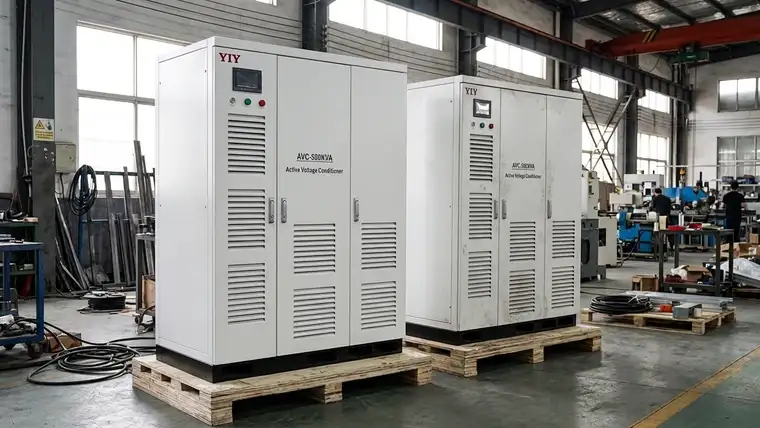
- specialized in voltage stabilization since 2008
- a 30,000 square meter manufacturing base
- annual production capacity above 1,000,000 units
- exports to 130+ countries
- OEM/ODM support
- documented ISO 9001:2015, ISO 14001, and CE-related credentials
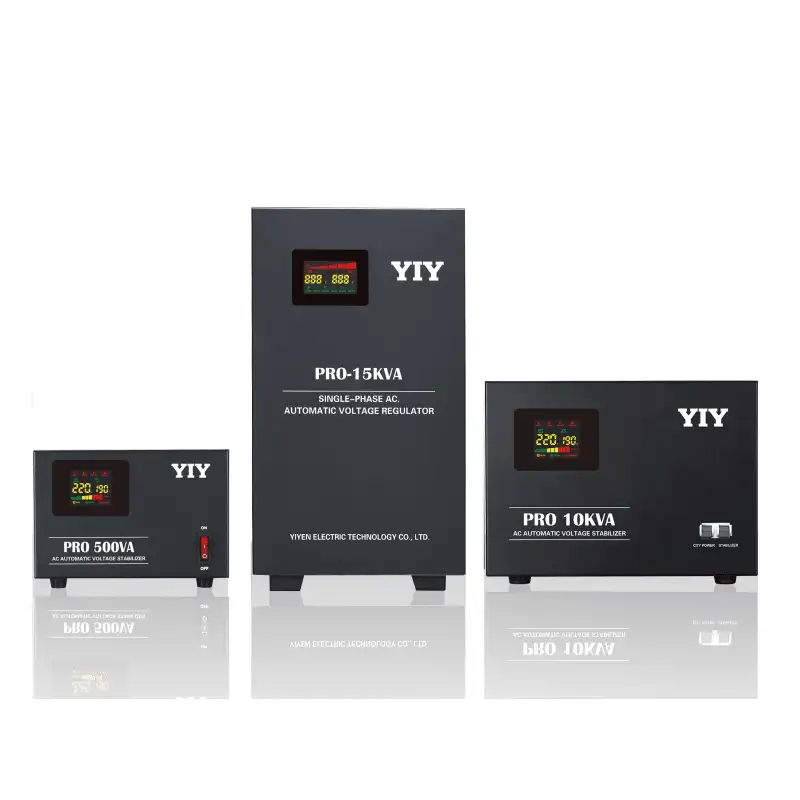
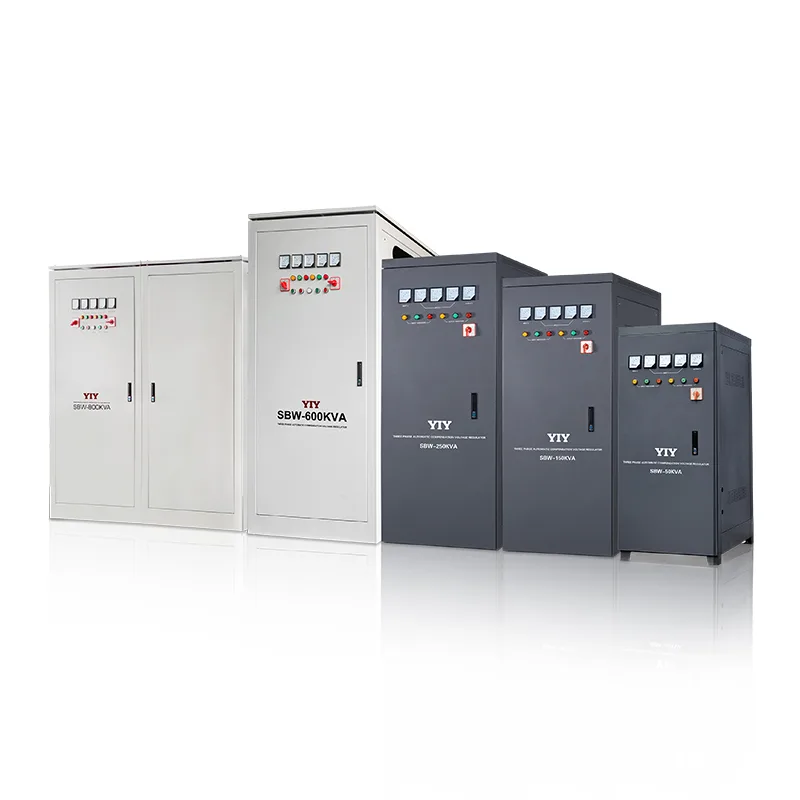
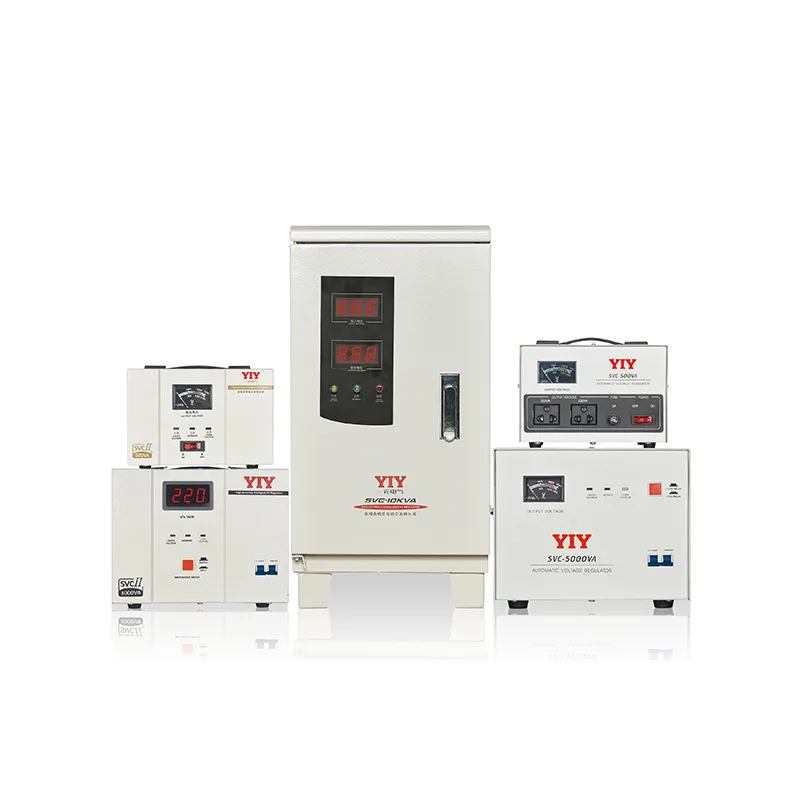
- product coverage from 0.5KVA to 3000KVA across multiple technologies
For India-specific sourcing, see the servo stabilizer India sourcing checks.
Frequently Asked Questions
When Do You Need a Manufacturer Instead of a Reseller?
When the load is industrial, motor-heavy, custom, or export-bound. A reseller can handle a stock replacement; projects need someone accountable for drawings, final testing, and warranty diagnosis. Check the manufacturer name on test reports, certificates, nameplates, and shipping documents.
Can a Stabilizer Supplier Support OEM or ODM Requirements?
Only with in-house engineering, production, labeling, testing, and documentation. Ask for a sample customized datasheet, wiring diagram, nameplate layout, packing spec, and its OEM/ODM workflow.
Can One Manufacturer Cover Servo, Relay, Static, and OEM Projects?
Yes, if it runs several technology lines and a real engineering review. Otherwise your project may be pushed toward the one topology it sells rather than the one your load needs.
What Proof Should You Get Before Shipment?
Factory test reports, inspection records, packaging controls, and photo or video verification if needed. International buyers should also confirm documentation lead time and escalation contacts.
What If the Quotation Doesn’t Support a Buying Decision?
Ask for the full datasheet, quoted input range, output accuracy, overload capacity, protection list, wiring diagram, test protocol, and warranty scope, and have the supplier mark its assumptions in a revised quote.
Final Thoughts
Choosing among industrial voltage stabilizer manufacturers is a supplier-qualification exercise first and a price negotiation second. Buyers who compare only catalog numbers often miss the variables that drive real project outcome: application fit, technology choice, test discipline, compliance readiness, and support quality.
Build a short checklist, normalize quotations, challenge sizing and input-range assumptions, and work only with suppliers that can explain why a model fits.
To have YIY review an industrial RFQ, send the load profile, voltage range, target market, and compliance requirements. For private-label production planning, see the OEM and private-label program.