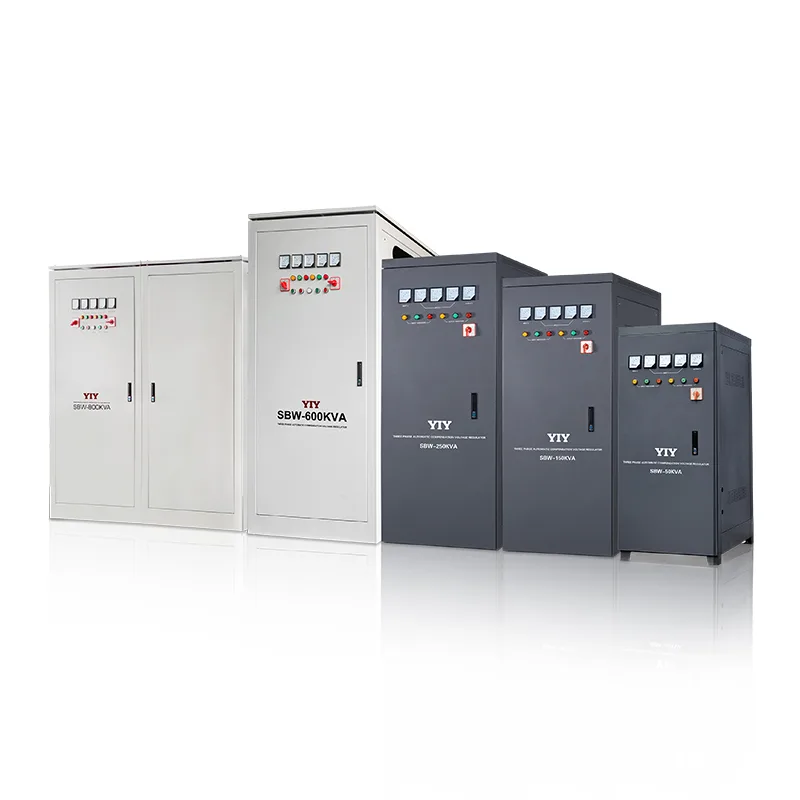
A voltage stabilizer industrial specification sheet should state seven lines: rated kVA, phase and line voltage, measured input window, output accuracy, protection set points, overload device, and enclosure rating. Below: what each line means, then sizing, standards, and YIY options.
What Should an Industrial Stabilizer Specification Sheet Include?
If a quote leaves out any of the seven lines below, it isn’t a specification yet. The examples come from YIY’s published SVC-3 three-phase servo datasheet, so you can see what a complete line looks like.
| Spec line | Example (SVC-3, 15 kVA) | Why it matters to you |
|---|---|---|
| Rated capacity | 15 kVA (12,000 W) | The kVA vs. W gap tells you the assumed power factor |
| Phase / wiring | 3-phase 4-wire (3-wire optional) | Must match your panel and neutral arrangement |
| Input window | 278–433 V | Compare it with your logged minimum and maximum, not nominal |
| Output accuracy | 380 V ±3%, or customized | 415 V or 400 V output has to be written into the order |
| Protection set points | Low 318 V ±7 V, high 426 V ±7 V, 3–6 s delay | Shows when the unit cuts off instead of passing bad power |
| Overload / short circuit | MCB / MCCB | Coordinate it with your upstream breaker |
| Enclosure | State the IP code per IEC 60529 | Dust and humidity decide service life more than kVA does |
For three-phase lines, compare the sheet against the industrial three-phase stabilizer range, and run the three-phase servo stabilizer sizing checks before you sign.
What an Industrial Voltage Stabilizer Does and Why It Matters
An industrial voltage stabilizer—also called an automatic voltage regulator (AVR)—is an electrical device that automatically maintains a constant output voltage regardless of fluctuations in the input supply. Unlike residential stabilizers designed for single appliances, industrial units protect entire production lines, critical infrastructure, and high-value equipment operating under demanding conditions.
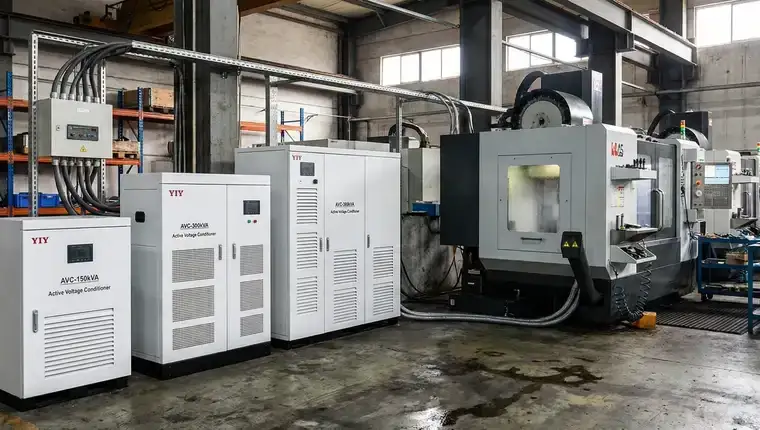
Utility grids in many regions deliver power with significant variation. Voltage sag (brownouts), voltage surge (spikes), and continuous fluctuation are common, particularly in developing industrial zones, rural grid-connected facilities, and regions with aging power infrastructure. The consequences for unprotected industrial operations are measurable:
- CNC machines lose positioning accuracy, producing out-of-spec parts
- Injection molding equipment generates defective products during voltage dips
- Semiconductor fabrication suffers yield losses from micro-voltage variations
- Medical imaging systems produce distorted results, requiring repeat procedures
Key point: Preventive voltage protection costs a fraction of reactive repair and production loss.
The three core technologies used in industrial voltage stabilizers—servo, relay, and IGBT—each address different combinations of precision, response speed, and capacity requirements. Choosing the wrong technology is one of the most expensive mistakes an engineering team can make.
Who Needs an Industrial Voltage Stabilizer and What Decisions They Face
Procurement teams, plant engineers, facility managers, and technical buyers evaluating voltage-stabilization decisions typically face a specific set of questions:
1. What technology type fits our application? Servo stabilizers offer the best balance of precision and reliability for most industrial use. Relay types suit cost-sensitive, lower-capacity applications. IGBT provides ultra-high precision for mission-critical processes.
2. What capacity do we actually need? Undersizing is the single most common procurement mistake. A 20% to 30% safety margin above total connected load is the minimum engineering standard.
3. What input voltage range must the stabilizer handle? Site conditions vary dramatically—a factory in a stable urban grid faces different requirements than one on a rural distribution network.
4. What environmental factors affect selection? Temperature, humidity, altitude, dust, and salt spray all influence sizing, enclosure rating, and technology choice.
The industrial voltage stabilizer market includes manufacturers ranging from single-product vendors to full-spectrum suppliers. industrial voltage stabilizer manufacturers vary significantly in technology range, capacity coverage, and certification portfolios. Evaluating these differences before requesting quotes prevents costly mismatches downstream.
Selection Criteria and Sizing Considerations
Effective industrial voltage stabilizer selection follows a structured evaluation against five parameters: load, voltage conditions, application type, environment, and feature requirements.
Step 1: Calculate Required Capacity
List all equipment the stabilizer will protect. Sum their wattage or VA ratings. Apply a 20–30% safety margin.
Formula: Required capacity = Total load × 1.2 to 1.3
Example:
- CNC machine: 15 kW
- Lighting and auxiliary: 5 kW
- Total: 20 kW × 1.25 = 25 kVA → select a 30 kVA model
Single-phase equipment (220V/230V/240V, 2 wires) requires a single-phase stabilizer. Three-phase equipment (380V/400V/415V/480V, 3 or 4 wires) requires a three-phase unit. Mixing these is a critical error that no specification should overlook. When you compare 20 kVA three-phase stabilizer type selection, the selection process starts with confirming actual load measurements.
Step 2: Assess Voltage Conditions
Use a multimeter over 24–48 hours to record minimum voltage, maximum voltage, and fluctuation frequency at the installation point. This measurement determines which technology class is appropriate:
| Voltage Condition | Recommended Technology |
|---|---|
| Mild fluctuation (±10%) | Relay (cost-effective) |
| Moderate fluctuation (±15%) | Servo (reliable, wide-range) |
| Severe fluctuation (±20%+) | Servo wide-range or IGBT |
| Frequency instability | IGBT CVCF (voltage + frequency) |
Specifications must match actual operating conditions, not nominal ratings. A stabilizer rated for ±10% input variation will not protect equipment on a line experiencing ±18% swings.
Step 3: Technology Comparison
| Feature | Servo | Relay | IGBT |
|---|---|---|---|
| Output precision | ±0.5% to ±3% | ±5% to ±8% | ±0.5% |
| Response time | 1–2 seconds | <60 ms | <10 ms |
| Input range | 80V–280V (widest) | 145V–270V | 85V–270V |
| Efficiency | 95–98% | 90–95% | 95–97% |
| Capacity range | 500 VA–3,000 KVA | 500 VA–20,000 VA | 5 KVA–3,600 KVA |
| Frequency control | No | No | Yes (CVCF models) |
| Maintenance | Carbon brush every 3–5 years | Maintenance-free | Maintenance-free |
| Lifespan | 10–15 years | 8–10 years | 15+ years |
| Cost | Medium | Low | High |
For most industrial applications—factories, manufacturing plants, hospitals—servo technology delivers the best combination of precision, reliability, wide input range, and lifecycle value. IGBT is the correct choice when voltage accuracy within ±0.5% is a hard requirement, or when frequency stabilization and harmonic filtering are needed.
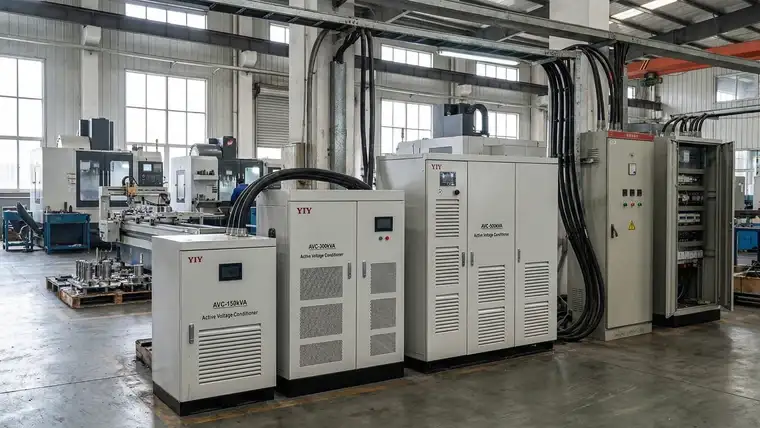
Reliability is the lowest-cost option in the long run. Selecting a lower-spec unit to save on initial price typically increases total cost of ownership through equipment damage, production loss, and premature replacement.
Step 4: Environmental Factors
| Environmental Factor | Impact on Selection |
|---|---|
| Temperature >40°C | Derate capacity or specify industrial-grade cooling |
| High humidity | Tropical design with enhanced insulation |
| Dust or sand exposure | Enclosed design with additional filtration |
| Outdoor installation | IP-rated enclosure with weather protection |
| Altitude >1,000 m | Derate capacity per manufacturer specifications |
| Coastal / salt spray | Corrosion-resistant coatings and materials |
Environment matters as much as specification. A stabilizer correctly sized for load but improperly rated for site conditions will underperform and fail prematurely.
Step 5: Phase Balance, Wiring, and Bypass
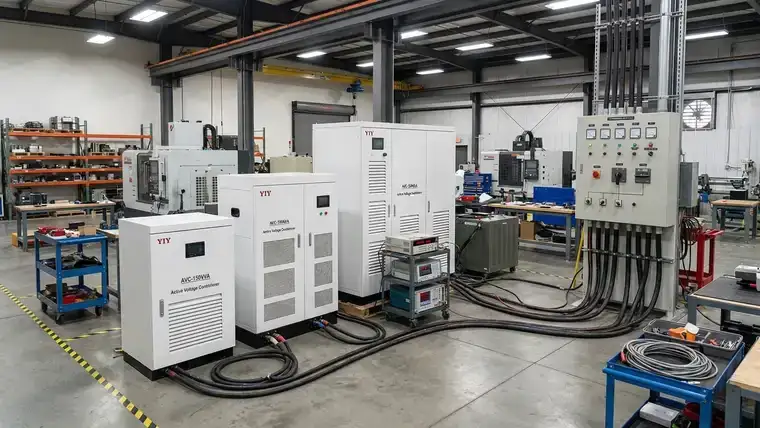
On a three-phase line, one three-phase stabilizer corrects all legs in a coordinated way. A bank of separate single-phase units adds wiring and footprint and still leaves the phase-to-phase balance uncorrected. Ask whether each phase is regulated independently or from a common control, since independent control handles unbalanced single-phase loads better.
Size the neutral for the return current of unbalanced single-phase machinery, as your local wiring code requires, and re-torque the terminals after the first thermal cycles. Choose a manual maintenance bypass for loads that can accept a planned stop, and an automatic static bypass for continuous processes that cannot ride through an interruption.
For the RFQ, attach a load list with power factors, the starting-current profile of motor loads, a multi-day site voltage log, and the installation footprint with service clearances.
Standards, Compliance, and Proof Points
Industrial voltage stabilizers must comply with international standards that define performance, safety, and electromagnetic compatibility requirements. Understanding which standards apply to your market and application is essential for specification writing and vendor evaluation.
Key Standards
- IEC 60038 defines standard voltages for AC and DC systems globally. This standard establishes the nominal voltage references (e.g., 230V single-phase, 400V three-phase) that stabilizers are designed to maintain.
- IEC 61000 series (Electromagnetic Compatibility) governs harmonic emissions (IEC 61000-3-2) and power quality measurement (IEC 61000-4-30). Industrial stabilizers must not introduce excessive harmonics into the supply network. IGBT-based stabilizers with THD (Total Harmonic Distortion) below 3% meet the strictest requirements in this category.
- ISO 9001:2015 ensures the manufacturer’s quality management system meets international standards for design, production, and service consistency. For procurement teams sourcing from international suppliers, ISO 9001:2015 certification is a non-negotiable baseline qualification.
Certification Requirements by Market
| Market | Required Certifications |
|---|---|
| European Union | CE marking |
| North America | UL, CSA, FCC |
| International | ISO 9001:2015, RoHS |
When evaluating vendors, request documentation for all applicable certifications. A manufacturer holding CE, UL, CSA, and ISO 9001:2015 certifications demonstrates compliance across the widest range of international requirements.
Data-driven decisions outperform assumption-based choices. Always verify claimed specifications against independent certification documentation, not marketing materials alone.
YIY Industrial Voltage Stabilizer Capabilities
Zhejiang Yiyen Holding Group (YIY) is a professional voltage stabilizer manufacturer founded in 2008. The company’s product portfolio covers all three core technologies—servo, relay, and IGBT—across a capacity range from 500 VA to 3,000 KVA.
Product Lines for Industrial Applications
| Application | Recommended Series | Technology | Capacity |
|---|---|---|---|
| Small workshop | SVC, PWR | Servo | 5–30 KVA |
| Factory / manufacturing plant | SBW, PWR | Servo | 30–3,000 KVA |
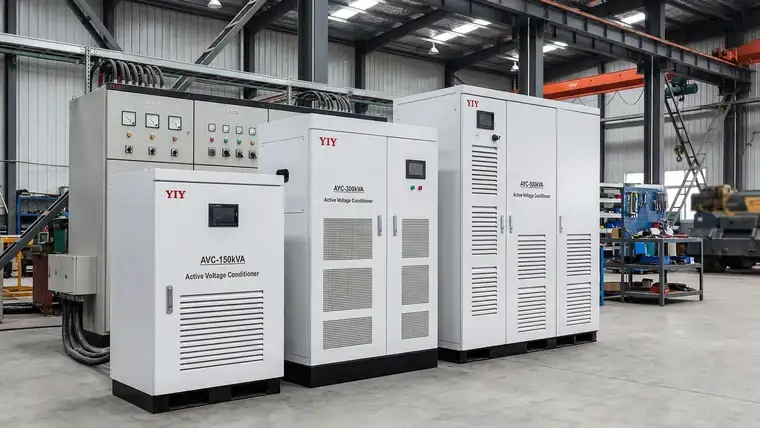
| Data center | AVC | IGBT | 50–3,600 KVA |
| Semiconductor fabrication | AVC, CVCF | IGBT | 50–3,600 KVA |
| Telecom infrastructure | SVC, YSVP | Servo / Smart | 5–30 KVA |
For buyers comparing capacity options, the 20kva voltage regulator guide provides detailed specifications for mid-range industrial applications, while voltage stabilizer 20kva price analysis helps procurement teams benchmark pricing. Smaller installations may benefit from reviewing the voltage stabilizer 3 kva sizing guide for auxiliary equipment protection.
Manufacturing and Quality
- Facility: 30,000 m² modern manufacturing campus
- Annual production capacity: 1,000,000+ units
- R&D team: 50+ engineers, 100+ patents
- Export coverage: 130+ countries, 120+ long-term distribution partners
- Quality system: ISO 9001:2015, with 99.5%+ factory pass rate
- Certifications: CE, FCC, RoHS
- Customization: Full OEM/ODM services for voltage, capacity, and enclosure specifications
Frequently Asked Questions
What Should Buyers Evaluate Before Choosing a Voltage Stabilizer for Industrial Use?
Five parameters determine the correct specification: total connected load (with 20–30% safety margin), measured input voltage range at the installation site, required output precision, environmental conditions (temperature, humidity, altitude), and applicable compliance standards for your market.
When Is an Industrial Voltage Stabilizer Necessary?
Whenever grid voltage fluctuations exceed the tolerance of connected equipment—typically beyond ±5% for sensitive industrial processes. Facilities experiencing frequent brownouts, voltage spikes, or supply instability in developing grid infrastructure should treat stabilization as mandatory rather than optional. Industries with high exposure include automotive manufacturing, CNC machining, pharmaceutical production, food processing, and any operation where even brief power quality events cause measurable losses in product quality or machine uptime.
How Should an Industrial Voltage Stabilizer Be Sized or Specified?
Start with actual load measurements, not nameplate ratings. Record input voltage over 24–48 hours to capture real fluctuation patterns. Apply a minimum 20% capacity margin. Match technology type (servo, relay, or IGBT) to application precision requirements. Specify environmental ratings for the installation site—ambient temperature, humidity, dust levels, and altitude all affect performance and longevity. For three-phase industrial installations, ensure phase balance is within specification to prevent asymmetric loading that degrades stabilizer performance.
Next Steps
Selecting the right industrial voltage stabilizer is a technical decision that directly impacts equipment reliability, production quality, and operational cost. Measurement before selection prevents costly mistakes—invest the time to document actual site conditions before engaging vendors.
The cost of professional consultation is minimal compared to the cost of choosing the wrong specification. For facilities requiring customized capacity, voltage range, or enclosure specifications, direct consultation with an experienced engineering team ensures the specification matches the application from day one.