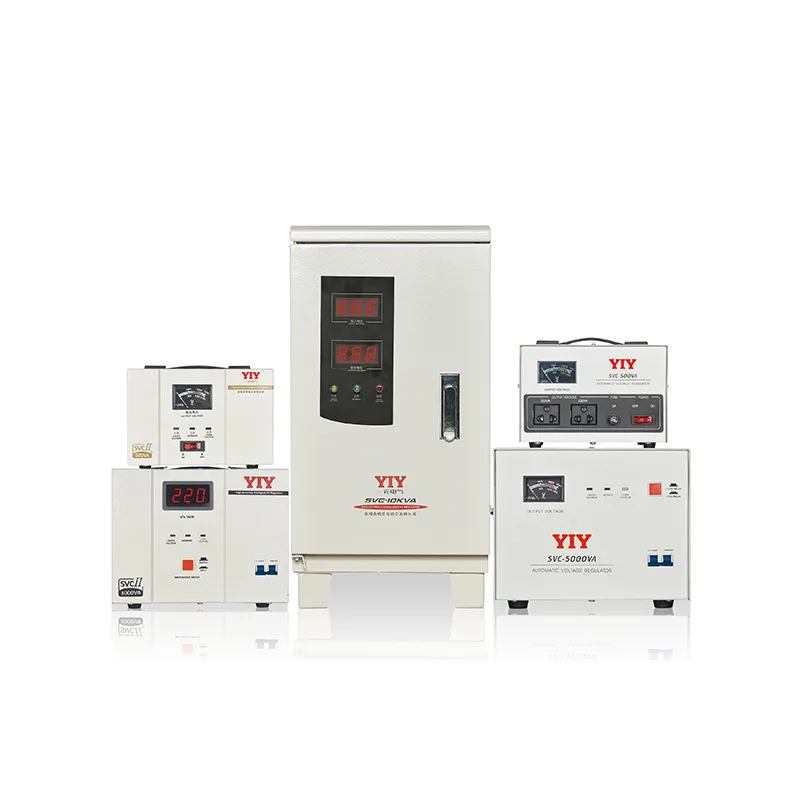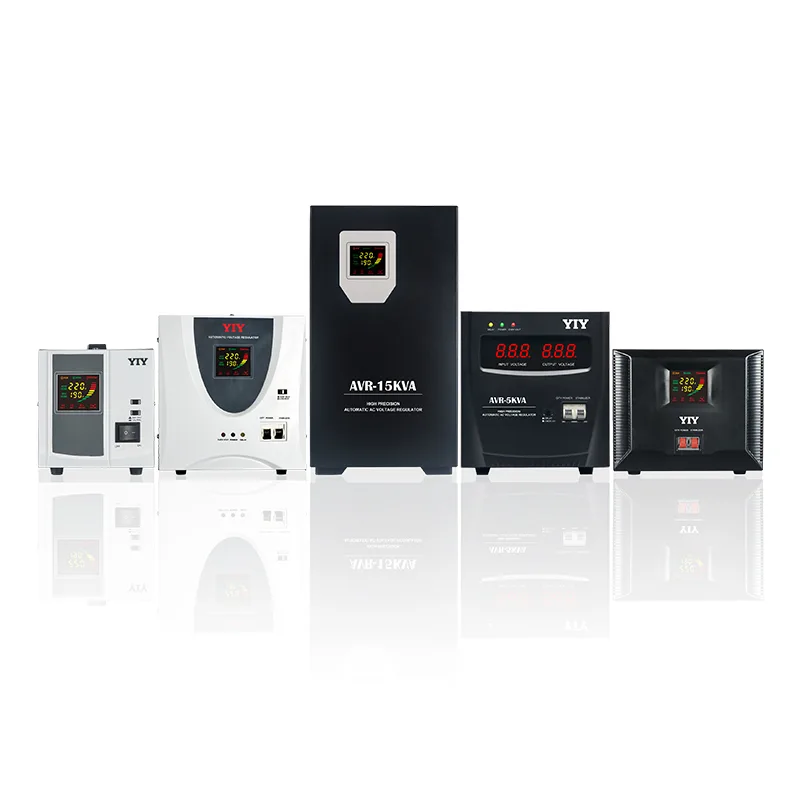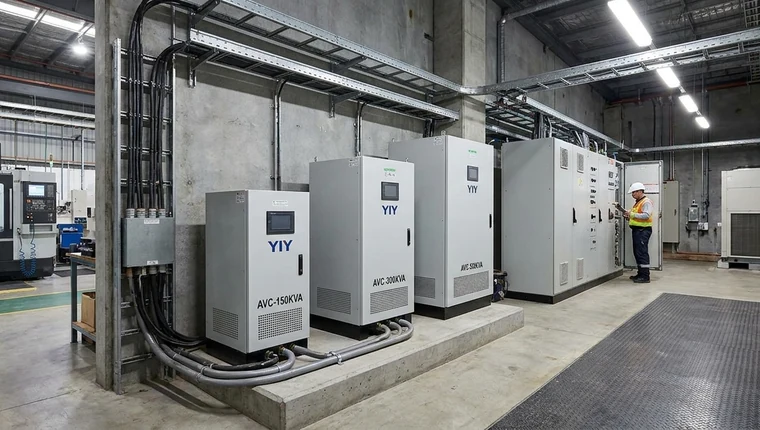
Servo stabilizer vs relay stabilizer is mainly a load-sensitivity decision: choose servo when your industrial or sensitive commercial equipment needs tighter, smoother voltage control, and choose relay when your load is non-critical, budget-led, and able to tolerate wider output variation.
A typical servo unit targets about ±0.5% to ±3% output accuracy, while many relay AVRs sit around ±5% to ±8% because they correct voltage in steps.
This guide walks you through the operating principle, precision tradeoffs, application fit, sizing checks, procurement documents, and final questions you should answer before approving an RFQ.
Why Does the Servo-or-Relay Choice Affect Your Downtime Risk?
Your stabilizer topology affects how much voltage movement your equipment actually sees after correction. If your procurement review only compares kVA, input range, and price, you may miss the factor that matters most: whether your connected load can tolerate stepped voltage correction without nuisance trips, control faults, calibration drift, or overheating.
Nominal voltage standards are useful, but they are not a substitute for site data. The official IEC 60038 standard voltages page defines recognized voltage references for electrical systems; for you, that means your RFQ should use consistent nominal voltage language, while your final selection should still be based on measured voltage at the machine terminals.
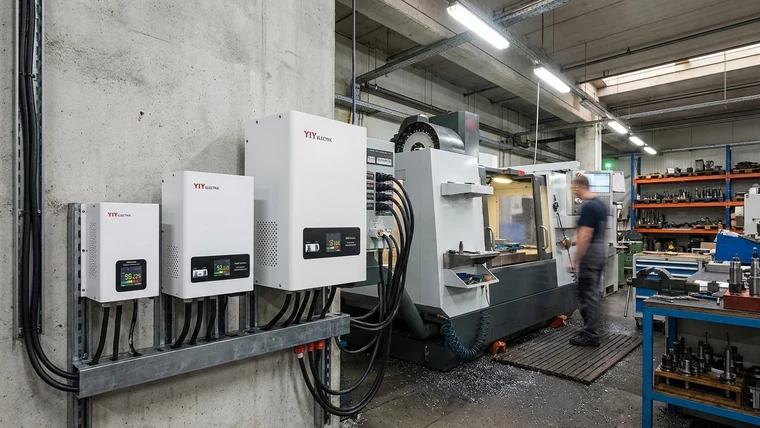
For most industrial buyers, the choice is not “which stabilizer is best?” but “which correction method matches my load consequence?” A relay stabilizer can be economical for lighting, basic appliances, or small non-critical commercial loads. A servo voltage stabilizer is usually the stronger starting point when your load includes CNC machines, production controls, telecom rectifiers, medical equipment, lab instruments, or chronic low-voltage conditions.
| Decision point | Servo stabilizer | Relay stabilizer | What it means for you |
|---|---|---|---|
| Correction method | Continuous motor-driven adjustment | Discrete tap switching | Servo gives smoother output; relay corrects in jumps. |
| Typical output accuracy | About ±0.5% to ±3% | About ±5% to ±8% | Servo keeps sensitive equipment closer to target voltage. |
| Response behavior | Smooth correction, often around 1-2 seconds depending on model and voltage deviation | Fast switching, but step-based | Relay may react quickly but still expose your load to voltage steps. |
| Cost position | Higher than relay in many cases | Lower upfront cost | Relay can save capex where load consequence is low. |
| Best fit | Industrial, medical, telecom, CNC, mixed sensitive loads | Residential, basic commercial, non-critical loads | Your downtime cost should drive the decision. |
A ±0.5% to ±3% specification means output voltage stays much closer to target during drift. In practical terms, your controllers, drives, instruments, and power supplies face less electrical stress.
A ±5% to ±8% relay range can still be acceptable where the load is rugged and interruption is not expensive. For sensitive loads, that wider window can become a maintenance and uptime risk rather than a harmless number on a datasheet.
How Do Servo and Relay Stabilizers Correct Voltage?
Servo stabilizers correct voltage continuously, while relay stabilizers correct voltage by switching fixed transformer taps. That difference determines whether your equipment sees a smooth correction curve or a series of voltage steps.
Servo Correction: Motor, Carbon Brush, and Autotransformer
Your servo stabilizer monitors input voltage through a control circuit or MCU, compares it with the target output, and drives a servo motor to move a carbon brush across an autotransformer. As the brush position changes, the transformer turns ratio changes continuously, which lets the stabilizer raise or lower output voltage smoothly.

That smooth movement is why servo designs are widely used for industrial loads with sustained voltage drift. If your supply commonly sits below or above nominal voltage for long periods, servo correction can keep downstream equipment closer to its preferred operating window.
The practical tradeoff is maintenance. Because a servo unit includes moving parts and a carbon brush, your maintenance plan should include brush inspection, autotransformer surface checks, ventilation checks, and access for service.
Relay Correction: Electromagnetic Tap Switching
Your relay AVR uses electromagnetic relays to select transformer taps. When input voltage falls, the relay selects a boost tap; when input voltage rises, it selects a lower tap. This is simple, fast, and cost-effective, but the output changes in fixed increments.
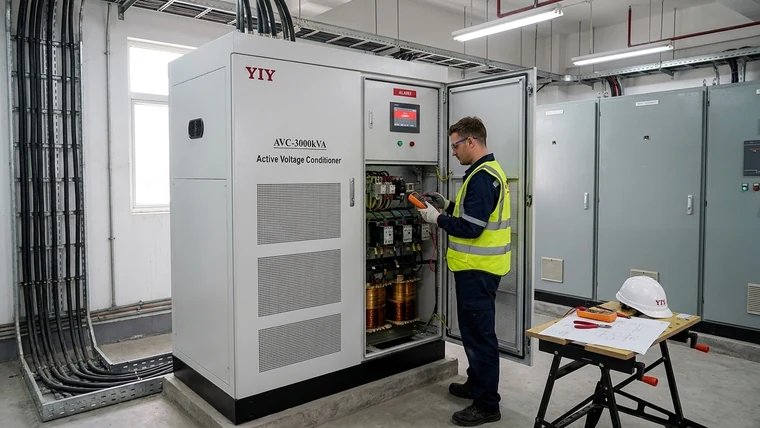
That is why relay units often show wider output variation. Your equipment may still be protected from broad undervoltage or overvoltage, but it receives correction as steps rather than a smooth adjustment.
The practical tradeoff is switching wear. Relay contacts can degrade with frequent operation, especially on unstable grids, generator-backed supplies, dusty panels, or applications with repeated voltage movement. Before you approve a relay model, ask how the contact design handles arcing, heat, dust ingress, and repeated switching cycles.
Which Performance Tradeoffs Matter Most in Real Operation?
You should judge performance by output precision, correction behavior, maintenance access, and load consequence rather than response speed alone. A fast relay action is not automatically safer if your equipment dislikes voltage steps, and a servo unit is not automatically better if your load is basic and tolerant.
| Factor | Servo stabilizer | Relay stabilizer | Practical impact for you |
|---|---|---|---|
| Output stability | Tighter, usually ±0.5% to ±3% | Wider, often ±5% to ±8% | Servo is better when voltage tolerance is narrow. |
| Correction feel | Smooth and continuous | Stepped | Smooth correction helps reduce stress on sensitive electronics. |
| Disturbance handling | Strong for chronic low/high voltage and gradual drift | Acceptable for broad fluctuations on non-critical loads | Relay may be enough when downtime consequence is low. |
| Maintenance focus | Carbon brush, motor mechanism, autotransformer surface, cooling | Relay contacts, coils, switching noise, heat | Your service team should check the parts most likely to wear. |
| Lifecycle risk | Often lower for sensitive industrial loads | Often lower upfront cost | The cheaper choice depends on your failure consequence. |
For mission-critical applications, you may also compare IGBT voltage stabilizer options or static stabilizers. These can be relevant when your load requires very fast correction, tighter control behavior, or higher tolerance for repeated disturbances, but they usually need a more detailed cost and application review.
Supplier quality also matters because stabilizer performance depends on consistent design, assembly, test procedure, and service support. The official ISO 9001:2015 quality management page defines quality management system requirements; for you, certification is not proof that a model fits your load, but it is a useful procurement signal when you compare manufacturing and service controls.
When Should You Choose Servo over Relay?
Choose servo when your load is sensitive, your voltage drift is frequent, or your downtime cost is higher than the price difference between the two topologies. Relay can still fit when your load is non-critical and your equipment can tolerate stepped correction without operational problems.
| Your application | Better starting point | Why it fits |
|---|---|---|
| CNC machines, machining centers, industrial controls | Servo | Tighter output helps protect drives, controllers, and precision operation. |
| Medical imaging, lab instruments, test equipment | Servo or IGBT/static | Sensitive electronics often need closer voltage control and better event visibility. |
| Telecom racks, data support equipment, rectifiers | Servo | Stable input helps reduce power-supply stress during chronic drift. |
| Residential appliances and basic commercial loads | Relay | Lower cost is reasonable when load tolerance is wide. |
| Lighting, fans, small non-critical loads | Relay | Stepped correction is often acceptable. |
| High-value production line with unstable supply | Servo or engineered IGBT/static | Your uptime risk may justify tighter correction, monitoring, and bypass design. |
If your site has motors, compressors, welders, pumps, elevators, HVAC equipment, or generator transfers, do not decide from the stabilizer nameplate alone. Review startup current, voltage dip depth, phase imbalance, and whether dips happen during peak production hours.
The official IEC 61000-4-11 voltage dip and interruption immunity testing page is a useful reference when you discuss voltage dips and short interruptions. For you, the practical takeaway is simple: ask how your connected equipment behaves during dips, not only how the stabilizer behaves under steady voltage drift.
This is also where “cvt vs servo stabilizer” questions often appear. A CVT may be considered for certain constant-voltage or isolation needs, but it is not a universal replacement for a mainline servo stabilizer on mixed industrial loads. Your better comparison is load-specific: voltage range, kVA, inrush, tolerance, correction behavior, heat, and serviceability.
How Should You Size the Stabilizer Before Approval?
You should size the stabilizer from real load demand, phase type, power factor, inrush current, and measured voltage range. A nameplate kVA match is not enough when motors start, loads expand, or your voltage dips during production peaks.
Use this basic sizing logic as a procurement screen:
| Sizing input | What to check | What it means for you |
|---|---|---|
| Connected load | Sum real kW/kVA from equipment nameplates | Your stabilizer must support actual load, not a rough estimate. |
| Power factor | Confirm whether load is motor-heavy or electronically controlled | Poor power factor can increase apparent power demand. |
| Startup current | Check motors, compressors, pumps, and transformers | High inrush can overload an undersized unit. |
| Phase type | Single-phase or three-phase, plus phase balance | Three-phase loads need balance and line-to-line checks. |
| Voltage range | Measure minimum and maximum input voltage at site | The stabilizer must correct your real fluctuation range. |
| Safety margin | Often 20-30% after load and inrush review | This buffer helps avoid nuisance overload trips and supports modest expansion. |
A 20-30% margin does not mean you should oversize blindly. It means that after you calculate connected load and startup behavior, you add practical headroom so the stabilizer is not operating at its limit during motor starts, compressor cycling, or future load additions.
For a mainline servo stabilizer on a three-phase system, confirm phase balance and line current before approval. If your project is three-phase, use a dedicated 3 phase main line stabilizer sizing review to check kVA, wiring, bypass, input range, and load expansion before you sign off.
You should also compare your sizing result with a broader industrial voltage stabilizer selection framework when the project includes mixed loads, generators, medical devices, telecom equipment, or production-critical machinery.
What Should Your Procurement Checklist Include?
You should approve the topology only after checking voltage logs, load tolerance, environment, bypass design, monitoring, and supplier documentation. This keeps your RFQ focused on operational risk rather than only purchase price.
| Check | Why it matters | If you skip it |
|---|---|---|
| Measured voltage logs | Shows real minimum, maximum, and event frequency | You may buy a unit that cannot correct your actual site conditions. |
| Load sensitivity | Confirms whether stepped correction is acceptable | You may choose relay for equipment that needs servo-level stability. |
| Startup and inrush current | Prevents overload during motor starts | Your stabilizer may trip when production starts. |
| Output accuracy | Matches topology to equipment voltage tolerance | Sensitive equipment may still see disruptive variation. |
| Bypass design | Allows maintenance without full shutdown | Service work may interrupt your operation. |
| Enclosure and cooling | Protects the unit in dust, heat, humidity, or poor ventilation | Heat and contamination may shorten service life. |
| Alarm and event logging | Helps diagnose repeated voltage problems | Your team may chase machine faults without seeing the power-quality cause. |
| Spare parts and service access | Supports long-term maintenance | A small component failure may become extended downtime. |
| Standards and documents | Gives procurement a consistent verification basis | You may receive incomplete or non-comparable supplier offers. |
For documentation, request the input voltage range, output accuracy, response behavior, wiring diagram, protection list, overload rating, bypass arrangement, enclosure/IP rating, cooling method, maintenance instructions, and spare-parts list.
If a supplier cites standards or certifications, verify the exact certificate or official standard reference rather than accepting generic claims. For example, check whether nominal voltage language aligns with IEC 60038, whether dip behavior is relevant to IEC 61000-4-11 discussions, and whether quality claims reference ISO 9001:2015 clearly.
How Should You Make the Final Selection?
You should choose the topology that protects your highest-consequence load at the lowest practical lifecycle risk. For many industrial sites, that points to servo; for basic and non-critical loads, relay may be enough; for mission-critical or fast-disturbance applications, IGBT/static options deserve review.
A practical decision path looks like this:
| If your situation is… | Your likely choice | Procurement note |
|---|---|---|
| Sensitive industrial equipment with repeated voltage drift | Servo | Ask for output accuracy, bypass, alarms, and service access. |
| Low-cost, non-critical commercial use | Relay | Confirm the connected load tolerates ±5% to ±8% output variation. |
| Mission-critical medical, lab, telecom, or process loads | Servo or IGBT/static | Compare correction speed, precision, event visibility, and redundancy needs. |
| Unclear site behavior | Do not finalize yet | Collect voltage logs and load details before RFQ approval. |
| Large three-phase mainline installation | Engineered servo or IGBT/static review | Confirm phase balance, inrush, cooling, bypass, and expansion margin. |
If you are comparing offers near a specific capacity tier, it can help to compare before buying a voltage stabilizer so your review includes lifecycle risk, maintenance access, protection design, and monitoring rather than only the kVA label.
YIY supports servo, relay, and IGBT voltage stabilization across a broad capacity range, so your discussion can start from site conditions instead of a single-technology pitch. A low-friction first step is to share your load list, phase type, voltage range, and downtime concern for a quick fit review before you prepare a full technical package.
Frequently Asked Questions
How Should Servo and Relay Stabilizers Be Sized for Industrial Loads?
Size servo and relay stabilizers from real connected load, startup current, power factor, phase type, and measured voltage range. For motor-heavy or expanding industrial loads, add a practical 20-30% capacity margin after checking nameplate kW/kVA and inrush behavior. As a concrete verification step, collect voltage logs from peak production hours and ask the supplier to validate the final kVA against your load list.
Is a Relay Stabilizer Enough for CNC Machines or Medical Equipment?
A relay stabilizer is usually not the safer choice when your CNC machines or medical equipment need tight voltage stability. Relay units correct in steps and often allow wider output variation, so sensitive controllers, drives, imaging systems, and instruments may still see disruptive voltage movement. Verify the equipment manual’s voltage tolerance, review alarm history, and compare those limits with the relay unit’s stated output accuracy before approval.
What Should You Know About Servo Stabilizer vs Relay Stabilizer Before Buying?
The choice comes down to how tight the output must be, what you can spend and how sensitive the load is. Servo units provide smoother continuous correction, often around ±0.5% to ±3%, while relay units use tap switching and commonly sit around ±5% to ±8%. If your downtime cost is high, compare lifecycle risk, service access, bypass design, and monitoring features before choosing the lower upfront price.
What Documents Should You Request Before Approving a Voltage Stabilizer Order?
Ask for the full datasheet (input window, output tolerance and correction speed), the wiring diagram, protection functions, bypass design, enclosure rating, maintenance instructions, test report, warranty terms, and spare-parts information. If compliance is part of your procurement process, verify named standards and certificates against official sources or supplier-issued documents before releasing the purchase order.
When Is IGBT or Static Better Than Servo?
IGBT or static stabilization may be better when your load is mission-critical, highly sensitive, or exposed to fast repeated disturbances that require tighter or faster correction than a conventional servo design can provide. You should verify this by reviewing disturbance logs, equipment tolerance, process interruption cost, and required response behavior rather than upgrading only because the technology sounds more advanced.
Final Thoughts
Your best stabilizer choice depends on load sensitivity, voltage fluctuation pattern, service expectations, and downtime consequence. Servo is often the practical default for industrial loads because it gives smoother correction and tighter output control. Relay remains useful for non-critical, budget-sensitive applications where stepped correction is acceptable. IGBT or static designs may fit when your application is mission-critical or disturbance behavior is more demanding.
Start with a quick fit review: load type, voltage logs, phase, kVA, inrush, environment, bypass needs, and acceptable downtime risk. Then request a quote or talk with the engineering team to confirm whether servo, relay, or another topology is the right match for your site.
About YIY
Zhejiang Yiyen Holding Group Co., Ltd. (YIY) is a professional voltage stabilizer manufacturer with 16+ years of experience. With a 30,000 sqm modern facility and an annual production capacity of 1,000,000+ units, YIY products are exported to 130+ countries. YIY provides OEM/ODM customization services and ISO 9001:2015 certified manufacturing support for stable and reliable voltage protection solutions.
Contact Us
Email: yiyen@yiyen.com
Phone/WhatsApp: +86 13587452904
Website: https://www.yiyavr.com/