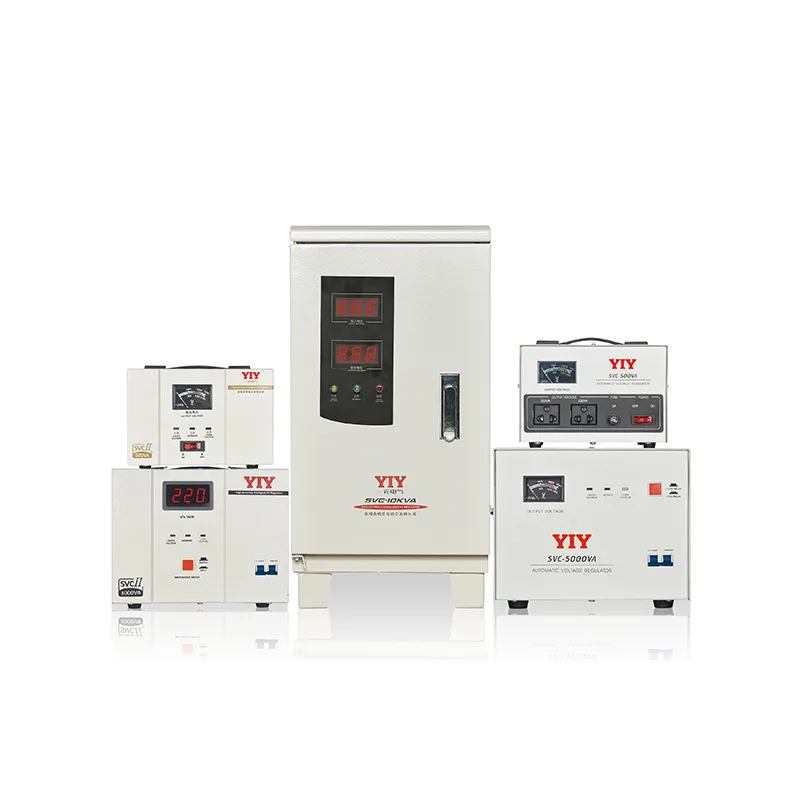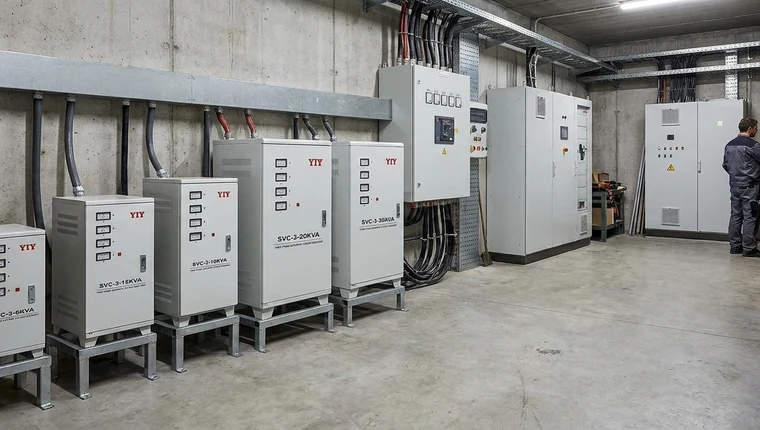
Before buying a servo stabilizer single phase, compare phase type, real load behavior, running kVA, startup current, power factor, input-voltage range, output precision, protection features, site conditions, and maintenance access before you send the RFQ.
If your load includes motors, compressors, CNC auxiliaries, pumps, control panels, or sensitive instruments, the buying risk is not only undersizing. The bigger risk is choosing a stabilizer that looks correct on catalog kVA but cannot handle your worst operating minute. IEC 60038 provides a standards-based framework for rated AC system voltages; for you, that means your specification should start from the electrical system actually installed, not only from a machine nameplate.
This guide walks you through the key decisions: when a single-phase unit fits, when to consider three-phase protection, how servo compares with relay and static designs, how to size from load behavior, and what to verify before procurement approval.
Why Do Single-Phase Stabilizer Mistakes Usually Start with Your Load Profile?
Your stabilizer selection should start with measured load behavior, not nominal voltage or a convenient kVA number. If your shortlist begins with “3kVA, 5kVA, or 10kVA should be enough,” you may miss the actual conditions that stress the AVR during operation.

A servo stabilizer 5kVA single phase may be suitable for a modest control load, but it may struggle if a motor, compressor, or heater starts at the same time as other equipment. A servo stabilizer 10kVA single phase may look conservative, but it can still be wrong if the input-voltage window is too narrow for your site or if the installation environment forces derating.
For broader plant applications, industrial voltage stabilizer selection should include phase type, load profile, power factor, startup current, safety margin, and application sensitivity together.
| Check | Why it matters | If you skip it |
|---|---|---|
| Phase type | Confirms whether your load is truly single-phase or part of a mixed panel | You may buy the wrong topology |
| Running load | Shows steady kVA demand during normal operation | The unit may overheat or trip |
| Power factor | Lower PF increases current for the same useful kW | A kW-only estimate can undersize the stabilizer |
| Startup current | Motors and compressors draw higher current at start | Output voltage may dip when your process starts |
| Input-voltage range | Weak grids may fall outside the correction window | The unit cannot regulate when you need it most |
| Safety margin | Allows for heat, aging, expansion, and load diversity | A tight purchase may become a downtime risk |
| Application sensitivity | CNC, lab, medical, and control loads tolerate less deviation | Small voltage errors can cause resets or quality drift |
For you, the practical question is not only “Will the load turn on?” It is “Will the stabilizer remain stable when the lowest grid voltage, highest load current, and worst startup event happen together?”
Site conditions also matter. Dust, humidity, heat, poor ventilation, weak rural grids, and unstable generator supply can change the final model choice. Before you compare prices, confirm enclosure expectations, airflow clearance, temperature margin, surge protection, bypass needs, alarm visibility, and service access.
What Should You Compare Between Single-Phase and Three-Phase Servo Stabilizers?
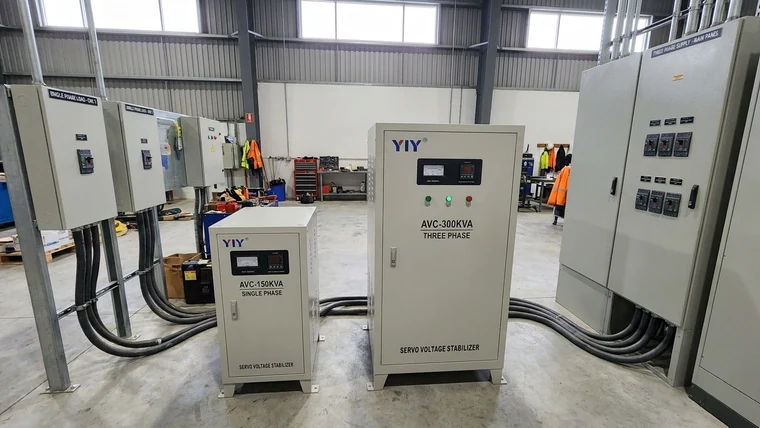
You should choose single phase for a dedicated single-phase circuit, and three phase for three-phase supply, three-phase machinery, or centralized industrial protection. The number of phases is not a catalog preference; it is a wiring, load-balance, and protection decision.
A single-phase AVR regulates one phase-to-neutral circuit. A three-phase voltage stabilizer regulates a three-phase system and must account for phase sequence, phase balance, neutral requirements, protection coordination, and uneven current draw. If your next upgrade adds three-phase motors, a larger panel, or centralized protection, review three-phase stabilizers before locking the RFQ.
| Compare | Single-phase servo stabilizer | Three-phase servo stabilizer |
|---|---|---|
| Supply type | Single-phase input, often phase-to-neutral | Three-phase input for industrial distribution |
| Load type | Instruments, small panels, control power, light machinery | Motors, compressors, CNC lines, production panels |
| Main electrical concern | Total current on one circuit | Phase sequence, imbalance, and three-line protection |
| Installation review | Breaker, cable, neutral, grounding, bypass | Phase rotation, earthing, breaker coordination, panel layout |
| Typical capacity discussion | Servo stabilizer 3kVA single phase, 5kVA, 10kVA, 15kVA | 3-phase servo controlled stabilizers for larger plant loads |
| Procurement risk | Undersizing causes overheating or trips | Wrong topology can affect multiple machines at once |
There is no universal kVA threshold where you automatically move from single phase to three phase. A 10kVA single-phase load and a 10kVA three-phase load are different installation cases. For you, the better rule is to follow the incoming supply, the load wiring, the equipment phase requirement, startup behavior, and expansion plan.
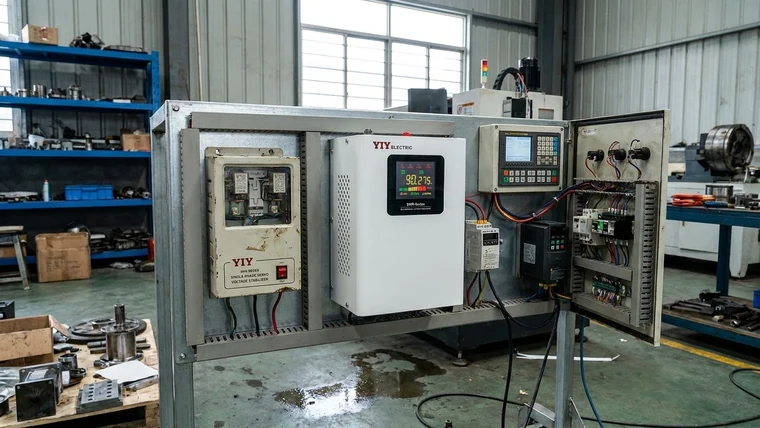
If your incoming supply is three phase but only one sensitive branch needs regulation, a dedicated single-phase unit may still make sense. If your protected loads are distributed across phases, forcing the job into one single-phase stabilizer can leave the rest of your system exposed to imbalance, dips, or nuisance trips.
When Is a Single-Phase Servo AVR Better Than Relay or Static Correction?
A single-phase servo AVR is usually the practical middle choice when you need smoother correction and tighter precision than relay switching, without moving directly to a premium static electronic topology. It suits many light industrial and general industrial loads where voltage fluctuation is frequent but ultra-fast correction is not the only requirement.
The single- and three-phase servo voltage stabilizer models page lists the SVC, PRO, TWS and PWR input windows side by side if you want to shortlist before sending load data.
In a servo design, the controller monitors input voltage and commands a servo motor to move a carbon brush along an autotransformer. This adjusts output voltage continuously rather than switching between relay taps. For your equipment, that smoother correction can reduce voltage steps reaching control circuits, motors, pumps, compressors, or auxiliary machine loads.
| Design | Response and precision | Maintenance | Practical fit |
|---|---|---|---|
| Relay stabilizer | Step correction; YIY relay overview lists +/-5% to +/-8% output precision | Lower complexity, relay wear over time | Budget-sensitive and less critical loads |
| Servo stabilizer | Continuous correction; YIY servo overview lists +/-0.5% to +/-3% output precision | Brush and drive inspection needed | Panels, pumps, compressors, CNC auxiliaries, light industrial loads |
| Static stabilizer | Fast electronic correction, no moving brush | Less mechanical wear, higher electronic complexity | Highly sensitive loads needing very fast correction |
Last verified: 2026-04-27. For you, +/-0.5% to +/-3% means the connected load sees a narrower voltage band, while +/-5% to +/-8% allows more output variation to reach the equipment. This does not mean servo is always best; it means you should match the correction method to your load sensitivity, voltage fluctuation pattern, and maintenance expectations.
If you are comparing a lower-cost step-regulation option, use the relay voltage stabilizer page to judge whether relay correction is enough for your load. If your application involves very sensitive electronics, fast voltage events, or strict process tolerances, you may also need to evaluate static or IGBT-based correction.
IEC 61000 electromagnetic compatibility standards provide broader low-voltage EMC and power-quality context. In practical terms, your stabilizer choice should consider not only output voltage accuracy, but also how the unit behaves in a real electrical environment with disturbance, load changes, and connected equipment interactions.
How Should You Size This Capacity Tier Before Requesting a Quote?
You should size from running kVA, power factor, startup current, measured voltage range, load sensitivity, and a realistic safety margin. A purchase based only on “watts divided by voltage” is too weak for motors, compressors, mixed panels, and unstable grids.
For a single-phase load, the basic apparent power relationship is:
| Input | What you calculate | What it means for you |
|---|---|---|
| Voltage and current | kVA = V x A / 1000 | Shows apparent power the stabilizer must carry |
| kW and power factor | kVA = kW / PF | Low PF raises required stabilizer capacity |
| Motor/compressor startup | Add allowance for starting current behavior | Prevents voltage dip and overload during start |
| Future load | Add planned expansion and safety margin | Avoids replacing the unit after a small upgrade |
These formulas are starting points, not final engineering approval. For you, the important step is to measure actual current and voltage under real operating conditions, especially when several loads start together. If the protected load belongs to a wider three-phase distribution system, use 3 phase main line stabilizer sizing before finalizing capacity.
A servo stabilizer 3kVA single phase may fit small instruments or control circuits. A 5kVA unit may fit light machinery or a small panel when startup current is controlled. A 10kVA or 15kVA unit may be more appropriate when motors, compressors, heating loads, or future expansion are involved. These numbers are not automatic recommendations; they are capacity bands that must be checked against your actual load list.
YIY product-family data supports both small and larger paths: SVC single-phase options cover 0.5KVA-50KVA, while SVC-3 three-phase options cover 3KVA-100KVA+ in the provided product summary. Last verified: 2026-04-27. For you, this means the shortlist can be built around application fit rather than stretching one catalog model beyond its intended use.
What Should Your RFQ Include So Suppliers Can Size Correctly?
Your RFQ should include the load list, running current, startup behavior, input-voltage window, site environment, protection expectations, and maintenance access. A clearer RFQ helps you compare suppliers on engineering fit instead of only headline price.
Use this procurement screen before you ask for a formal offer:
| Check | Why it matters | If you skip it |
|---|---|---|
| Incoming supply | Confirms single-phase or three-phase architecture | Supplier may quote the wrong phase configuration |
| Load list | Shows motors, heaters, controls, compressors, and instruments | Capacity may be based on incomplete data |
| Running current | Supports realistic kVA sizing | The stabilizer may run near overload |
| Startup current | Captures the hardest operating moment | Voltage may dip during start |
| Input-voltage window | Defines the correction range needed | The unit may not regulate during low grid voltage |
| Output precision | Matches the load’s tolerance | Sensitive equipment may reset or drift |
| Protection features | Covers over/under-voltage, overload, surge, and bypass | Faults may be harder to isolate safely |
| Environment | Accounts for dust, humidity, heat, and ventilation | The unit may derate or fail early |
| Monitoring | Supports alarms, meters, logs, or remote visibility | Maintenance may not know whether the issue is grid or load |
| Documentation | Confirms wiring diagram, test records, and certification requests | Acceptance review becomes slower |
For your internal approval, separate “must have” requirements from “nice to have” requirements. Phase type, capacity, correction range, protection, and safe installation are must-have items. Remote monitoring, special enclosure design, branding, or additional meters may be project-specific.
If you are procuring for a larger capacity or centralized installation, it can help to compare before buying a voltage stabilizer using the same load, voltage window, protection, and maintenance logic. The capacity may change, but your decision structure should stay consistent.
How Does YIY Turn Your Site Data into a Sizing-Ready Shortlist?
You can start with a short fit review before preparing a full technical package. YIY would first look at your load list, measured input-voltage window, starting current, installation environment, protection needs, and service access to determine whether a dedicated single-phase AVR or a three-phase configuration is more appropriate.
Imagine you are building a panel for control power, instruments, a small CNC auxiliary circuit, or a compressor control line. A 5kVA single-phase servo unit may fit if the running load is modest and starting current is controlled. A 10kVA unit may be safer if motors start together, voltage dips are frequent, or future loads are planned.
| Site input | What YIY would check | Shortlist impact |
|---|---|---|
| Load list | Running kVA, PF, motor/compressor starts | Separates 3kVA, 5kVA, 10kVA, and larger needs |
| Voltage window | Lowest and highest measured input | Confirms whether the stabilizer can correct your grid |
| Environment | Dust, humidity, heat, cabinet airflow | Drives enclosure, ventilation, and derating choices |
| Service access | Bypass, brush inspection, front/rear clearance | Reduces downtime during maintenance |
| Monitoring | Meters, alarms, fault visibility | Helps diagnose grid issues versus load issues |
The same logic applies if your site is moving toward three-phase loads. Instead of treating single phase and three phase as competing catalog categories, treat them as different answers to your actual electrical system.
What Final Acceptance Checks Reduce Commissioning Risk?
You should complete a phase, wiring, protection, environment, and documentation review before energizing the stabilizer. This is where you turn a purchase order into a safe installation.
| Check | Why it matters | If you skip it |
|---|---|---|
| Data plate | Confirms voltage, phase, frequency, and kVA | Wrong equipment may be installed unnoticed |
| Wiring diagram | Confirms input/output terminals and neutral requirement | Miswiring can damage the stabilizer or load |
| Earthing | Supports safety and fault clearing | Touch voltage and fault risk increase |
| Breaker coordination | Matches cable, current, and protection | Trips may be unreliable or nuisance-prone |
| Bypass plan | Keeps service and emergency operation practical | Maintenance may require full shutdown |
| Ventilation | Prevents overheating under load | Capacity can derate in hot cabinets |
| Alarm visibility | Helps operators respond quickly | Small faults may become downtime |
| Test record | Verifies no-load and loaded output voltage | Acceptance becomes opinion-based |
Have a qualified electrician, panel builder, or site electrical engineer perform the connection under local electrical code. Your verification action should include checking phase rotation where applicable, measuring input and output voltage before and after load connection, confirming grounding continuity, and recording the readings for handover.
Frequently Asked Questions
What Is the Difference Between a Single-Phase Stabilizer and a 3 Phase Stabilizer?
A single-phase stabilizer regulates one phase-to-neutral circuit, while a 3 phase stabilizer regulates a three-phase supply. Choose single phase for dedicated single-phase loads, small panels, instruments, or light machinery. Choose three phase for three-phase motors, CNC lines, compressors, and industrial distribution. Before purchase, verify the incoming supply, load wiring, phase balance, breaker rating, neutral requirement, and earthing plan against the site electrical drawing.
How Does a 3-Phase Stabilizer Work?
A 3-phase stabilizer senses voltage variation across a three-phase supply and corrects the output to keep connected equipment within a safer operating range. In a servo-controlled design, the controller drives a motorized variac or autotransformer system for smooth voltage correction. For you, this helps motors, compressors, CNC equipment, and production panels operate with less exposure to raw grid fluctuation.
What Load Readings Should You Collect Before Sizing a Single-Phase Servo Stabilizer?
A single-phase servo stabilizer should be sized from measured load behavior, not nameplate voltage alone. Start with running kVA, power factor, startup current, input-voltage range, load sensitivity, and safety margin. Verify actual current measurement, worst-case voltage dip, ambient temperature, ventilation clearance, and future load expansion before finalizing the RFQ.
How Do You Connect a 3 Phase Stabilizer Safely?
A 3 phase stabilizer should be connected only after confirming the wiring diagram, phase sequence, input and output terminals, neutral requirement, earthing, breaker size, and bypass arrangement. Have a qualified electrician make the connection to your local wiring rules. Before energizing, cross-check the data plate against the panel drawing, test phase rotation, confirm grounding continuity, and record no-load and loaded output voltage.
Which Certification Records and Test Documents Should Appear in Your RFQ File?
You should ask for the relevant quality, safety, and test documentation that applies to your market and project. For example, if a supplier cites ISO 9001:2015, verify the certificate scope, issuing body, validity date, and whether the scope covers stabilizer design, manufacturing, or service. For your acceptance file, also request wiring diagrams, test records, product labels, and any project-specific compliance documents required by your buyer or local authority.
Final Thoughts
The right single-phase servo stabilizer depends on your measured site data, real load behavior, phase configuration, voltage window, precision needs, and maintainability.
For your procurement decision, the logic is straightforward: match the AVR to the supply actually installed, the loads that start together, the lowest and highest input voltage you see, and the level of output stability your equipment can tolerate. Getting this wrong can create operational cost through nuisance trips, overheating, delayed commissioning, emergency replacement, and unclear fault diagnosis.
A practical next step is a quick-fit sizing review with YIY. Start with your load list, starting current if available, input-voltage window, and installation conditions; if the fit looks close, you can move into a more detailed shortlist and quotation.
About YIY
Zhejiang Yiyen Holding Group Co., Ltd. (YIY) is a professional voltage stabilizer manufacturer with 16+ years of experience. With a 30,000sqm modern facility and an annual production capacity of 1,000,000+ units, YIY products are exported to 130+ countries. YIY provides OEM/ODM customization services and supports voltage protection solutions across residential, commercial, and industrial applications.
Contact Us
Email: yiyen@yiyen.com
Phone/WhatsApp: +86 13587452904
Website: https://www.yiyavr.com/