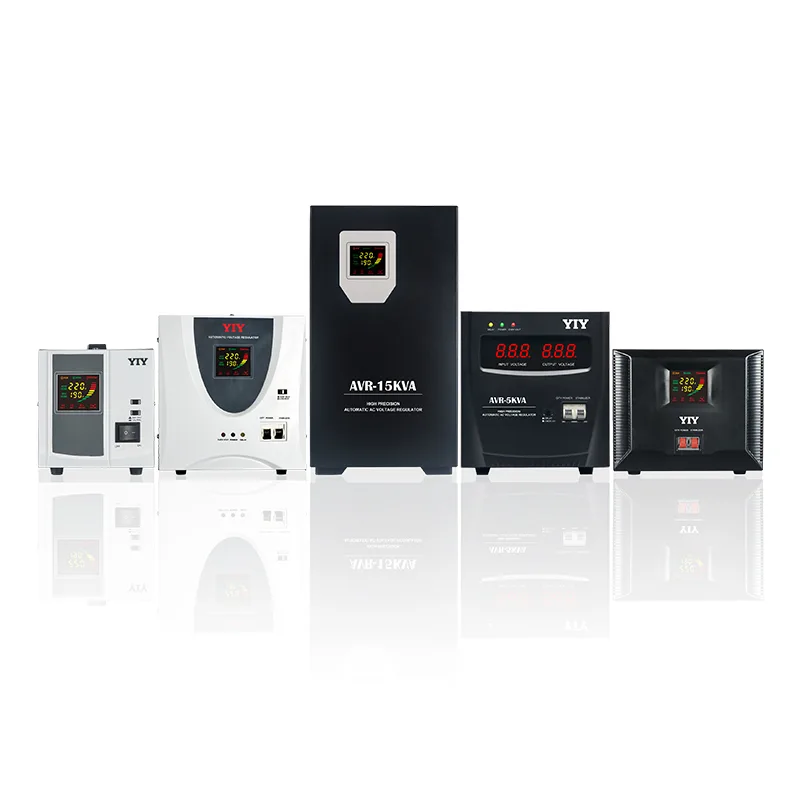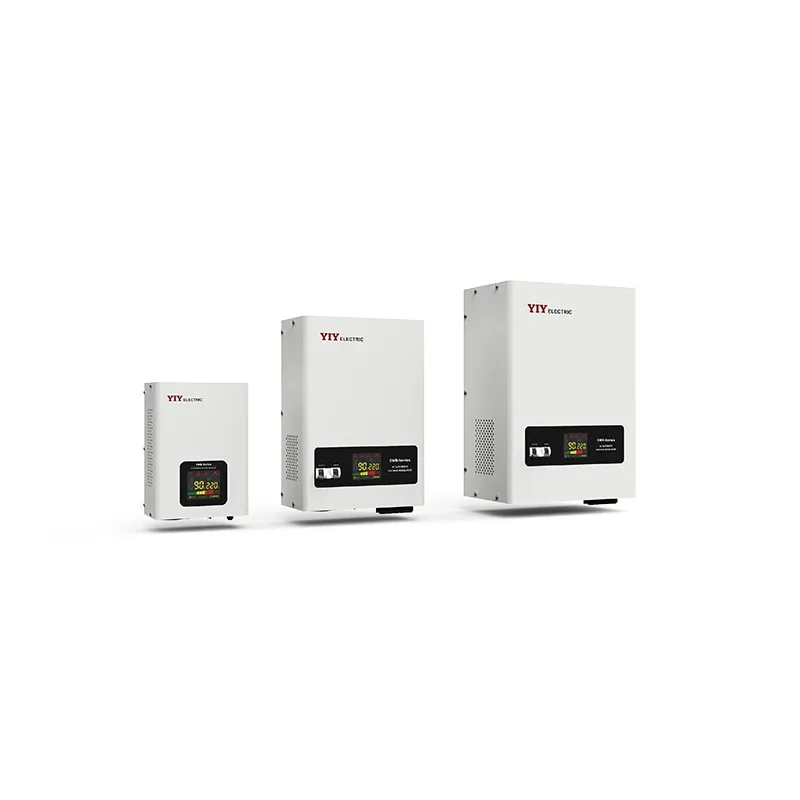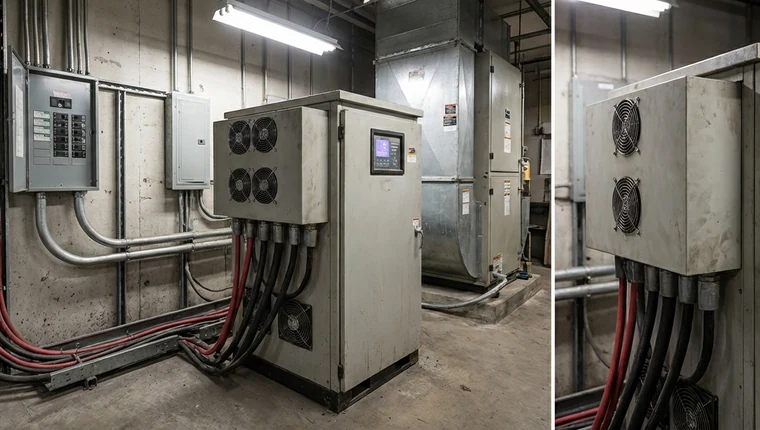
Grid voltage instability is one of the most common causes of premature AC failure — and a stabilizer used in AC is the first line of defense when your supply fluctuates beyond what the unit’s internal protection can handle.
In regions where brownouts, voltage sags, and sudden spikes are routine, running an air conditioner without external voltage regulation is a calculated risk most facility managers and installers can’t afford to take.
This guide covers what to check before deploying one: how to determine whether your environment actually requires it, how to size it correctly, which technology fits your application, and what compliance markers matter when sourcing at scale.
What a Stabilizer Used in AC Actually Does
A voltage stabilizer — also called an automatic voltage regulator (AVR) — is an electrical device that continuously monitors incoming supply voltage and automatically adjusts it to maintain a constant output, regardless of how much the input fluctuates. When grid voltage swings between 160V and 260V, the stabilizer absorbs that variation and delivers a steady 220V (or your target nominal) to the AC unit.
Why Air Conditioners Are Particularly Vulnerable
ACs are among the most voltage-sensitive loads in a building. The compressor motor draws a surge current 4–6× its rated load at startup — and that inrush happens every time the thermostat cycles the compressor on. During a brownout, when supply voltage drops below the compressor’s minimum operating threshold, the motor strains to start, draws excessive current, and generates heat in the windings. Repeated low-voltage restarts accelerate insulation degradation and shorten compressor life significantly.
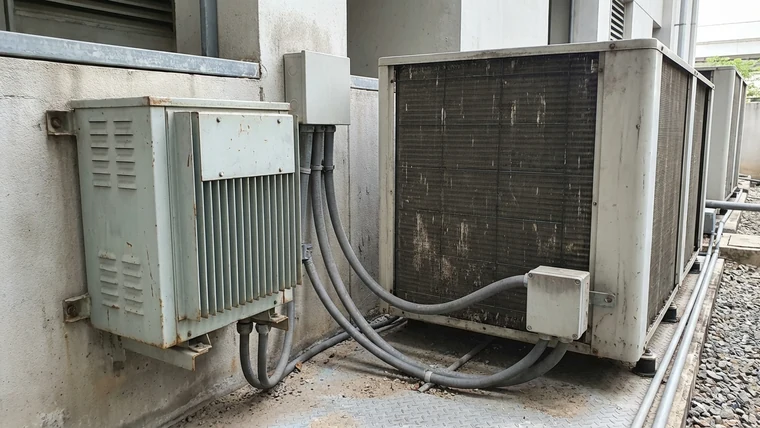
Voltage spikes present the opposite problem: overvoltage stresses the motor windings, PCB components, and capacitors simultaneously. Modern inverter ACs include some built-in protection circuitry, but it’s designed for minor deviations — typically ±10% of nominal. Anything beyond that range, and the unit either trips on its own protection or absorbs the stress silently over time.
The Gap Built-In Protection Doesn’t Cover
Most AC manufacturers specify an operating voltage range (e.g., 198V–242V for a 220V unit). The internal stabilizer handles fluctuations within that window. But in regions with chronic grid instability — where voltage can drop to 150V during peak demand or spike above 270V during load shedding — the built-in protection is simply out of its depth.
An external stabilizer used in AC applications covers the broader input range (commonly 140V–260V or wider), corrects voltage before it reaches the unit, and adds a time-delay relay on startup to prevent compressor damage from rapid cycling. That’s the protection gap it fills.
Who Actually Needs One — and When It Becomes Non-Negotiable
A stabilizer used in AC is not a universal requirement — but in certain grid environments, skipping it is a decision you’ll pay for in compressor repairs or early unit replacement. The question isn’t whether stabilizers work; it’s whether your operating conditions actually demand one.
The Primary Audience
Three groups consistently face this decision:
- Residential AC owners in regions with chronic grid instability — South Asia, Sub-Saharan Africa, parts of Southeast Asia and Latin America — where brownouts during peak demand are routine rather than exceptional.
- HVAC installers and contractors specifying protection equipment for client sites, particularly where the local utility cannot guarantee supply within ±10% of nominal voltage.
- Facility managers running multiple AC units in commercial or light-industrial buildings, where a single compressor failure disrupts operations and replacement costs are significant.
Grid Instability: The Trigger Conditions
The threshold that makes a stabilizer non-negotiable is voltage swinging beyond ±10% of your rated supply on a regular basis. A 220V system that routinely drops to 185V during afternoon peak, or spikes above 250V when large loads disconnect, is operating outside the safe envelope of most AC units. Brownouts — sustained low-voltage conditions rather than momentary dips — are particularly damaging because the compressor motor keeps attempting to run under strain rather than tripping cleanly.
If your site logs frequent voltage complaints, experiences nuisance tripping on AC units, or shows visible dimming during compressor startup, those are field indicators that your grid instability exceeds what built-in protection can absorb.
Inverter AC vs. Non-Inverter AC
Modern inverter ACs have a wider input voltage tolerance than older fixed-speed units — many are rated for 160V–264V input. In moderately unstable grids, this built-in range is often sufficient, and a stabilizer becomes optional rather than mandatory. That said, “wider tolerance” is not the same as “immune to damage.” In severe cases — voltage dropping below 150V, spikes above 270V, or rapid cycling between extremes — even inverter ACs benefit from external regulation upstream.
Non-inverter (fixed-speed) ACs have narrower operating windows and are significantly more vulnerable. For these units in unstable-grid environments, an external stabilizer is effectively mandatory.
Are AC Stabilizers Really Necessary?
The honest answer: it depends on your grid. In stable utility environments (Europe, North America, Japan), most modern ACs run fine without one. In regions where voltage swings beyond ±10% are common — and this covers a large share of the global installed base — an external stabilizer used in AC applications can noticeably extend compressor life. Running without it is a calculated risk, not a safe default.
How to Size and Select the Right AC Stabilizer
Getting the sizing wrong is the most common mistake buyers make. Undersized units trip under compressor startup surge; oversized units waste budget and floor space. The formula is straightforward: total AC load (watts) × 1.25 = minimum stabilizer KVA. Take the input watts from the AC nameplate: for example, a unit rated at 1,800 W gives 1,800 × 1.25 = 2,250 VA, so you would pick the next standard rating above 2.25 kVA.
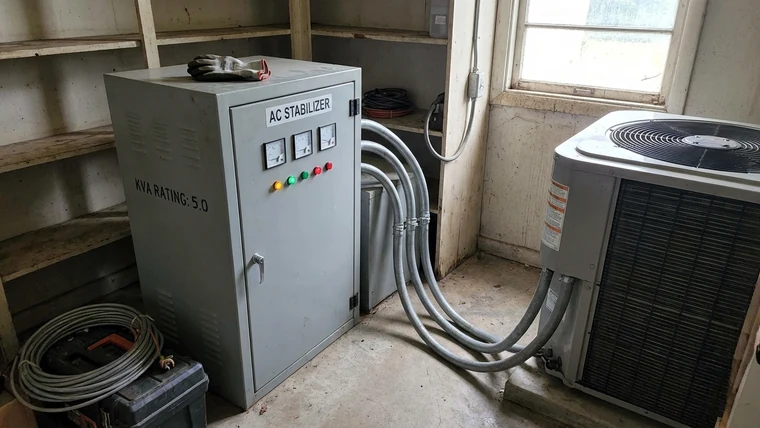
If you’re protecting multiple AC units on a shared circuit, sum the wattage of all connected loads before applying the margin. Don’t size to average draw — size to simultaneous startup load.
Technology Type: Match the Application
Three technologies dominate the market (see how a voltage stabilizer works), and the right choice depends on your environment:
| Technology | Regulation Accuracy | Response | Best Fit |
|---|---|---|---|
| Relay | ±5–8% | Fastest (~20ms) | Residential, portable use |
| Servo | ±1–3% | Moderate | Commercial, light industrial |
| IGBT | ±0.5% | ~10ms | Mission-critical, precision loads |
Relay stabilizers are the default for residential AC protection. They’re lowest cost, require no mechanical maintenance, and handle the fast voltage swings typical of residential grids. The PR Series (500VA–2,000VA) is a practical example: portable, CPU-controlled, with built-in surge and brownout protection.
Servo stabilizers use a motorized variac for continuous regulation — better precision than relay, suitable for commercial buildings running multiple AC units where ±1% output matters for equipment longevity.
IGBT stabilizers (double-conversion AC-DC-AC) deliver ±0.5% output accuracy with THD <3%. Overkill for a home split unit, but the right call for data center cooling, medical facility HVAC, or any load where voltage deviation directly affects process outcomes.
Spec Checkpoints Before You Buy
Four specs to verify on any datasheet:
- Input voltage range: Should cover your actual grid swing — minimum 140V–260V for unstable-grid environments, wider if brownouts drop below 150V
- Output regulation accuracy: ±5% is acceptable for residential; ±1% or better for commercial
- Response time: Under 40ms for relay; confirm the spec, not just the technology claim
- Protection features: Overload cutoff, surge suppression, brownout disconnect, and time-delay relay on startup (prevents compressor damage from rapid cycling)
The time-delay relay is often overlooked — it enforces a 3–5 minute restart delay after a power interruption, which is the same logic behind the “3-minute rule” for AC compressors. Confirm it’s present before specifying.
Compliance, Certifications, and What the Standards Actually Require
Selecting a stabilizer used in AC isn’t just a technical decision — it’s a compliance decision in many markets. Understanding which standards are mandatory versus advisory changes how you evaluate suppliers and specify equipment.
IEC Standards: The Baseline
IEC 60038 defines standard voltage levels globally — 220V/230V/240V for single-phase systems, 380V/400V/415V for three-phase. Any stabilizer you deploy must output within these defined nominal levels. This isn’t optional; it’s the reference point against which output regulation accuracy is measured.
IEC 61000 covers electromagnetic compatibility (EMC). A stabilizer must not introduce harmonic distortion or electrical interference back into the supply circuit. This matters particularly for IGBT-based units: the double-conversion AC-DC-AC topology can generate switching noise if the output filter isn’t properly designed. Confirm THD (total harmonic distortion) specs — under 3% is the accepted threshold for sensitive loads.
CE Certification: Mandatory for EU Deployments
If you’re sourcing stabilizers for any EU market installation, CE marking is not optional. It confirms the unit meets the Low Voltage Directive (LVD) and EMC Directive requirements. Absence of CE on a unit destined for Europe is a procurement disqualifier, not a negotiation point.
ISO 9001:2015: A Quality Signal, Not a Compliance Requirement
ISO 9001:2015 certification applies to the manufacturer’s quality management system — design controls, production consistency, traceability. It doesn’t certify the product itself, but it’s a meaningful signal that the factory operates with documented processes. When evaluating suppliers, ask specifically: Is the certification current? Does it cover the product lines you’re sourcing, or only part of the facility?
Does Modern AC Require a Stabilizer?
Standards context gives a direct answer: modern inverter ACs are designed to IEC tolerances, typically ±10% of nominal. In grids that stay within that band, a stabilizer is redundant. In grids that routinely fall outside it — which IEC 60038 defines as the acceptable range — external regulation is the standards-compliant response, not an optional upgrade.
YIY Product Fit: Relay, Servo, and IGBT Options for AC Protection
Most competitors in this space — Servomax being the clearest example — operate within a narrow technology band: servo stabilizers and transformers, primarily for the Indian domestic market. That scope works for a specific buyer profile. It doesn’t work if you’re sourcing for multiple deployment environments, need OEM customization, or are shipping to markets outside South Asia.
YIY’s differentiation starts with technology breadth across the full relay-servo-IGBT range, backed by OEM/ODM capability and distribution to 130+ countries.
PR Series: Relay Stabilizer for Residential AC
The PR Series (500VA–2000VA) is the direct-fit option for single-phase residential AC protection. It’s portable, CPU-controlled, and includes a digital meter, selectable time delay, surge protection, and brownout/overvoltage cutoff. The selectable delay enforces the compressor restart interval automatically — no manual intervention required.
Its product page lists capacities only up to 2000VA, so larger split units need a higher-rated model. For wall-mounted protection across a wider range, see the YIY SWR wall-mounted relay voltage stabilizer and confirm the capacity on that page against your sized load.
Servo Stabilizers: Commercial HVAC and Multi-Unit Installations
Where a building runs multiple AC units or commercial HVAC equipment, relay-type regulation introduces cumulative step errors across the load. Servo stabilizers use a motorized variac for continuous, smooth regulation — output accuracy in the ±1–3% range with no switching artifacts. This matters for commercial installations where compressor cycling across multiple units creates complex load profiles that relay switching handles less cleanly.
CVCF Series: IGBT for Mission-Critical AC Environments
The CVCF Series uses double-conversion IGBT topology (AC-DC-AC) to deliver ±0.5% output voltage accuracy with THD <3% and a 10ms correction response. This is the right specification for generator-backed systems, data center cooling, medical facility HVAC, or any environment where voltage deviation directly affects process outcomes. No India-focused competitor offers this tier for AC applications.
The Differentiator in Practice
The practical gap isn’t any single product — it’s the ability to source relay, servo, and IGBT stabilizers from one manufacturer with consistent quality documentation (ISO 9001:2015, CE), OEM/ODM customization, and a supply chain that reaches 130+ countries. For procurement teams managing multi-site deployments across different grid environments, that consolidation reduces vendor complexity significantly.
Frequently Asked Questions
Are AC Stabilizers Really Necessary?
Only where the measured supply regularly leaves the AC’s rated input window. Log the socket voltage at peak and off-peak hours and compare it with the nameplate range; if the readings stay inside it, the unit’s own protection is usually enough.
Is It Okay to Run AC Without a Stabilizer?
Yes, on a stable grid. On a weak grid, watch for warning signs such as hard compressor starts, nuisance trips, or lights dimming when the outdoor unit kicks in. Those signs justify an external regulator sized to the compressor’s starting load.
What Is the 3-Minute Rule for Air Conditioners?
It means waiting a few minutes after power returns before the compressor restarts, so refrigerant pressures can equalize. Many stabilizers include an adjustable restart delay that does this automatically; check the delay setting on the data sheet.
Final Thoughts
Choosing a stabilizer used in AC comes down to three variables: how far your grid voltage actually swings, what load you’re protecting, and how much downtime you can tolerate. Residential single-phase units in moderately unstable grids typically need a relay stabilizer sized at 1.25× rated load. Commercial multi-unit installations benefit from servo regulation. Mission-critical HVAC environments — generator-backed, data center, medical — warrant IGBT precision.
The decision tree isn’t complicated once you have the right inputs.
If you’re ready to specify, share your operating environment, the loads you’re protecting, and your observed voltage behavior with YIY’s engineering team. We’ll recommend the right deployment path — relay, servo, or IGBT — based on your actual conditions, not a generic spec sheet. Dealers and wholesale buyers can request distributor terms through the YIY contact page.
📧 yiyen at yiyen.com | 📞 +86 13587452904 | 🌐 https://www.yiyavr.com/
—
About YIY
Zhejiang Yiyen Holding Group Co., Ltd. (YIY) is a professional voltage stabilizer manufacturer founded in 2008. With a 30,000sqm modern facility and an annual production capacity of 1,000,000+ units, our products are exported to 130+ countries. We provide OEM/ODM customization services and are ISO 9001:2015 certified, committed to delivering stable and reliable voltage protection solutions to global customers.
Contact Us
Email: yiyen at yiyen.com
Phone/WhatsApp: +86 13587452904
Website: https://www.yiyavr.com/
If you found this article helpful, contact us for a sizing review or customized solution.