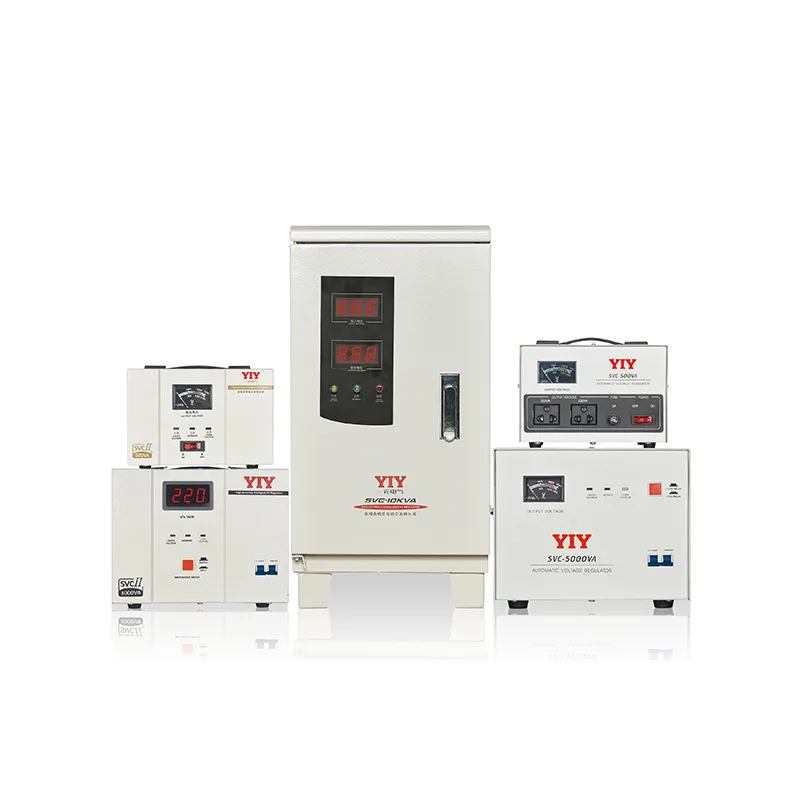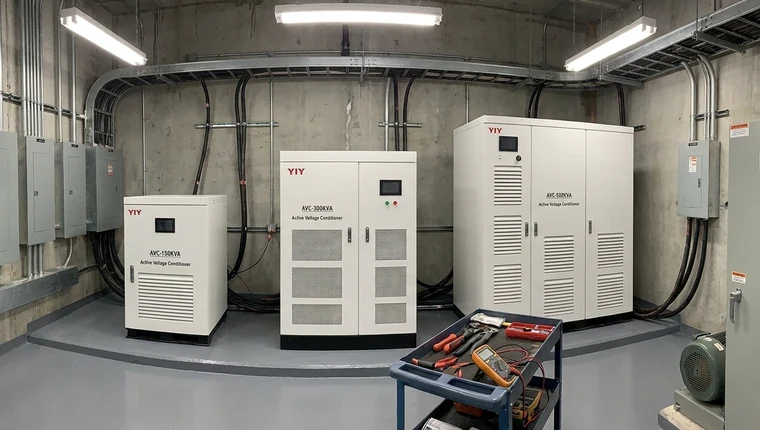
For most pump, fan, compressor, and small-machine duty, the best stabilizer for 3hp single phase motor use is a correctly sized servo AVR. Shortlist from measured voltage range, starting current, power factor, and protection needs, not the 3HP nameplate alone.
This guide covers when a dedicated stabilizer is needed, how to size it, which technology fits, how to install it, and what to check before approving a supplier.
Why Does Your 3HP Single-Phase Motor Need Voltage Stabilization?
You protect your 3HP motor best when you treat voltage quality as a motor-life issue, not only a power-supply issue. A 3HP single-phase motor needs stabilization when dips, surges, or repeated low-voltage starts increase current draw, raise winding temperature, and create nuisance trips during normal production.
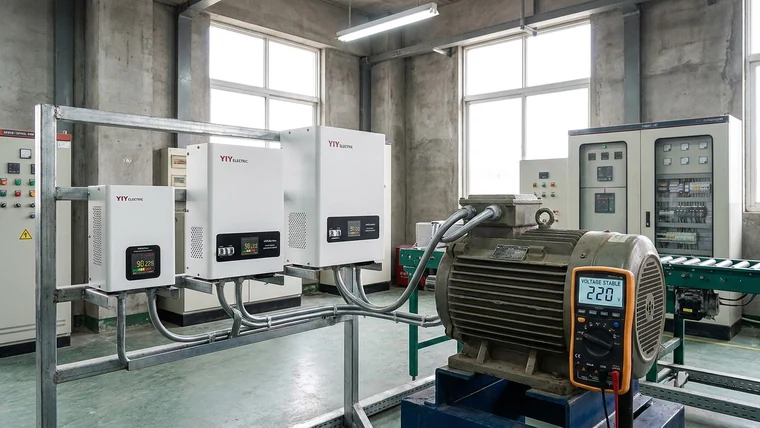
In many unstable-grid locations, your measured supply may fall toward 180–200V during peak demand, weak feeder conditions, or generator changeover. For reference, IEC 60038 standard voltage definitions provide recognized nominal voltage values such as 230/400V. In practical terms, that gives you a baseline: if your real site voltage is repeatedly far below nominal, you should not rely on the motor nameplate alone.
Low voltage is especially risky during starting. Your motor needs torque at the same moment the supply may be weakest. If voltage drops, the motor can draw higher current, run hotter, accelerate more slowly, or trip protection devices. Over time, that heat is what damages insulation and turns a voltage fluctuation into winding failure.
A budget-first buying process can miss this. Many buyers compare only kVA labels, but your site conditions decide whether a relay, servo, or static/IGBT AVR is suitable. If you are reviewing lighter-duty or small-capacity options, a relay voltage stabilizer can be a useful baseline for understanding step-based correction, but it should not be assumed to fit every 3HP motor application.
| What you should check | Why it matters | If you ignore it |
|---|---|---|
| Lowest measured input voltage | Confirms whether the stabilizer can correct the worst recurring dip | Your motor may still start under-voltage |
| Startup current | Shows whether the AVR can handle starting demand | The unit may trip or overheat during startup |
| Running current under load | Confirms the real electrical load | You may oversize or undersize the stabilizer |
| Duty cycle and start frequency | Repeated starts create repeated heat cycles | Winding stress and nuisance trips increase |
| Ambient heat, dust, humidity | Affects enclosure, ventilation, and derating | The stabilizer may fail before it protects the motor |
For you, the buying lesson is simple: a stabilizer protects the motor only when its correction range, current capacity, and protection functions match the actual site.
Which Stabilizer Type Fits Your 3HP Single-Phase Motor Load?
You should choose servo for most general 3HP motor loads, relay for lighter and budget-sensitive duties, and static/IGBT when fast correction or sensitive nearby electronics matter. The right choice depends on your fluctuation severity, startup pattern, and how much downstream equipment shares the same supply.
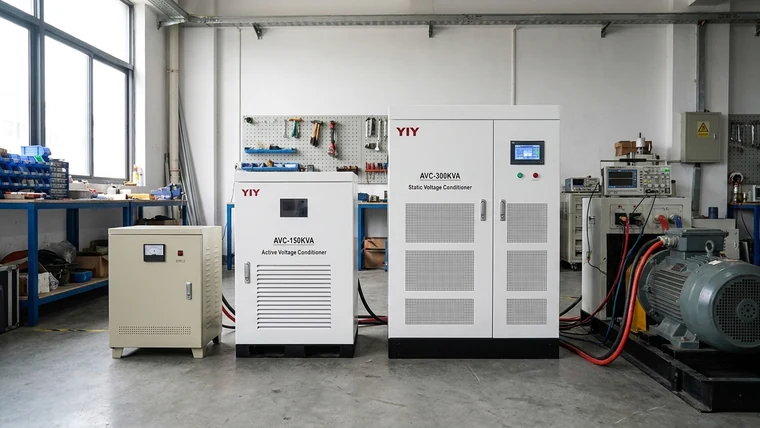
| Selection point | Relay stabilizer | Servo voltage stabilizer | Static/IGBT stabilizer |
|---|---|---|---|
| Correction method | Relay step switching | Motor-driven variable correction | Electronic high-speed correction |
| Best fit | Light, moderate fluctuation, budget-sensitive use | General 3HP motor duty with recurring voltage variation | Sensitive mixed loads, PLCs, test equipment, medical or precision controls |
| Output regulation | Coarser step changes | Moderate to tight, model-dependent | Tightest among the three |
| Response behavior | Adequate for mild swings | Stable for common industrial voltage variation | Fastest correction |
| Cost profile | Lowest | Balanced | Highest |
| Maintenance profile | Contact wear; low routine work | Periodic brush and track inspection | Sealed electronics; lowest routine work |
| Main caution | Not ideal for frequent deep dips or sensitive controls | Must be sized and ventilated correctly | May be unnecessary for motor-only duty |
Relay stabilizers can work when your voltage variation is moderate, the motor does not start frequently under load, and no sensitive control electronics share the same line. Your caution is that relay switching is step-based, so it may not be the best fit for frequent deep dips or loads that need tighter regulation.
Servo stabilizers are often the practical middle ground. For your pump, fan, compressor, or small production machine, a servo design usually gives smoother correction than relay technology while keeping procurement cost more reasonable than static/IGBT equipment. This is why many general motor applications start with servo as the default shortlist option.
Static or IGBT stabilizers make sense when the motor is not the only concern. If your line also feeds PLCs, sensors, testing instruments, medical devices, precision controllers, or other sensitive electronics, fast correction can matter more than lowest purchase cost. IEC 61000-4-11 voltage dip testing defines immunity test methods for voltage dips, short interruptions, and voltage variations; practically, it reminds you that sensitive equipment can react badly to short disturbances even if the motor continues running.
Your site environment should also influence the topology decision. Hot workshops need ventilation and derating attention. Dusty rooms may need better cabinet design. Pump houses may require humidity protection. If your maintenance team needs to diagnose recurring grid faults, alarms or event visibility can be more valuable than a cheaper model with no fault record.
How Should You Size the Stabilizer Instead of Relying on 3HP Alone?
You should size this capacity tier from nameplate current, measured running current, startup demand, power factor, input-voltage range, and a safety margin. A 3HP single-phase motor is often discussed near the ~3kVA range, but your final stabilizer rating should be validated against the actual motor and site behavior.
A simple single-phase capacity check is:
kVA ≈ Voltage × Current ÷ 1000
That formula gives you a starting point, not the final purchasing answer. In practical terms, it tells you the apparent power your stabilizer must support during normal operation; you still need to account for starting current, power factor, low-voltage correction range, ambient temperature, and manufacturer safety margin.
| Sizing input | What you should record | What it means for you |
|---|---|---|
| Motor nameplate | Voltage, current, HP/kW, duty cycle, power factor if listed | Gives the first sizing baseline |
| Running current | Clamp-meter current under real load | Confirms whether the motor behaves as expected |
| Startup current | Data sheet value or measured start current | Determines whether the AVR can survive starting demand |
| Input voltage range | Lowest and highest voltage across working periods | Confirms whether the stabilizer has enough correction range |
| Load type | Pump, compressor, fan, machine tool, loaded start, unloaded start | Explains why two 3HP motors may need different margins |
| Environment | Heat, dust, humidity, ventilation, enclosure placement | Prevents derating and premature failure |
Do not use a generic inrush multiplier unless your motor data supports it. Your compressor, pump, fan, or machine may start differently depending on load torque, starting method, and supply weakness. If startup current is not available, ask for a controlled measurement or supplier calculation before you approve the model.
Input voltage range is equally important. Measure supply across shifts, peak-demand periods, generator changeover, and actual motor starts. If your line repeatedly drops toward 180–200V, an AVR with a narrow input range may look correct on paper but fail at the moment you need it most.
If you are protecting more than one circuit, you may be comparing a dedicated motor AVR with a single phase main line stabilizer. A dedicated unit protects one critical motor more directly, while a main-line unit can protect a small facility or shared single-phase circuit. For you, the practical decision is whether the voltage problem affects only one motor or the wider incoming line.
Output accuracy should be read in plain language. A tolerance such as ±0.5% to ±8% means some models hold output much closer to nominal than others. Tighter regulation usually costs more, but it may be worth it if contactors, sensors, drives, or control electronics are affected by voltage movement.
For a structured sizing review that includes load, power factor, startup current, input range, phase type, and safety margin, use YIY’s industrial voltage stabilizer selection framework as your execution checklist before requesting quotations.
When Should You Consider Main-Line or Three-Phase Expansion?
You should consider main-line or three-phase planning when your voltage issue affects more than one load, more than one distribution branch, or future equipment expansion. Your 3HP single-phase motor may be today’s problem, but your incoming supply may reveal a wider power-quality issue.
If your workshop has several single-phase loads sharing one weak line, a local stabilizer for one motor may solve only part of the problem. In that case, your evaluation should compare a dedicated AVR against a main-line stabilizer that corrects the whole protected circuit. This matters when nuisance trips, dimming, contactor chatter, or equipment alarms appear across multiple machines.
If your facility may later move to larger pumps, compressors, lifts, or three-phase machinery, document the current supply architecture now. The sizing logic changes when you move from one single-phase motor to a three-phase distribution system, especially because phase loss, phase sequence, and voltage unbalance become more important. For expansion planning, YIY’s 3 phase main line stabilizer sizing guide can help you compare how main-line protection differs when the facility scales beyond single-phase loads.
Phase unbalance protection is mainly a three-phase concern, but you should still care about upstream distribution. If your single-phase motor is fed from a three-phase board, upstream phase loss or abnormal distribution conditions may affect connected loads. Your procurement file should state whether the motor is on a true single-phase supply, a single-phase branch from a three-phase system, or a mixed-load panel.
What Should You Verify Before Procurement Approval?
You should approve the shortlist only after the supplier validates capacity, input range, protection functions, certification evidence, installation environment, and exception notes in writing. The goal is not just to buy an AVR; it is to prove that the selected model protects your motor during the worst recurring site condition.
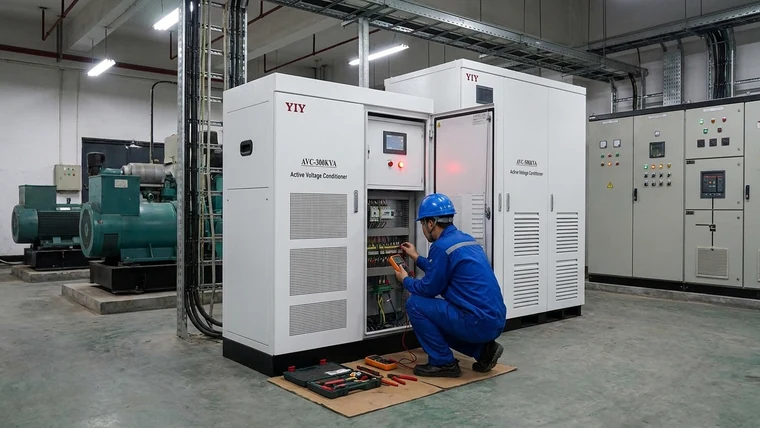
| Check | Why it matters | If you skip it |
|---|---|---|
| Load data and startup current | Confirms the unit can handle running load and motor starting demand | The stabilizer may trip, overheat, or fail during startup |
| Voltage logs | Shows recurring low/high voltage instead of one convenient reading | You may buy for the average voltage and miss the worst case |
| Input correction range | Confirms whether the AVR can correct deep dips such as 180–200V | Output may remain unsafe during weak-grid periods |
| Protection functions | Verifies over/under-voltage cutoff, overload, delay, thermal protection, bypass, and alarms | A voltage event may become motor damage or unsafe bypass use |
| Overload relay coordination | Confirms motor protection is set to the nameplate full-load current | The stabilizer may work while the motor remains thermally unprotected |
| Installation environment | Checks heat, dust, humidity, ventilation, cable access, and service clearance | The stabilizer may derate or become difficult to maintain |
| Factory and certification proof | Confirms auditable quality documentation such as ISO 9001:2015 quality management | You may accept unverifiable quality claims |
| Written sizing basis | Creates a record of why the model was selected | Future troubleshooting becomes guesswork |
A voltage stabilizer does not replace motor overload protection. You still need an overload relay, thermal protector, motor protection device, or suitable protection arrangement set against the motor nameplate current. This matters because mechanical problems—blocked pumps, worn bearings, jammed compressors, or abnormal load torque—can create excessive current even when voltage is stable.
For compliance and purchasing verification, ask for documents rather than broad claims. Request the datasheet, wiring diagram, protection list, certification copies, test report if available, warranty scope, bypass instructions, and installation assumptions. If your supplier mentions ISO 9001:2015, verify that the certificate covers the relevant organization and scope, not only a loosely related company name.
Your supplier should also explain what the stabilizer will not solve. It will not repair a failing motor, correct undersized cabling, remove harmonics from all nonlinear loads, or replace proper motor protection. A transparent exception note helps you avoid blaming the AVR for problems caused by wiring, mechanical overload, or poor protection coordination.
How Should You Install the Stabilizer for a 3HP Motor?
Check terminations, grounding, and ventilation before you energize the panel. Most early failures on small motor circuits come from loose or overheated connections, not from the regulator itself.
- Terminals and torque: size conductors for the calculated load current and torque lugs to the manufacturer’s values. Loose lugs heat up during every start and can trip the upstream breaker.
- Ventilation and derating: keep the intake clearance the datasheet specifies, and apply the supplier’s derating curve if the room runs hot.
- Grounding and bypass: bond the chassis to the site earth to the resistance your local code requires, and wire a manual bypass so the motor can run during servicing.
- Commissioning test: confirm surge protection coordination, then run the motor through loaded starts while recording input, output, and alarm events.
How Should You Finalize the Shortlist with YIY?
You should start with a quick first-pass fit review, then collect deeper logs only if the initial model range looks viable. That keeps your process low-friction while still moving toward an engineering-backed quotation.
YIY can support your selection by reviewing the motor nameplate, expected load type, available voltage measurements, installation environment, and required protection functions. For general 3HP motor duty, the first shortlist often compares relay, servo, and static/IGBT options against your fluctuation severity and budget. For sensitive mixed-load sites, the review should also include downstream electronics and required output accuracy.
Before you request final pricing, prepare these items:
- Motor nameplate photo or data: voltage, current, HP/kW, frequency, duty cycle.
- Actual voltage readings: lowest, highest, and typical values during working hours.
- Startup behavior: loaded start, unloaded start, start frequency, trip history.
- Load type: pump, compressor, fan, small machine, or mixed control panel.
- Installation conditions: indoor/outdoor, heat, dust, humidity, ventilation.
- Protection expectations: overload, delay, bypass, over/under-voltage, alarms.
- Commercial requirements: delivery timing, warranty expectations, documentation needs.
If your procurement process is moving from technical review to supplier comparison, you can also compare before buying a voltage stabilizer to structure your RFQ questions, even if your current capacity is much smaller than 50 kVA. The comparison logic—capacity proof, protection, documentation, and serviceability—still applies.
Frequently Asked Questions
Do VFD or Soft-Starter Controls Replace an External Stabilizer?
No, not when the supply sits low for long periods. A drive or soft starter handles the start and short transients, but sustained undervoltage still pulls the DC bus down and trips the drive. A stabilizer upstream keeps the drive inside its input window.
When Is a Dedicated Stabilizer Necessary for 3HP Single-Phase Loads?
A dedicated stabilizer is necessary when your 3HP load faces recurring voltage dips, frequent trips, loaded starts, or sensitive nearby controls. If your supply drops toward 180–200V, log voltage during peak-load periods and actual motor starts before approving the capacity. This gives your supplier evidence for the input range and starting demand.
Does a 3HP Single-Phase Motor Need Overload Protection in Addition to a Stabilizer?
Yes. Your stabilizer corrects voltage fluctuations, while overload protection responds to excessive current from mechanical jams, bearing wear, pump blockage, compressor overload, or abnormal load conditions. Before commissioning, cross-check the overload relay setting with the motor nameplate current and confirm the protection device is tested according to your site procedure.
How Does Phase Unbalance Protection Relate to Single-Phase Motor Voltage Protection?
Phase unbalance protection mainly applies to three-phase systems, while your single-phase motor protection focuses on over-voltage, under-voltage, overload, delay, and thermal faults. If your single-phase motor is supplied from a three-phase distribution board, verify the incoming supply configuration and check whether upstream phase-loss or unbalance alarms are required.
Is a Relay Stabilizer Enough for a 3HP Single-Phase Motor?
A relay stabilizer may be enough if your voltage swings are moderate, starts are not severe, and the motor circuit does not feed sensitive electronics. Verify this by comparing the relay model’s input range, output accuracy, current rating, and protection functions against your voltage log and motor nameplate. If your site has deep dips or frequent starts, servo is usually the safer shortlist option.
Final Thoughts
The right stabilizer for your 3HP single-phase motor is selected from real voltage behavior, startup current, power factor, protection needs, and load sensitivity. Servo is usually the practical middle ground for general motor duty; relay fits lighter and less sensitive use; static/IGBT fits faster-response or electronics-heavy environments.
Your next step can be simple: request a quick sizing review with your motor nameplate, approximate voltage range, and load type. If the first-pass fit looks promising, you can then add voltage logs, startup-current evidence, and installation details to finalize the specification and quotation.