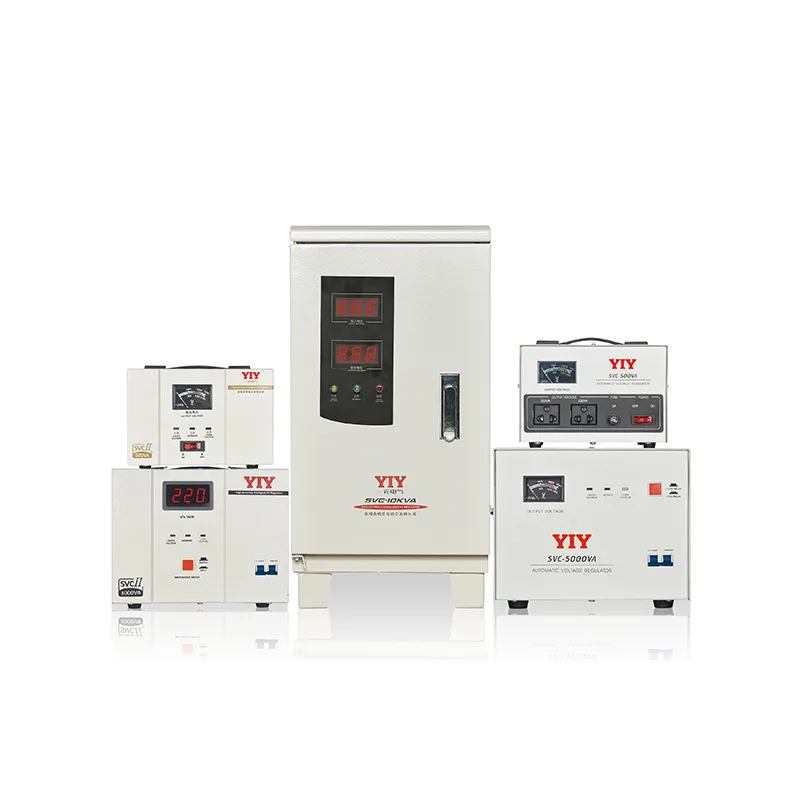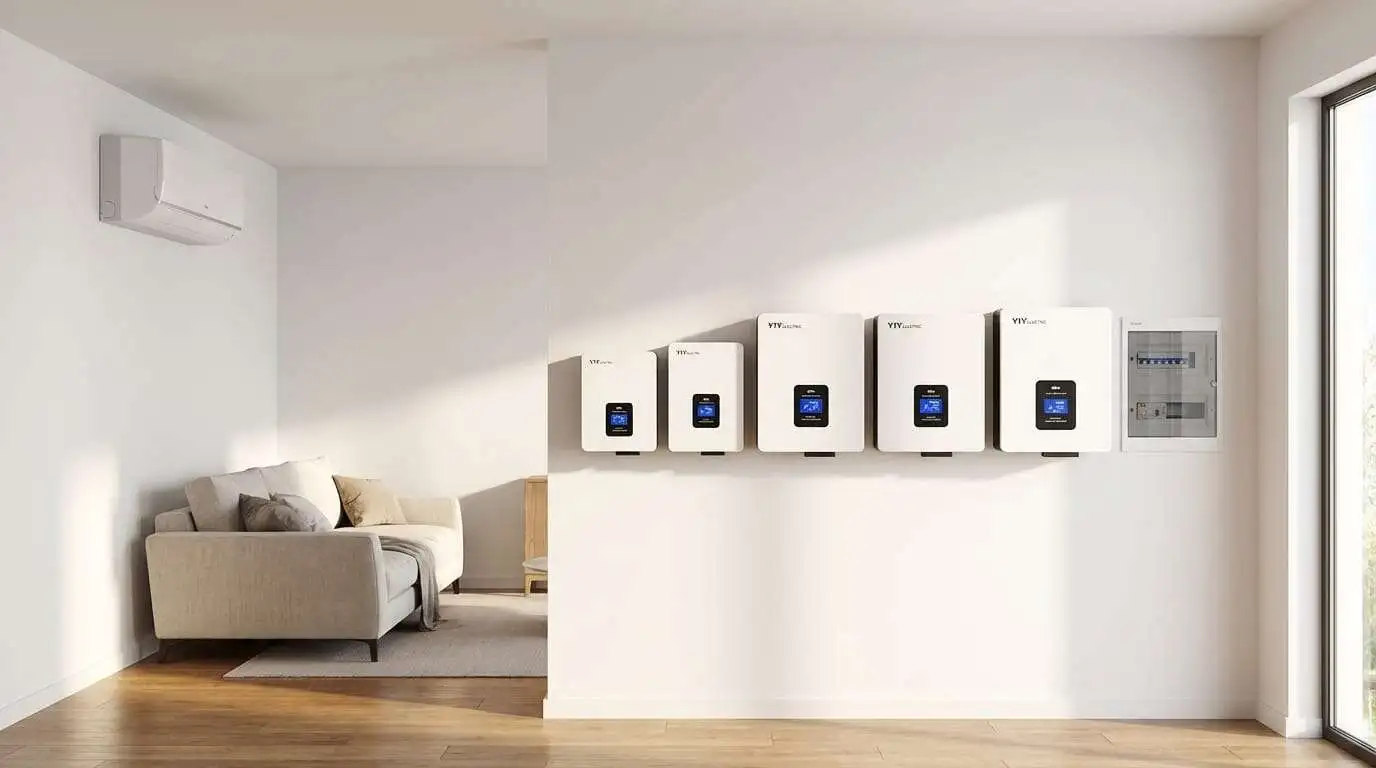
A ±10% swing in grid voltage cuts sensitive-equipment life by up to half. For loads under 4 kW — home appliances, office networks, small CNC controllers — a single-phase stabilizer rated between 1 and 5 KVA is the standard fix. The challenge is not buying one; it is buying the right one. Three KVA units outsell every other small-capacity rating, yet roughly half of field returns trace back to a sizing error or a technology mismatch — problems that a ten-minute specification check eliminates.
This guide consolidates everything a plant engineer, panel builder, or procurement team needs to move from “we need a stabilizer” to a spec-ready purchase order: capacity sizing, technology selection, pricing context, and product recommendations by use case.
How to Size a Small Voltage Stabilizer in 3 Steps
Getting the capacity right before requesting a quote is the single highest-ROI task in this process. An undersized unit trips on motor inrush; an oversized one inflates cost with zero extra protection.
Step 1 — List every load. Sum the rated wattage (or VA) of each device on the circuit. Include startup multipliers for anything with a compressor or motor: air-conditioner compressors draw 3–6× running current for the first 200–500 ms.
Step 2 — Apply the safety margin.
Required KVA = Total Load (kW) ÷ Power Factor × Safety Margin
| Variable | Typical Value | Notes |
|---|---|---|
| Power factor | 0.8 | Mixed resistive + inductive loads |
| Safety margin | 1.25 | Covers inrush, future additions, ambient derating |
Example: A home office with 1.6 kW of equipment → 1.6 ÷ 0.8 × 1.25 = 2.5 KVA → select a 3 KVA unit.
Step 3 — Pick the capacity tier.
| If your calculated KVA lands at… | Select | Why |
|---|---|---|
| ≤ 1.5 KVA | 2 KVA | Minimum commercial unit with margin |
| 1.5 – 2.8 KVA | 3 KVA | Most popular tier; covers 80% of home/office loads |
| 2.8 – 4.0 KVA | 5 KVA | Required when AC compressors or small motors are on the circuit |
| > 4.0 KVA | Step up to 10 KVA | See the medium-capacity guide |
Relay vs Servo vs IGBT: Which Technology for Small Loads?
Technology choice drives the price more than any other variable. Two buyers requesting the same 5 KVA unit can receive quotes that differ by 40% because one selected relay and the other selected IGBT.
For the full set of compact models, see the small voltage stabilizer range from 500VA portable units to 10kVA wall-mounted stabilizers.
| Relay (AVR Series) | Servo (SVC / TWS Series) | IGBT (CVCF) | |
|---|---|---|---|
| How it works | Electromagnetic tap switching between fixed transformer positions | Motor-driven brush adjusts a variable transformer continuously | Solid-state power electronics regenerate a clean sine wave |
| Output accuracy | ±5–8% | ±2–3% | ±0.5% |
| Response time | < 60 ms (fast, but stepped) | 1–2 s (slow, but smooth) | < 20 ms (fastest, seamless) |
| Efficiency | 90–92% | ≥ 95% | 90–95% |
| Noise | Audible click on each tap change | Low motor hum during correction | Near-silent |
| Maintenance | Contact inspection every 18–24 months | Carbon-brush check every 12–18 months | Capacitor health monitoring |
| Relative price | 1× (baseline) | 1.5–2× | 3–4× |
| Best for | Lighting, basic appliances, budget-first scenarios | Home AC, office servers, workshop CNC controllers | Medical instruments, semiconductor test rigs |
Decision shortcut:
- Budget is the constraint → Relay (AVR)
- Precision matters more than speed → Servo (SVC or TWS)
- Millisecond response + ±0.5% are non-negotiable → IGBT (CVCF)
For 80% of residential and light-commercial applications in the 1–5 KVA range, servo is the right default. It delivers the precision-to-cost ratio that relay cannot match and IGBT does not require.
Choosing by Use Case: Home, Office, or Workshop
Instead of guessing, match your scenario to the recommendation below.
Home — Protecting AC, Refrigerator, and Electronics
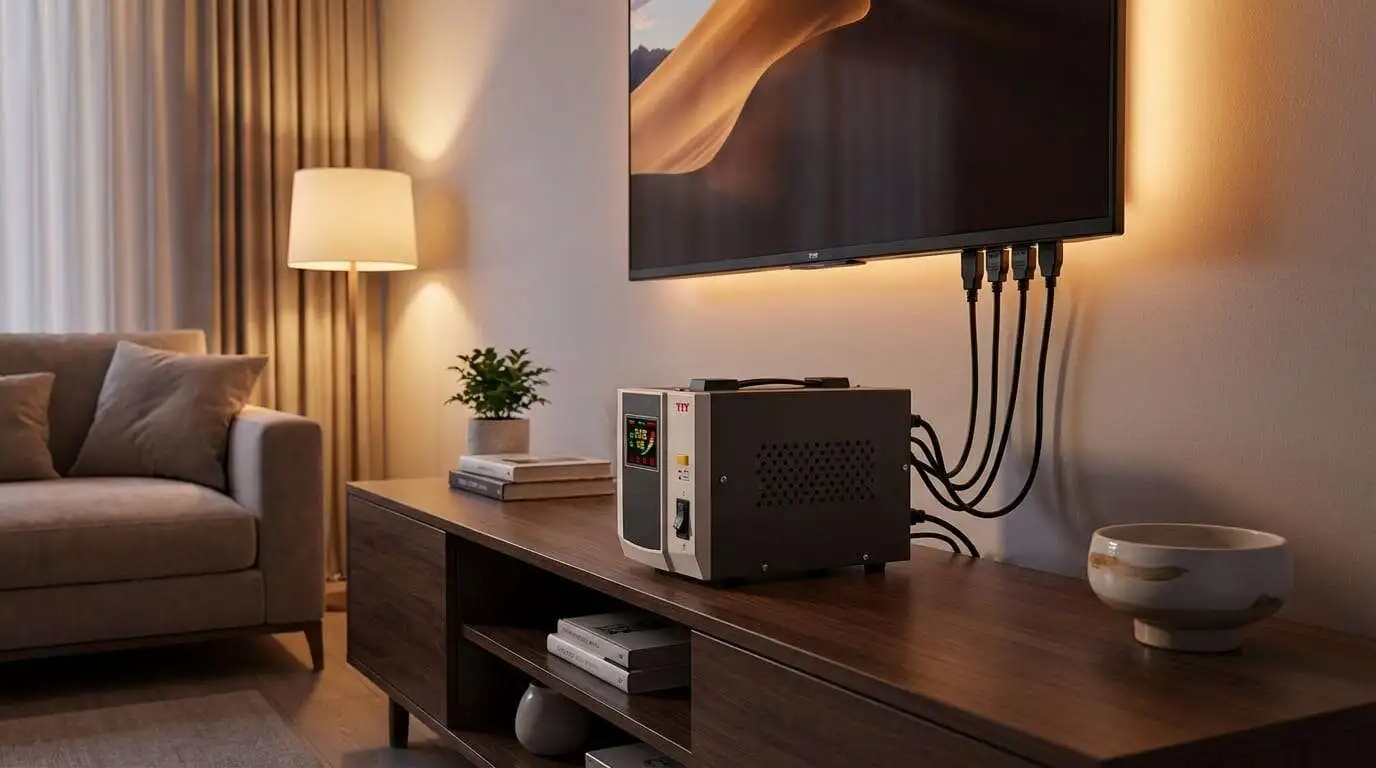
Grid sag dims lights and stresses compressors; surges destroy control boards. A wall-mounted unit keeps the installation clean and saves floor space.
| Recommendation | Why |
|---|---|
| TWS Series (wall-mounted servo, 1–5 KVA) | ±3% accuracy, compact wall-mount, LCD display, input range down to 80 V — handles deep brownouts common in developing-grid regions |
Typical sizing: 1.5-ton split AC (1.2 kW) + refrigerator (0.15 kW) + TV + router ≈ 1.8 kW → 3 KVA TWS.
Office — Servers, POS, Networking
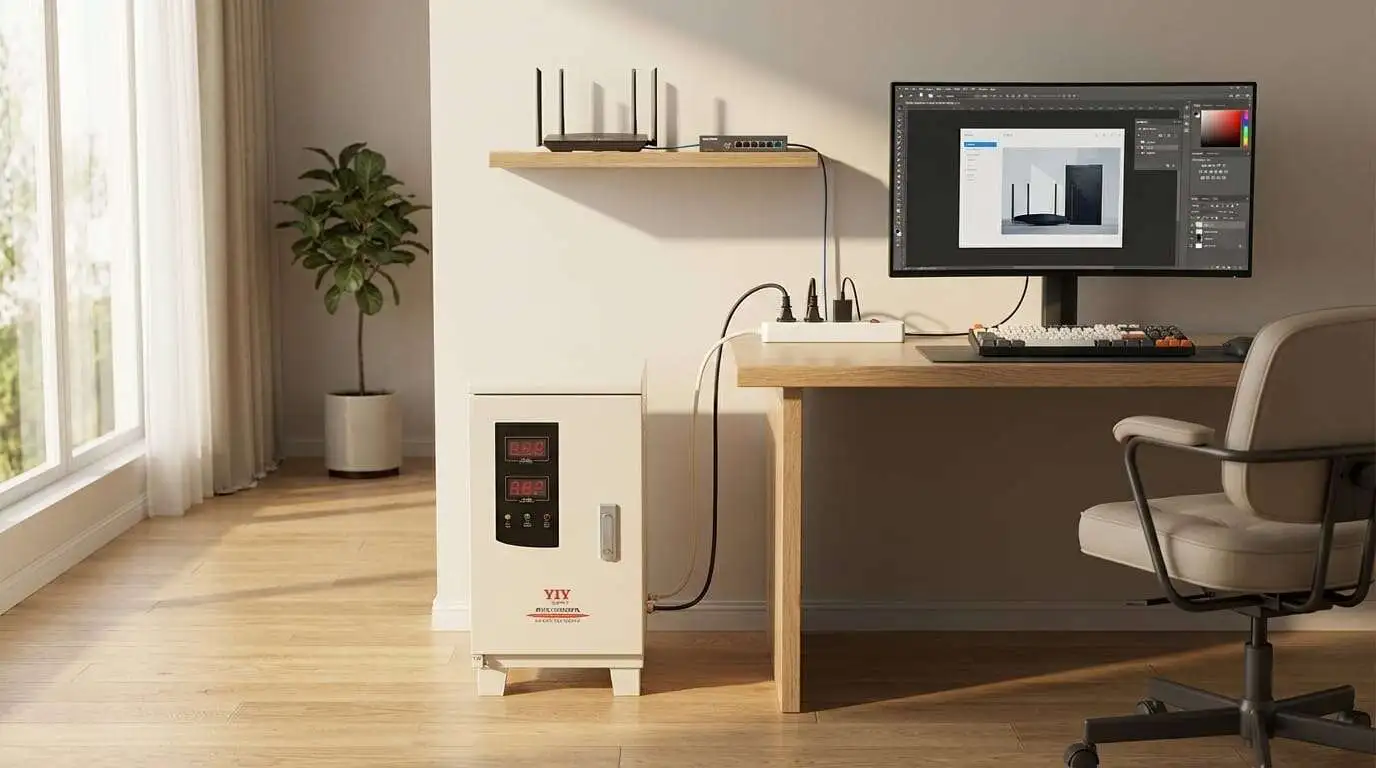
Step-switched relay correction introduces micro-interruptions that reset networking gear. Servo’s continuous adjustment avoids this.
| Recommendation | Why |
|---|---|
| SVC Series (floor-standing servo, 1–5 KVA) | ±2–3% accuracy, industrial-grade build, wide 160–260 V input, floor or rack mounting |
Typical sizing: server rack (1.5 kW) + 4 workstations (0.8 kW) + networking (0.2 kW) = 2.5 kW → 5 KVA SVC.
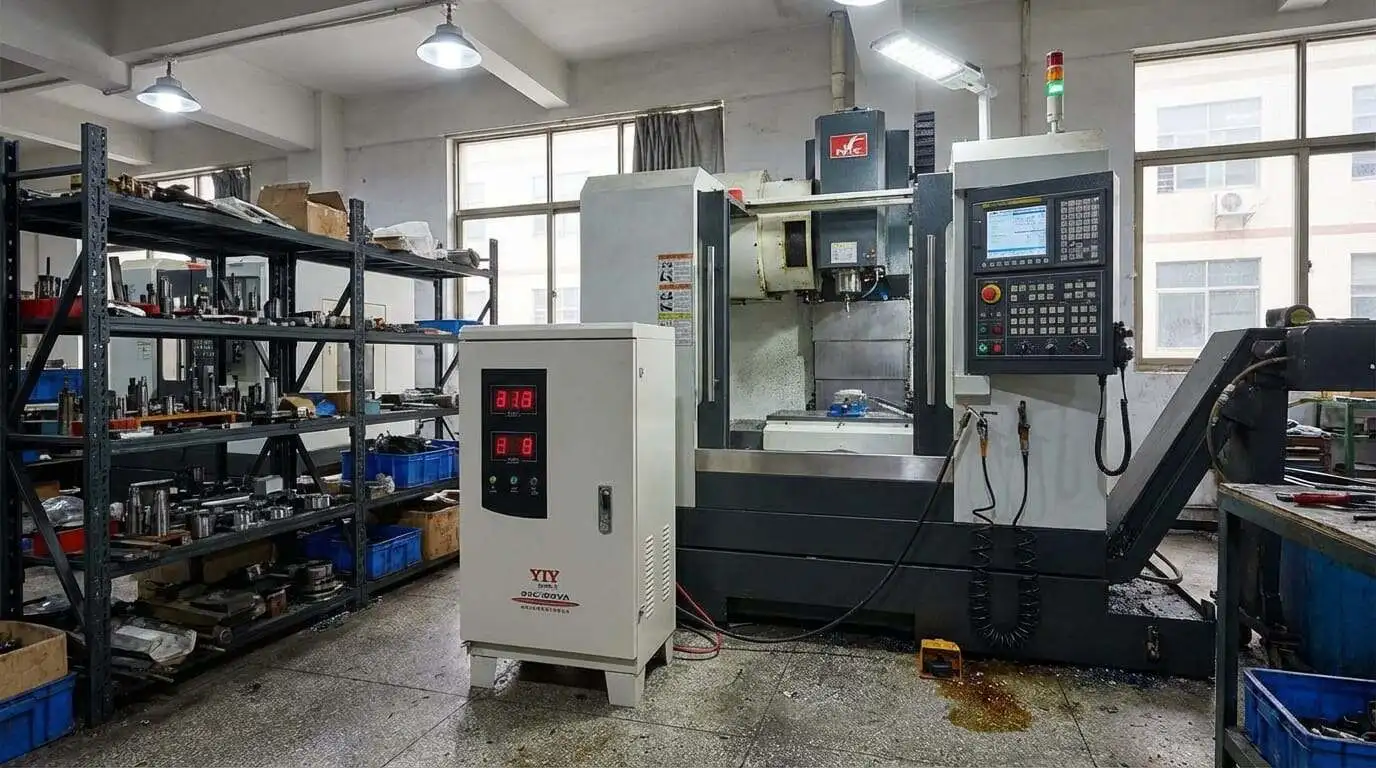
Workshop — Small CNC, Laser Cutter, Test Bench
CNC controllers and laser optics are sensitive to stepped voltage transitions. Servo’s smooth correction is the minimum; IGBT is preferred for precision machining.
| Recommendation | Why |
|---|---|
| SVC Series or CVCF | SVC covers most small CNC loads; CVCF for high-precision or medical-grade instruments |
Typical sizing: CNC controller + spindle (3.5 kW) + auxiliaries (0.5 kW) = 4 kW → 5 KVA SVC (tight margin — consider stepping to the medium-capacity range if inrush is high).
If that “small CNC” load grows into a full workshop with higher motor inrush or three-phase distribution, move to our servo stabilizer for CNC machines guide for machine-specific protection details and the 20 KVA three-phase selection guide for the next realistic capacity band.
What Drives the Price of a Small Voltage Stabilizer
Two buyers requesting the same 5 KVA quote can receive numbers that differ by 40%. Here is why:
Primary cost driver: technology type (see comparison table above). Relay is cheapest; IGBT is 3–4× the price of relay at the same KVA rating.
Secondary cost drivers:
| Factor | Impact on Price |
|---|---|
| Copper vs aluminum winding | Copper adds 15–25% but lasts longer under continuous load and high ambient heat |
| Input voltage range | Wide-range units (80–280 V) cost more than standard (160–260 V) |
| Enclosure rating | IP20 (indoor) is standard; IP54 (dust/splash) adds material cost |
| Certifications | CE + ISO 9001 is baseline; UL/CSA for North America adds testing cost |
| OEM/ODM customization | Custom branding, non-standard voltage, communication protocols (RS485, Modbus) add engineering time |
Five Mistakes That Cause Field Failures
- Ignoring inrush current. A 2.4 kW resistive heater draws 2.4 kW continuously. A 2.4 kW compressor motor draws 3–6× that for the first half-second. Size for the peak, not the nameplate.
- Using nominal voltage instead of measured voltage. Grid nominal is 220/230 V. Actual supply at the point of use may swing from 150 V to 270 V depending on transformer loading and time of day. The stabilizer’s input range must cover measured extremes — log for at least 48 hours.
- Selecting on price alone. A relay unit at ±5–8% costs 30–50% less than servo. But if the application requires ±2% output, the relay causes the same equipment damage it was purchased to prevent.
- Forgetting installation environment. A stabilizer rated for 40°C ambient, installed in a 55°C outdoor cabinet in the Gulf region, overheats and shuts down during peak demand. Derate by 1.5–2% per degree above 40°C.
- No maintenance plan. Servo brushes wear; relay contacts pit; IGBT capacitors age. Scheduled inspection prevents unplanned downtime.
Standards and Certifications to Verify
Do not accept marketing claims. Verify these documents before signing a PO:
| Standard | What It Covers | Why It Matters |
|---|---|---|
| IEC 60038 | Defines nominal voltages and ±10% tolerance | Confirms the unit is calibrated to international grid standards |
| IEC 61000 | Electromagnetic compatibility (EMC) | Ensures the stabilizer does not inject harmonics back into the panel |
| CE marking | EU safety + EMC directives | Legally required for EU deployment; treat as a minimum filter |
| ISO 9001:2015 | Quality management system | Confirms controlled design, production, and traceability |
YIY holds all four, verified and current. Units are eligible for EU, Middle East, Africa, and Southeast Asia deployment without additional compliance work.
YIY Product Matrix for 1–5 KVA
| Series | Type | Capacity | Accuracy | Form Factor | Standout Feature |
|---|---|---|---|---|---|
| TWS | Servo | 0.5–5 KVA | ±3% | Wall-mounted | Compact, LCD display, 80–260 V ultra-wide input |
| SVC | Servo | 0.5–30 KVA | ±2–3% | Floor-standing | Industrial-grade, wide capacity range, easy maintenance |
| AVR | Relay | 0.5–60 KVA | ±5–8% | Floor-standing | Lowest cost, fast electronic switching, minimal maintenance |
| CVCF | IGBT | 1–500 KVA | ±0.5% | Cabinet | Double-conversion, near-silent, millisecond response |
Manufacturing credentials: 30,000 m² facility, 1,000,000+ units/year, 130+ export countries, ISO 9001 + ISO 14001 + CE certified. OEM/ODM available for custom branding, non-standard specifications, and communication protocol integration.
Frequently Asked Questions
What should I evaluate before buying a small voltage stabilizer?
Five factors: (1) total load with 20–30% safety margin, (2) measured input voltage range at the installation point (not grid nominal), (3) required output precision, (4) installation environment (temperature, humidity, dust), (5) destination-market certifications. Resolve the spec before comparing prices.
How do I decide between 3 KVA and 5 KVA?
Apply the formula: total load (kW) ÷ 0.8 × 1.25. If the result is under 2.8 KVA, a 3 KVA unit is comfortable. If it lands between 2.8 and 4.0, choose 5 KVA. If above 4.0, step up to 10 KVA.
Is a servo stabilizer worth the extra cost over relay for home use?
For a single appliance like a TV or router — no, relay is fine. For a circuit that includes an AC compressor or refrigerator — yes, because relay’s stepped correction can reset compressor control boards. Servo’s continuous adjustment avoids this.
What is the price difference between relay and servo at 3–5 KVA?
Servo typically costs 1.5–2× the relay price at the same capacity. The premium pays for continuous ±2–3% correction versus stepped ±5–8% correction. For loads sensitive to voltage steps, the premium avoids equipment damage that costs far more than the price difference.
Can I install a voltage stabilizer outdoors?
Standard units are rated IP20 (indoor only). For outdoor or dusty environments, specify IP54 or higher enclosure rating, and derate the capacity for ambient temperatures above 40°C.
Next Steps
Before requesting a quote, prepare four data points:
- Load list — every device with rated wattage and starting-current multiplier
- Voltage log — 48-hour measurement at the point of connection
- Site conditions — ambient temperature range, humidity, mounting preference (wall / floor)
- Output requirement — required precision band and any communication protocol needs
Submit these to YIY’s engineering team for a complimentary sizing review. The review confirms whether 3 KVA or 5 KVA is the right fit, which technology matches your load, and what input range the unit needs — turning a price inquiry into a specification you can stand behind.