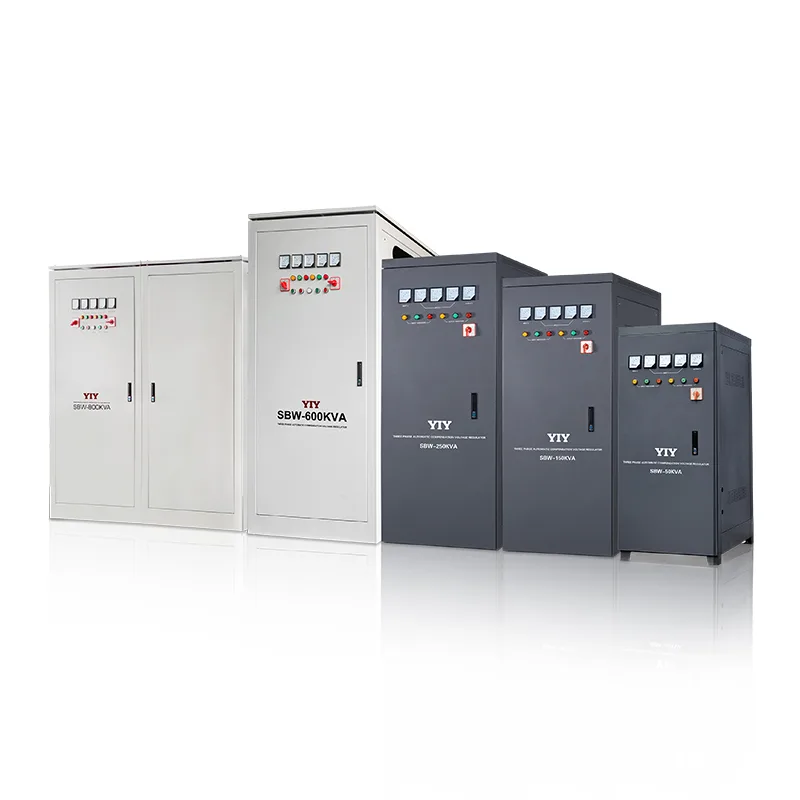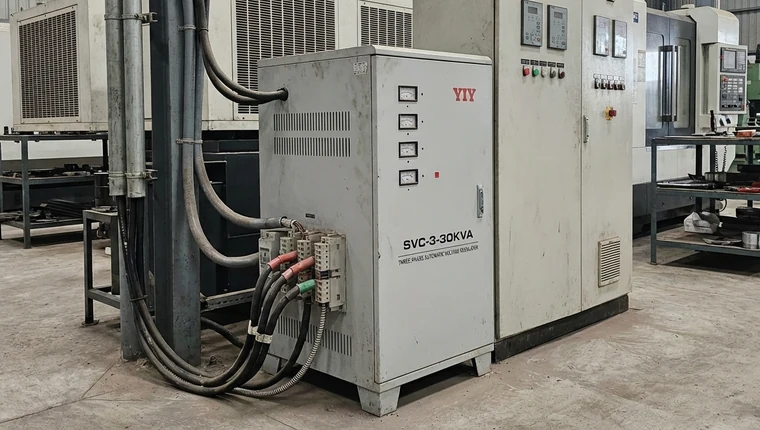
The 30 kva servo stabilizer 3 phase price in india depends on three core variables: the control technology inside the unit, how precisely the specification matches your actual load profile, and what the supplier includes in scope — hardware, protections, certifications, and post-sale support. Get any one of those wrong and the quoted price becomes the wrong number to compare.
This guide is structured as a sizing-to-shortlist reference for plant engineers and procurement teams. It covers how servo technology compares to relay and IGBT designs, what specification checkpoints matter before you request a quote, and where supplier differences actually show up in price.
What a 30 KVA 3-Phase Servo Stabilizer Actually Does
A 30 kVA 3-phase servo stabilizer is an industrial automatic voltage regulator that continuously monitors and corrects incoming supply voltage across all three phases. It sits between the utility feed and your equipment, delivering a stable output — per HomepageIEC 60038 standard voltages, the target for Indian industrial installations is 415V — regardless of what the grid throws at it.

The Servo Correction Loop
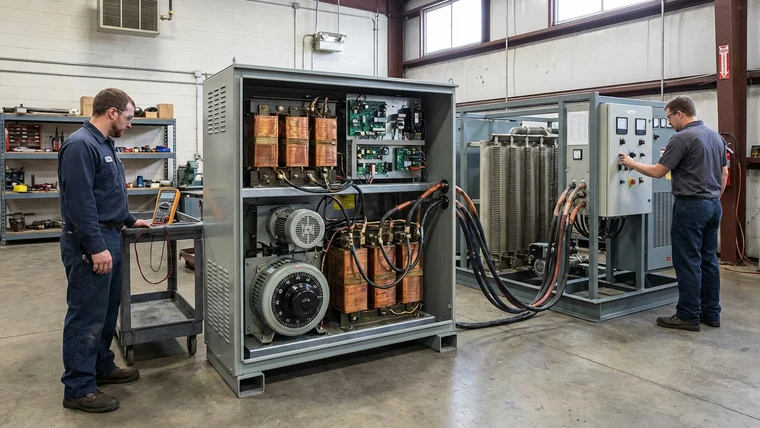
The core mechanism is a servo motor-driven variac (variable autotransformer) connected to a sensing circuit. When the control board detects a deviation from the set output voltage, it drives the servo motor to rotate the variac’s carbon brush — either boosting or bucking the voltage in real time. This is a closed-loop, continuous correction process, not a stepped relay switch. The result: output precision of ±1–2%, which is tight enough for CNC spindle drives, servo motors, and sensitive PLCs that would fault or degrade under wider swings.
Why 30 kVA for Mid-Sized Industrial Loads
Sizing follows a straightforward formula. Take your total connected load in kilowatts, apply a 1.25 safety margin to cover starting current surges and future expansion, then convert to kVA.
A typical mid-sized CNC shop example:
– CNC machine: 15 kW
– Lighting, HVAC, auxiliaries: 5 kW
– Total: 20 kW × 1.25 = 25 kVA minimum
– Select: 30 kVA model (next standard size up)
For detailed load calculation methodology, see our dedicated guide on Servo Stabilizer For Cnc Machinesservo stabilizer for CNC machines.
This margin matters. Motor starting currents can hit 5–7× rated current for 100–300 ms. A unit sized too close to nameplate load will trip on overload or degrade output regulation during startup events.
If your load calculation lands below 25 kVA, a 20kva Voltage Stabilizer Technical Guide20kva voltage stabilizer may be the correct size — the same input-range and cooling checkpoints apply.
Three-Phase Compensation for Indian Grid Conditions
Indian industrial grids frequently run with Three Phase Electric Powerthree-phase power systems phase imbalance — one phase sagging while others hold nominal. A 3-phase servo stabilizer compensates each phase independently, not as a single aggregate. This means a voltage drop on L2 gets corrected without affecting L1 or L3 regulation. For facilities running unbalanced loads across phases — which is the norm, not the exception — this per-phase correction is what keeps sensitive equipment running cleanly.
Who Is Buying This and What Decision They Face
The buyers searching for 30 kva servo stabilizer 3 phase price in india are not browsing — they are specifying. The typical profile is a plant engineer or panel builder at a CNC shop or mid-sized factory, working through a load calculation and trying to close a purchase order. EPC teams sourcing for industrial fit-outs fall into the same category: they need a confirmed specification before they can request a valid quote.
The Core Procurement Decision
The decision is not simply “which stabilizer is cheapest.” It is: does this unit handle our actual input voltage window, our phase imbalance conditions, and our load type — and what does the supplier include in scope?
Indian industrial grids routinely deliver 300–480V across phases, with frequent sags and phase imbalance that vary by region and feeder quality. The output target is 415V ±1–2%. That input-to-output window, combined with whether the load is resistive, inductive, or mixed, determines which model is technically valid — before price enters the conversation.
The same procurement variables — input range, cooling, control board quality — that drive Voltage Stabilizer 20kva Price Guidevoltage stabilizer 20kva price apply at 30 kVA with proportionally higher material cost.
What Buyers Are Evaluating
- Input range coverage: Does the unit handle the actual low-end voltage at the site, not just nominal?
- Cooling method: Oil-cooled for enclosed or high-ambient environments; air-cooled where ventilation is adequate and footprint matters
- Output accuracy: ±1% vs ±2% matters for CNC spindle drives and servo motors; less so for lighting or HVAC
- Phase balance handling: Independent per-phase correction, not aggregate — critical for unbalanced factory loads
- Warranty and after-sales: Especially relevant when sourcing from outside India, where service response time is a real procurement risk
Why India Context Changes the Spec
Voltage fluctuation in Indian industrial zones is not an edge case — it is the baseline operating condition. A stabilizer sized for nominal grid behavior will underperform or trip. This is why servo stabilizers are a standard line item in Indian industrial panel builds, not an optional upgrade.
Servo vs. Relay vs. IGBT: Which Technology Fits Your Load
Before comparing prices, confirm you’re comparing the right technology. The three stabilizer topologies differ in precision, cost, load compatibility, and maintenance — and choosing the wrong one means the quoted price is irrelevant.
Relay-Type: Fast Switching, Limited Precision
Relay stabilizers correct voltage in discrete steps by switching transformer taps. Response is fast, and the design is simple with minimal moving parts. But step-based correction means output accuracy stays in the ±5–8% range — acceptable for lighting, HVAC, and basic commercial loads, but not for CNC drives or servo motors that fault on tighter deviations. Maintenance is low since there’s no mechanical drive component.
IGBT/Static: Highest Precision, Highest Cost
Static stabilizers using IGBT switching achieve ±0.5–1% output accuracy with near-instantaneous response. They’re the right call for ultra-sensitive equipment: medical imaging, semiconductor test benches, precision metrology. The trade-off is cost — IGBT units run significantly higher than servo equivalents at the same kVA rating, and the power electronics add complexity to fault diagnosis. For a standard industrial panel, this precision level is more than the load requires. For a deeper comparison of Stabilizer Voltage Regulator Comparisonservo vs. IGBT technology, see our dedicated technical breakdown.
Servo: The Industrial Default for Good Reason
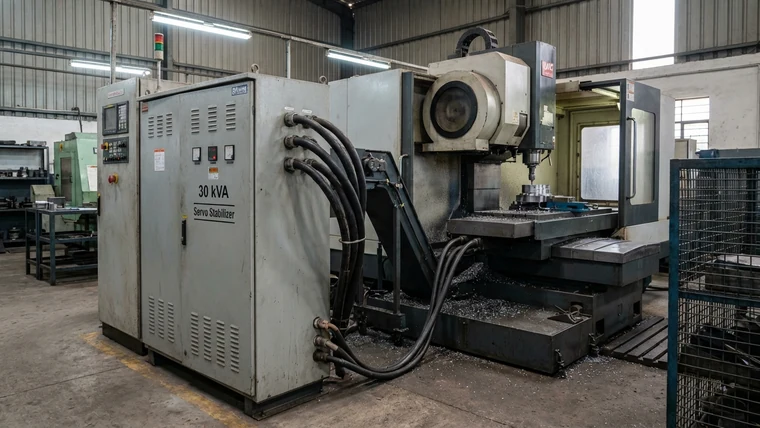
Servo stabilizers hit the practical sweet spot for most 3-phase industrial applications. Output accuracy of ±1–2% covers CNC machines, injection molding equipment, compressors, and mixed factory loads without the cost premium of IGBT. The continuous motor-driven correction handles gradual sags and swells cleanly, not in steps.
The critical advantage for Indian industrial sites: servo designs handle 100% unbalanced loading across phases. When your panel runs different loads on L1, L2, and L3 — which is standard in any mixed-equipment facility — per-phase servo correction keeps each phase regulated independently. Relay and basic static designs don’t offer this at the same price point.
Maintenance note: The servo motor’s carbon brush and variac contact surface require periodic inspection — typically every 12–18 months under continuous industrial use. Relay and IGBT designs have no equivalent wear component. Factor this into total cost of ownership, not just purchase price.
| Technology | Precision | Relative Cost | Unbalanced Load | Maintenance |
|---|---|---|---|---|
| Relay | ±5–8% | Low | Limited | Minimal |
| Servo | ±1–2% | Medium | 100% capable | Periodic brush check |
| IGBT/Static | ±0.5–1% | High | Yes | Low |
For a 30 kVA 3-phase industrial installation in India, servo is the correct starting point unless the load profile specifically demands IGBT-level precision or the application is purely light commercial.
Specification Checkpoints Before You Request a Quote
For smaller 3-phase loads, a 3 Phase Voltage Stabilizer 20kva Type Selection3 phase voltage stabilizer 10kva may be sufficient — the same specification checkpoints apply at lower capacity. At 30 kVA, a valid quote requires a valid specification. Suppliers price against what you give them — an incomplete spec means the number you get back is either padded for unknowns or missing scope entirely. Run through these five checkpoints before you approach any supplier.
Input Voltage Window
Confirm the actual fluctuation range at your site, not the nominal value. Indian industrial feeders commonly swing between 300V and 480V across phases, and the stabilizer’s input range must cover your real low-end, not just 415V nominal. A unit rated for 340–460V input costs less than one covering 300–480V — the wider the correction window, the more variac travel and transformer capacity required. Measure your site voltage over at least a week before specifying.
Load Type: Resistive vs. Inductive
Resistive loads (heating elements, lighting) draw steady current. Inductive loads — motors, compressors, CNC spindle drives — draw 5–7× rated current for 100–300 ms at startup. For inductive loads, apply a 1.5–2× sizing multiplier on top of your kVA calculation. A 30 kVA unit sized for a 20 kW resistive load is not the same as one sized for a 20 kW motor-heavy panel. Confirm your load mix before finalizing the model.
Cooling Method
Air-cooled units suit most factory floors with adequate ventilation — lower cost, easier maintenance, smaller footprint. Oil-cooled units are the right call for dusty environments, outdoor installations, or enclosed enclosures where heat dissipation is constrained. Specifying the wrong cooling method means either premature thermal trips or unnecessary cost. State your installation environment explicitly in the RFQ.
Bypass Requirement
Manual bypass allows maintenance without shutting down the load — the operator switches to direct supply while the stabilizer is serviced. Automatic bypass cuts over without operator intervention if the stabilizer faults. Both add cost; automatic bypass adds more. For critical production lines where downtime is measured in lost output, bypass is not optional — it’s a reliability requirement. Decide this before quoting, not after.
Protection Features to Verify
Don’t accept a spec sheet that only lists kVA and input range. Confirm these protections are present and rated correctly:
- Overload protection: rated at ≥120% of nameplate — units that trip at 105% will fault on normal motor starting events
- Short circuit protection: PCB-level, not just fuse-based
- Over/under voltage cutoff: output disconnect when correction limits are exceeded
- Fan failure cutoff: thermal protection that shuts down before winding damage occurs
- Motor protection: relevant if the stabilizer feeds motor-heavy loads directly
These protections determine whether the unit survives your actual operating conditions — not just whether it works on a clean bench test.
What Drives 30 KVA Servo Stabilizer 3 Phase Price in India
The 30 kva servo stabilizer 3 phase price in india is not a fixed number — it’s a function of four spec variables and two supplier variables. Get the spec wrong and you’re comparing units that aren’t equivalent. Get the supplier wrong and the quoted price doesn’t reflect what you’ll actually receive.
Core Spec Variables That Move the Price
Input voltage range is the single biggest cost driver. A unit rated for 340–460V input costs less than one covering 300–480V. Wider correction range requires more variac travel and transformer capacity — that’s real material cost, not margin padding. If your site voltage regularly dips below 320V, you need the wider-range model, and it will cost more.
Cooling method is the second lever. Air-cooled units in the 30 kVA range are the standard choice for ventilated factory floors — lower cost, easier maintenance, smaller footprint. Oil-cooled units add 15–25% to the price but are the right call for dusty environments, outdoor enclosures, or high-ambient installations where air cooling can’t dissipate heat reliably.
Control board quality separates entry-level from industrial-grade. Basic servo designs use analog control circuits with ±2–4% output accuracy. MCU-based control (as in YIY’s PRO-3 series) achieves ≤2% precision with additional protections: motor protection, fan failure cutoff, and overload rated at ≥120% of nameplate. These aren’t premium features — they’re what keeps the unit running under real industrial load conditions.
Protection depth affects both price and reliability. A unit with PCB-level short circuit protection, over/under voltage cutoff, and fan failure shutdown costs more than one with fuse-only protection. The difference shows up in the BOM, not just the spec sheet.
India Market Reference Pricing
Air-cooled 30 kVA 3-phase units from India-domestic suppliers are quoted in the range of approximately Rs 55,000–60,500. Oil-cooled models and wider-input configurations push above that band. These figures are indicative — final price depends on the full spec, not just kVA rating.
Global vs. Domestic Supplier Trade-Off
India-domestic players like Servomax serve local government and industrial projects but operate without IGBT capability and without OEM/ODM programs. If your spec evolves — wider input range, higher kVA, custom enclosure — they can’t scale with you.
YIY (Iso 9001 Quality Management.htmlISO 9001:2015 certified, 130+ export countries, 500 VA–3000 kVA range) offers OEM/ODM customization and a full technology stack across servo, relay, and IGBT topologies. For procurement teams planning plant expansion, a supplier with capacity breadth from 500 VA to 3000 kVA means one vendor relationship covers future load growth without re-qualifying a new supplier.
No published list price is reliable for this category. Final cost depends on input spec, cooling method, bypass configuration, and order volume. Request a quote with your full load list attached.
YIY Series Options for 30 KVA 3-Phase Applications
YIY offers three 3-phase servo series that cover the 30 kVA use case at different capability levels. The right choice depends on your input voltage window, load type, and how much protection depth your application requires.
SVC-3 Series — Baseline 3-Phase Servo
The SVC-3 (1.5–100 kVA) is the entry point for 3-phase servo correction. It handles 100% unbalanced loading across phases, includes isolated bypass, and ships with LED/analog display options. Wide input range coverage and full standard protections make it a solid fit for stable industrial sites where the grid doesn’t swing to extremes.
For a standard 30 kVA CNC shop installation with moderate voltage variation, the SVC-3 delivers what most basic servo competitors offer — but with verified unbalanced load handling that many domestic India-market units don’t explicitly rate.
PRO-3 Series — MCU Control, Tighter Precision
The PRO-3 (1.5–100 kVA) is the key upgrade over basic servo designs. MCU-based control achieves ≤2% output precision — tighter than analog-controlled competitors. It adds motor protection, fan failure cutoff, and overload rated at ≥120% of nameplate. That last point matters: units rated at 105% will trip on normal motor starting events; the PRO-3 won’t.
For CNC spindle drives, injection molding machines, or any motor-heavy panel, the PRO-3’s protection stack is what separates a unit that survives real industrial conditions from one that passes a bench test.
PWR-3 Series — For Sites With Severe Voltage Dips
The PWR-3 (45–150 kVA) targets installations where the grid regularly drops to extreme lows. Ultra-low input capability, surge protection, and multi-display monitoring make it the right call when standard servo input ranges aren’t wide enough. If your site voltage dips below what the SVC-3 or PRO-3 can correct, the PWR-3 is the model to specify.
Supplier Differentiation
All three series are manufactured under ISO 9001:2015 certification and exported to 130+ countries. OEM/ODM customization is available — relevant for panel builders and EPC teams who need custom enclosures, labeling, or modified input specs. India-domestic competitors like Servomax don’t offer OEM/ODM programs or IGBT alternatives, which limits their flexibility as your load profile evolves.
Ready to confirm the right model? Share your load list, motor starting current, input-voltage window, and site conditions — YIY’s engineering team will run a sizing review and recommend the correct series and configuration.
Frequently Asked Questions
What should buyers evaluate before choosing a 30 KVA servo stabilizer 3 phase price in India?
Price alone is the wrong starting point. Before requesting a quote, confirm five things: your actual site voltage range (not nominal — measure it over at least a week, since Indian industrial feeders commonly swing between 300V and 480V); your load type (resistive vs. inductive — motor-heavy panels need a 1.5–2× sizing multiplier on top of the kVA calculation); cooling method (air-cooled for ventilated floors, oil-cooled for dusty or enclosed environments); whether bypass is required for critical production lines; and what protections are included — overload rated at ≥120% of nameplate, PCB-level short circuit protection, and fan failure cutoff are non-negotiable for real industrial conditions. An incomplete spec means the quoted price doesn’t reflect what you’ll actually receive.
When is a 30 KVA 3-phase servo stabilizer necessary for industrial applications?
A 30 kVA 3-phase unit is the right call when your total connected load sits in the 20–25 kW range and your equipment includes CNC machines, servo motors, injection molding equipment, or other inductive loads that fault or degrade under voltage swings wider than ±2%. Indian industrial grids routinely deliver phase imbalance alongside voltage sags — a 3-phase servo stabilizer corrects each phase independently, which is what keeps sensitive equipment running cleanly. If your load is purely resistive (lighting, basic HVAC), a relay-type unit may be sufficient at lower cost.
How should a 30 KVA 3-phase servo stabilizer be sized and specified?
Start with your total connected load in kilowatts, apply a 1.25× safety margin to cover motor starting surges and future expansion, then convert to kVA. A typical example: 15 kW CNC + 5 kW auxiliaries = 20 kW × 1.25 = 25 kVA minimum — select the 30 kVA model as the next standard size up. For motor-heavy panels, use a 1.5–2× multiplier instead. Then confirm the input voltage window covers your actual site low-end, not just 415V nominal.
Final Thoughts
For most Indian industrial 3-phase loads at 30 kVA, servo is the right technology. It delivers ±1–2% output precision, handles 100% unbalanced loading across phases, and sits at a cost point that relay can’t match on accuracy and IGBT can’t match on price. The variables that move the quoted number are input voltage range, cooling method, control board quality, and protection depth — not kVA alone.
A generic price is the wrong number to act on. The correct number comes from your actual load list, motor starting current, site voltage window, and installation environment. Bring that data to YIY’s engineering team for a sizing review, and you’ll get a configuration that fits — not a ballpark that doesn’t.
About YIY
Zhejiang Yiyen Holding Group Co., Ltd. (YIY) is a professional voltage stabilizer manufacturer with 16+ years of experience. With a 30,000sqm modern facility and an annual production capacity of 1,000,000+ units, our products are exported to 130+ countries. We provide OEM/ODM customization services and are ISO 9001:2015 certified, committed to delivering stable and reliable voltage protection solutions to global customers.
Contact Us
Email: yiyen at yiyen.com
Phone/WhatsApp: +86 13587452904
Website: https://www.yiyavr.com/
If you found this article helpful, contact us for a sizing review or customized solution.