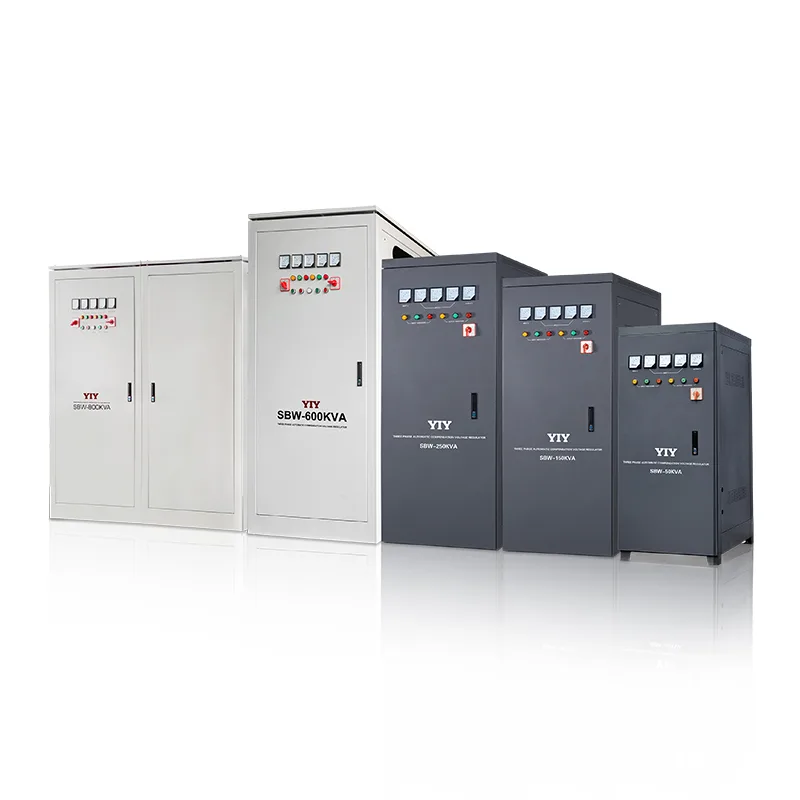
The right voltage stabilizer 3 phase system is the one that matches your connected kVA, motor starting current, phase balance, voltage sag depth, and load sensitivity to the correct topology: servo, static/IGBT, or relay.
In this guide, you will compare three-phase versus single-phase correction, choose between servo, relay, and static/IGBT regulation, size capacity around startup current and phase unbalance, and prepare a practical RFQ checklist before you buy.
When Do You Need a Three-Phase Stabilizer Instead of Separate Single-Phase Units?
You need a three-phase stabilizer when your equipment depends on stable line-to-line voltage, balanced phase behavior, or continuous industrial operation above small isolated loads.

A single-phase stabilizer regulates one phase. That may work for a small office load, one appliance, or a single 230V machine. Your three-phase machinery is different: the motor, drive, control board, or production panel sees the relationship between L1, L2, and L3. If each phase is corrected independently, one leg may recover while another remains low, high, or delayed.
A centralized three-phase stabilizer monitors the complete supply pattern and corrects the three-phase system as one electrical environment. For your plant, that means better control of line-to-line voltage, phase loss risk, and motor heating than three unrelated single-phase units can usually provide.
According to IEC 60038 standard voltage systems, AC systems are standardized around nominal voltage levels. Many industrial specifications then design correction windows around defined supply variation limits such as +/-10%. For you, this means the input range on the stabilizer quotation should be checked against real incoming voltage logs, not only the nominal voltage printed on your machine nameplate.
Your load condition Better choice Why it matters to you If you ignore it CNC, PLC, robotics, servo drives Three-phase AVR or line conditioner Protects line-to-line stability for sensitive controls Drive alarms, board faults, process errors Pumps, compressors, lifts, conveyors Three-phase servo stabilizer Handles motor-heavy panels with startup stress Contactor chatter, winding heat, nuisance trips Mixed production panel above small isolated loads Centralized three-phase system Corrects the panel as one supply environment Uneven correction and callbacks Weak grid, sag, surge, or generator feed Balanced three-phase regulation Reduces repeated undervoltage and overvoltage events Downtime, thermal stress, unstable output
Your warning signs are usually practical: motors run hotter than expected, drives trip during startup, one phase reads consistently lower, or generator transfer causes repeated control faults. Before you choose a model, record your L1-L2, L2-L3, and L3-L1 voltage under normal production and during the largest motor start.
Which Technology Fits Your Precision, Response Time, and Budget?
For most industrial loads, a servo three-phase stabilizer gives you the best balance of capacity, precision, and cost; choose static/IGBT only when your load trips on fast dips, and use relay/tap-switching for less sensitive loads where wider output variation is acceptable.
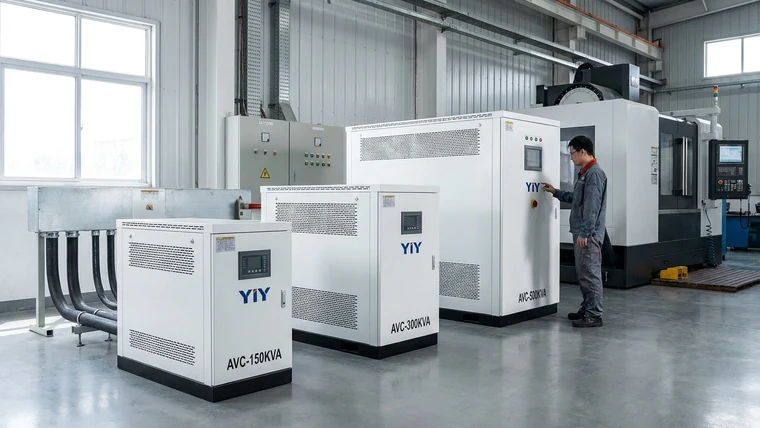
The technology decision is not only about price. Your load sensitivity decides how tightly the output must be held and how quickly the correction must happen after a sag or surge.
Technology Typical output precision Typical response time Best fit for your load Practical meaning Servo-motor AVR +/-0.5% to +/-3% About 1-2 s CNC, motors, pumps, compressors, mixed production panels Smooth correction for sustained grid drift and most industrial voltage fluctuation Relay / tap-switching +/-5% to +/-8% <0.5 s Basic machinery, lighting, non-critical utility loads Faster tap change, but output moves in steps and tolerance is wider Static / IGBT stabilizer About +/-0.5% <20 ms PLC-heavy lines, lab equipment, medical equipment, sensitive electronics, unstable generator feeds Fast electronic correction for loads that trip before mechanical correction finishes
A response time of <20 ms means the stabilizer can respond within about one cycle on a 50 Hz supply. For your PLCs, sensors, drives, and control boards, that can be the difference between a ride-through event and a machine stop. A response time of 1-2 seconds can still be fully suitable when your main risk is sustained low voltage, slow grid drift, or motor heating rather than instant electronic trip behavior.
The official IEC 61000-4-11 voltage dip and interruption immunity testing page defines testing around voltage dips and interruptions. For your selection process, the practical lesson is simple: do not compare stabilizers only by nominal input range. Compare them against your actual sag depth, sag duration, and equipment trip behavior.
If your project is around a smaller industrial panel, a capacity-specific guide such as a 3 phase voltage stabilizer 10kva reference can help you compare load type, motor startup, cabinet format, and cost drivers before you scale the same logic upward.
How Does a Three-Phase Stabilizer Correct Voltage Sags While Your Equipment Stays Online?
A three-phase stabilizer keeps your equipment online by sensing incoming voltage continuously, comparing it with the target output window, and adjusting the correction circuit while power remains connected to the downstream load.
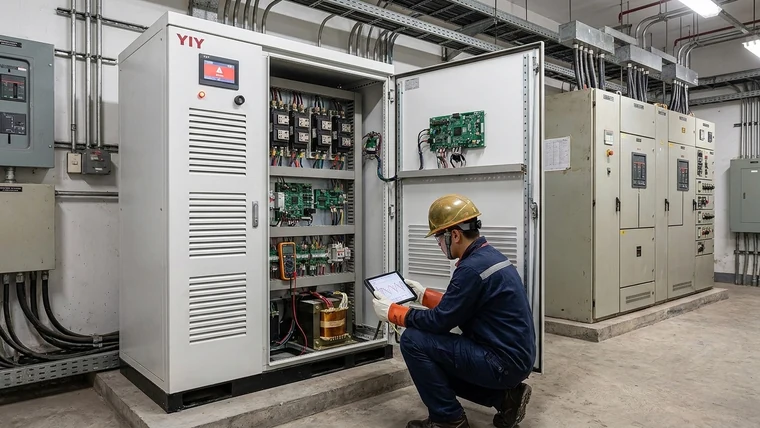
Your stabilizer is not only a protective switch. It is a closed-loop regulation system. The control board reads the incoming three-phase supply, detects whether voltage is outside the target range, and commands the correction element to restore output.
The correction path usually works like this:
1. Voltage sensors monitor L1-L2, L2-L3, and L3-L1. 2. The controller checks undervoltage, overvoltage, phase loss, phase sequence, and sometimes frequency. 3. A servo model moves a motorized variac to correct output smoothly. 4. A static/IGBT model uses electronic switching or DSP/PWM control to correct much faster. 5. Protection circuits alarm, bypass, or isolate the load when the fault exceeds the safe correction range.
For your operation, the key is matching correction behavior to failure mode. If your machinery trips during short dips, response time matters more. If your motors suffer from long low-voltage periods, transformer reserve, copper section, cooling, and continuous-duty capacity may matter more than ultra-fast switching.
How Should You Size kVA Around Startup Current and Phase Unbalance?
Size your stabilizer from running kVA, power factor, largest startup current, input-voltage range, phase unbalance, duty cycle, and a practical reserve margin instead of nameplate kW alone.
The working formula is:
Required stabilizer kVA = corrected running kVA + startup allowance + reserve margin
For your procurement file, that means kW is not enough. Motors draw apparent power, not only real power, so power factor changes the real stabilizer burden. A motor-heavy panel can look safe on a running-load list and still sag during compressor, pump, lift, or conveyor startup.
A common engineering approach is to allow for the largest motor starting surge, often in the 1.5x-2.0x range depending on starting method and site behavior, then add a 20-25% reserve for heat, input-voltage derating, phase unbalance, and future expansion. In practical terms, this reserve helps the stabilizer survive real production conditions instead of operating permanently at its nameplate edge.
Sizing input What you should verify What it means for you Total running kVA Measured panel current and voltage under normal production Prevents undersizing during continuous duty Power factor Motor and drive load characteristics Converts kW into actual apparent power demand Largest startup current Clamp-meter reading or starter data Avoids voltage dip during motor start Input-voltage window Lowest and highest logged incoming voltage Wider correction range may require a stronger transformer and larger cabinet Phase current unbalance L1, L2, and L3 current under load Reduces one-leg overheating and nuisance trips Duty cycle Continuous, intermittent, or simultaneous operation Avoids both unnecessary oversizing and risky undersizing Environment Heat, dust, humidity, ventilation, altitude Protects real capacity and component life
For a full execution workflow, use a 3 phase main line stabilizer sizing process that includes running kVA, power factor, startup current, input-voltage range, and phase current unbalance. Your best RFQ will include measured data, not only equipment nameplates.
Input range is one of the easiest traps to miss. A unit correcting +/-20% and a unit correcting +/-35% may share the same nominal kVA, but the wider correction model handles deeper sags and higher current stress. For your installation, deeper sag correction often means a larger transformer core, more copper, stronger ventilation, and a floor-standing cabinet rather than a compact wall-mounted box.
What Should You Check Before Approving the Quotation?
You should approve the quotation only after the supplier has matched topology, kVA, input range, protection, installation environment, and service access to your real site conditions.
A low price can hide the wrong correction range, weak thermal design, missing bypass, or insufficient reserve for motor starts. Use this procurement screen before you sign off.
Check Why it matters If you skip it Load list and measured current Confirms real kVA instead of estimated kW The unit overheats or trips under normal production Largest motor startup behavior Captures the short event that often causes sag The stabilizer looks correct on paper but fails at startup Input-voltage logs Shows actual sag depth and high-voltage events You buy the wrong correction window Phase balance Identifies whether one leg carries more current Motors and transformers run hotter Protection functions Covers phase loss, over/under-voltage, overload, bypass, alarms Faults become downtime instead of controlled events Cabinet and environment Checks heat, dust, humidity, IP needs, cable access, ventilation Service life drops and maintenance access becomes difficult Documentation and service Confirms drawings, test records, wiring, warranty, and spare support Installation and troubleshooting become slower
For broader sourcing decisions, the industrial voltage stabilizer selection framework helps you compare total load, power factor, startup current, safety margin, input-voltage range, phase type, and application sensitivity. If your project is moving into higher capacity, it is also worth using a checklist to compare before buying a voltage stabilizer so topology, transformer reserve, protection, service access, and quotation scope are reviewed together.
If you are comparing regional pricing such as 3 phase voltage stabilizer price in Kenya, avoid treating online prices as final landed cost. Your actual quotation can change with input range, copper content, cabinet type, freight, duties, certification requirements, bypass configuration, and local service expectations. Ask suppliers to state what is included before you compare numbers.
What Does YIY Bring to This Selection Process?
You get the best result from YIY when you use the first conversation as a quick fit review rather than a full documentation burden.
YIY supports relay, servo, and IGBT voltage stabilization across a broad capacity range, including industrial three-phase applications. That matters when your project is not only “how many kVA,” but whether the load needs economical servo correction, step regulation, or fast static/IGBT response.
YIY also provides OEM/ODM support for projects where your cabinet format, input range, alarm logic, language labels, terminal layout, or installation conditions differ from a standard model. For procurement, that helps when your panel builder, EPC contractor, or distributor needs a defined specification rather than a generic product page.
YIY cites ISO-based manufacturing and management practices; if your procurement process requires certification evidence, verify the certificate name, scope, issuing body, and validity date against the official ISO 9001:2015 quality management systems standard page and the supplier’s current documents. That gives your quality file a concrete verification action instead of a principle-level trust statement.
Frequently Asked Questions
How Do You Balance a 3 Phase Load Before Selecting a Stabilizer?
Balance your load by measuring current on L1, L2, and L3 during normal production, then redistributing auxiliary single-phase loads if one phase is consistently higher. For motor-heavy panels, also measure startup current because a balanced running load can still sag during motor starting.
How Does a 3 Phase Stabilizer Correct Voltage Sags Without Interrupting Downstream Equipment?
A 3 phase stabilizer corrects voltage sags by continuously sensing input voltage and adjusting its correction circuit while power remains connected. Servo models drive a motorized variac, while static or IGBT models use electronic switching for faster correction. To verify the fit, compare the quoted response time with your voltage logs and the trip behavior of your most sensitive equipment.
Should You Choose a Wall-Mounted or Floor-Standing Unit for a 15kVA to 30kVA Installation?
For most 15kVA to 30kVA industrial motor, mixed machinery, or wide input-range installations, choose a floor-standing unit. A wall-mounted unit can fit lighter-duty loads only when weight, heat, bypass access, cable bending radius, ventilation clearance, and maintenance access remain safe.
What Is the Difference Between Single-Phase Stabilizer and 3-Phase Stabilizer?
A single-phase unit corrects one live conductor; a 3-phase unit corrects all three lines together so line-to-line voltage stays steady. Use single-phase units for isolated 230V loads; use a three-phase unit for CNC machines, pumps, compressors, lifts, production lines, and distribution panels where phase imbalance can overheat motors or trip drives.
What Should You Verify Before Accepting a Compliance or Quality Claim?
Verify the exact standard name, certificate number, issuing body, scope, factory name, and validity date. For example, if a supplier cites ISO 9001:2015, ask for the certificate and confirm that the scope covers stabilizer design, manufacturing, or service rather than an unrelated business activity.
Final Fit Decision
Your best voltage stabilizer 3 phase choice comes from matching load risk to technology: servo for most motors and mixed industrial panels, static/IGBT for fast-tripping electronics and precision loads, and relay for less sensitive utility applications. After that, your sizing should account for running kVA, power factor, startup current, input-voltage range, phase unbalance, and installation environment.
Start with a quick review before building a full RFQ. Share your load list, largest motor startup condition, expected input-voltage window, and installation conditions with YIY, and ask for a first-pass sizing recommendation for the safest topology and capacity range.