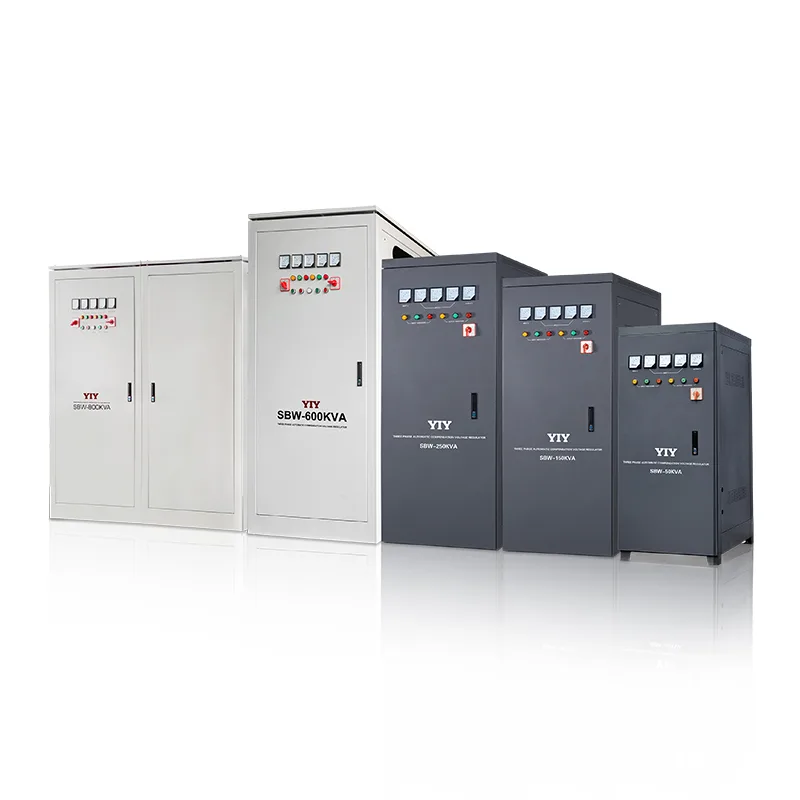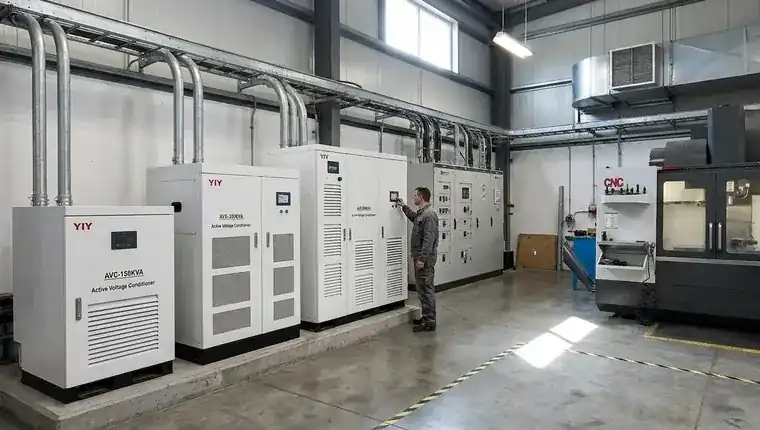
The right 3 phase stabilizer type depends on your load sensitivity, input-voltage fluctuation, starting current, phase balance, and required response accuracy: relay suits basic correction, servo fits most industrial precision loads, and IGBT/static AVR fits sensitive or fast-changing equipment.
YIY documented stabilizer ranges span relay about +/-5-8%, servo about +/-0.5-3%, and IGBT about +/-0.5% output accuracy, so the practical decision is not just “what kVA do I need?” but “how tightly must the voltage be controlled?”
If your load includes motors, CNC equipment, lifts, lab instruments, medical devices, or uneven three-phase demand, your safest shortlist starts with measured site behavior rather than catalog capacity alone. This guide walks you through when a three-phase AVR is needed, how relay, servo, and IGBT options compare, what happens inside the cabinet, which sizing inputs to collect, and what procurement checks protect you from a wrong specification.
If you need the broader industrial path behind this topic, start with Three-Phase Voltage Stabilizers.
When Is a Three-Phase Voltage Stabilizer the Right Fit for Your Load?
You should evaluate a three-phase voltage stabilizer when your equipment depends on stable three-phase power and voltage fluctuation can stop production, trip controls, overheat motors, or reset sensitive electronics. In practical terms, if one unstable feeder can affect several machines or one critical process, you should solve the feeder-level power issue before treating each equipment fault separately.
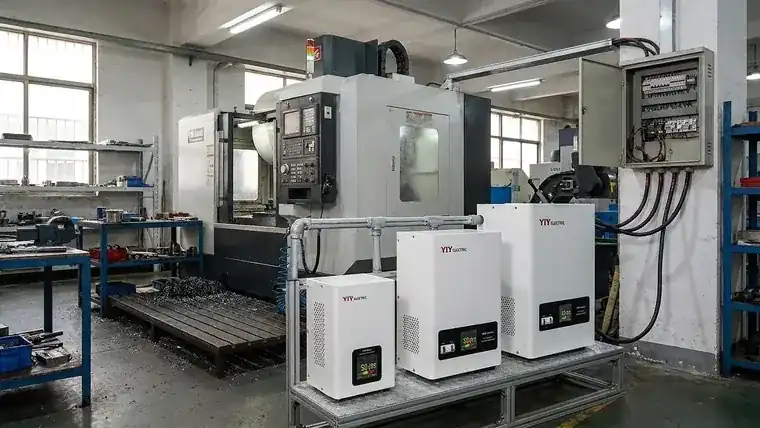
A voltage stabilizer is an automatic voltage regulator, or AVR, that maintains output voltage despite input-voltage variation. It helps your load ride through sags, brownouts, and unstable supply conditions that would otherwise appear as drive faults, contactor chatter, PLC resets, temperature alarms, or unexplained machine stops.
The official IEC 60038 standard system voltages page is a useful reference when you compare your measured site voltage against standard system-voltage expectations. For you, that means you can discuss 380V, 400V, 415V, or project-specific voltage targets with a recognized technical reference instead of relying only on local habit or a nameplate assumption.
Single-phase correction is not enough when your load depends on phase-to-phase voltage stability. A single-phase stabilizer can protect one isolated load, but it cannot properly regulate a shared three-phase panel, lift, compressor, main feeder, CNC system, or motor circuit where all phases must remain coordinated.
Consider a three-phase AVR, line conditioner, or servo configuration when your site shows these signals:
- Recurring undervoltage alarms on drives, CNC controllers, UPS inputs, or medical devices
- Motor overheating without a clear mechanical overload cause
- Contactor chatter during generator changeover, brownouts, or peak-demand periods
- Drive trips linked to DC bus undervoltage, phase loss, or input instability
- Machine resets during compressor starts, lift operation, or grid dips
If those symptoms match your site, review YIY’s three-phase stabilizers as the product family before narrowing the technology. The hub helps you move from symptoms to the correct three-phase voltage stabilizer category rather than comparing unrelated single-phase or residential units.
For dusty workshops, humid utility rooms, generator-fed sites, or unstable rural grids, specify cabinet conditions early. Your quote should address ventilation clearance, enclosure or IP expectations, surge and phase-loss protection, ambient-temperature limits, alarm visibility, and any metering or event records your maintenance workflow needs.
Before you finalize sizing or implementation details, review 3 phase main line stabilizer sizing.
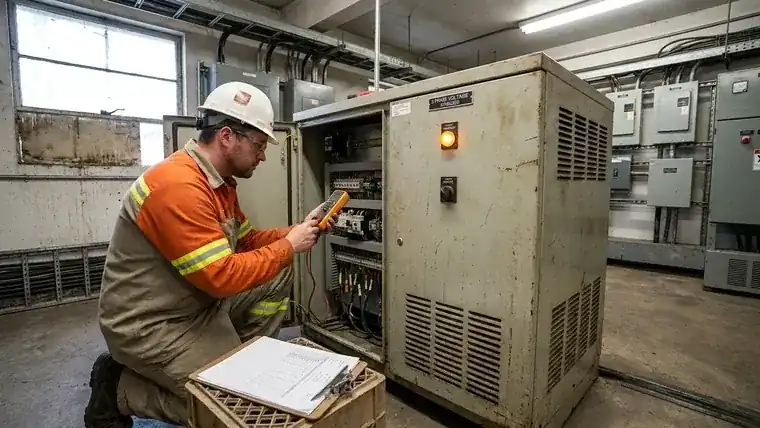
Before you finalize sizing or implementation details, review industrial voltage stabilizer selection.
Which Technology Fits Your Precision and Budget Requirements?
You should shortlist relay, servo, or IGBT/static regulation by load tolerance first, then compare price, cabinet design, and supplier options. A lower-cost stabilizer can be the right choice for rugged loads, but a sensitive controller, lift, CNC cell, or lab instrument may need tighter correction than a basic tap-switching unit can provide.
| Stabilizer type | Regulation method | Documented output precision | Best-fit load profile | What it means for you |
|---|---|---|---|---|
| Relay tap-switching | Transformer taps switched by relays | About +/-5-8% | Rugged commercial loads, lighting, basic HVAC, small mixed panels | Your equipment must tolerate wider voltage steps and less precise correction. |
| Servo motor-driven autotransformer | Motor adjusts transformer contact position | About +/-0.5-3%, response around <=1-2s | Motors, lifts, compressors, CNC support panels, 10-30kVA workshops, 100kVA+ industrial feeders | You get tighter output for most industrial loads without jumping straight to a static system. |
| IGBT/DSP PWM static AVR | Power electronics with PWM / AC-DC-AC conversion | About +/-0.5% where applicable | CNC controllers, lab equipment, medical devices, semiconductor tools, generator-fed or fast-swinging grids | Your sensitive electronics receive a cleaner voltage window when slower correction is not enough. |
For a 3kVA lab bench, test instrument, or small medical load, relay correction may be too coarse if the device resets on dips. A compact servo or static AVR is usually safer when the connected equipment has strict tolerance, even if the kVA number looks small.
For a 5kVA 3 phase stabilizer serving mixed office, light workshop, or small commercial equipment, servo is often the balanced shortlist unless your voltage swing is mild and the load is rugged. The practical value is stable correction without over-specifying a static cabinet for a load that does not need it.
In the 10-30kVA range, servo regulation usually earns its keep because motors, lifts, CNC auxiliaries, pumps, and compressors need stable correction through everyday grid variation. If your comparison has already moved into budget planning, the 20 kva 3 phase stabilizer price guide can help you separate real cost drivers from generic price-list noise.
At 100kVA and above, the technology decision still starts with load behavior, but your cabinet design becomes more important. Check bypass design, ventilation, phase imbalance, starting current, monitoring, heat dissipation, cable access, and service clearance because a large stabilizer that is hard to maintain can still create avoidable downtime.
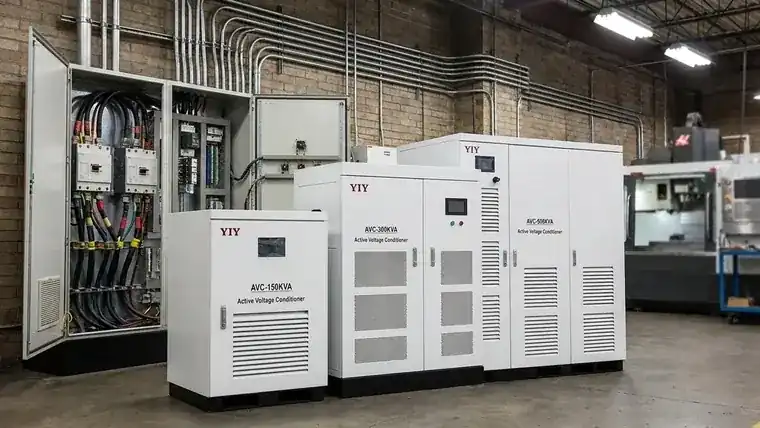
IGBT/static regulation becomes more compelling when your site has generator changeover, rapid voltage fluctuation, strict process tolerances, or repeated controller faults. The official page for IEC 61000-4-11 voltage dip and interruption immunity testing helps frame why dip behavior matters for electrical equipment. For you, the point is practical: nominal voltage is not enough if short dips are what reset your controls.
How Does a 3 Phase Stabilizer Work Inside the Cabinet?
You can think of a 3 phase stabilizer as a closed-loop control system that senses incoming voltage, compares it with the target output, corrects the voltage, and delivers protected power to your downstream load. The exact correction method depends on whether the cabinet uses relay taps, a servo-driven transformer, or static IGBT regulation.
The control loop usually follows this sequence:
- Sensing: Voltage sensors read the input and output condition of L1, L2, and L3.
- Comparison: The control board compares each reading against the target output voltage, such as 380V, 400V, 415V, or another project-specific set point.
- Correction command: The controller decides whether voltage must be raised, reduced, or held steady.
- Regulation action: A relay model switches transformer taps, a servo model moves a motor-driven brush on an autotransformer, and an IGBT/static AVR uses power electronics and PWM conversion.
- Protected output: The corrected three-phase output is sent to your downstream panel, with protection logic for abnormal conditions where specified.
That sequence matters because your equipment does not experience the utility grid directly; it experiences the voltage window delivered at its terminals. Tighter stabilizer tolerance gives your machine less voltage variation to absorb during dips, peaks, load starts, or generator transitions.
Inside many three-phase cabinets, you have three regulated phase paths governed by coordinated control logic. Some designs are described around Y-connection principles, where a neutral point may be present depending on system design and load requirements. This is a topology concept, not an installation instruction; your wiring method still needs to follow the approved diagram, earthing practice, local code, and protection design.
Phase balance is the detail many buyers underestimate. If your load distribution is uneven, one phase can run hotter or trip earlier, which affects motors, drives, transformers, contactors, and overload relays. For you, that means nuisance stoppages can continue even when the average line voltage looks acceptable.
What Site Data Turns Interest into a Sizing-Ready Specification?
Your shortlist should be built from measured input-voltage range, total kVA, power factor, starting current, load sensitivity, phase balance, duty cycle, and cabinet environment. That data turns general interest in a three-phase AVR into a specification your supplier can actually size and verify.
| Input to collect | Why it matters | Risk if skipped |
|---|---|---|
| Load list with rated kW/kVA | Defines connected demand by machine, panel, or feeder | Hidden loads push the unit beyond capacity |
| Power factor and diversity factor | Converts real load into apparent power and realistic demand | You may oversize or undersize the stabilizer |
| Motor starting current | Captures inrush from pumps, lifts, compressors, and drives | Nuisance trips or voltage dips during startup |
| Future expansion margin | Leaves headroom for planned equipment | Early replacement when production expands |
| Input range, output voltage, frequency | Matches correction window to site supply and load voltage | Correct kVA but wrong correction range |
| Phase/wiring and phase balance | Confirms three-phase connection, neutral needs, and imbalance | One phase overheats or trips before the others |
| Bypass needs and protection devices | Defines maintenance access, surge, overload, phase-loss, and short-circuit logic | Downtime during service or weak fault protection |
| Ambient environment | Guides enclosure, ventilation, cabinet placement, and derating | Heat, dust, or moisture shortens service life |
For a sizing discussion, record your lowest and highest input voltage over real operating periods, not just one spot reading. If your site voltage drops during peak load, compressor start, lift operation, or generator transfer, that event is more important than the quiet-hour voltage.
Your capacity estimate should include apparent power, not only rated kW. Power factor, diversity, inrush, and expansion margin all affect the final kVA. For main-line projects, use 3 phase main line stabilizer sizing to go deeper on feeder-level load calculation and practical selection checks.
For broader project screening, YIY’s industrial voltage stabilizer selection guide can help you organize RFQ inputs across application type, grid condition, and protection requirements. That matters when your procurement file must compare more than one supplier or more than one technology.
YIY selection context spans relay, servo, and IGBT options, OEM/ODM customization, and documented capacity coverage from 500VA to 3000kVA for deployments across 130+ countries; data verified against YIY documentation in 2026 Q2. For you, that range matters because small 3kVA and 5kVA loads, mid-range 20kVA panels, and 100kVA+ feeders should not be forced into one generic stabilizer design.
What Procurement Checks Should You Complete Before Ordering?
You should confirm wiring compatibility, phase balance, correction range, protection features, site environment, supplier documentation, and monitoring expectations before you release the purchase order. These checks reduce the chance that a correctly priced stabilizer becomes the wrong installed solution.
| Check | Why it matters | If you skip it |
|---|---|---|
| Confirm input/output voltage and frequency | Matches the stabilizer to your actual grid and machine voltage | The cabinet may be rated correctly but regulate to the wrong target |
| Verify L1/L2/L3, neutral, earth, and phase sequence | Prevents wiring errors during installation | Miswiring can cause trips, equipment faults, or unsafe operation |
| Measure phase current under load | Shows whether one phase is already overloaded | The stabilizer may be blamed for an imbalance it cannot fix |
| Review starting current | Protects against inrush from motors, lifts, pumps, and compressors | Startup dips or trips may continue after installation |
| Specify bypass and protection | Enables maintenance and abnormal-condition response | Service work becomes disruptive or fault protection stays weak |
| Check cabinet environment | Aligns ventilation, IP expectations, heat, dust, and humidity exposure | Components age faster or alarms appear under thermal stress |
| Request drawings, test data, and warranty terms | Gives procurement and maintenance teams verifiable documents | Acceptance becomes subjective and disputes become harder to resolve |
| Define alarm, meter, or communication needs | Supports maintenance history and fault tracing | You may lose evidence when voltage events cause stoppages |
For connection review, your installer should verify the approved wiring diagram, data plate, cable size, earthing point, input breaker, output breaker, bypass arrangement, and load-panel connection before energizing the unit. A correct kVA rating cannot protect your equipment if incoming and outgoing phases are misidentified.
For phase balance, measure current on L1, L2, and L3 under normal operation and during the events that cause trouble. Redistribute single-phase branch loads where practical, then size protection and stabilizer settings around the worst-loaded phase rather than only the average kVA.
For final commercial evaluation, compare before buying a voltage stabilizer if your project is moving from sizing into supplier selection. This keeps your procurement review focused on capacity, protection, documentation, and sourcing risk rather than only the lowest cabinet price.
Frequently Asked Questions
You can use these answers to verify the common details that cause specification errors before you approve a three-phase stabilizer.
How to Balance a 3 Phase Load Before Choosing a Stabilizer?
Clamp each line while the plant is running normally, note which phase carries the most, then move single-phase branch loads where possible. Record both running current and startup current, especially for lifts, pumps, compressors, and CNC feeders. As a concrete verification action, take clamp-meter readings during normal production and during the event that causes the voltage complaint.
Does 3 Phase Need to Be Balanced for an AVR to Work Properly?
A 3 phase supply should be reasonably balanced for the AVR and downstream equipment to operate reliably. The stabilizer can regulate voltage, but it does not correct poor load distribution, undersized cabling, weak neutral design, or motor inrush problems. Before approval, verify phase current, phase-to-phase voltage, phase sequence, neutral condition where used, and overload relay settings against the actual connected load.
What Is the Difference Between a Single-Phase Stabilizer and a 3-Phase Stabilizer for Industrial Loads?
A single-phase stabilizer regulates one phase, while a 3-phase stabilizer regulates three-phase power for machinery, panels, motors, lifts, and mixed industrial feeders. Where machines rely on steady line-to-line voltage, a three-phase AVR is normally the safer choice. Do not replace one integrated unit with three separate single-phase units unless an electrical engineer verifies wiring, neutral behavior, bypass design, and protection coordination.
How Does a 3 Phase Stabilizer Work When Voltage Drops on One Phase?
It compares each phase with the setpoint and boosts the low one, using relay taps, a motor-driven transformer or IGBT electronics depending on the design. In a three-phase cabinet, the control system monitors phase behavior and adjusts within the unit’s correction range. If one phase drops beyond the specified input window, the stabilizer may alarm, trip, or bypass depending on the protection design you ordered.
What Should You Do Next?
You should choose your three-phase AVR by load behavior, voltage risk, and response needs rather than catalog kVA capacity alone. Relay regulation fits rugged loads with wider tolerance, servo regulation fits most industrial panels needing stable correction, and IGBT/static regulation fits sensitive, fast-changing, or generator-fed applications.
For your next step, prepare a first-pass load list with input-voltage window, running current, starting current, phase balance, load sensitivity, duty cycle, and cabinet environment. YIY can review those inputs and help you shortlist the right relay, servo, or IGBT/static configuration before you move into a detailed quotation.
About YIY
Zhejiang Yiyen Holding Group Co., Ltd. (YIY) is a professional voltage stabilizer manufacturer with 15+ years of experience in voltage stabilization technology. YIY provides relay, servo, and IGBT voltage stabilizer solutions from 500VA to 3000kVA, with OEM/ODM customization and exports to 130+ countries. YIY’s quality-management certification can be checked against the official ISO 9001:2015 standard page when you review supplier documentation.
Contact Us
Email: yiyen at yiyen.com
Phone/WhatsApp: +86 13587452904
Website: https://www.yiyavr.com/
If you are moving from evaluation toward supplier shortlisting or buying review, use compare before buying a voltage stabilizer as your next step.
For this application, the SVC3 Three-Phase Servo Voltage Stabilizer is a matched product option worth evaluating.