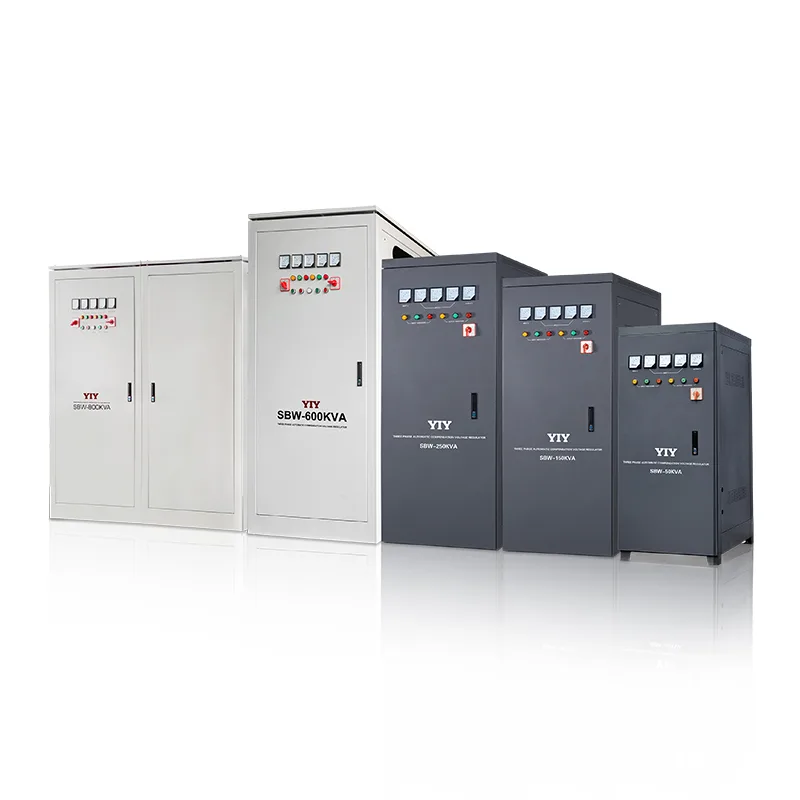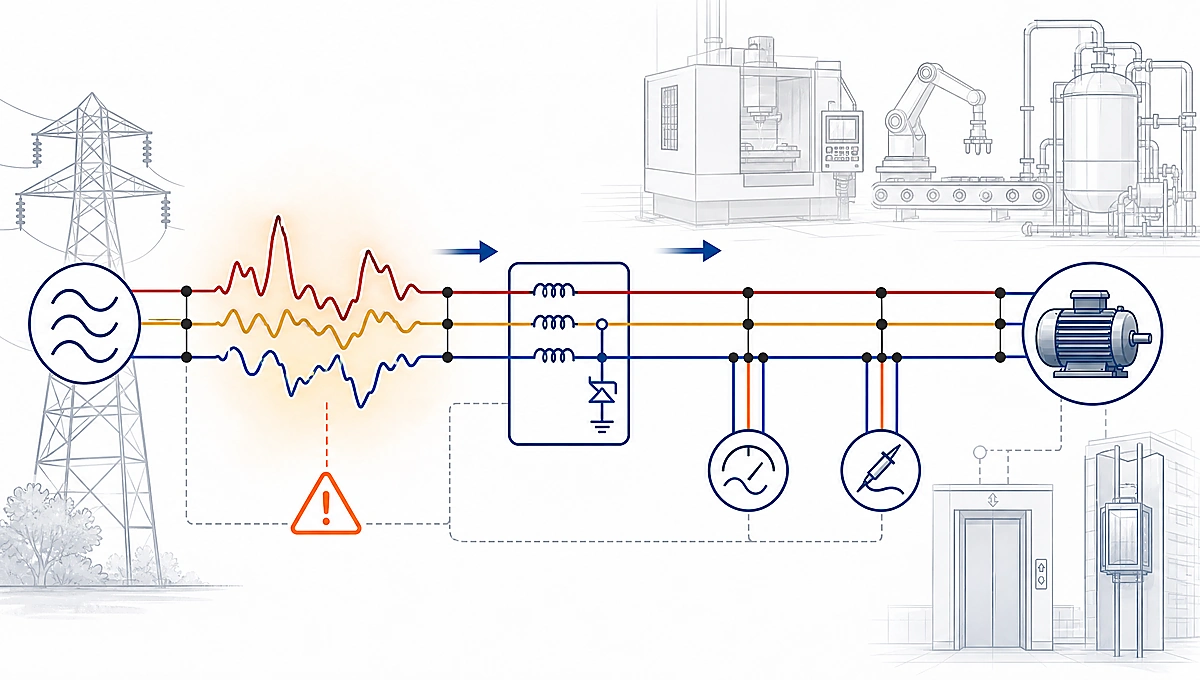
Before buying a three phase voltage stabilizer, compare your load kVA, input-voltage window, phase imbalance behavior, protection functions, installation environment, and supplier support because each item changes whether the unit will protect your equipment in real operating conditions.
If your site runs motors, CNC machines, pumps, compressors, HVAC, elevators, production lines, or mixed industrial panels, nominal voltage alone is not enough. IEC 60038 standard voltages define standard voltage system context for low-voltage AC systems, but your stabilizer selection still depends on measured site voltage and load behavior.
This guide walks you through when a three-phase unit fits, how to size kVA and input range, how servo, relay, and static AVR designs differ, which RFQ checks matter, and how to keep price comparisons fair.
If you need the broader industrial path behind this topic, start with three-phase stabilizers.
When Is a Three-Phase Stabilizer the Right Fit for Your Load?
You should choose a three-phase stabilizer when your protected load is three-phase, sensitive to voltage fluctuation, affected by phase imbalance, or too large for practical single-phase protection. If your machines depend on a balanced industrial feeder, regulating only one phase can leave the real problem unsolved.
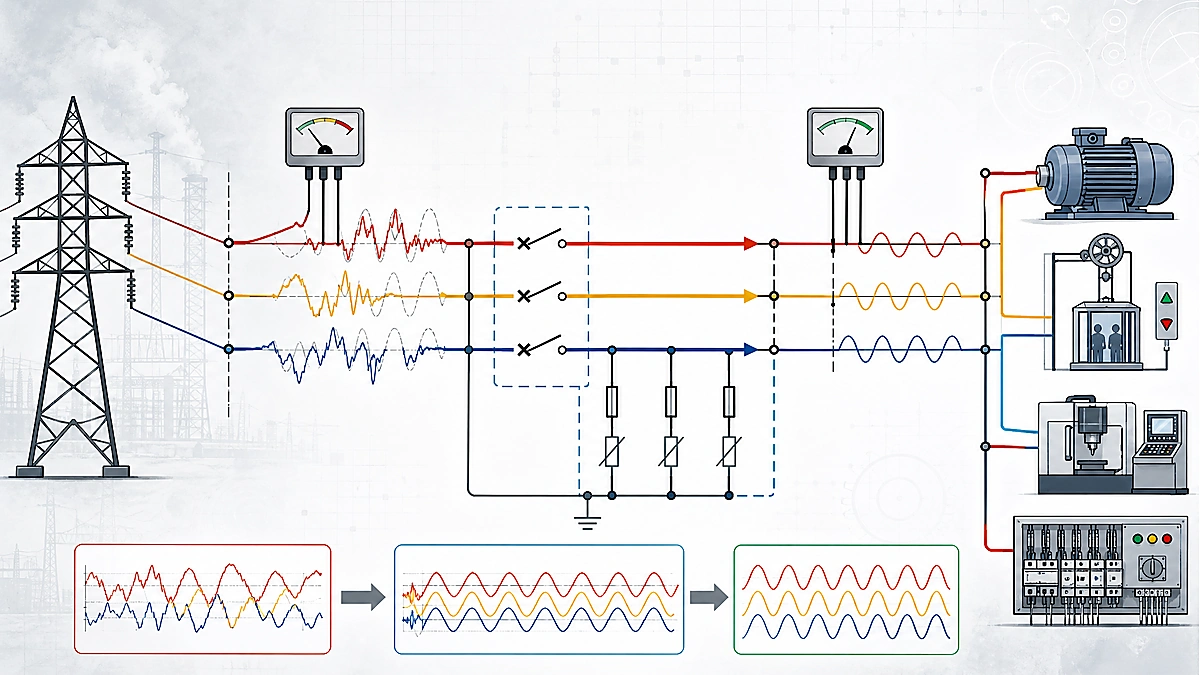
Typical fit cases include CNC machines, pumps, compressors, elevators, production lines, HVAC systems, laboratory equipment, medical equipment, and industrial control panels. For these loads, the better question is not only “Is my supply 380 V, 400 V, or 415 V?” but “What happens when one phase drops, disappears, reverses, or surges during startup?”
A single-phase stabilizer is usually not suitable for three-phase motors, shared distribution boards, or balanced industrial feeders. Using three separate single-phase units can also create coordination problems if each unit responds differently during a voltage event.
Modern three-phase stabilizers should support visible alarms, phase-fault indication, and practical maintenance access. That visibility helps you connect voltage events to trips, rejected production, or service calls before the same fault repeats.
| Problem signal | What it suggests | What it means for you |
|---|---|---|
| Voltage fluctuation | Grid supply rises or drops outside a stable operating range | Your machines may trip, overheat, or lose process consistency |
| Phase loss | One phase is missing or intermittently weak | Your motors, compressors, or elevators may be exposed to damaging current stress |
| Phase sequence error | Incoming phase order is reversed | Your motors may rotate in the wrong direction |
| Unbalanced phase voltage | Phase-to-phase values are uneven | Your motors may run hotter and draw uneven current |
| High starting current | Motors or compressors pull heavy current at startup | Your stabilizer needs enough margin to ride through startup |
For harsh sites, match the stabilizer to the room as well as the load. Dust, humidity, high ambient heat, poor ventilation, unstable grids, and outdoor-adjacent electrical rooms may require forced cooling, filters, sealed cabinets, corrosion-aware components, bypass planning, or a higher-protection enclosure.
Before you finalize sizing or implementation details, review three-phase stabilizer sizing guide.
How Should You Size kVA, Input Range, and Load Margin?
You should size the unit from measured connected load, power factor, starting current, lowest input voltage, duty cycle, and planned expansion, not from nameplate voltage alone. The correct capacity is the one that supports your real operating current during low-grid conditions.
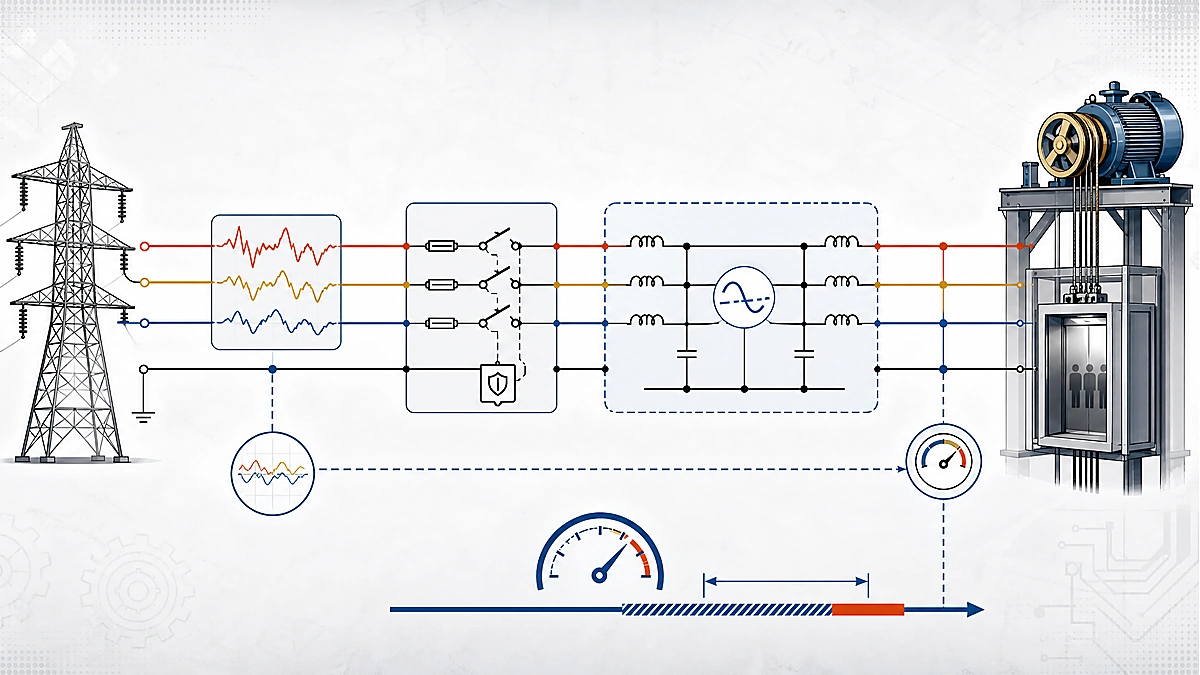
Start by separating kW from kVA. kW is useful working power; kVA is apparent power, which is what the stabilizer must carry. A simple conversion is:
kVA = kW / power factor
A 16 kW load at 0.8 PF needs about 20 kVA before spare margin. In practical terms, this means your motor-driven or mixed industrial load may need a larger stabilizer than the kW figure first suggests.
Motor starting current is the next sizing trap. Pumps, compressors, and elevators may draw several times their running current during startup. Your supplier should check both continuous load and startup behavior, especially when the grid is already low.
| Check | Why it matters | If you skip it |
|---|---|---|
| Actual connected kW/kVA | Confirms real demand and reserve margin | Undersizing, overheating, nuisance trips |
| Power factor | Converts working power into apparent power | A “20 kW” load may exceed a 20 kVA unit |
| Motor starting current | Confirms startup stress | Shutdowns during every motor start |
| Minimum and maximum input voltage | Defines the correction range | The output may not hold during deep sag |
| Continuous vs intermittent duty | Matches thermal design to real use | Shorter service life under heavy duty |
| Spare margin | Allows for expansion and measurement error | No room for new machines or grid worsening |
For many industrial RFQs, a 20-30% spare margin is a practical starting point after calculating real load and startup demand. For example, a measured 8 kVA load may point to a 10 kVA unit, while 22-24 kVA of mixed load may justify this capacity tier around 30 kVA, especially where the grid often sags.
That margin is not a shortcut. It simply gives your stabilizer room for heat, starting current, future loads, and imperfect field measurements. If your input voltage drops deeply or your motors start frequently, your sizing review should be more conservative.
For 10 kVA to 30 kVA industrial loads, the 10kVA to 30kVA selection guide can help you compare capacity margin across common power classes. When you are ready to turn readings into a specification, use a practical three-phase stabilizer sizing guide alongside your load list, measured voltage, and startup details.
When you compare search phrases such as three phase voltage stabilizer price, servo stabilizer 10kva price three phase, or 30 kva three phase automatic voltage stabilizer price, treat price only as meaningful after the same kVA, input range, wiring, protection package, cooling method, and enclosure are aligned. Otherwise, you may be comparing a basic unit against a much more site-ready configuration.
For a concrete product reference while you compare options, review voltage stabilizer sizing and buying guide.
Which Technology Fits Your Precision and Budget Requirements?
Servo, relay, and static AVR designs differ mainly by correction method: servo designs provide smooth motor-driven regulation, relay designs provide simpler stepped correction, and static or IGBT designs provide faster electronic regulation. Your best option depends on load sensitivity, correction speed, maintenance model, and budget.
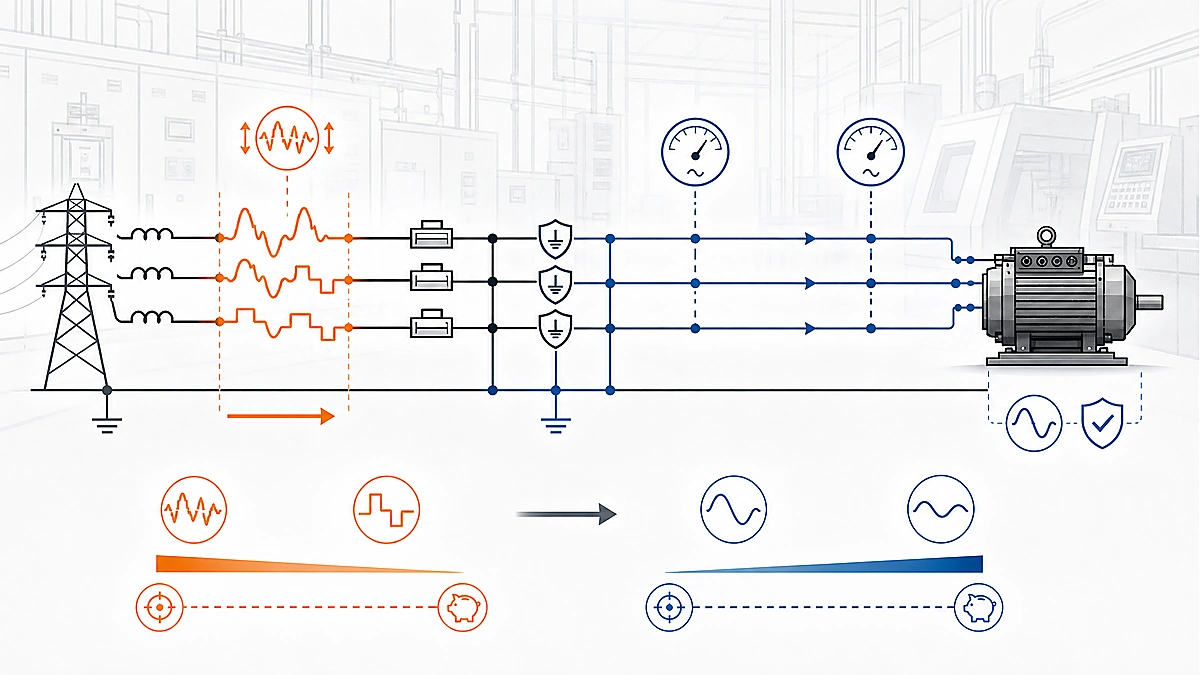
A voltage stabilizer, automatic voltage regulator, and AVR all describe equipment that helps keep output voltage within a controlled range when supply voltage fluctuates. A three phase servo voltage stabilizer uses a motorized correction mechanism, while a voltage conditioner may also include filtering, surge protection, or broader power-quality functions.
In a servo system, a controller monitors input and output voltage, then commands a servo motor to move a carbon brush across an autotransformer or variac. That movement changes the turns ratio smoothly, which is useful when your load does not respond well to abrupt voltage steps.
Relay stabilizers switch transformer taps through relays. They can be cost-effective for basic loads, but the output changes in steps. That may be acceptable for less sensitive equipment and less suitable for precision production or demanding motor loads.
Static AVR or IGBT stabilizers use power electronics for high-speed correction without moving brushes. IEC 61000-4-11 voltage dip and interruption immunity testing is often used as a reference when evaluating equipment behavior under voltage dips and short interruptions. In practical buying terms, this helps you ask how the selected design behaves during real grid events, not only under steady test voltage.
| Design type | Correction principle | Where it often fits | What you should verify |
|---|---|---|---|
| Servo AVR | MCU, servo motor, brush, variac or autotransformer | Industrial motors, mixed loads, common plant voltage fluctuation | Brush access, cooling, response time, independent phase option |
| Relay AVR | Relay-switched transformer taps | Basic loads and tighter budgets | Step size, relay life, audible switching, load sensitivity |
| Static / IGBT AVR | Electronic switching regulation | Sensitive automation, CNC, medical, unstable-grid applications | Heat management, service capability, cost, fault behavior |
For unbalanced three-phase sites, ask whether the design uses common-phase or independent-phase regulation. Independent regulation is often stronger when one phase sags more than the others. For your motors and control panels, that can mean less thermal stress and fewer nuisance trips during uneven grid conditions.
What Installation and Protection Details Should Your RFQ Lock Down?
Before RFQ, you should confirm wiring system, phase balance, grounding, bypass method, enclosure, cooling, protection functions, temperature, dust, humidity, and installation space. These details help your supplier quote a unit that fits your site instead of only matching a nominal kVA number.
Your RFQ should describe both the electrical system and the operating environment. A 400 V, 30 kVA requirement can mean very different products depending on whether your site has stable indoor supply, deep grid sag, high dust, high temperature, uneven phases, generator transfer, or outdoor cabinet exposure.
| Check | Why it matters | If you skip it |
|---|---|---|
| Load list and total kVA/kW | Confirms connected demand and reserve | The unit may trip or overheat |
| Power factor and starting method | Captures apparent power and startup stress | Motor starts may exceed the stabilizer |
| Input-voltage window and output target | Defines correction range | Output may collapse during deep sag |
| Frequency, wiring, neutral, grounding | Matches 3-phase 3-wire or 4-wire installation | Rework or unsafe fault behavior |
| Phase imbalance readings | Shows whether independent regulation is needed | Your load may still see uneven voltage |
| Ambient temperature, altitude, dust, humidity | Determines cooling, derating, and enclosure | Shorter service life |
| Bypass and protection devices | Supports maintenance and fault isolation | Downtime becomes harder to control |
Protection should be specified as a functional list: over-voltage, under-voltage, overload, short circuit, phase loss, phase sequence, surge protection, alarms, and manual or automatic bypass. For your operation, these functions decide whether the stabilizer only regulates voltage or also helps prevent avoidable equipment damage.
Ask for meter display, alarm visibility, event history, alarm logs, and remote monitoring where maintenance review matters. If your plant uses PLC, BMS, or SCADA workflows, confirm whether signal outputs or communication options are available.
Supplier capability matters too. Before approval, ask how your supplier reviews engineering data, handles customization, provides drawings and test reports, supports warranty service, and manages OEM/ODM requests. If ISO certification is part of your procurement screen, verify the certificate against the official ISO 9001:2015 quality management standard context and request the supplier’s current certificate number or audit document.
What Should You Compare Before Approving a Supplier Quote?
You should compare quotes only after every supplier is pricing the same load data, voltage range, wiring, protection functions, enclosure, cooling method, documentation, and support scope. A lower price can be misleading if the quote removes the features your site actually needs.
Use the following procurement screen before you approve a three-phase servo setup or any industrial three phase stabilizer quote:
| Check | Why it matters | If you skip it |
|---|---|---|
| Same kVA and overload assumptions | Keeps capacity comparison fair | One quote may be smaller than it appears |
| Same input-voltage range | Wider range changes transformer and thermal design | A cheaper unit may fail during low-grid periods |
| Same regulation method | Servo, relay, and static designs behave differently | You may compare unlike technologies |
| Same phase regulation behavior | Common and independent regulation handle imbalance differently | Uneven phases may remain uncorrected |
| Same enclosure and cooling | Site conditions affect cabinet and thermal design | Dust, heat, or humidity may shorten life |
| Same protection package | Protection functions affect safety and uptime | Important fault protection may be missing |
| Same documentation | Drawings and test reports reduce approval risk | Installation and acceptance become unclear |
| Same service terms | Spare parts, warranty, and support affect lifecycle cost | Downtime support may be weak |
If you are comparing a 10 kVA unit, the servo stabilizer 10kVA three phase specification checks can help you review the details that commonly change a quote. For broader category decisions, YIY’s voltage stabilizer sizing and buying guide is a useful next reference after your first-pass shortlist is clear.
YIY can support your review with load-list checking, input-voltage-window review, configuration guidance, and customization discussion. Zhejiang Yiyen Holding Group has 16+ years of voltage stabilization experience, a 30,000 sqm production facility, annual capacity of 1,000,000+ units, exports to 130+ countries, OEM/ODM support, and ISO 9001:2015 certification.
Frequently Asked Questions
You can use these answers to verify your RFQ before you send it to suppliers.
What affects three phase voltage stabilizer price?
Three phase voltage stabilizer price depends on kVA rating, input-voltage range, regulation technology, protection functions, enclosure design, cooling method, documentation, and customization. To verify a quote, ask each supplier to price the same load list, voltage window, wiring system, phase regulation method, protection package, cabinet type, and delivery terms.
Can one stabilizer protect mixed three-phase and single-phase loads?
One stabilizer can protect mixed three-phase and single-phase loads if your distribution design, neutral wiring, phase balance, and total kVA are correctly specified. Before ordering, share your panel diagram, connected load schedule, neutral requirement, and phase current readings so the supplier can confirm whether common or independent phase regulation is suitable.
How should you size this power-protection setup for your actual load profile?
Size the setup from measured kW, kVA, power factor, starting current, duty cycle, and lowest input voltage. Convert kW to kVA, add realistic spare margin, and check motor startup behavior under low-grid conditions. For verification, provide voltage readings from peak production, motor start, generator transfer, and low-supply periods.
Which documentation and compliance checks matter before procurement?
Procurement should verify datasheets, wiring drawings, protection functions, factory test reports, quality certification, warranty terms, and service access before approving the order. A concrete verification step is to request the electrical schematic, factory test report, ISO 9001 certificate where relevant, and written protection settings for over-voltage, under-voltage, overload, short circuit, phase loss, and phase sequence.
Final Thoughts
You should treat a three phase voltage stabilizer as a site-specific specification item, not a commodity quote. The right unit depends on measured voltage behavior, connected load, kVA margin, regulation technology, protection functions, installation conditions, and supplier engineering support.
Price becomes useful only after those variables are aligned. If the unit is undersized, too narrow in input range, poorly protected, or unsuitable for heat, dust, humidity, or phase imbalance, your real cost shows up later as trips, downtime, service calls, and damaged equipment.
Start with a quick sizing review before preparing a full RFQ. YIY can review your load list, starting current, input-voltage window, and installation conditions, then help shortlist the suitable power class and configuration.
Contact YIY
Email: yiyen at yiyen.com
Phone/WhatsApp: +86 13587452904
Website: https://www.yiyavr.com/
If you are moving from evaluation toward supplier shortlisting or buying review, use servo stabilizer 10kVA three phase specification checks as your next step.