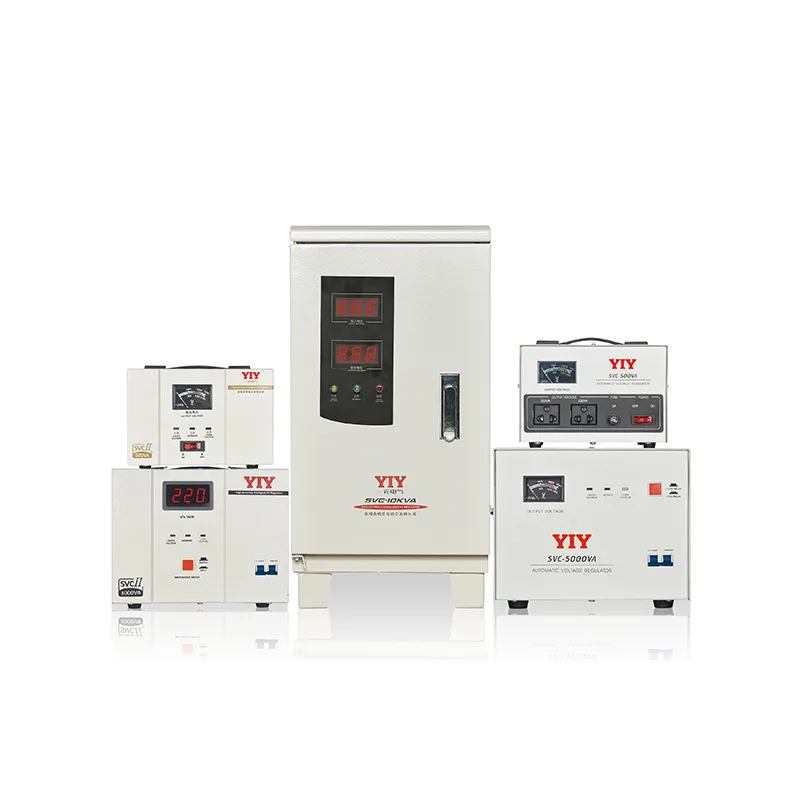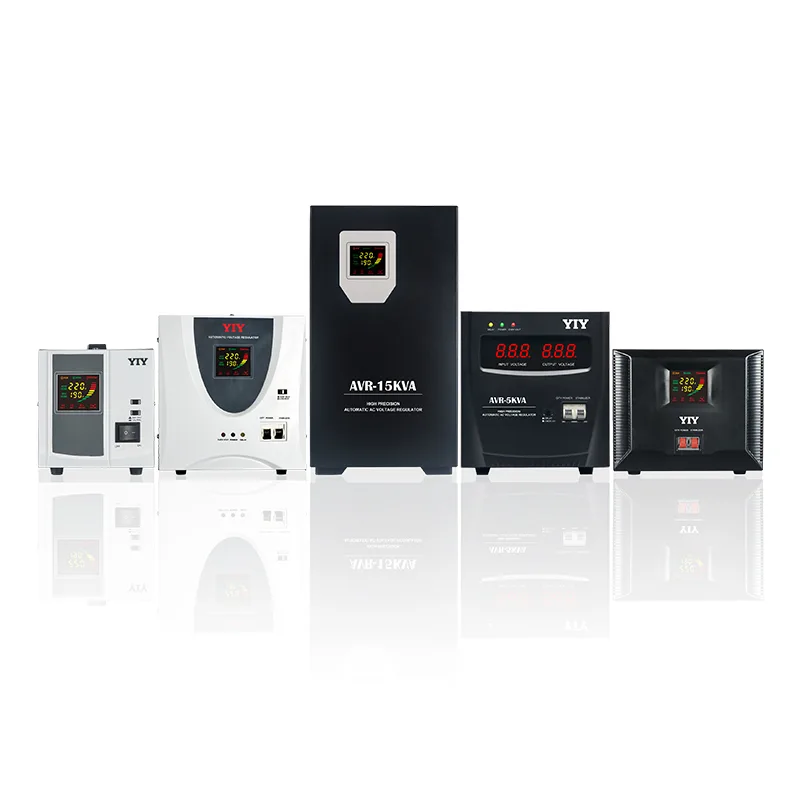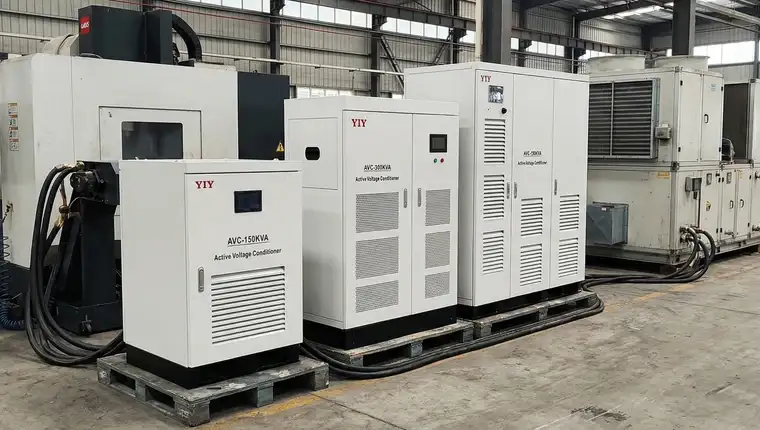
Automatic Voltage Regulators (AVRs)—also called voltage stabilizers—maintain constant output voltage despite input fluctuations from utility grids. The three main types are relay-based (±5-8% precision, fastest response, lowest cost), servo-controlled (balanced precision and reliability for industrial use), and IGBT/AVC systems (±0.5% accuracy, sub-cycle response for mission-critical loads).
Each type serves different load profiles, input voltage ranges, and site conditions. Choosing the wrong type means either overpaying for precision you don’t need or risking equipment damage from inadequate regulation.
This guide walks plant engineers, panel builders, and procurement teams through the comparison framework that converts load data and site conditions into a specification-ready shortlist.
Why AVR Type Selection Matters for Equipment Protection
Voltage sags, surges, and brownouts are common in industrial power grids. A voltage stabilizer automatically corrects these fluctuations to protect sensitive equipment like CNC machines, medical devices, data centers, and production lines. The “type” determines how the stabilizer achieves regulation—and that mechanism directly affects precision, response time, maintenance requirements, and total cost of ownership.
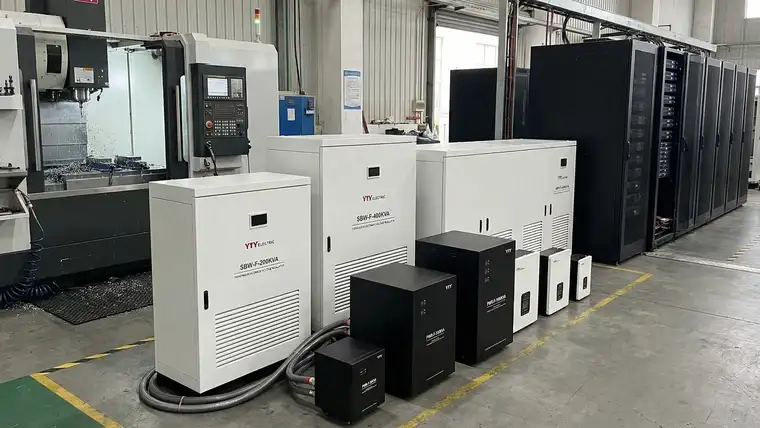
Industrial engineers researching AVR technologies need type comparisons that map to real-world load requirements. A lighting system tolerates±8% variation; a precision CNC machine requires ±1%. A facility with frequent30% voltage swings needs different input tolerance than one with occasional 5% dips. The selection decision hinges on matching stabilizer capabilities to application demands.
The Three Core AVR Technologies and Their Trade-Offs
Relay-Based Voltage Stabilizers
Relay stabilizers use electromagnetic relays to switch transformer taps. When input voltage changes, the relay selects a different tap to maintain output within ±5% to ±8% of nominal. This is the fastest-responding technology—typically under 20 milliseconds—and the most cost-effective for general-purpose loads.
Best for: Lighting systems, HVAC equipment, general machinery, residential applications where±8% regulation is acceptable.
Limitations: Lower precision than servo or IGBT types. Relay contacts wear over time in high-switching environments.
Servo-Controlled Voltage Stabilizers
Servo stabilizers use a motor-driven variable transformer (variac) with feedback control. A servo motor continuously adjusts the transformer position to maintain output voltage within ±1% to ±3%. This offers the best balance of precision, reliability, and cost for industrial applications.
Best for: CNC machines, injection molding equipment, printing presses, industrial automation—any load requiring tighter regulation than relay types but not needing sub-1% precision.
Limitations: Mechanical components (motor, carbon brush) require periodic maintenance. Response time is slower than relay types (typically 50-200ms depending on load).
IGBT/AVC (Active Voltage Conditioner) Systems
IGBT-based stabilizers use inverter technology to synthesize a clean output waveform with ±0.5% accuracy and sub-half-cycle response time. YIY’s AVC series spans 15KVA to 3,600KVA in single-phase and three-phase configurations. These systems require no batteries and handle both voltage regulation and harmonic filtering.
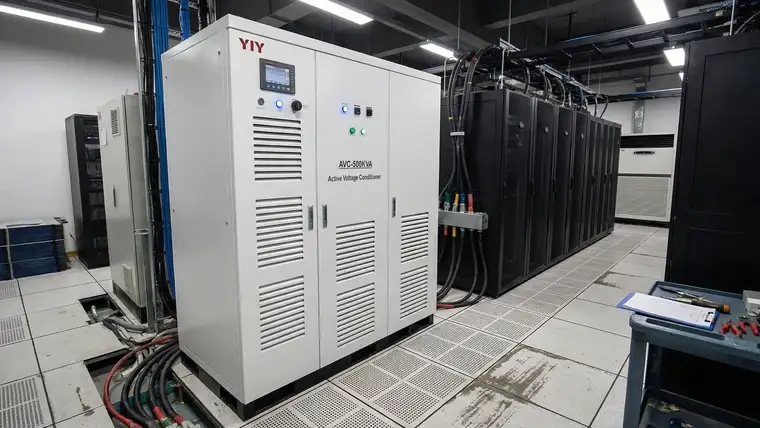
Best for: Medical imaging equipment, semiconductor manufacturing, data centers, telecom infrastructure, precision test equipment—any mission-critical load where voltage deviation must stay under 1%.
Limitations: Higher initial cost than relay or servo types. Requires proper cooling and clean operating environment.
Selection Criteria: Converting Load Data Into Specifications
Load Capacity Calculation
Calculate total connected load, then add 20-30% margin for starting current and future expansion:
- List all equipment with nameplate power ratings
- Sum total wattage or VA
- Multiply by 1.2 to1.3 safety factor
- Select next standard stabilizer size
Example: A facility has 15KW CNC machine + 2KW lighting + 3KW auxiliary equipment = 20KW total. With 25% margin: 20KW × 1.25 = 25KVA. Specify a 30KVA unit to ensure adequate headroom.
For three-phase loads, calculate per-phase and total capacity. Unbalanced loads require phase-by-phase analysis to avoid overloading individual phases.
Input Voltage Range and Tolerance
IEC 60038 defines standard voltage levels and requires stabilizers to handle±10% input variation with automatic alarm beyond that range. YIY products comply with this standard across all series.
Measure your site’s actual voltage variation over24-48 hours:
– If input stays within ±10% of nominal (e.g., 198-242V for 220V systems), standard stabilizers work
– If swings exceed ±15%, specify wide-input-range models or consider upstream power conditioning
– For sites with frequent >20% variation, evaluate dedicated voltage regulators or UPS systems
Precision Requirements by Application
Match stabilizer precision to load sensitivity:
| Application Type | Required Precision | Recommended Type |
|---|---|---|
| Lighting, HVAC | ±5-8% | Relay |
| General machinery | ±3-5% | Relay or Servo |
| CNC, automation | ±1-3% | Servo |
| Medical, semiconductor | ±0.5-1% | IGBT/AVC |
Don’t over-specify. A ±0.5% IGBT stabilizer costs 3-5× more than a servo unit. If your load tolerates ±3%, servo is the economical choice.
Response Time and Load Dynamics
Response time is how fast the stabilizer corrects voltage changes:
– Relay: <20ms (fastest mechanical switching)
– Servo: 50-200ms (depends on motor speed and load inertia)
– IGBT/AVC: <10ms, often<½ cycle (electronic switching)
For loads with frequent on/off cycling or rapid power changes (welding equipment, motor starters), fast response prevents voltage dips during transitions. For steady-state loads (lighting, constant-speed motors), slower response is acceptable.
Phase Configuration and Voltage Level
Single-phase (120V, 220V, 240V): Residential, small commercial, light industrial. YIY offers relay and manual regulators from 0.5KVA to 20KVA for single-phase applications.
Three-phase (208V, 380V, 400V, 480V): Industrial facilities, large commercial buildings, data centers. Three-phase stabilizers range from 10KVA to 3,600KVA. Specify whether you need phase-to-phase or phase-to-neutral regulation.
Medium voltage (>1kV): Specialized industrial applications. Requires custom engineering and compliance with additional standards.
Environmental and Installation Conditions
Consider:
– Ambient temperature: Standard units operate 0-40°C. High-temperature environments need derating or cooling
– Humidity and dust: IP-rated enclosures for harsh environments
– Altitude: Derating required above 1000m due to reduced cooling efficiency
– Space constraints: Wall-mount vs. floor-standing vs. rack-mount configurations
– Noise level: Servo motors and cooling fans generate noise; specify low-noise models for office environments
Standards, Compliance, and Quality Verification
IEC 60038: Voltage Standards and Input Tolerance
IEC 60038 defines standard voltage levels worldwide and specifies that stabilizers must handle ±10% input variation. YIY stabilizers comply with this standard and include automatic alarm functions when input exceeds the regulation range.
This compliance ensures:
– Compatibility with global power systems (120V, 220V, 380V, 400V, 480V)
– Predictable performance across rated input range
– Safe shutdown or alarm when input exceeds design limits
IEC 61000: EMC and Harmonic Standards
Electromagnetic compatibility (EMC) standards ensure stabilizers don’t introduce noise or harmonics into the power system. IGBT/AVC systems actively filter harmonics, making them suitable for sensitive electronic loads.
ISO 9001:2015 Quality Management
YIY maintains ISO 9001:2015 certification for stabilizer design and manufacturing. This ensures:
– Consistent product quality across production runs
– Documented testing and validation procedures
– Traceability for components and assemblies
Factory Testing and Acceptance
Before deployment, verify:
– Full-load regulation accuracy at minimum, nominal, and maximum input voltage
– Response time under step-load changes
– Overload and short-circuit protection
– Alarm and shutdown functions
– Efficiency at50%, 75%, and 100% load
YIY provides factory acceptance test (FAT) reports documenting these parameters for each unit.
YIY Capabilities: Product Range and Differentiation
Comprehensive Capacity Range
YIY offers voltage stabilizers from 0.5KVA to 3,600KVA:
Manual regulators (TDGC2series): 0.2KVA to 0.5KVA, 220V input, variable0-250V output. Used for laboratory testing and small-scale voltage adjustment.
Relay stabilizers: 0.5KVA to 50KVA, single-phase and three-phase. Fast response, cost-effective for general loads.
Servo stabilizers: 5KVA to 500KVA, three-phase. Balanced precision and reliability for industrial applications.
IGBT/AVC series: 15KVA to 3,600KVA, single-phase and three-phase. ±0.5% accuracy, <½ cycle response, no battery required. Suitable for mission-critical loads requiring both voltage regulation and harmonic filtering.
Global Standards Compliance
All YIY products comply with:
– IEC 60038 for voltage levels and input tolerance
– ISO 9001:2015 quality management
– CE certification for European markets
This compliance ensures compatibility with power systems in130+ countries where YIY products are deployed.
Differentiation from Competitors
While competitors like TSI Power focus on outdoor/extreme environments and telecom applications, YIY provides:
– Broader capacity range: 0.5KVA to 3,600KVA vs. narrower specialty ranges
– Industrial precision: AVC series delivers<½ cycle response for sensitive loads
– Global standards compliance: IEC 60038, ISO 9001:2015
– Application flexibility: Relay, servo, and IGBT technologies under one manufacturer
This breadth allows procurement teams to standardize on a single supplier across multiple facility types and load profiles.
Manufacturing Capability and Quality Assurance
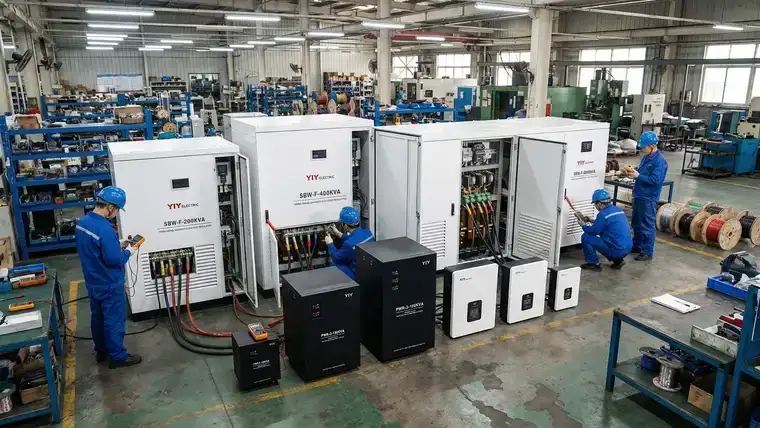
YIY operates a30,000㎡ manufacturing facility with annual production capacity exceeding 1,000,000 units. Quality control includes:
– Incoming component inspection
– In-process testing at each assembly stage
– Full-load burn-in testing before shipment
– Factory acceptance testing with documented reports
With16+ years of experience in voltage stabilization technology, YIY serves130+ countries and maintains 120+ long-term partnerships with industrial customers.
Frequently Asked Questions
What Should Buyers Evaluate Before Choosing Types of Automatic Voltage Regulator?
Start with load capacity (total kW/kVA plus a margin for starting current), then the input voltage range you actually measured on site, then the precision your most sensitive load needs. Phase configuration, response time and environment come last. Working in that order usually leaves a short list of models to quote.
How Should Types of Automatic Voltage Regulator Be Sized or Specified?
- Calculate total connected load (KW or KVA)
- Allow headroom for motor inrush and planned load growth
- Log the site input voltage range over at least a full working cycle
- Match stabilizer input range to measured variation
- Select technology type based on required precision
- Verify phase configuration (single or three-phase)
- Confirm environmental ratings (temperature, humidity, IP rating)
- Request factory test report documenting regulation accuracy
What Are the Maintenance Requirements for Different AVR Types?
Relay: Minimal maintenance. Inspect relay contacts on a regular schedule and replace them if pitted or worn; contact life depends on how often the unit switches.
Servo: Inspect carbon brushes at the interval in the maintenance manual and replace them before they reach the wear limit. Lubricate motor bearings as scheduled. Check belt tension (if belt-driven).
IGBT/AVC: Keep cooling fans and heat sinks clean and inspect capacitors periodically. There are no mechanical wear parts, so service visits are less frequent.
Can One Stabilizer Type Handle Multiple Load Types?
Yes, but match the stabilizer to the most sensitive load. If a facility has both loose-tolerance lighting and tight-tolerance CNC machines, specify a servo or IGBT unit to protect the CNC equipment. The lighting will also benefit from tighter regulation.
What Documentation Should Be Requested from the Manufacturer?
- Product datasheet with electrical specifications
- Factory acceptance test (FAT) report
- Compliance certificates (IEC, CE, ISO)
- Installation and operation manual
- Maintenance schedule and spare parts list
- Warranty terms and service contact information
Get a Sizing Review from YIY
Selecting the right voltage stabilizer requires converting your load list, starting current profile, input voltage window, and installation conditions into a specification that balances performance and cost. YIY’s engineering team can review your requirements and recommend the optimal stabilizer type and capacity.
About YIY
Zhejiang Yiyen Holding Group Co., Ltd. (YIY) is a professional voltage stabilizer manufacturer with 16+ years of experience. With a30,000㎡ modern facility and an annual production capacity of 1,000,000+ units, our products are exported to 130+ countries. We provide OEM/ODM customization services and are ISO 9001:2015 certified, committed to delivering stable and reliable voltage protection solutions to global customers.
Contact Us
📧 Email: yiyen@yiyen.com
📞 Phone/WhatsApp: +86 13587452904
🌐 Website: https://www.yiyavr.com/
Share your load list, input voltage measurements, and site conditions with our team. We’ll provide a sizing review with recommended models, expected regulation performance, and a detailed quotation within 24-48 hours.
What Is the Purpose of the AVR?
An automatic voltage regulator (AVR) keeps output voltage within a set tolerance band regardless of load changes or input fluctuations. When utility power dips, surges, or becomes phase-imbalanced, the AVR detects the deviation and uses a tap-changer, thyristor, or servo motor to correct output in milliseconds to seconds. The result is stable voltage to motors, drives, PLCs, and sensitive electronics—preventing insulation damage, nuisance tripping, and premature component failure.
Industrial buyers specify AVRs when measured input fluctuations exceed ±10% of rated voltage, or when equipment warranty explicitly requires regulated supply.
What Are the Two Types of Voltage Regulators?
The two fundamental types are linear voltage regulators and switching (switch-mode) voltage regulators. Linear regulators—including LDO types—dissipate excess voltage as heat, delivering clean, low-noise output suited for low-power electronics. Switching regulators use high-frequency switching to achieve 85–95% efficiency across a wide input range; they are standard in industrial power supplies and large-load applications. For mains-connected AC line regulators, the equivalent split is between electromechanical servo stabilizers (wide range, lower cost) and static IGBT stabilizers (fast response, no moving parts).
What Is an LDO Regulator Used For?
LDO (Low-Dropout) regulators maintain a stable low-voltage DC output with as little as 0.1–0.5V between input and output. They power microcontrollers, sensors, RF circuits, and battery-management ICs inside control panels and instrumentation where switching noise from a PWM converter would degrade performance. In industrial settings, LDOs regulate 3.3V and 5V logic rails derived from a 24VDC bus.
They operate in the milliwatt to low-watt range—distinct from the kilowatt-scale servo or IGBT stabilizers that regulate incoming AC mains voltage for heavy industrial loads.