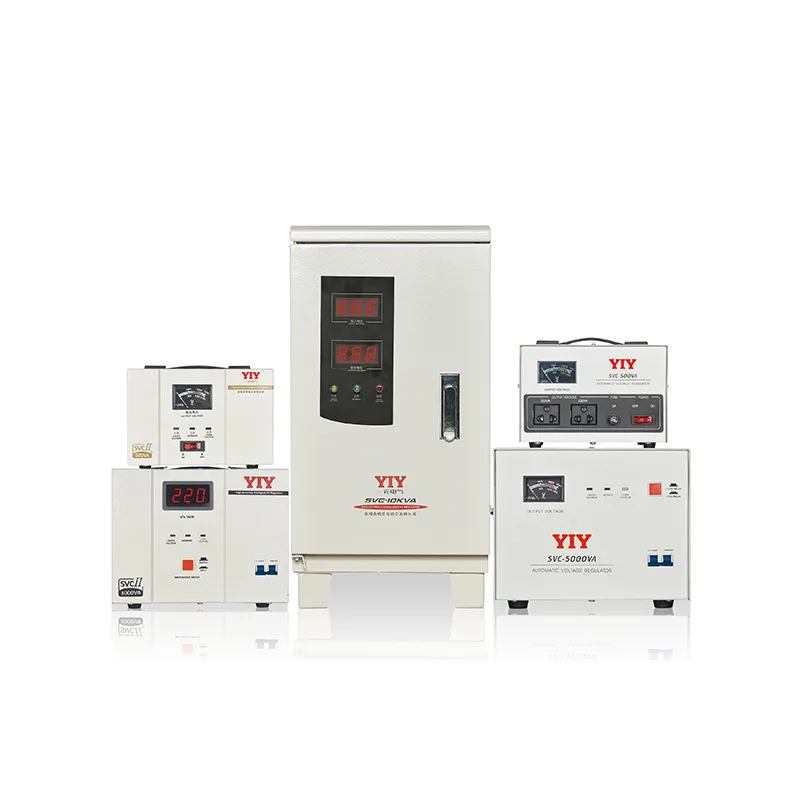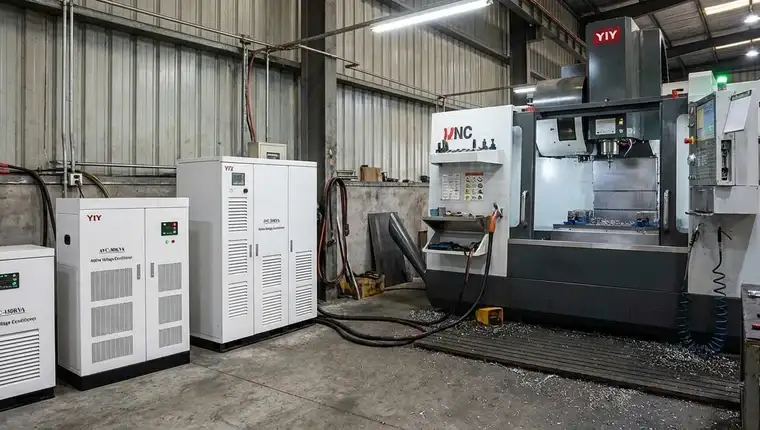
A 5kva servo stabilizer uses a motor-driven carbon brush on an autotransformer to correct output voltage continuously. Choose it when the load needs tight, stepless regulation, can accept correction in seconds, and suits servo maintenance better than relay or IGBT.
What a 5kVA Servo Stabilizer Is and Why It Matters
A servo voltage stabilizer is a closed-loop voltage regulation device that uses a servo motor to drive a carbon brush along an autotransformer (variac). As the MCU detects output deviation, it commands the motor to reposition the brush, continuously trimming the transformer’s turns ratio until output voltage returns to the target. YIY’s single-phase SVC and TWS servo lines list ±3% output, and correction takes seconds rather than milliseconds.

The Mechanism in Plain Terms
The core components are a servo motor, a carbon brush, and a toroidal autotransformer. The MCU samples output voltage in real time. When input sags or spikes, the motor rotates the brush to a new tap position on the winding, adjusting the output continuously rather than in discrete steps. This is what separates servo from relay-type designs—there are no switching transients, no voltage steps, just smooth analog correction.
Where 5kVA Fits
5kVA is a common entry point for light industrial and commercial loads: small CNC machines, medical diagnostic equipment, laboratory instruments, or mixed office-industrial panels. At 0.8 power factor it carries about 4kW of real load, enough for single-machine protection or small multi-outlet circuits on an unstable supply.
Why the Topology Choice Matters
Relay-type stabilizers switch faster but introduce step transients, which residential appliances tolerate and precision equipment does not. For a deeper look at servo vs IGBT technology: IGBT static stabilizers respond faster and regulate more tightly, at higher cost and complexity.
Servo sits in the middle, with tighter regulation than relay, lower cost than IGBT, and a mechanical design that holds up in dusty or humid plants.
Where sags, brownouts, or spikes are frequent, servo is usually the most cost-effective choice for loads that cannot accept relay switching but do not need IGBT. See the 5 kVA stabilizer selection guide for how topology affects total cost.
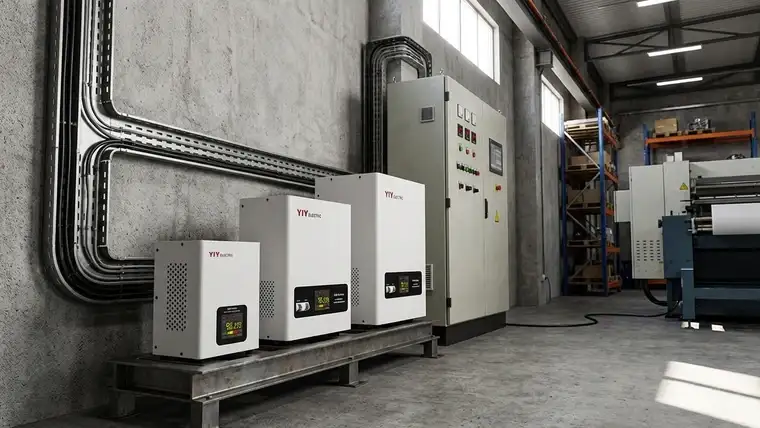
Who Needs a 5kVA Servo Stabilizer and What to Consider
Target Buyers and Application Context
Industrial engineers, facility managers, and procurement teams usually evaluate 5kVA servo stabilizers to protect single machines or small multi-outlet circuits on an unstable supply.
Common applications include servo stabilizer for CNC machines on small spindle loads, mixed commercial lighting, laboratory instruments, and panels where one circuit draws much more current than the rest. These buyers need sag and spike correction without relay switching transients.
Capacity Sizing Rule
Size from total connected load. Add the kW of every machine, auxiliary unit, and light on the circuit, convert to kVA by dividing by power factor, then add a safety margin for motor inrush and future load growth. The margin keeps the stabilizer inside its thermal limits instead of running at continuous peak capacity.
If your load exceeds 5kVA or you’re protecting a three-phase panel, a larger unit may be required; the three-phase stabilizer type selection guide covers sizing at the next capacity tier.
Key Comparison Needs
Before selecting a servo model, compare it against relay stabilizers (faster, but stepped) and IGBT designs (tighter regulation, higher cost).
Confirm the input voltage window, the published output tolerance, response under a typical sag, overload capacity for motor starts, and whether a manual bypass is included. Dust, humidity, and ambient temperature also decide whether servo mechanics beat solid-state electronics on your site.
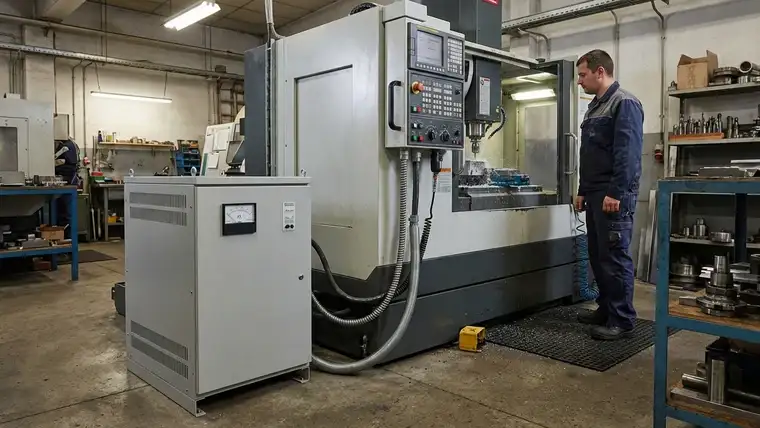
How Servo Voltage Stabilizers Work in Industrial Settings
The servo control mechanism operates through a closed feedback loop: the MCU samples output voltage continuously, compares it against the target setpoint, and commands the servo motor control system to rotate the carbon brush to a new position on the autotransformer winding. This repositioning changes the turns ratio and trims the output back to specification.
The full correction cycle takes seconds, which suits loads that can ride through a brief deviation but not a switching transient.
Real-Time Monitoring and Adjustment
The MCU continuously monitors input and output voltage and calculates the deviation from target. When input sags or spikes, the controller signals the servo motor to move the brush along the winding. This analog method tracks slow changes such as brownouts as well as sudden disturbances, holding output inside the model’s published tolerance.
The MCU also watches motor position, load current, and temperature, and triggers protection if any of them leaves its safe range.
Continuous Smooth Adjustment vs Stepped Relay Switching
Relay stabilizers switch between discrete transformer taps, and each tap change puts a voltage step on the output that can disrupt precision equipment. Servo designs adjust continuously across the winding, so correction is smooth and free of switching noise. That is why servo is preferred for CNC controllers, medical imaging systems, and laboratory instruments, where brief transients can cause data corruption, process errors, or resets.
For a complete explanation of how voltage stabilizer works across all three topologies, including relay and IGBT control logic, see the dedicated technical guide.
Preferred for Sensitive Industrial Loads
Servo stabilizers excel in environments where grid voltage fluctuates frequently but equipment cannot tolerate relay-type switching. Industrial facilities with aging grid infrastructure, remote sites with weak utility connections, and regions with frequent brownouts benefit most from servo’s combination of precision, mechanical reliability, and tolerance for dusty or high-humidity conditions where solid-state IGBT designs may be more vulnerable to environmental stress.
When to Choose Servo Over Relay or IGBT Designs
The choice between servo, relay, and IGBT stabilizer topologies depends on three factors: how much precision your load requires, whether you can tolerate mechanical maintenance, and what your budget allows. Each topology represents a different tradeoff between response speed, output accuracy, maintenance complexity, and cost.
| Criterion | Relay Stabilizer | Servo Stabilizer | IGBT Stabilizer |
|---|---|---|---|
| Response time | Fast steps | Seconds | Milliseconds |
| Output precision | Wide band | Tight (±3% on YIY SVC/TWS) | Tightest |
| Switching behavior | Stepped (per tap) | Smooth, stepless | Smooth, stepless |
| Maintenance | Contactor replacement | Carbon brush (periodic) | None (solid-state) |
| Environmental tolerance | Moderate | High (dust/humidity) | Low (surge/heat sensitive) |
| Relative cost | Lowest | Mid-range | Highest |
| Best application | Residential, non-critical loads | Industrial CNC, medical, labs | Semiconductor, data centers |
Response Speed and Switching Behavior
Relay stabilizers switch fastest but step the output at each tap change, creating transients that can disrupt precision equipment. IGBT designs respond within milliseconds and add no switching transients, which suits mission-critical loads.
Servo correction takes seconds. Most industrial loads accept that brief sag when the correction itself is smooth.
Precision and Application Fit
Servo regulation is tight enough for CNC machines, medical equipment, and industrial control systems where relay switching would cause process errors. Relay stabilizers hold a wider band that suits residential appliances, lighting, and non-sensitive commercial loads where cost comes first. IGBT designs regulate most tightly with no mechanical drift, for semiconductor fabs, data centers, and instruments where small deviations change results.
Maintenance and Operational Reality
Servo stabilizers need periodic carbon brush inspection and replacement, at an interval set by load cycling, but the mechanical design tolerates dust, humidity, and temperature extremes better than solid-state parts. Relay designs wear contactors at a rate driven by switching frequency. IGBT units have no moving parts, which removes mechanical maintenance but leaves them more exposed to surges, heat, and harsh environments.
Cost-Benefit Positioning
Servo sits in the middle: tighter regulation than relay at lower cost than IGBT, with mechanics that survive harsh plants where solid-state designs can fail early. Relay is the lowest-cost option for non-critical loads. IGBT carries a clear cost premium, justified only when the application needs millisecond response and regulation that servo cannot reach.
Key Specifications and Maintenance Factors to Evaluate
Beyond the headline 5kVA rating, buyers must confirm several operational parameters before selecting a servo stabilizer model. These specifications determine whether the unit will perform reliably in your specific application and site conditions, and what ongoing maintenance commitments you’re accepting.
Input and Output Voltage Range
Confirm that the stabilizer’s input window covers your site’s worst-case grid conditions. IEC 60038 standard voltages define nominal supply levels and their permitted deviations, but sites with severe brownouts or spikes need a wider input window than standard models offer.
Match the output tolerance to the load: precision loads such as CNC machines need the tightest servo grade, while less sensitive equipment can accept more. Check the unit against measured worst-case grid fluctuations.
Load Type Compatibility
Servo stabilizers handle resistive, inductive, and capacitive loads, but power factor and inrush still matter. Motors and transformers draw high starting current, so confirm the overload rating and how long the unit can hold it during startup. Capacitive loads such as power factor correction banks and LED drivers can push power factor leading; check that the MCU logic accommodates this. For unbalanced three-phase loads, ask for an explicit unbalanced-load rating.
Site Environmental Conditions
Choose an IP rating that matches the dust, humidity, and temperature on site: indoor enclosures suit clean rooms, while outdoor or dusty sites need a higher-rated enclosure. Check the published operating temperature range against your site extremes. Humid or corrosive atmospheres may also call for conformal-coated boards and corrosion-resistant hardware.
Bypass Options and Maintenance Access
Manual bypass allows maintenance without shutting down the load, essential for 24/7 operations. Automatic bypass, where offered, moves the load to raw mains if the stabilizer fails, preventing an outage but exposing equipment to unregulated voltage. Carbon brush replacement is the main maintenance task, at an interval set by load cycling and input variation. Confirm that brush access needs no full disassembly and that spares are available locally.
How YIY Supports Your Servo Stabilizer Selection
YIY approaches servo stabilizer selection as a technology-fit decision, not a product-push exercise. Whether 5kVA servo is the right choice depends on your load characteristics, site conditions, and maintenance context—and YIY’s engineering team helps you confirm that before quotation.
Multi-Technology Coverage and Product Range
YIY manufactures servo, relay, and IGBT stabilizers across a 0.5–3000KVA range, so the technical review is not tied to one topology. At 5kVA single-phase, the servo options are the SVC (500VA–30kVA) and the wall-mounted TWS (3–30kVA), both listed at ±3%. If relay or IGBT fits better, those options come from the same supplier.
Global Experience and Customization Capability
Since 2008, YIY has supplied stabilizers to 130+ countries, from brownout-prone grids in South Asia to spike-prone industrial zones in Africa, and that field data feeds back into product design. For OEM/ODM buyers, YIY supports custom input/output ranges, enclosure changes, and branding, backed by ISO 9001:2015 certification and a 30,000㎡ facility with 1,000,000+ units of annual capacity.
Technical Review Process
YIY’s application engineers review your load profile, input voltage range, site environment, and maintenance capabilities to confirm whether servo, relay, or IGBT is the most cost-effective protection topology. Contact YIY at yiyen at yiyen.com or +86 13587452904 to start the review.
Frequently Asked Questions
When Is a 5kVA Servo Stabilizer Necessary?
When equipment resets or throws errors during sags, spikes, or brownouts and cannot accept relay switching steps. Typical cases are a small CNC machine, a diagnostic instrument, or a lab bench on a weak utility feed. If the load plus motor-start headroom lands at 5kVA, that is the size to check first.
How Should a 5kVA Servo Stabilizer Be Sized or Specified?
Add up the kW on the circuit, divide by power factor, and leave headroom for motor starts. Then ask the supplier for three things in writing: the input window compared against your lowest measured site voltage, the overload rating for startup, and whether bypass is manual or automatic.
What Should Buyers Evaluate Before Choosing a 5kVA Servo Stabilizer?
Three things matter most: load type (motors need overload headroom), site environment (dust and humidity favor servo mechanics over solid-state IGBT), and maintenance (periodic carbon brush replacement). Also match the published output tolerance to how sensitive the equipment is.
Final Thoughts
Choosing a 5kVA servo stabilizer comes down to three questions: Does your load need tight, stepless regulation? Can it tolerate a correction window of seconds? And does your maintenance context favor servo’s mechanical reliability over solid-state alternatives?
If the answer to all three is yes, servo is the right topology. If your load is non-critical and cost is the primary driver, relay may suffice. If you need sub-cycle response and can justify the premium, IGBT is the better fit.
Topology choice is not a product decision—it’s an application decision. Getting it wrong means either overspending on capability you don’t need or under-protecting equipment that can’t tolerate relay switching transients.
YIY’s engineering team offers a technical review covering load profile, input range, site conditions, and maintenance context, to confirm whether servo, relay, or IGBT fits before you commit to a model. Contact us at yiyen at yiyen.com or +86 13587452904 to start.
Related Servo Stabilizer Sizing and Procurement Guides
Use these guides when checking servo stabilizer capacity, HS code context, and supplier qualification before a buying decision.